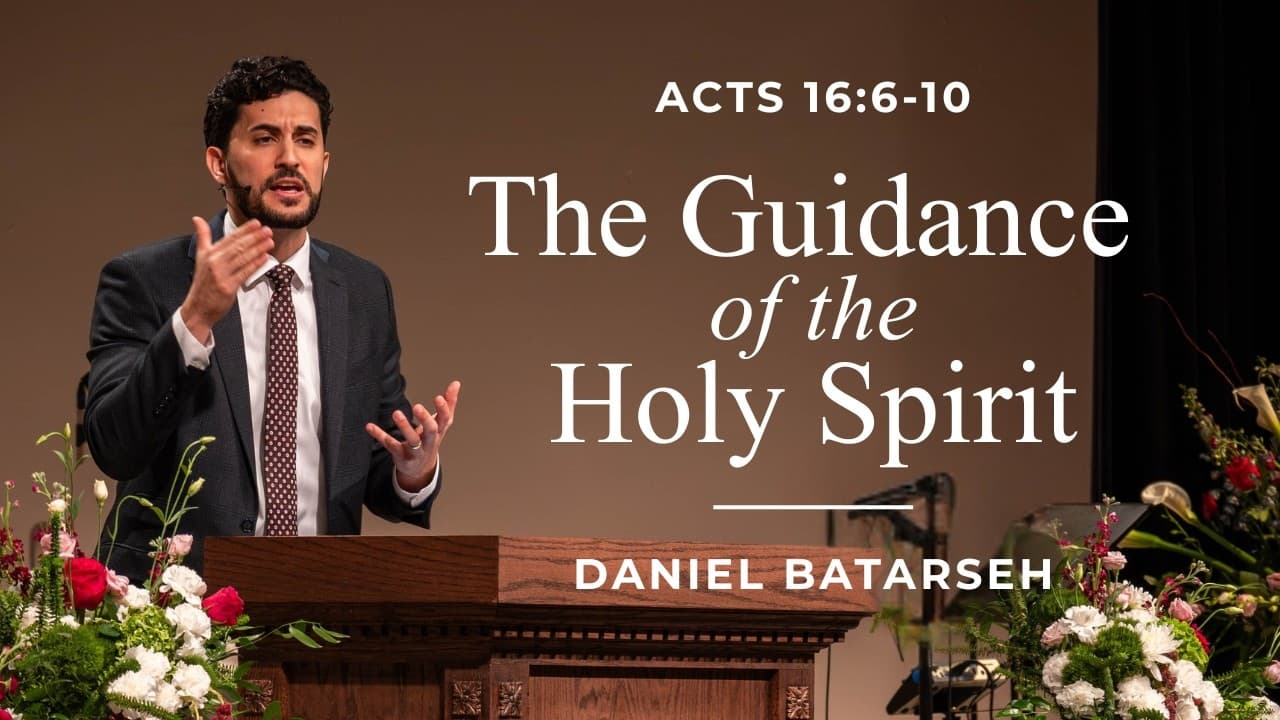
God blocked Paul twice before giving him a vision. The reason why reveals how the Holy Spirit actually leads — and it's not what most people expect.
How the Holy Spirit Guides You (Acts 16:6-10)
Here is a man with a burning desire to preach the gospel. He has a team assembled. He has a destination in mind. And God says no. Twice.
Most people read Acts 16:6-10 and focus on the dramatic vision of the Macedonian man — the supernatural moment where Paul finally gets a green light. But the real revelation in this passage isn't the vision. It's the two closed doors that came before it, and why God closed them. The answer, buried in a single pronoun shift in verse 10, will change the way you think about every unanswered prayer, every stalled plan, and every frustrating detour in your life.
Pastor Daniel Batarseh preached this text on a momentous Sunday — the first service in Maranatha Bible Church's new building in Barrington, Illinois, a building that came only after years of closed doors, unexplained denials, and persistent prayer. The parallels between Paul's journey and the church's own story gave the teaching a weight that no commentary could manufacture. This wasn't theory. It was testimony.
You Can't Steer a Parked Car
Before examining how the Spirit leads, we need to settle who the Spirit leads. The "they" in Acts 16:6 is not a random group of travelers. It's Paul, whose life mission was singular — "I do not account my life of any value, nor as precious to myself, if only I may finish my course in the ministry that I received from the Lord Jesus" (Acts 20:24). It's Timothy, about whom Paul wrote in Philippians 2:20-21 that he had no one else like him, because everyone else sought their own interests. It's Silas, whom Peter called "a faithful brother" in 1 Peter 5:12.
These were men whose ambitions, affections, and activity were aligned with the cause of Christ. And that alignment is not incidental to the story — it's the prerequisite.
But here's the tension that needs to be named honestly: this truth can become a trap. You can torture yourself with introspection — Are my ambitions strong enough? Are my affections real enough? Am I good enough for God to lead me? And the answer from this very text is a resounding relief. These men were not perfect. Paul's presence with Silas was itself the product of a painful failure. Back in Acts 13:2, the Holy Spirit had specifically paired Barnabas and Saul together. The Spirit brought them together. And yet by Acts 15:39, Paul and Barnabas had "a sharp disagreement, so that they separated from each other" (watch at 54:16). These men, in their flesh, severed what the Holy Spirit had joined.
And yet the Spirit still led Paul. He didn't lose signal. As Pastor Daniel Batarseh put it: "We don't have to reach a certain status quo and stay there, and the moment you step outside of it, you lose signal with the Holy Spirit. That's not how it works. He's incredibly merciful. He's incredibly patient and kind. But we have to be realistic. What he asks of us is a heart that longs to do his will" (watch at 55:22).
The point is not perfection. The point is direction. Paul was moving. He was doing what he could with the light he had — heading west toward Asia, then north toward Bithynia — and the Lord redirected him along the way. "You can't steer a parked car," the sermon noted. And some Christians are frustrated with their walk with God, but if they examined themselves honestly, there's very little for the Holy Spirit to work with. If all we're expecting from God is a comfortable life, a cushioned bank account, healthy bodies, and well-behaved children, we should not expect the kind of testimonies of the Spirit's leadership that we see in this passage.
The 'No' That Was Building Something You Couldn't See
The most intriguing feature of this episode is that the Holy Spirit's guidance comes primarily as detours and dead ends. Paul wants to go to Asia — blocked. He pivots north toward Bithynia — blocked again. Two divine red lights with no explanation attached.
How did the Spirit communicate these denials? Some commentators speculate about audible voices or prophetic words. But the text itself creates a subtle contrast. When Paul reaches Troas, he receives a vision — and the author describes it explicitly as a vision. The fact that Luke specifies the mode of communication in verse 9 but doesn't specify it in verses 6-7 suggests something important: the earlier guidance was more natural, more providential. Closed roads. Circumstances that didn't align. Perhaps even physical obstacles.
This is enormously reassuring. Even in Acts — this miracle-saturated book — the Spirit's leading can look like unanswered phone calls, cancelled flights, unjust decisions at work, even bodily sickness. Paul himself told the Galatians that "it was because of a bodily ailment that I preached the gospel to you at first" (Galatians 4:13). His sickness either brought him to the region or kept him there — and Paul understood that none of it was accidental (watch at 59:53).
But here is the observation that, once you see it, you will never unsee it. Why did the vision of the Macedonian man come only in Troas? Why not earlier, in Galatia? Why not in Mysia? Why not save everyone some time?
The answer is hiding in plain sight in verse 10: "Immediately we sought to go into Macedonia, concluding that God had called us." The pronouns shift. For the first time in the entire book of Acts, Luke switches from third person to first person plural. He's no longer reporting — he's participating. He's there. Which means Paul met Luke in Troas.
The Lord did not allow Paul to go where he wanted to go because the Lord wanted to introduce him to a doctor.
Let that settle. God blocked two good plans — preaching the gospel in Asia and Bithynia, both entirely righteous ambitions — because He had a different priority. He was building Paul's team. He was adding the man who would go on to write more of the New Testament by word count than Paul himself — the Gospel of Luke and the book of Acts. As Pastor Daniel Batarseh said: "If you were to ask Paul, was Troas your first choice? He would say, no, it was my third. But it was God's first" (watch at 1:05:17).
What might God be building in your season of waiting? It could be character. It could be knowledge. It could be relationships entering or exiting your life. The closed door is not a punishment. It's a construction site.
And for anyone wondering whether God simply didn't care about Asia and Bithynia — turn to 1 Peter 1:1. Peter addresses his letter "to those who are elect exiles of the dispersion in Pontus, Galatia, Cappadocia, Asia, and Bithynia." The gospel eventually reached the very regions Paul was blocked from entering. We don't know how. We don't know who brought it. But it came. God's "no" was never a "never." It was a "not yet, and not through you." Timing is everything with God — even for holy things.
The Vision Said 'Man' — But God Had More in Mind
Paul receives the vision: a Macedonian man standing before him, saying, "Come over to Macedonia and help us." Notice how Paul and his team interpreted "help us." They didn't conclude that God wanted them to start a relief fund. Verse 10 says they concluded "that God had called us to preach the gospel to them." Help, in the vocabulary of heaven, means the gospel. Everything else — humanitarian aid, practical support, acts of charity — is good and necessary. But without the gospel attached, as the sermon put it bluntly, "all we're really doing is making them more comfortable on their way to eternal damnation."
But here's what makes this passage shimmer with surprise. Paul had a vision of a man. One man. And look at who he actually encounters when he arrives in Macedonia.
First: a woman. Lydia, a seller of purple goods from Thyatira, whose heart the Lord opened to receive the gospel (Acts 16:11-14). Second: another woman — a slave girl possessed by a spirit of divination, whom Paul delivered in the name of Jesus Christ (Acts 16:16-18). And only then, after being thrown in prison for the exorcism, does Paul encounter a man — the Philippian jailer, trembling on the ground, asking, "Sirs, what must I do to be saved?" (Acts 16:25-30).
The vision showed one man. God delivered two women and a jailer. Before the man even appeared, there was a businesswoman who needed salvation and a captive girl who needed deliverance. God's plan was always bigger than the preview He gave.
As Pastor Daniel Batarseh observed: "We're praying about one thing. We're believing for one thing. We have one main thing oftentimes, and the Lord wants to sprinkle surprises along the journey. He wants to unfold even more than what we had anticipated and believed him for" (watch at 1:22:41).
This is the God who, according to Ephesians 3:20, is able to do "far more abundantly than all that we ask or think." Maranatha Bible Church was praying for a building. They got a building. But along the way, people from other churches showed up and worked as if it were their own. Lives were changed through the online ministry. Emails arrived from strangers testifying to what the Word had done in them. God gave more than the request.
The Spirit Leads Through Community, Not Lone Rangers
One final detail that's easy to rush past. Though Paul received the vision alone, it was the team that concluded together what it meant. That word "concluding" in the Greek carries the idea of knitting pieces together, assembling evidence. You can picture the scene: Paul recounts the vision. Silas connects it to the closed door in Asia. Timothy links it to the failed attempt at Bithynia. And Luke — the newcomer — says something like, "If you hadn't come to Troas, we never would have met."
Together, they knit the evidence into conviction.
This is a rebuke to the lone-ranger Christianity that pervades our culture. If the apostle Paul — a man of colossal intellect and direct revelation — didn't kick down the door and announce, "I've figured it out, let's go," then neither should you. He brought the vision to his brothers and said, "Let's conclude together if this is from God."
Who speaks into your life? Who are your closest friends? Who are your spiritual leaders? Is there anyone you can say with confidence today, "That person may not be perfect, but I know they bathe in the Bible, and there are marks of God's hand on them"? If you think you don't need that, then you must also be ready to admit you're more insightful than the apostle Paul.
And notice the Trinity woven through these five verses: "forbidden by the Holy Spirit" (v. 6), "the Spirit of Jesus did not allow them" (v. 7), "God had called us" (v. 10). Father, Son, and Holy Spirit — all three persons directing the steps of these men. The same triune God wants to lead your life. But He does it through a yielded heart, through providential denials, through occasional supernatural clarity, and through the community of faith.
What to Remember
- The Holy Spirit leads people who are already moving — you cannot steer a parked car, and God does not guide those who refuse to go anywhere for His sake.
- God's "no" is not a rejection; it's a redirection. Paul's two closed doors led him to Luke, the man who would write more of the New Testament than any other author.
- The gospel reached Asia and Bithynia eventually (1 Peter 1:1) — God's denial of your plan doesn't mean He's denied the outcome, only your timing and your method.
- When Paul heard "help us," he interpreted it as "preach the gospel to them" — the greatest help anyone can receive is not comfort but Christ.
- God's actual plan is always larger than the preview He gives — Paul saw one man, but God delivered two women and a jailer.
- Spirit-led living requires Spirit-led community; even Paul submitted his private revelation to the collective discernment of his team.
Questions to Sit With
- Is there a closed door in your life right now that you've been interpreting as God's rejection rather than His redirection? What might He be building that you can't yet see?
- If you're honest, is your expectation of God's guidance mostly about comfort and security — or about the advance of the gospel? What does that reveal about what the Spirit has to work with in your life?
- Paul had Silas, Timothy, and Luke to help him interpret God's leading. Who are the people in your life qualified to help you discern — and when was the last time you actually brought a decision to them?
- The Macedonian man said "help us," and Paul heard "preach the gospel." When someone in your life asks for help, what's your first instinct — and does it ever include the thing they need most?
- Paul's third choice was God's first choice. What would change in your heart if you truly believed that about the place you're in right now?
Scripture Referenced
- Acts 16:6-10 — Primary passage
- Acts 15:36
- Acts 20:24
- Philippians 2:20-21
- 1 Peter 5:12
- Acts 13:2
- Acts 15:39-40
- Galatians 4:13
- 1 Peter 1:1
- Acts 16:11-14
- Acts 16:16-18
- Acts 16:25-30
- 1 Chronicles 16:23-34
- Ephesians 3:20-21
- Deuteronomy 12:13-14
- 1 Corinthians 10:17
This summary was generated by AI from the sermon "The Guidance of The Holy Spirit | Acts 16:6 | Pastor Daniel Batarseh (5/31/26)" preached by Pastor Daniel Batarseh at Maranatha Bible Church Chicago. Watch the full sermon →
Preached by
Pastor Daniel BatarsehSenior Pastor
This summary was generated by AI from the sermon transcript.
Based on the sermon
The Guidance of The Holy Spirit | Acts 16:6 | Pastor Daniel Batarseh (5/31/26)
Watch Full SermonRelated Articles
Nehemiah 6:15-19 — What 52 Days of Rebuilding Teaches About Prayer and Fruitfulness
Pastor Daniel Batarseh · September 11, 2026
Nehemiah 6:15-19 — What 52 Days of Rebuilding Teach Us About Prayer and Persistence
Pastor Daniel Batarseh · September 11, 2026

Is the Millennium in Revelation 20 Literal? 5 Reasons
Pastor Daniel Batarseh · September 6, 2026