The walls of Jerusalem lay in ruins for 150 years. They were rebuilt in 52 days. The math reveals something stunning about the relationship between prayer and fruitfulness.
Here is a piece of math that should stop you cold: Nehemiah spent four months fasting and praying before he ever picked up a stone. The wall itself went up in fifty-two days. This man invested more time on his knees than on the construction site — and the result was a feat so staggering that even Israel's enemies had to admit God was behind it.
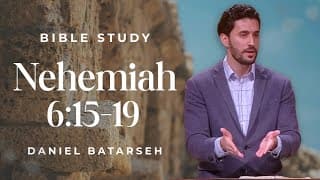
Nehemiah 6:15–19 records the completion of Jerusalem's walls, and at first glance it reads like a simple historical footnote — a date, a timeline, a few political complications. But Pastor Daniel Batarseh, teaching through this passage at Maranatha Bible Church, showed that these five verses are loaded with instruction about prayer, perseverance, spiritual discernment, and the kind of God who can restore in weeks what has been broken for over a century.
Three things emerge from this text: the timing of the completion, the testimonies surrounding it, and the triumph within it. Each one has something to say to anyone who has ever wondered whether their labor for the Lord is actually going anywhere.
More Time Praying Than Building
Verse 15 gives us the raw data: "So the wall was finished on the twenty-fifth day of the month Elul, in fifty-two days." That number is so remarkable that some historians and commentators have tried to explain it away — suggesting Nehemiah had unlimited volunteers, or that the project was merely cosmetic repairs rather than genuine reconstruction. But those explanations conveniently ignore everything that made this timeline nearly impossible.
Consider what happened during those fifty-two days. The workers faced relentless external threats from Sanballat, Tobiah, and Geshem. Internal conspiracies tried to lure Nehemiah into traps. Traitors within the camp were leaking intelligence to the enemy. The month of Elul falls between August and September — meaning the bulk of this work was done under a blazing Middle Eastern sun. And if Nehemiah was faithful to God's law, which everything in his character suggests, the people observed the Sabbath each week, voluntarily pausing the urgent work by faith.
Fifty-two days under those conditions is nothing short of miraculous. But the timeline reveals something even more striking when you zoom out.
In Nehemiah 1:1, we learn that Nehemiah first heard about Jerusalem's broken walls in the month of Kislev. He didn't approach King Artaxerxes until the month of Nisan — four months later (Nehemiah 2:1). What was he doing during those four months? Fasting. Praying. Waiting on God for a breakthrough.
Four months of prayer. Fifty-two days of building. As the teaching made plain: "Nehemiah spent more time praying about the wall than actually building it" (hear this moment). The implications are uncomfortable for anyone who treats prayer as a quick preamble before the "real work" begins. The real work was the prayer. The construction was the overflow.
"Prayerfulness is not optional if you want to be optimal" (watch at 39:56). That's a line worth writing on a wall somewhere. All the public success that gained the attention of the surrounding nations was rooted in a man who sat in the presence of God in secret, refusing to move until God gave him favor, wisdom, clarification, and confidence. You and I cannot shortcut that process. We cannot replace it with better strategies, harder effort, or louder platforms. The efficiency came from heaven, and it was unlocked on his knees.
Determination Makes You Surprisingly Fruitful
But let's not spiritualize this into passivity. Nehemiah gives God full credit for the accomplishment — verse 16 says the nations "perceived that this work had been accomplished with the help of our God." Yet back in chapter four, when the wall reached its halfway point, Nehemiah also wrote this: "So we built the wall, and all the wall was joined together to half its height, for the people had a mind to work" (Nehemiah 4:6, watch at 33:13).
Was it God? Absolutely. Was it also human determination? Nehemiah says so himself.
This is the Hebrews 12:1 principle lived out before it was written: "Let us lay aside every weight and sin which clings so closely, and let us run with endurance the race that is set before us." Nehemiah didn't merely avoid sin — he stripped away every distraction, every weight, every excuse. He was diligent in a way that made him surprisingly productive.
Sometimes the lack of results in our service to the Lord really is a matter of providence. God, in his wisdom, slows things down to do a deeper work in us. That's legitimate. But we also have to be honest enough to admit that sometimes the delay is simpler than that. We don't have the mind to work. We coast on autopilot. We give the bare minimum of energy and then wonder why nothing is advancing. Paul told Timothy to immerse himself in his calling and let everyone see his progress — not to settle for the least amount of effort possible.
How much could you grow in your knowledge of Scripture if you were just slightly more intentional in your daily reading? How much more fruitful could your service become if you took Paul's charge to Timothy personally? Fifty-two days happened because God was behind it and because the people refused to be passive.
When God Defends You, Your Enemies Bow
The irony in verse 16 is exquisite. Throughout the entire book, Nehemiah's enemies have been trying to inject fear into the hearts of God's people — mockery, threats, lies, political schemes, assassination plots. And now, at the climax of the story, who is afraid? Not the Jews. The enemies. "All the nations around us were afraid and fell greatly in their own esteem, for they perceived that this work had been accomplished with the help of our God."
The very fear they tried to manufacture in God's people fell back on their own heads. Beautiful, poetic, divine justice.
But there's a practical lesson embedded here. Nehemiah never wasted time trying to convince Sanballat and Tobiah that he was a good man with right motives. He never launched a PR campaign. He never sought a formal apology. He just kept his hands white-knuckled on the plow, and when the time came, the completed wall spoke louder than any defense he could have mounted.
The teaching drew a stunning parallel to Genesis 39 and 41 — the story of Joseph. Falsely accused of sexual assault by Potiphar's wife, thrown into prison for his righteousness, Joseph had every reason to despair. But Genesis 39:21 says simply, "The Lord was with Joseph." That's all that mattered. Not what people said. Not who believed the lie. Not who posted about him. The one question worth asking was: Is God with me?
And God vindicated Joseph in a way that defies imagination. Pharaoh put his signet ring on Joseph's hand, clothed him in fine linen, set him in the second chariot, and commanded the people to bow the knee before him. As Pastor Daniel Batarseh observed with vivid imagination: picture Potiphar and his wife somewhere in that parade, forced to bow before the very man they accused of immorality (watch at 54:58). That's what it looks like when God defends you.
The application is direct: let the fruit of your life and the fruit of your ministry speak for itself. The combination of Christlike character and Spirit-empowered results will always speak louder than slander.
Why Good Names Don't Guarantee Good Hearts
The final verses of Nehemiah 6 reveal something deeply disturbing. Many — not some, not a few, but many — of the nobles of Judah were secretly pledged to Tobiah, one of the chief enemies of the rebuilding project. They were sending him letters, reporting Nehemiah's private words back to him, and even trying to convince Nehemiah that Tobiah was actually a good guy. "They spoke of his good deeds in my presence," Nehemiah writes with what you can almost feel is restrained fury (v. 19).
How could leaders within God's own people defend a man who was actively trying to destroy the work of God? The answer comes from Proverbs 28:4: "Those who forsake the law praise the wicked, but those who keep the law strive against them" (watch at 67:10).
That verse is a scalpel. Abandon God's Word long enough and you will lose the ability to tell the difference between an ally and an enemy. You will praise what you should condemn. You will defend what you should resist. Your moral compass doesn't just drift — it inverts.
Notice the names. Tobiah means "Jehovah is good." His son Jehohanan means "Jehovah has favored." Wonderful names. Theologically rich labels. And utterly disconnected from the reality of their lives. The nobles of Judah couldn't see past the labels. They heard the right vocabulary and assumed the right heart.
Nehemiah could see through it because he was tethered to Scripture. He knew the Word. He argued from it, confronted with it, rebuked by it. And because he did, he had the spiritual perception to recognize a wolf even when it wore a name tag that said "Jehovah is good."
This is not an ancient problem. It is a Sunday morning problem. It is a Christian publishing problem. It is a social media problem. People with the right vocabulary and the right branding who are working against the purposes of God — and professing believers who cannot tell the difference because they have drifted from the Scriptures.
The only antidote is the same one Nehemiah had: stay close to the Book.
One personal story from the teaching drives this home with force. A friend from Canada — a major drug dealer, spending hundreds of dollars a day to get high, grinding his teeth through Christmas unable to open presents because he was desperate for his next fix. The kind of person you look at and think, that's a lost cause. And then the gospel reached him. He came off the drugs, walked away from the lifestyle, emptied his safe of paraphernalia, burned it all in a bonfire on a friend's property, and never looked back. Today he has a family, serves the Lord, and has done missions work. How do you explain that? The same way you explain fifty-two days: God was behind it (hear this moment).
Jesus asked the man who had been an invalid for thirty-eight years a question that seems almost absurd: "Do you want to be healed?" (John 5:6). But it's the question he asks anyone who has been stuck so long they can't imagine anything different. Do you want to be healed? Then stretch out your hand. Do what he asks. And the God who rebuilt 150-year-old ruins in fifty-two days can rebuild you too.
What to Remember
- Nehemiah invested four months in prayer and fifty-two days in building — more time on his knees than on the construction site. Prayer is not the prelude to the work; it is the foundation that makes the work effective.
- Determination is not unspiritual. God was behind the wall's completion, and so were people who "had a mind to work." Divine sovereignty and human diligence are partners, not rivals.
- The best defense against slander is not a louder voice but a faithful life. Nehemiah never campaigned for his reputation — the finished wall spoke for him, and even his enemies had to acknowledge God's hand.
- Forsaking Scripture doesn't just weaken your faith; it destroys your discernment. Those who abandon God's Word end up praising the very people they should oppose (Proverbs 28:4).
- God specializes in restoring what has been broken for longer than anyone thought possible — whether it's ancient walls, decades-long addictions, or relationships everyone else has written off.
- The church belongs to Christ, not to any leader or faction. As 1 Corinthians 3:17 warns, anyone who seeks to destroy God's temple through division will answer to God directly.
Questions to Sit With
- If Nehemiah spent more time praying about the wall than building it, what does your ratio of prayer to activity say about where you're placing your trust?
- Is there an area of your life or service where you've been coasting on autopilot — and if you're honest, the lack of fruit isn't providence but a lack of determination?
- Are you currently trying to defend your own reputation in a situation where God is asking you to keep your hands on the plow and let the fruit speak?
- Has distance from Scripture caused you to admire or defend someone — a leader, a public figure, a friend — whose life and actions actually work against the purposes of God?
- Jesus asked a man who had been broken for thirty-eight years: "Do you want to be healed?" If he asked you that tonight about the thing you've carried the longest, what would your honest answer be?
Scripture Referenced
- Nehemiah 6:15-19 — The wall completed in fifty-two days
- 2 Corinthians 5:21 — The double imputation of the gospel
- Nehemiah 4:6 — The people had a mind to work
- Hebrews 12:1 — Laying aside every weight to run with endurance
- Nehemiah 1:1 — The month of Kislev; Nehemiah begins fasting and praying
- Nehemiah 2:1 — The month of Nisan; Nehemiah approaches the king
- John 5:5-6 — The invalid healed after thirty-eight years
- Acts 4:22 — The healed man was over forty years old
- Genesis 39:19-22 — Joseph imprisoned after false accusation
- Genesis 41:42-43 — Joseph exalted by Pharaoh
- Nehemiah 13:4 — Eliashib the priest related to Tobiah
- Proverbs 28:4 — Those who forsake the law praise the wicked
- 1 Corinthians 3:17 — If anyone destroys God's temple, God will destroy him
This summary was generated by AI from the sermon "Nehemiah 6 (Part 2) Bible Study (The Wall Is Finished) | Pastor Daniel Batarseh (9/11/26)" preached by Pastor Daniel Batarseh at Maranatha Bible Church Chicago. Watch the full sermon →
Preached by
Pastor Daniel BatarsehSenior Pastor
This summary was generated by AI from the sermon transcript.
Based on the sermon