Jerusalem's walls lay in ruins for over a century. Nehemiah rebuilt them in 52 days. The timing reveals something stunning about prayer, perseverance, and God's power.
Here's a detail from Nehemiah 6 that most people read right past: Nehemiah spent more time praying about the wall than building it. Four months on his knees between Kislev and Nisan. Fifty-two days of construction. The man who accomplished one of the most remarkable feats in Israel's history invested more hours in a prayer closet than on a scaffold. That ratio should rearrange how we think about productivity, ministry, and what it actually means for God to be "behind" a work.
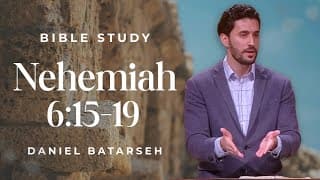
Nehemiah 6:15–19 records the completion of Jerusalem's walls — a project that defied every reasonable expectation. The walls had been rubble for roughly 150 years. Enemies harassed from the outside. Traitors leaked information from the inside. And the whole thing was done during the hottest months of the Middle Eastern summer. Yet in less than two months, it was finished. These five verses offer far more than a celebration. They contain instruction about timing, testimony, and triumph that Christ's church desperately needs to hear.
Fifty-Two Days in a Blazing Sun — Why the Timing Matters More Than You Think
Verse 15 reads simply: "So the wall was finished on the twenty-fifth day of the month Elul, in fifty-two days." The brevity of the sentence belies the enormity of what it describes. The month of Elul falls between August and September on the Jewish calendar. That means the bulk of this construction happened under a Middle Eastern sun at its most punishing. Add to that the weekly Sabbath rest — which Nehemiah, as a man who revered God's law, would have enforced — and the math becomes even more staggering. Factor in the work stoppages caused by threats, conspiracies, internal conflicts over debt and exploitation, and the constant psychological warfare from Sanballat, Tobiah, and Geshem, and you begin to see why some historians refuse to take the timeline literally.
But that refusal says more about the historian than the history. As the teaching pointed out, "There are many things in God's word that stump the carnal mind. Instead of looking at how this is possible, we have to understand that with God all things are possible" (watch at 29:27).
So how did they do it? Two answers, and you need both.
First, God was behind it. Verse 16 says the surrounding nations "perceived that this work had been accomplished with the help of our God." Second — and this is the part we tend to spiritualize away — the people were determined. Back in Nehemiah 4:6, when the wall reached its halfway point, Nehemiah wrote: "The people had a mind to work." God's sovereignty and human diligence are not competitors. They are partners. The wall went up because heaven was behind it and because flesh-and-blood people decided they would not coast.
That phrase — "a mind to work" — is a rebuke to every believer who wonders why their knowledge of Scripture hasn't grown, why their gifting hasn't sharpened, why their ministry feels stalled. Sometimes the delay isn't mysterious providence. Sometimes it's simpler than that. We just haven't brought the intensity. As Pastor Daniel Batarseh put it: "Some of us might be shocked to know how much we can excel in our knowledge of God's word if we were just a little bit more intentional in our daily investment" (hear this moment).
Nehemiah models what Hebrews 12:1 calls for — not just laying aside sin, but removing every weight. Not just avoiding the obviously wrong, but refusing the subtly distracting. This man was diligent to the point of being surprisingly fruitful.
He Prayed Longer Than He Built — The Ratio That Changes Everything
Here is where the timeline becomes genuinely convicting. Nehemiah 1:1 tells us the burden for Jerusalem hit him in the month of Kislev. Nehemiah 2:1 records his request to the king in the month of Nisan — four months later. What was he doing for those four months? Fasting. Praying. Waiting on God for a breakthrough.
Now follow the math. The events of chapters 2 through 6 unfold across roughly six months. The wall itself took fifty-two days. But the prayer that preceded and undergirded the work consumed four months — nearly two and a half times longer than the construction.
The implications are enormous. "Nehemiah spent more time praying about the wall than actually building it. Prayerfulness is not optional if you want to be optimal" (watch at 39:56). Every bit of public success Nehemiah experienced was rooted in a man who sat before God in secret. The favor he received from the king, the wisdom to organize the labor, the discernment to see through schemes, the courage to refuse distraction — all of it was forged on his knees before a single stone was lifted.
This is not a formula. It's a principle woven through all of Scripture: the work of God requires the power of God, and the power of God is accessed through dependence on God. You cannot replace prayer with strategy. You cannot substitute hustle for communion. The reason the wall went up in fifty-two days is partly because a man spent four months making sure heaven was involved before he picked up a trowel.
Broken for 150 Years, Restored in 52 Days — A God Who Still Does Miracles
Perhaps the most stunning dimension of the timing is the contrast between how long the walls had been destroyed and how quickly God rebuilt them. Between 140 and 150 years of rubble. Over a century of exposure, vulnerability, and shame. And in less than two months, it was over.
If God can do that with stones, what can he do with a human soul?
The New Testament amplifies this pattern. In John 5:5–6, Jesus encounters a man who had been an invalid for thirty-eight years and asks him a question that sounds almost absurd: "Do you want to be healed?" Why would he not? But Jesus knew something about the human heart — that after decades in a certain condition, a person can lose the ability to imagine anything different. The dysfunction becomes identity. The brokenness becomes home. In Acts 4:22, Luke notes that the man healed at the Beautiful Gate was over forty years old. Why mention his age? To make the miracle louder. To remind us that the length of the affliction is not the measure of God's power.
During the closing moments of the service, a story brought this truth to life in a way no theological abstraction could. A man from Canada — a heavy drug dealer with an addiction that consumed hundreds of dollars a day — came to Christ and walked away from everything. He was still physically swollen, could barely speak, but there was light in his eyes. Friends from the church went to his house, filled garbage bags with paraphernalia, and burned it all in a fire on someone's property. He never looked back. Today he has a family, children, and serves the Lord (hear this moment).
How do you explain that? You don't. You worship the God who did it. And you refuse to believe that anyone — including you — is beyond the reach of the same power that raised walls from rubble and raised Christ from the dead.
When Your Enemies Become Afraid — The Irony of Verse 16
Throughout Nehemiah's story, his enemies had one primary weapon: fear. Mockery designed to demoralize. Threats designed to paralyze. Lies designed to discredit. And now, at the climax, the irony is breathtaking: "All the nations around us were afraid and fell greatly in their own esteem" (6:16). The very fear they tried to manufacture in God's people fell on their own heads.
Nehemiah never wasted energy defending his reputation to Sanballat or Tobiah. He didn't launch a PR campaign. He didn't write open letters. He kept his hands on the plow and let the finished wall speak for itself. The completed work was an undeniable declaration that God was behind this man.
The parallel to Joseph in Genesis is striking. Falsely accused of sexual assault by Potiphar's wife, thrown into prison for his righteousness, Joseph could have spent years nursing bitterness and demanding vindication. Instead, Genesis 39:21 records the only thing that mattered: "But the Lord was with Joseph." That's the one thing worth protecting — not your reputation, not your platform, not who likes you. Is God with you? Because if God is with you, it doesn't matter who is against you. And if God is not with you, it doesn't matter who is for you.
And God did vindicate Joseph — spectacularly. Pharaoh put his signet ring on Joseph's hand, dressed him in fine linen, and paraded him through Egypt in the second chariot while heralds cried, "Bow the knee!" One wonders whether Potiphar and his wife were somewhere in that crowd, forced to kneel before the very man they had tried to destroy.
The lesson is the same for Nehemiah and for us: let the fruit of your life and ministry, as God blesses it, be your defense. God knows how to speak on behalf of those who are too busy serving him to speak for themselves.
Praising the Wicked — The Danger Nehemiah Faced from Within
The final verses of chapter 6 reveal something deeply disturbing. Not some, not a few, but many nobles of Judah were bound by oath to Tobiah — an Ammonite enemy of God's people who had been trying to sabotage the rebuilding from the start. These nobles were sending him intelligence, reporting Nehemiah's private words, and even speaking of Tobiah's "good deeds" to Nehemiah's face, trying to soften his stance toward a man who was actively working against God's purposes.
How could leaders within God's own community defend someone whose hostility was so obvious? Proverbs 28:4 provides the diagnosis: "Those who forsake the law praise the wicked, but those who keep the law strive against them." Abandon Scripture long enough and you lose the ability to distinguish friend from foe. Your moral compass doesn't just drift — it inverts. You begin admiring what you should condemn.
The irony deepens when you consider the names. Tobiah means "Jehovah is good." His son Jehohanan means "Jehovah has favored." Beautiful names. Righteous-sounding labels. But names don't determine character. As Pastor Daniel Batarseh observed, the nobles "couldn't see past the labels" (watch at 1:10:15). Nehemiah could — because he was tethered to the Word of God. He knew it, prayed it, argued from it, rebuked with it. And that's what gave him x-ray vision when everyone around him was fooled.
This is a warning for every church. Paul told the Corinthians in 1 Corinthians 3:17 that the church is God's temple, and if anyone destroys it through division, God will deal with them directly. The church belongs to Christ. He is the head. He birthed it, and those who seek to tear it apart answer to him — not to a board, not to a faction, not to popular opinion. That truth is either terrifying or deeply comforting, depending on whose side you're on.
What to Remember
- Nehemiah invested four months in prayer and fifty-two days in construction — he prayed longer than he built, and that ratio explains his effectiveness more than any management strategy ever could.
- Determination is not unspiritual. God was behind the wall, but the people "had a mind to work." Divine sovereignty and human diligence are partners, not competitors.
- Something broken for over 150 years was restored in less than two months. No addiction, no dysfunction, no relational devastation is beyond the reach of a God who specializes in resurrection.
- The best defense of your character is not a social media post — it's a finished wall. Let the fruit of your obedience speak louder than anything said about you.
- Forsake Scripture long enough and you will praise the very people you should oppose. The Word of God is not just information — it is your capacity for discernment.
- The church is God's temple. He hires and he fires. Those who seek to divide it answer to him directly.
Questions to Sit With
- If Nehemiah spent more time praying about the wall than building it, what does the ratio of your prayer life to your activity reveal about where you think power actually comes from?
- Is there an area of your life or ministry where the honest explanation for the lack of fruit is simply that you don't have "a mind to work"?
- Jesus asked a man who'd been disabled for thirty-eight years, "Do you want to be healed?" — is there a brokenness you've lived with so long that you've stopped believing change is possible?
- Have you ever found yourself defending someone whose behavior clearly opposes God's purposes — and if so, what does Proverbs 28:4 say about why?
- When people slander or misrepresent you, is your instinct to defend yourself or to keep building? What would it look like to trust God with your reputation this week?
Scripture Referenced
- Nehemiah 6:15–19 — the wall completed in fifty-two days
- 2 Corinthians 5:21 — the double imputation of the gospel
- Nehemiah 4:6 — the people had a mind to work
- Hebrews 12:1 — lay aside every weight and run with endurance
- Nehemiah 1:1 — the month of Kislev, the burden begins
- Nehemiah 2:1 — the month of Nisan, the request to the king
- John 5:5–6 — the invalid of thirty-eight years
- Acts 4:22 — the healed man was over forty years old
- Genesis 39:19–22 — Joseph imprisoned after false accusation
- Genesis 41:42–43 — Joseph exalted by Pharaoh
- Nehemiah 13:4 — Eliashib the priest related to Tobiah
- Proverbs 28:4 — those who forsake the law praise the wicked
- 1 Corinthians 3:17 — if anyone destroys God's temple
This summary was generated by AI from the sermon "Nehemiah 6 (Part 2) Bible Study (The Wall Is Finished) | Pastor Daniel Batarseh (9/11/26)" preached by Pastor Daniel Batarseh at Maranatha Bible Church Chicago. Watch the full sermon →
Preached by
Pastor Daniel BatarsehSenior Pastor
This summary was generated by AI from the sermon transcript.
Based on the sermon