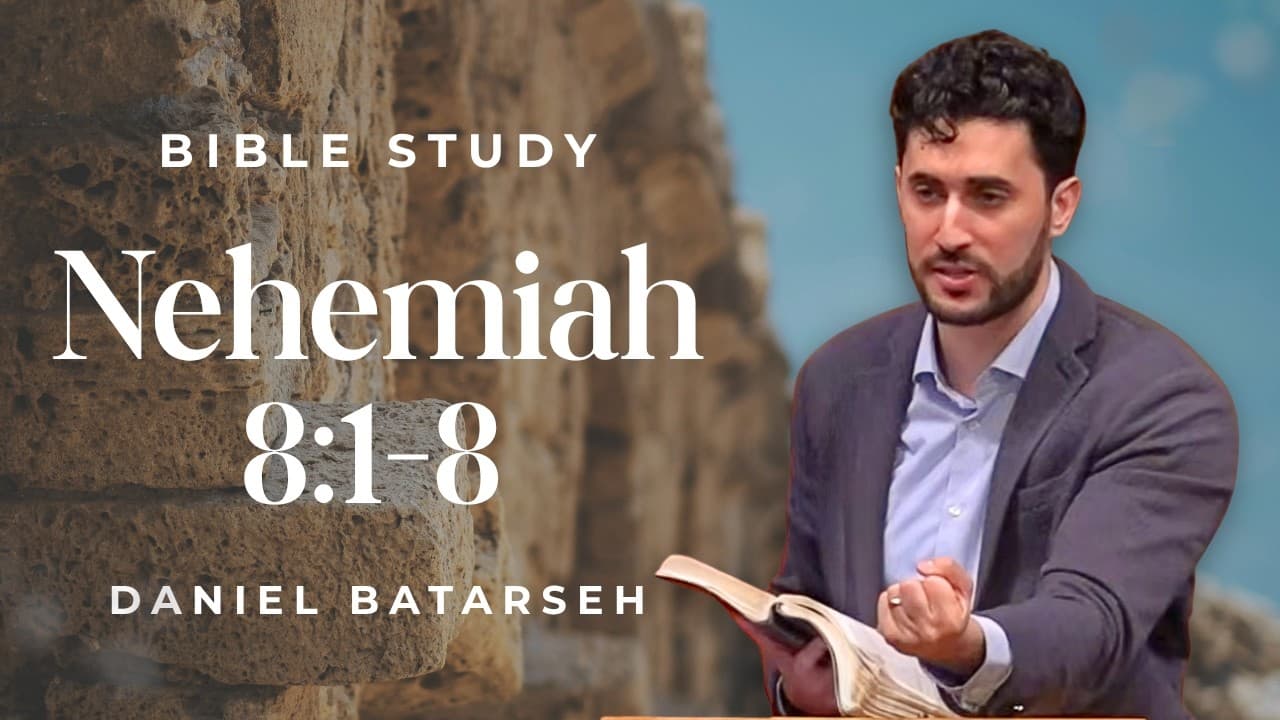
In Nehemiah 8, the people didn't just hear God's Word read — they were undone by it. What made the difference? They bought the truth and refused to sell it.
You're not approaching black ink on white pages. You're approaching the voice of God.
That distinction — between treating Scripture as content to consume and treating it as a living word that God breathed out, preserved across millennia, and intended for you to open — sits at the heart of Nehemiah 8. And it's the distinction that separates a people who merely know about God from a people who fall on their faces before Him.
In Nehemiah 8:1-6, we find one of the most remarkable worship scenes in all of Scripture. The wall is rebuilt. The city is secured. And now the people gather — not because a priest summoned them, but because they demanded it. They asked Ezra to bring the Book of the Law. And what unfolds is not a religious ceremony. It's a detonation. The Word of God hits their ears and they cannot stay standing. Hands go up. Faces go down. Amens — not one, but two — thunder across the square.
What produced that response? And why does our own engagement with Scripture so rarely look like this?
The People Demanded the Word — Not the Priests
Here's the detail most of us read right past. Look carefully at who initiates this gathering. Nehemiah 8:1 says the people gathered as one man into the square before the Water Gate, and they told Ezra the scribe to bring the Book of the Law of Moses. Not Ezra calling a meeting. Not Nehemiah issuing a decree. The people — ordinary citizens of Judah — made the demand.
This is extraordinary. These are people who had just finished backbreaking labor on the wall. They could have celebrated. They could have rested. Instead, they hungered. They understood something that many modern believers have forgotten: the wall was never the point. Physical security without spiritual foundation is just a decorated ruin. As Pastor Daniel Batarseh put it, they wanted to "establish a fresh foundation in their walk with God" (watch at 9:42).
And notice the phrase: "as one man." This wasn't a fragmented crowd with half the people checking the sundial. This was unified, collective hunger. Every man, woman, and child old enough to understand — all of them pressing in, all of them wanting the same thing. When was the last time you saw an entire congregation desperate for the reading of Scripture? Not entertained by a sermon. Not moved by music. Desperate for the text.
The implication lands hard: if we are not hungry for God's Word, the problem is not the Word. The problem is us.
"Give Me Understanding" — The Prayer That Changes How You Read
Before walking through the Nehemiah text, there was a challenge issued to the room that deserves repeating. Read Psalm 119 in one sitting. All 176 verses. Thirty minutes of your day. No phone. No commentary. Just you and the longest chapter in the Bible — a chapter that is, from start to finish, a love letter to the Word of God.
And here's what surfaces when you do: one prayer, repeated again and again like a heartbeat. Give me understanding.
Psalm 119:99 — "I have more understanding than all my teachers." Psalm 119:125 — "I am your servant; give me understanding." Psalm 119:144 — "Your testimonies are righteous forever; give me understanding that I may live."
The psalmist is not asking for more information. He's asking for illumination. There's a canyon of difference between the two. You can memorize every verse in the Bible and still be spiritually blind. You can parse Greek verbs and diagram Hebrew sentences and miss the glory staring back at you from the page. The psalmist knew this. So he prayed the one prayer that every Bible reader should have on their lips before they open the book: Lord, don't just let me read the content — show me what it means.
As it was framed for us: "I don't just wanna be familiar with the content. I wanna know what it means, Lord. Give me understanding" (hear this moment). That prayer is the difference between Bible reading as a discipline and Bible reading as an encounter. One checks a box. The other changes a life.
And notice the promise embedded in that Psalm 119 prayer — "give me understanding that I may live." Understanding isn't academic. It's oxygen. Without it, you're not just uninformed. You're not truly living.
What Buying the Truth Actually Produces
The teaching zeroed in on a phrase that reframes everything: buy the truth and do not sell it. That language comes from Proverbs 23:23, but the concept saturates Nehemiah 8. These people had invested. They had stuck with it. They had gathered, listened, returned, and gathered again. And now, in verses 5-6, we see the dividends of that investment.
Three things happened when Ezra opened the book.
A Reorientation Around God's Glory
Ezra blessed the Lord, the great God. And the people responded: "Amen. Amen." Not one amen — two. That double amen is not filler. It's fire. "So be it. So be it." They were saying: Ezra, we agree with you. We want the Lord to be blessed. We want Him to be pleased. We want Him to take delight in our words and in our lives.
This is what sustained exposure to God's Word does to your priorities. It doesn't just add God to your life. It reorganizes everything around Him. "There's a reorientation in your priorities and your ambitions, and everything will begin to orbit around this one thing — glorifying God. Your thinking begins to change. Your convictions begin to change. Your standards begin to change" (watch at 7:14).
You stop asking "What do I want from life?" and start asking "What does my life owe to God?" You stop measuring your days by productivity and start measuring them by faithfulness. The heartbeat of your existence shifts. As the congregation often sings: His glory is my good.
That's not a slogan. It's the inevitable conclusion of a life marinated in Scripture.
A Physical Response You Can't Contain
The people lifted their hands. And then they bowed their faces to the ground.
Hands up. Faces down. Two postures that seem contradictory but are actually complementary — reaching toward God and submitting before Him in the same breath.
Now, the lifting of hands makes some people nervous. We've all been in services where we wonder: is this genuine or performative? That tension was addressed honestly. Lifting hands is a biblical posture. Paul himself wrote about it. But Paul also warned: lift holy hands. Don't just lift your hands — make sure they're clean. "This is genuine, this isn't artificial, this isn't a show. This is real" (hear this moment).
The point isn't that hand-raisers are more spiritual. The point is that when God's truth so moves you that your body can't stay still, that's not weird — that's worship. It's the overflow of an internal reality demanding external expression. Empty hands stretched upward say: I have nothing to offer You but myself. I'm reaching for You. I surrender.
And here's the tension worth sitting in: if the Word of God never moves you physically — never makes your eyes wet, never makes you stand, never makes you lift your hands or bow your head — is it possible you're reading it with your head and not your heart? The people in Nehemiah 8 didn't plan their response. They didn't coordinate a liturgy. The Word hit them, and their bodies followed their souls.
The Word Creates Worship — Or It Creates Nothing
This is the unavoidable conclusion of the passage. God's Word, rightly received, produces worship. Not information. Not theological sophistication. Worship. If your Bible reading makes your head heavy but leaves your heart cold, something has gone wrong. The text was direct about this: "It should create worship — if it makes your head heavy and not your heart" (watch at 9:42), then we've missed the point entirely.
The people of Judah didn't attend a lecture. They entered the presence of God through His Word. They understood — perhaps better than most modern Christians — that when Scripture is read aloud, God is speaking. Not spoke. Not will speak. Is speaking. Present tense. Living and active.
This is what made the scene at the Water Gate so electric. These weren't people fulfilling a religious obligation. These were people who understood that the book Ezra held was God-breathed, preserved across generations, and intended for them. As Pastor Daniel Batarseh pressed the point: "You're not approaching black ink on white pages. You are approaching something that God has breathed into — something He has preserved from generation to generation and had you in mind to open up, to read, to digest, and to be transformed by" (watch at 10:41).
Let that sink in. God had you in mind. When He preserved this book through wars and exiles and centuries of copying by hand — He was thinking about the moment you would open it. That's not sentimentality. That's theology. And it should change the way you pick up your Bible tomorrow morning.
The Challenge You Shouldn't Ignore
Before the teaching closed, a practical challenge was laid down — one worth repeating because it's the kind of thing we nod at and never do.
Read Psalm 119 in one sitting. All of it. Find thirty minutes. Cut out the noise. No one is going to check up on you. But do it for your own soul's sake.
"You can't do that without being moved when you see the hunger and the pursuit and the faith that the psalmist has regarding the Word of God" (hear this moment). You'll feel a cleansing force. You'll leave with a stirring you didn't manufacture. And you'll start to understand why the people at the Water Gate couldn't stay on their feet.
The truth is available. The question is whether you'll buy it — invest your time, your attention, your mornings, your quiet — and refuse to sell it when the world offers you something shinier.
What to Remember
- The people in Nehemiah 8 weren't summoned to hear God's Word — they demanded it. Hunger for Scripture is not a pastoral responsibility to create; it's a personal fire to tend.
- "Give me understanding" is the most important prayer you can pray before opening your Bible. Information without illumination is spiritually useless.
- Sustained investment in God's Word reorients your entire life around His glory — your priorities, ambitions, convictions, and standards all begin to shift.
- Physical expressions of worship — lifting hands, bowing faces — are not performative extras but the natural overflow of a heart genuinely moved by truth.
- You are not reading ancient literature when you open Scripture. You are approaching the living voice of God, who preserved this book across millennia with you in mind.
Questions to Sit With
- When was the last time you were so moved by Scripture that your body responded — tears, raised hands, a bowed head — without you planning it?
- If the people of Judah demanded the Word be read, what does it say about us when we have Bibles on every device and rarely open them?
- What would change in your daily life if you truly believed that God had you in mind when He preserved His Word?
- Are you buying the truth — investing real time and attention — or are you slowly selling it for the sake of convenience and distraction?
- Could you carve out thirty minutes this week to read Psalm 119 in one sitting? What's actually stopping you?
Scripture Referenced
This summary was generated by AI from the sermon "Nehemiah 8 (Part 1) Bible Study (Ezra Reads the Law) | Pastor Daniel Batarseh (10/2/26)" preached by Pastor Daniel Batarseh at Maranatha Bible Church Chicago. Watch the full sermon →
Preached by
Pastor Daniel BatarsehSenior Pastor
This summary was generated by AI from the sermon transcript.
Based on the sermon