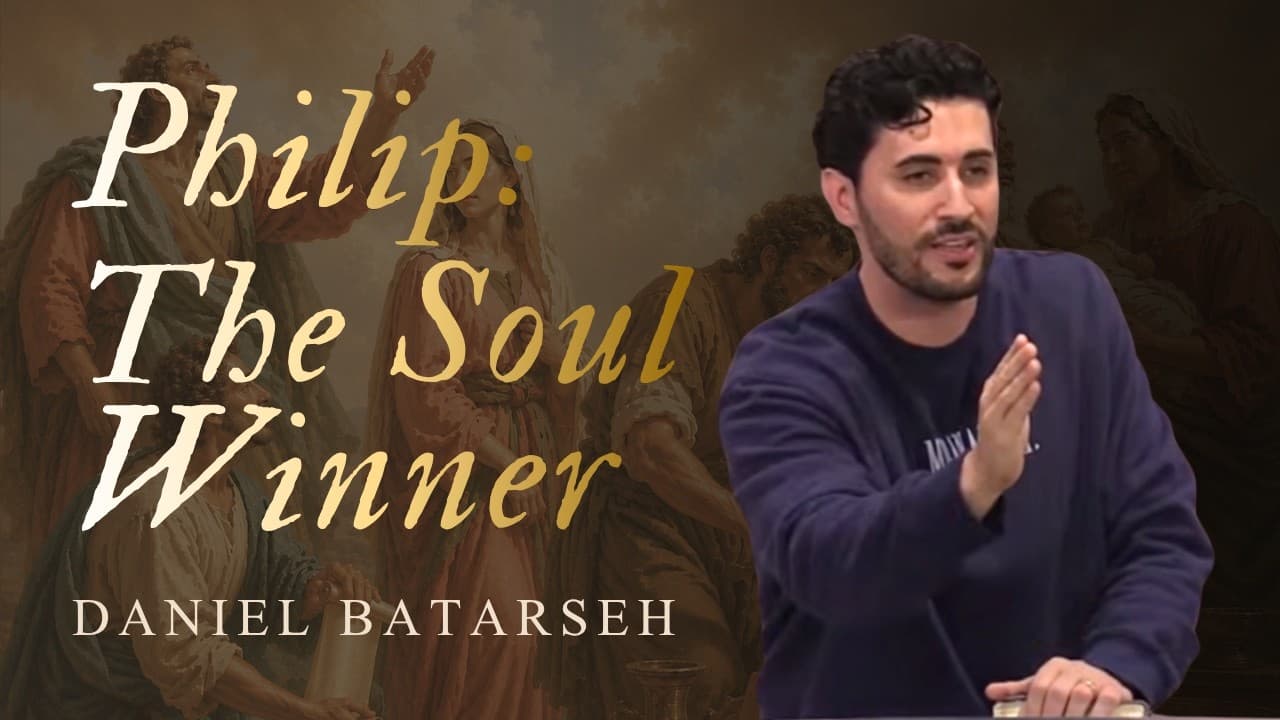
Only one person in the Bible is called 'the evangelist.' Philip's story across Acts 6, 8, and 21 reveals what it actually takes for God to use someone to reach the lost.
There are four different Philips in the New Testament. One is an apostle. Two are political figures tangled up with the Herodian dynasty. But only one receives a title from the Holy Spirit that no other individual in all of Scripture is given: Philip the evangelist (Acts 21:8). Not Philip the preacher. Not Philip the church planter. The evangelist. And what's striking is that when we first meet this Philip, he's not behind a pulpit — he's wearing an apron, running food to widows in Jerusalem. His introduction is as ordinary as it gets. But trace his story through Acts 6, 8, and 21, and you'll discover a blueprint for what it actually takes for God to entrust someone with the work of reaching lost souls — and it starts long before you ever open your mouth.
Before Philip Preached Anything, His Life Was the Message
The church in Jerusalem was enormous. By Acts 4:4, conversions among men alone had reached five thousand. Double that for women, add children, and you're looking at a congregation that dwarfs most megachurches today. And out of those thousands, when the apostles needed seven men of impeccable character to oversee the food distribution for neglected widows, Philip's name kept coming up (watch at 40:24).
Notice what the apostles emphasized in their criteria: "Pick out from among you seven men of good repute, full of the Spirit and of wisdom" (Acts 6:3). Not seven men of great gifting. Not seven dynamic speakers. Conduct. Integrity. Spirit-fullness. And even among thousands of believers, not everyone qualified — "among you" implies that even within the church, not everyone was full of the Spirit, not everyone carried that kind of reputation. Philip did.
This is the foundation most conversations about evangelism skip entirely. We talk about methods, strategies, conversation starters, apologetic arguments. Philip's story says something far more uncomfortable: the most effective soul winners are first and foremost holy. As Pastor Daniel Batarseh put it, "Before Philip preached anything, his message was his life. His life was the message. And many people hurt their message because they think that as long as they say the truth, that's all that's required of them" (watch at 50:37).
There's another lesson buried here. Philip was passionate about evangelism — that much becomes obvious in Acts 8. But in Acts 6, he's not evangelizing. He's serving tables. He's doing the practical, unglamorous work of making sure widows don't go hungry. And he did it faithfully, without complaint, without treating it as beneath his "real" calling. If there was anyone who had an excuse not to know the Bible, it was a man whose assignment was logistics, not teaching. The apostles selected the seven precisely so they themselves could devote time to prayer and the ministry of the word. Philip's job was to support that — not do it.
But Philip didn't use that as a reason for spiritual laziness. He clearly sat at the feet of the apostles. He clearly devoured the Scriptures on his own time. Because when the moment came — and it came suddenly — he was ready.
Why Philip Ran Toward Samaria When Everyone Else Just Ran
The turning point arrives in Acts 8:1. Stephen, the first of the seven listed, Philip's fellow minister and likely his friend, is brutally martyred. Saul of Tarsus emerges with fangs bared — hunting men and women alike, dragging them to prison without discrimination. The believers scatter. And here the sovereignty of God does something breathtaking: the commission Jesus gave in Acts 1:8 — "you will be my witnesses in Jerusalem and in all Judea and Samaria and to the end of the earth" — had stalled. The church was thriving, but exclusively in Jerusalem. Nobody had gone out. So God shook things up. He used Saul's persecution to turn Acts 1:8 into Acts 8:1.
And when the believers scattered, Philip didn't just flee. He chose a direction. He went to Samaria (watch at 45:00).
If you don't know the history, that choice doesn't register. But the animosity between Jews and Samaritans was centuries deep, rooted in the exile, hardened through the era of Ezra, and still raw in the Gospels. The Samaritans were considered half-breeds — Jews who had adopted idolatry. For a man with a Jewish background to voluntarily go to Samaria to preach the Messiah required something beyond strategy. It required a heart that had been broken open by love.
"Paul did not discriminate who he would persecute. Philip did not discriminate who he would seek with the gospel" (watch at 56:35). That parallel hits hard. And the sermon pressed the implication directly: if you carry bitterness, prejudice, or resentment toward any people group — whether because of personal history, ethnic history, or religious background — so much so that you'd have zero interaction with them, "you will never be the soul winner God wants you to be. Never. Never."
Revival broke out in Samaria. Miracles accompanied the message. Demons were cast out. Great joy flooded the region. Philip was continuing the work Jesus himself had started there with the woman at the well. And then, right in the middle of this unprecedented move of God, an angel spoke: Rise and go south, to the road from Jerusalem to Gaza. This is a desert place.
A Crowd or a Chariot — Philip Didn't Get to Choose
Imagine it. You're the preacher at the center of a regional awakening. People are being saved. Miracles are happening. News is spreading. And God wakes you up and says, "Leave. Go to a desert road where no one is."
Philip went. And when the Spirit said, "Go over and join this chariot," Philip didn't walk. He ran (Acts 8:29-30). He ran to a single man sitting alone in a chariot reading a scroll of Isaiah. And he ran from a revival. In the natural, this looks like a demotion — fewer people, no crowd, no platform. But as the sermon made clear: "When you're on the path of obedience, there's no such thing as a demotion."
What follows is a masterclass in personal evangelism. Philip doesn't blast the man with a gospel presentation. He asks a question: "Do you understand what you are reading?" He meets the Ethiopian eunuch where he is. He listens. He assesses what light the man already has. And then, starting from the exact passage the eunuch was reading — Isaiah 53, of all texts — "he told him the good news about Jesus" (Acts 8:35).
Consider what this required. Philip didn't choose the text. The eunuch was reading Isaiah 53 and asked, "About whom does the prophet say this — himself or someone else?" Philip had to be ready. He had to know his Bible well enough to take a text given to him by surprise and trace it to Christ. He could do this because he had spent years immersed in Scripture, even while his official job title was food distribution coordinator.
And notice Philip's singular subject. In Samaria, he "proclaimed to them the Christ" (Acts 8:5). With the eunuch, he "told him the good news about Jesus" (Acts 8:35). Philip had a favorite subject. Not prosperity. Not community. Not self-help psychology dressed in biblical language. Christ. He gave people Christ — his character, his teaching, his power, his salvation, his holiness, his loveliness. And the only way to speak about Christ that effectively is to know Christ intimately.
After the eunuch believed and was baptized, something remarkable happened: "the Spirit of the Lord carried Philip away. And the eunuch saw him no more and went on his way rejoicing" (Acts 8:39). Philip was supernaturally removed from the scene. The eunuch never saw him again. And yet — rejoicing. Why? Because the eunuch had Christ. That was enough. Philip gave the man what he needed and then disappeared. No follow-up Instagram post. No ministry brand. No platform built on the back of a conversion story. Just Christ delivered, and a servant removed.
Twenty Years Later, Still the Evangelist
The final snapshot of Philip comes in Acts 21:8, roughly twenty years after the events of Acts 8. Paul's missionary team passes through Caesarea and stays at Philip's house. Luke, writing under the Spirit's inspiration, identifies him: "Philip the evangelist, who was one of the seven." Two decades have passed. Philip now has four unmarried daughters who prophesy. He's settled. Domesticated. Raising a family.
And the Holy Spirit still calls him the evangelist.
This is the consistency that crowns the whole story. Philip didn't burn bright for a few years and then fade into comfortable obscurity. His heart was still beating the same way it had in Samaria and on the Gaza road. Luke even notes that "some of the disciples from Caesarea" accompanied Paul's team to Jerusalem (Acts 21:16) — and you can't help but wonder how many of those disciples came to faith because Philip, now a father of four, was still telling people about Jesus in his own neighborhood.
But there's a detail in Acts 21 that will stop you cold if you're paying attention. Who is staying in Philip's home? Paul. The same Paul who, as Saul of Tarsus, "approved of the execution" of Stephen — Philip's fellow minister, likely his friend, the first of the seven. The man who killed your friend is now sleeping under your roof, eating breakfast your daughters prepared, having long conversations into the night. For many days (Acts 21:10).
As Pastor Daniel Batarseh said, his voice weighted with the gravity of it: "How? This man killed Stephen. And you're having him over your house, Philip? Yes. Why? Because that's the power of the gospel. That's why. Because the gospel can take a murderer, make him friends with an evangelist because of Christ" (watch at 1:35:24).
If you've ever doubted whether the gospel can change someone — whether that hostile neighbor, that blasphemous coworker, that person whose history makes reconciliation seem impossible — look at Paul eating dinner in Philip's house. That's what this truth can do in a human heart.
What to Remember
- The only person in the Bible called "the evangelist" was first known as a man who served food to widows — effective witness begins with character, not charisma.
- Philip went to Samaria because he loved the people other Jews despised; prejudice and soul-winning cannot coexist in the same heart.
- When God called Philip away from a revival to sit with one man in a chariot, Philip ran — obedience on the path God sets is never a demotion, no matter how small it looks.
- Philip didn't choose his text with the Ethiopian eunuch; he was ready because he had spent years absorbing Scripture even when his job didn't require it.
- Twenty years after his most dramatic ministry moments, the Holy Spirit still called Philip "the evangelist" — faithfulness is not a season, it's a lifestyle.
- Paul sleeping in Philip's home proves the gospel can reconcile a murderer and the friend of his victim — never underestimate what Christ can do in someone's life.
Questions to Sit With
- If the people who know you best were asked to select seven people of impeccable character from your church, would your name come up? What would need to change for it to?
- Is there a people group, nationality, or type of person you instinctively avoid or dismiss — and has that prejudice quietly disqualified you from opportunities God might otherwise give?
- When was the last time you told someone about Christ and walked away with your heart pounding? If you can't remember, what does that reveal about where your joy has gone?
- Philip knew his Bible well enough to explain Isaiah 53 on the spot — if someone handed you an unfamiliar passage and asked "What does this mean?", would you be ready?
- Could you host someone in your home for many days who had deeply wronged someone you loved — and do it with genuine fellowship, not just tolerance?
Scripture Referenced
- Acts 8:4-40 — Philip in Samaria and with the Ethiopian eunuch
- Acts 6:3-7 — Selection of the seven, including Philip
- Acts 21:8-16 — Philip the evangelist in Caesarea, Paul's visit
- Acts 1:8 — The Great Commission: Jerusalem, Judea, Samaria, the ends of the earth
- Acts 4:4 — The Jerusalem church reaches 5,000 men
- Acts 10:1-5 — Cornelius in Caesarea, Peter summoned instead of Philip
- Isaiah 53 — The suffering servant passage the eunuch was reading
- Colossians 3:1-17 — Put off the old self, put on the new
- 1 Peter 5:8-10 — Be sober-minded, resist the devil
This summary was generated by AI from the sermon "Philip: The Soul Winner | Acts 8:4-40 | Pastor Daniel Batarseh | Maranatha Conference 2026 (Sat Mor)" preached by Pastor Daniel Batarseh at Maranatha Bible Church Chicago. Watch the full sermon →
Preached by
Pastor Daniel BatarsehSenior Pastor
This summary was generated by AI from the sermon transcript.
Based on the sermon
Philip: The Soul Winner | Acts 8:4-40 | Pastor Daniel Batarseh | Maranatha Conference 2026 (Sat Mor)
Watch Full SermonRelated Articles
Nehemiah 6:15-19 — What 52 Days of Rebuilding Teaches About Prayer and Fruitfulness
Pastor Daniel Batarseh · September 11, 2026
Nehemiah 6:15-19 — What 52 Days of Rebuilding Teach Us About Prayer and Persistence
Pastor Daniel Batarseh · September 11, 2026

Is the Millennium in Revelation 20 Literal? 5 Reasons
Pastor Daniel Batarseh · September 6, 2026