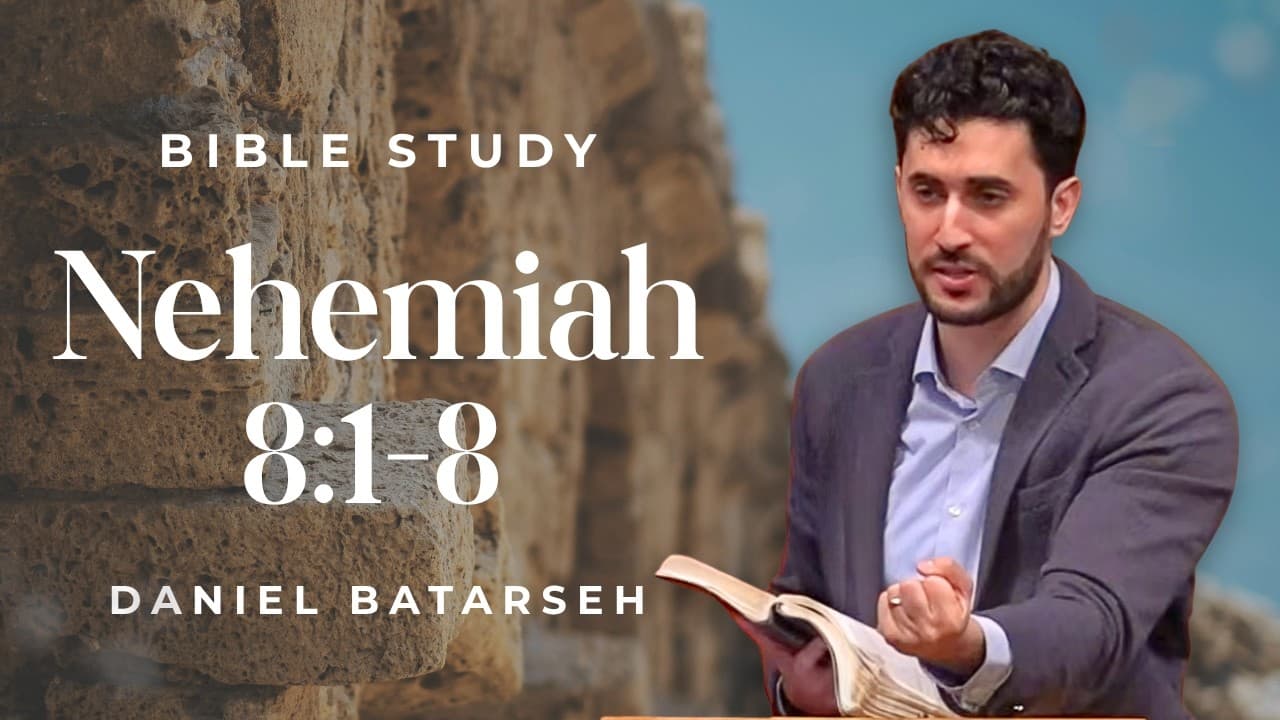
Nehemiah 8 shows us what happens when people stop treating Scripture as familiar content and start approaching it as the living voice of God. Three unmistakable signs follow.
There is a prayer buried in Psalm 119 that most of us never think to pray. It's not a prayer for blessing, not a prayer for protection, not even a prayer for strength. It's this: Give me understanding.
The psalmist repeats it like a drumbeat — verse 99, verse 125, verse 144 — over and over, the same desperate plea. Not "give me more content," not "give me more chapters to check off." Give me understanding that I may live. That single prayer reframes everything we think we know about reading the Bible. And it's the doorway into one of the most extraordinary scenes in the Old Testament: Nehemiah 8:1-6, where Ezra reads the Law of Moses to a people who had been starved of it for generations — and what happens next reveals what a patient, genuine investment in God's Word actually produces in the human heart.
This isn't about reading more. It's about receiving differently.
The Prayer You Forgot to Pray Before Opening Your Bible
Pastor Daniel Batarseh opened this study with a challenge that felt almost too simple: read Psalm 119 in one sitting. Thirty minutes. No commentary, no study notes. Just you and the longest chapter in Scripture. But the simplicity is deceptive. As he explained, "You can't do that without being moved when you see the hunger and the pursuit and the faith that the psalmist has regarding the word of God" (watch at 1:43).
What emerges from that kind of sustained reading is a pattern most of us miss when we dip in and out of the psalm verse by verse. The psalmist isn't just celebrating Scripture — he's begging for something. Give me understanding. It appears again and again like a refrain the writer can't shake. Verse 99: "I have more understanding than all my teachers." Verse 125: "I am your servant. Give me understanding." Verse 144: "Your testimonies are righteous forever. Give me understanding that I may live."
Notice the escalation. Understanding isn't an academic luxury here. It's linked to life itself. The psalmist doesn't say, "Give me understanding so I can teach a Bible study" or "so I can win a theological argument." He says, that I may live. As if to say: without genuine comprehension of what God has spoken, I am not truly living at all.
This is the posture that sets the stage for Nehemiah 8. The people gathered before the Water Gate weren't checking a religious box. They were approaching the voice of God — and they knew it. As the teaching made clear: "You're not approaching black ink on white pages. You are approaching something that God has breathed into. Something he has preserved from generation to generation and had you in mind to open up, to read, to digest, and to be transformed by" (hear this moment).
That distinction — between approaching a text and approaching a voice — changes everything about how we read.
The People Demanded the Word (Not the Priest)
Here's a detail that slips past most readers of Nehemiah 8. When the text says "they told Ezra the scribe to bring the book of the law of Moses," who are the they? It wasn't the Levites organizing a worship service. It wasn't the priests scheduling a liturgical reading. It was the people.
The congregation made the demand.
This is extraordinary. In most religious settings — ancient and modern — the leaders initiate the teaching, and the people show up (or don't). Here, the order is reversed. The people of Judah gathered "as one man" into the square and essentially said: Bring us the Book. They were hungry, and they knew where the food was.
The phrase "as one man" deserves attention too. This wasn't a fragmented crowd with competing agendas. There was a unified, singular hunger driving an entire community to the same place at the same time. When was the last time you saw a group of people that unified about anything — let alone about hearing Scripture read aloud?
What produced this hunger? Context matters. These were people who had just completed the rebuilding of Jerusalem's walls under Nehemiah's leadership. They had labored, fought opposition, and endured exhaustion. Now, with the walls standing, they instinctively understood that physical restoration without spiritual foundation was meaningless. Bricks and mortar don't make a nation. The Word of God does.
And so they didn't wait for an invitation. They issued one.
This challenges a comfortable assumption many of us carry: that spiritual hunger is the pastor's job to create. That if we're not moved by Scripture, it's because the sermon wasn't engaging enough, or the worship set didn't hit right, or the Bible reading plan was too boring. Nehemiah 8 flips that entirely. The people took ownership of their own hunger. They pursued the Word before the Word was offered to them.
Three Things That Happen When You Buy the Truth and Don't Sell It
Verses 5 and 6 of Nehemiah 8 describe the scene after Ezra opens the book. The language is physical, visceral, and deeply revealing. Three responses cascade from the people — and each one tells us something about what a sustained investment in God's Word produces over time.
The framing question is sharp: "What happens if you buy the truth? What happens when you invest in the truth, and you protect the truth, and you don't sell it and you stick with it and you are regularly coming to it?" (watch at 5:50). The language of buying and not selling echoes Proverbs 23:23 — Buy truth, and do not sell it — and it implies that truth costs something. Time. Comfort. The willingness to be changed by what you find.
A Greater Concern for the Glory of God
Ezra opened the book. Then he blessed the Lord, the great God. And the people responded: Amen. Amen. Not one amen — two. The double amen is emphatic. It means so be it, so be it. It's not polite agreement. It's a declaration: we want the Lord to be blessed. We want Him to be pleased. We want Him to take delight in our words and with our lives.
This is what happens when Scripture soaks into a person over time. There's a reorientation. Priorities shift. Ambitions reorganize. Everything begins to orbit around a single gravitational center: the glory of God. Your thinking changes. Your convictions change. Your standards change. And the heartbeat of your life grows stronger in one direction: I want my life to bless the Lord.
You realize why you live. You realize why you were created. You realize what the future holds. And as the congregation often sings, "His glory is my good."
This isn't a truth you arrive at through sheer willpower. You can't just decide to care about God's glory the way you decide to start a new diet. It grows — slowly, steadily — as you expose yourself to what God has said. The Word does the reorienting. You just have to keep showing up.
A Greater Sense of Worship
The text says they lifted up their hands. This is where the teaching handled a tension that many churchgoers feel but rarely voice: the awkwardness of physical worship. Some people feel nervous lifting their hands in a service. It feels vulnerable, conspicuous, maybe even performative.
But the text is clear — it's a biblical posture. And the explanation of it was refreshingly honest: "What we find here is that throughout the scriptures, the lifting of hands signifies different things, but ultimately, it's when God's truth so moves you that you can't contain it, but must express it physically" (watch at 8:25).
The hands lifted are empty hands. Reaching out. Surrendering. Saying: what's happening inside me has outgrown my ability to contain it with just my thoughts. I need my body to join in.
But here's the tension that was named honestly and without flinching: lifted hands don't automatically mean genuine worship. Paul's warning was invoked — lift holy hands. Don't just lift your hands. They have to be holy hands. "This is genuine, this isn't artificial, this isn't a show. This is real" (hear this moment). The caution cuts both ways. Don't be so self-conscious that you never express worship physically. But don't be so performative that your hands are raised while your heart is elsewhere.
The Word of God, received with understanding, produces worship that is both internal and external — heart-deep and body-expressed. If your engagement with Scripture only ever makes your head heavy with information but never makes your heart burn with adoration, something has gone wrong.
A Posture of Reverence
The third response: they bowed their heads and worshiped the Lord with their faces to the ground. Hands up, then faces down. The progression is striking. First, they reached toward heaven. Then they pressed their foreheads into the dirt.
This is the full arc of what the Word produces — exaltation and humility, awe and submission, joy and reverence. It's not one or the other. A faith that only lifts hands but never bows is incomplete. A faith that only bows but never lifts is joyless. The people in Nehemiah 8 did both, because the truth they received demanded both.
The Difference Between Familiarity and Understanding
There's a quiet indictment running beneath this entire passage that's easy to miss. These people had access to the Law of Moses before this moment. They weren't encountering it for the first time in human history. What made this moment different wasn't the content — it was the posture.
The psalmist's prayer — give me understanding — draws a sharp line between familiarity and comprehension. You can be familiar with the content of Scripture and still be untransformed by it. You can know the stories, recite the verses, pass the theology exam, and still have a heart that's cold to the glory of God. Familiarity without understanding is one of the most dangerous places a Christian can live, because it inoculates you against the very truth that could save you.
As the teaching put it plainly: "I don't just wanna be familiar with the content. I wanna know what it means, Lord. Give me understanding" (watch at 2:40).
That prayer — honest, humble, almost childlike — is the difference between the person who reads the Bible and the person the Bible reads.
What to Remember
- The most neglected prayer in the Christian life may be the simplest: "Lord, give me understanding" — not more information, but genuine comprehension that changes how you live.
- The people in Nehemiah 8 didn't wait for a leader to spoon-feed them the Word. They demanded it. Spiritual hunger is your responsibility, not your pastor's.
- A sustained investment in Scripture reorients your entire life around one center: the glory of God. Priorities shift, ambitions reorganize, and you finally understand why you exist.
- Physical worship — lifting hands, bowing faces — is a biblical response to truth that has outgrown your ability to contain it internally. But Paul's warning stands: lift holy hands, not just visible ones.
- Familiarity with Scripture without understanding is one of the most dangerous spiritual conditions. You can know the content and still miss the voice behind it.
- Truth costs something — time, comfort, the willingness to be changed. Buy it. Protect it. Never sell it.
Questions to Sit With
- When was the last time you prayed "give me understanding" before opening your Bible — not out of routine, but because you genuinely felt the gap between knowing the words and grasping what they mean?
- If the people of Nehemiah 8 demanded the Word without being prompted, what does it say about your spiritual hunger that you often have to be convinced to open Scripture?
- Has your familiarity with the Bible actually made you less responsive to it? Are there passages you've read so many times that they no longer move you — and what would it take to hear them again as if for the first time?
- What would change in your daily life if "his glory is my good" moved from a song lyric to an actual operating principle?
- Do you lift your hands in worship? If not, is it because of genuine theological conviction — or just self-consciousness? And if you do, are they holy hands?
Scripture Referenced
This summary was generated by AI from the sermon "Nehemiah 8 (Part 1) Bible Study (Ezra Reads the Law) | Pastor Daniel Batarseh (10/2/26)" preached by Pastor Daniel Batarseh at Maranatha Bible Church Chicago. Watch the full sermon →
Preached by
Pastor Daniel BatarsehSenior Pastor
This summary was generated by AI from the sermon transcript.
Based on the sermon