Revelation 13 ends with the Antichrist conquering the saints. Revelation 14 opens with every single sealed believer standing safe on Mount Zion. Not one lost. That same seal is yours.
The Antichrist will conquer the saints. Revelation 13:7 says it plainly, and it is a terrible thing to read. One man will deceive the nations, bend every government into a global concentration camp, wage war on the people of God — and win. If you closed your Bible at the end of chapter 13, despair would be the only rational response.
But God does not leave his people in chapter 13.
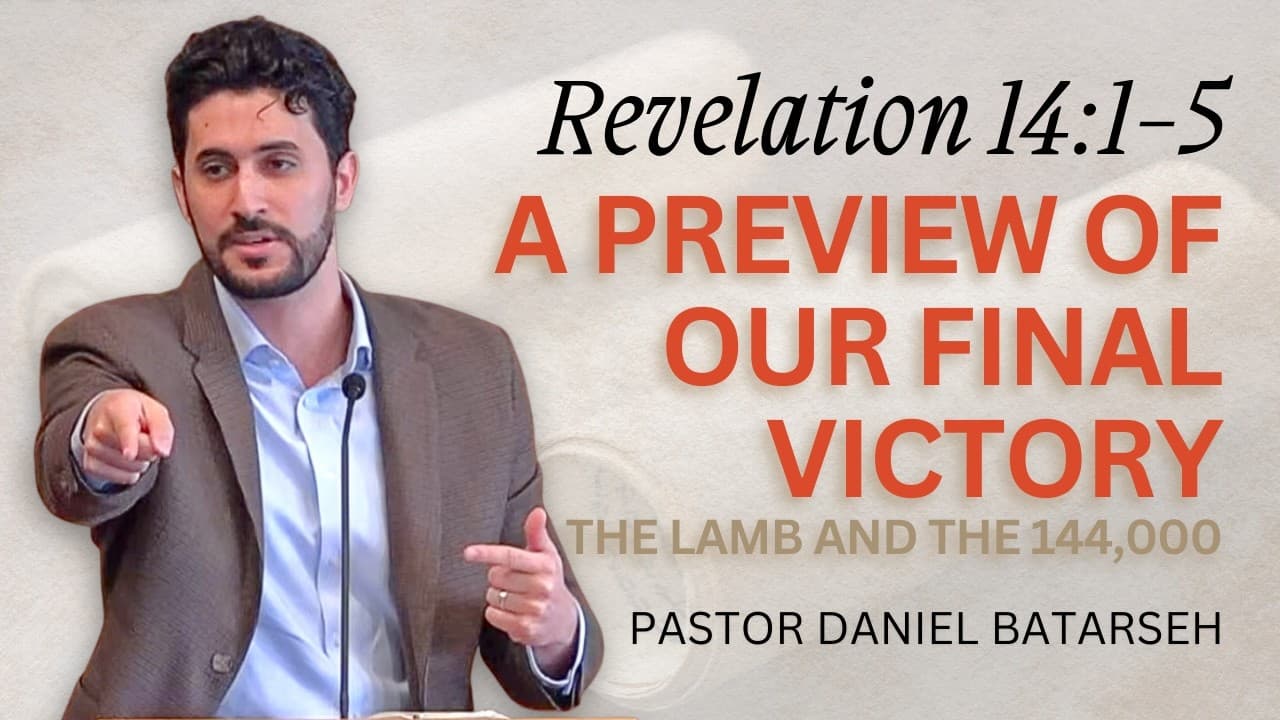
Revelation 14:1-5 rips the curtain forward and shows you how this actually ends. The Lamb stands on Mount Zion. With him: 144,000 sealed believers. Every single one accounted for. Not 139,999. All 144,000. And they are singing a song that no one else in the universe can learn. This is the trailer before the final act. And it changes everything about how you endure the present.
Whomever God Seals, He Secures
The 144,000 first appear in Revelation 7, early in the tribulation. God marks them — 12,000 from each tribe of Israel — with a seal on their foreheads before the worst judgments are unleashed. They are set apart for a specific mission: to bear witness to the nation of Israel and to the world in its darkest hour.
Now fast-forward to chapter 14. The tribulation is finished. The smoke has cleared. And there they stand — every last one of them, with the Lamb on Mount Zion.
As Pastor Daniel Batarseh put it: "It doesn't say that there were 139,999 standing on Mount Zion. A 144,000. You know what that tells me? Whomever God seals, he secures" (watch at 43:37).
And before anyone could retreat into the comfortable notion that this is a one-time privilege for some future elite remnant, the teaching went straight to Ephesians 1:13-14. If you heard the gospel and believed, you were "sealed with the promised Holy Spirit" — and that Spirit is described as a down payment, a guarantee of your inheritance until you take full possession of it. Same verb. Same God. Same security.
Then came John 6:39, where Jesus defined the Father's will for his mission in terms most of us gloss over. We know he came to die for sins — that is the safest answer, and the most glorious. But listen to what he actually said: "This is the will of him who sent me, that I should lose nothing of all that he has given me, but raise it up on the last day" (hear this moment). Christ did not merely come to rescue you. He came to keep you. He has your name in mind at this moment, and he will have it in mind at the last moment when all things are made new. He will not overlook a single one.
This is not sentimental optimism. This is the logic of the seal. If God sealed you, the question of whether you will arrive safely is already answered.
Your Suffering Will Become Your Song
Something strikes you about verse 3 the moment you slow down enough to feel it: "No one could learn that song except the 144,000 who had been redeemed from the earth." At first glance, it stings. Why the restriction? Why can't everyone join?
The answer, once you see it, is one of the most beautiful truths in the entire book. This is not exclusion for the sake of elitism. It is the song of lived experience. These are people who were sealed by God, hunted by the Antichrist, surrounded by a world gone utterly mad — and they survived every bit of it. The song they sing is forged from what they walked through. No one else can learn the lyrics because no one else lived the story.
And then came the moment in the sermon that pressed every heavy heart in the room into the arms of God:
"All the pain, all the suffering, all the anguish, all the loss, all the betrayal, all the doubt, all the fear, all the loss that you and I encounter in this life, especially those that we believe to be uniquely ours, like nobody else is going through what I'm going through — you know what I get from this verse? All of that will one day become something you sing about" (watch at 54:39).
The Bible teaches two kinds of singing in suffering. There is the Acts 16 kind — Paul and Silas shackled in a Philippian jail, singing hymns at midnight while their backs are still raw. Songs during the storm. But Scripture also teaches that there is a melody that waits on the other side. A song with lyrics and a tune that only make sense after you have walked through the fire and discovered that God did not let go.
The 144,000 had both. And so will you.
If you are heavy today — if the thread you are hanging by feels thinner than it has ever been — know this: you are not writing the final verse yet. The closing chorus is coming. And it will be uniquely yours, because no one else walked your particular road through the darkness.
Mount Zion Is Not Heaven — and That Changes the Prophecy
There is a real interpretive debate here that matters. Some scholars connect Mount Zion in this passage with Hebrews 12:22, where the term refers to the heavenly realm, and conclude that John is seeing a scene in heaven. But two details in the text push back hard against that reading.
First, if the 144,000 are in heaven, that means they died — which would undermine the entire point of the seal they received in chapter 7. God sealed them to protect them through the tribulation, not to let them perish and meet them later. Second, verse 2 says John "heard a voice from heaven," which places him below, on the earth, hearing something from above. He is not in heaven. He is watching from the ground.
So Mount Zion here is the physical mountain in Jerusalem. And this is where the Old Testament prophets become essential. Psalms 2:6: "As for me, I have set my king on Zion, my holy hill." Isaiah 24:23: "The Lord of hosts reigns on Mount Zion and in Jerusalem, and his glory will be before his elders." Micah 4:7: "The Lord will reign over them in Mount Zion from this time forth and forevermore" (watch at 49:02).
John is not inventing something new. He is showing the fulfillment of centuries of prophecy. The Lamb will stand on the same mountain the prophets pointed to. The Antichrist's empire, for all its global reach, has an expiration date — forty-two months — and then the true King descends.
This also reframes the conflict over Jerusalem that fills our headlines. The tension over that contested strip of real estate is not merely political. "We're spiritual people and the Bible tells us that there is good and evil, the kingdom of darkness and the kingdom of light. There's a spiritual battle going on... Jesus Christ, the risen savior, has his eyes on Jerusalem because he's gonna rule from there whether you like it or not" (watch at 49:55). That sentence is not diplomatic. It is biblical.
Three Marks of Those Who Overcome — Before the Victory Arrives
John does something unexpected before moving on. He pauses the prophetic narrative to describe the character of the 144,000. Three times: "It is these... It is these... It is these." He wants you to know that their triumph on Mount Zion was not disconnected from how they lived during the worst years of human history. There was a thread of victory woven through their suffering. And here is why that matters right now: the spirit of the Antichrist is not a future phenomenon. It has been operating since the days of Christ — manipulating, perverting, infiltrating. The tribulation is the climax when that spirit takes flesh. But its influence is already here.
So these three marks are not just a resume of future saints. They are a blueprint for present faithfulness.
Their sexual purity. Verse 4: "It is these who have not defiled themselves with women, for they are virgins." Revelation 9:21 reminds us that even amid global catastrophe, humanity will not stop sinning — murders, sorcery, sexual immorality, theft. New levels of indecency will be promoted and practiced. But the 144,000 remained undefiled.
1 Corinthians 7:26 provides crucial context. Paul told the Corinthians not to seek marriage "in view of the present distress" — not because marriage is lesser, but because intense persecution made the timing unwise. Matthew 24:19 echoes the same for the tribulation: "Alas for women who are pregnant and for those who are nursing infants in those days." The 144,000 understood their moment and ordered their lives accordingly.
The argument is devastating in its simplicity: if they could remain pure in the most corrupt era of human history, can we not remain pure today? Are they less human than you? They had a seal — but are you not sealed? The Bible does not present purity as a wistful ideal we admire from a distance. It presents it as possible. Here is the proof.
Their unreserved devotion. "It is these who follow the Lamb wherever he goes." While the entire world chases the Antichrist, this group walks in the opposite direction. No nation to flee to. No government sympathetic. Every system hostile. And still, wherever the Lamb leads, they follow. The title "Lamb" is not incidental here — it signals humility, sacrifice, innocence. They are not following a military conqueror. They are imitating a suffering servant.
Pastor Daniel Batarseh turned this into a prayer: "Lord, I would love for it to be said of me that he followed the Lamb wherever he goes. So counter-cultural that everybody's being swept up with this trend and they're believing these ideas and they're falling for this frenzy — but that man, he has the Lamb before him at all times" (hear this moment).
Their blameless testimony. Verse 5: "In their mouth no lie was found, for they are blameless." In an empire built on deception, there will be a group of truth-tellers who refuse to bend the gospel to survive. They will sit across from people justifying sin and say — with love, but without flinching — this is what God's word says. "I have nothing to apologize for with the truth. I want to be faithful when I sit across a coffee table with a friend who's justifying sin and to say with love in my eyes, but this is what God's word says" (watch at 1:11:16).
The Lamb, Three Times Over
It is not accidental that Christ is called "the Lamb" three times in these five verses. Not King. Not Judge. Not Conqueror. The Lamb. The one who was led to sacrifice in innocence, who chose weakness and won through suffering.
Every virtue the 144,000 displayed — purity, devotion, honesty — flows from the Lamb's sacrifice. You do not manufacture these qualities through gritted teeth and iron willpower. You draw them from the love of the one who became a man, laid his life down, and promised to hold you until the end.
The communion table the church shared after this sermon was a fitting close: broken bread and poured-out wine, the simplest elements reminding a room full of imperfect people that the Lamb who sealed 144,000 through the tribulation is the same Lamb who seals you through yours. He loved you enough to die for you. He loves you enough to keep you until the end.
The Antichrist gets forty-two months. Christ gets eternity. And every sealed, secured, Spirit-indwelt believer gets to share it with him.
What to Remember
- God's seal is God's guarantee — the 144,000 were sealed in chapter 7 and not one was missing in chapter 14. The same Holy Spirit seals every believer today.
- Your deepest suffering is not wasted — it is raw material for a song that only you will be able to sing on the other side of sorrow.
- Mount Zion in Revelation 14 is physical Jerusalem, consistent with Psalms, Isaiah, and Micah, pointing to Christ's literal reign on earth.
- The spirit of the Antichrist is already operating — sexual purity, unreserved devotion, and truthful testimony are not future ideals but present obligations.
- Christ is called "the Lamb" three times in five verses because victory flows from sacrifice, not force. Draw your strength from what he has done, not from your own resolve.
- The Antichrist's empire expires after forty-two months. The Lamb's reign is forevermore.
Questions to Sit With
- If God preserved every one of the 144,000 through the worst period in human history, what does that say about his ability to preserve you through what you are facing right now?
- What is the suffering you carry that feels so singular, so impossible to explain to another person — and can you begin to believe it will one day become something you sing about?
- Of the three marks — sexual purity, unreserved devotion, blameless testimony — which one costs you the most to maintain in your current circumstances, and what would it look like to stop negotiating with yourself about it?
- When you sit across from someone justifying sin, do you speak truth with love — or do you avoid the discomfort altogether?
- If someone summarized your life the way John summarized the 144,000 — "it is these who..." — what three phrases would follow your name?
Scripture Referenced
- Revelation 14:1-5
- Revelation 7:2-3
- Revelation 9:21
- Revelation 13:5, 7
- Exodus 35:4-20
- Acts 8:26-31
- Ephesians 1:13-14
- John 6:39
- Hebrews 12:22
- Psalm 2:6
- Isaiah 24:21-23
- Micah 4:6-7
- 1 Corinthians 7:26-27
- Matthew 24:19
- Romans 11
- Leviticus 2:11-12
- 1 Corinthians 5:6-13
This article is drawn from the sermon "A Preview of Our Final Victory | Revelation 14:1-5 | Pastor Daniel Batarseh (3/1/26)" by Pastor Daniel Batarseh at Maranatha Bible Church Chicago. Watch the full sermon →
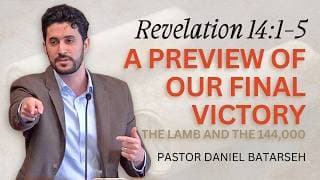
Based on the sermon