Three angels race through the sky with three messages for a doomed world: fear God, Babylon is falling, and hell is real. What their testimony reveals about the gospel we preach today.
The first angel in Revelation 14 is given what the text calls "an eternal gospel" to proclaim to every nation on earth. You'd expect the content to sound familiar — believe on the Lord Jesus Christ, confess with your mouth, there is no other name. But the angel doesn't say any of that. His message is blunt and strange to modern ears: Fear God. Give him glory. Worship him who made heaven and earth. That's the eternal gospel? Apparently so. And if that makes you uncomfortable, this passage has already begun its work on you.
What follows in Revelation 14:6–11 is a sequence of three angelic proclamations — each building on the last — that together form one of the most concentrated warnings in all of Scripture. The first announces the gospel. The second announces the fall of the world system. The third announces hell. And sandwiched between the horror of eternal torment and the collapse of everything humanity has built, there stands the Lamb — not the Lion, not the Judge, but the Lamb. That detail alone is worth the price of admission.
The Eternal Gospel Doesn't Start Where You Think It Does
When the first angel flies "directly overhead" in verse 6, he carries a message described as the eternal gospel. Not a new gospel. Not a revised one. The Spirit of God is precise here — this is the same gospel prepared from eternity past, prophesied by the prophets, spread by the apostles, and still saving souls in our own day. The word "eternal" locks it in place. No alternative interpretation. No updated version for a more enlightened generation.
But the content of the angel's proclamation forces us to reckon with something: fearing God is not a relic of the Old Testament. It is the appropriate response to the gospel itself.
As Pastor Daniel Batarseh put it: "If someone professes Christ but lacks reverence, is void of seriousness, does not even have a hint of majesty in their worship or in how they relate to the Lord, I question if they've really tasted the gospel" (watch at 53:20).
That's a confrontational statement. It's also biblically airtight. Consider Psalm 33:8: "Let all the earth fear the Lord; let all the inhabitants of the world stand in awe of him." Hebrew parallelism clarifies the meaning — fearing the Lord is standing in awe of him. Not cowering. Not slavish dread. Awe. The kind that makes your mouth close and your knees weak because you've glimpsed something infinitely greater than yourself.
And this isn't confined to the Old Testament. 1 Peter 1:17–19 places the command to "conduct yourselves with fear" directly between two of the most glorious gospel realities in the New Testament: calling God as Father (v. 17) and being ransomed by the precious blood of Christ (v. 19). Fear is not the opposite of grace. It's the fruit of understanding it.
Now consider why the angel leads with this particular emphasis. The world at this point in the tribulation is not struggling with legalism or self-righteousness. The problem is idolatry — misdirected adoration. The Antichrist is ruling, the masses are worshiping him, and the angel's message cuts through the fog: You're standing in awe of the wrong person. Fear God. Not this man. Not this system. The one who made heaven and earth and the sea and the springs of water — worship him.
Proverbs 23:17 adds a practical edge: "Let not your heart envy sinners, but continue in the fear of the Lord all the day." Not just on Sunday afternoon. Not just during worship when the music swells. All the day — in your car, at your desk, on vacation. The sermon pressed the example of Joseph, alone with Potiphar's wife, with no human witness in sight. "How can I do this great evil against God?" That's a man who feared God all the day. That awareness of God's presence was his shield when every circumstance invited compromise.
The application is direct: if you and I fear God all the day, it becomes much harder to sin throughout the day. Coat your mind with Scripture. Pray without ceasing. Include God in your plans, your worries, your idle moments. Let him occupy the forefront of your thinking. This is what the eternal gospel produces in those who truly receive it.
Babylon Falls — And So Does Everything You're Clinging To
The second angel arrives with a declaration that sounds like a premature obituary: "Fallen, fallen is Babylon the great" (v. 8). But Babylon doesn't actually fall until Revelation 17–18. So why speak of it in the past tense?
Because the doom is so certain it can be announced as accomplished fact.
Babylon in Scripture is more than a historical city. It is a symbol — a shorthand for every worldly system that opposes God, promotes idolatry, and consolidates power apart from divine authority. You see it in Genesis 11 with the Tower of Babel: "Come, let us make a name for ourselves." You see it in Daniel with Nebuchadnezzar's golden statue — his defiant declaration that Babylon would reign forever, head to toe, no succession of kingdoms. Both times, God humbled the system. Babel was scattered. Nebuchadnezzar ate grass like an animal.
Now in Revelation, Babylon makes its final comeback. And for the first time in history, it achieves what it has always craved: global dominance. The Antichrist's empire — its commerce, its military, its infrastructure — will be so impressive that the nations will ask, "Who is like the beast, and who can fight against it?" (Revelation 13:4). It will appear indestructible.
And then an angel screams through the sky: It's already over.
The relevance for us today is not subtle. The same John who recorded this angel's message wrote to believers in 1 John 2:17: "The world is passing away along with its desires, but whoever does the will of God abides forever." As the sermon framed it: "You and I are just walking through the corridor. There is a door that's going to lead us into eternal life, which is true life. Don't camp in the corridor" (hear this moment).
Those things you think will bring fulfillment — the bank account, the career, the house, the reputation — they have an expiration date. They were never designed to last. The angel's message to a future generation under the spell of an invincible empire is the same message we need while scrolling through curated lives and accumulating things that moths and rust will devour: This is all coming down. The only question is whether you've invested in what remains when it does.
The Lamb Supervises Hell
The third angel's message is the one that makes people squirm. And it should. Verses 9–11 describe the fate of those who worship the beast and receive his mark: they will "drink the wine of God's wrath, poured full strength into the cup of his anger" and be "tormented with fire and sulfur." The smoke of their torment rises "forever and ever," and they have "no rest, day or night."
Is hell eternal? According to this text, yes. Is it conscious? Yes. Is it uninterrupted? The passage leaves no room for ambiguity.
But here is where the sermon made the room go quiet. Look at who is present in this scene of judgment: "He will be tormented with fire and sulfur in the presence of the holy angels and in the presence of the Lamb" (v. 10). Not the King. Not the Lion. Not the Judge. The Lamb.
The Lamb — the symbol of Christ's substitutionary sacrifice, his humility, his willful surrender for our salvation. What is that title doing in a passage about eternal wrath?
"Even the Lamb supervises hell," the sermon observed (watch at 54:28). And the reason is devastating in its logic: hell is ultimately for those who rejected the One who drank the cup of God's wrath on their behalf.
Notice the imagery. The condemned drink "the wine of God's wrath, poured full strength" — undiluted, no mercy mixed in. A cup of judgment. And in Luke 22:42, Jesus prayed in Gethsemane: "Father, if you are willing, remove this cup from me." That cup held the same wrath — the full fury of God's justice against every sin ever committed. The Father's will was for Christ to drink it. And he drank every drop. As the sermon put it: "You turn that cup over and there is not one drop that will come out. He absorbed all of God's justice for our sin" (hear this moment).
Here is the gospel in its starkest terms: Jesus drank your cup. If you reject that, there is another cup reserved for you — and it will never run dry.
A story from the sermon sharpened this further. Years ago, after preaching at a conference, someone approached with a long list of objections about hell. They weren't a Christian. They were living in open sin. After extended conversation, the person finally said: "Why can't God just leave us alone? I just want to live my life." And there it was — the real issue laid bare. People don't want God. And in the endless debates about the fairness of hell, one thing is almost never discussed: what the Son of God had to endure to rescue us from it. "Nobody ever talks about the suffering Christ had to endure," the sermon pressed. "Things so deep, things so profound that we dare tread even exploring what happened on that cross for those hours" (watch at 1:32:46).
If you struggle with the concept of hell, the sermon's counsel was pointed: take your eyes off yourself for a moment and plant them on Calvary. Ask what Christ suffered and why. You will come to different conclusions.
The Three Messages Are One Message
Step back and see the architecture. The first angel says: Fear God — the gospel demands it. The second says: The world is falling — don't cling to it. The third says: Hell is real — and the Lamb you rejected will be there when you arrive. Each message escalates. Each builds on the one before. Together, they form a single, urgent plea: Come to your senses before it's too late.
And notice what immediately follows in verse 12: "Here is a call for the endurance of the saints, those who keep the commandments of God and their faith in Jesus." The passage about hell is not only a warning to the lost — it is fuel for the persecuted believer. Your suffering is temporary. Theirs is eternal. Compare everything in light of eternity, and the calculus of faithfulness changes completely.
These three angelic messages belong to a future era — the great tribulation, the final three and a half years before Christ returns. But they echo truths that are thundering now. The gospel still demands reverence. The world is still passing away. Hell is still real. And the Lamb is still willing to drink the cup you cannot survive.
What to Remember
- Fearing God is not an Old Testament relic — it is the New Testament's expected response to the gospel, placed between calling God "Father" and being ransomed by Christ's blood (1 Peter 1:17–19).
- The angel's gospel presentation targets idolatry, not legalism — because the greatest spiritual danger is not rule-keeping but misdirected worship.
- Babylon represents every human system that consolidates power apart from God — and its doom is so certain that Scripture speaks of it in the past tense before it happens.
- The Lamb's presence in the passage about hell is not accidental — it is a reminder that eternal judgment falls on those who rejected the One who already bore their wrath.
- Christ did not endure a few hours of inconvenience on the cross — he absorbed the full, undiluted fury of God's justice against sin, and dismissing that suffering is its own form of blasphemy.
- Meditating on eternity is not morbid — it is the biblical strategy for endurance in a world designed to distract you from what lasts.
Questions to Sit With
- If fearing God "all the day" (Proverbs 23:17) is the mark of someone who truly knows the gospel, what does your average Tuesday reveal about how deeply the gospel has penetrated your life?
- What is your personal "Babylon" — the system, achievement, or comfort that feels too permanent to ever fall?
- When you think about hell, do you spend more time defending God's fairness or contemplating what Christ endured to save you from it?
- The angel's gospel message was calibrated to the specific sin of the audience — idolatry, not shame, not legalism. If an angel were sent to your city today, what sin would the message target?
- What would change in your daily decisions if you genuinely believed that everything you can see and touch has an expiration date?
Scripture Referenced
- Revelation 14:6-11 (primary passage)
- Revelation 14:12
- Revelation 13:4, 10
- Psalm 92:1-15
- Psalm 33:8
- Proverbs 23:17
- 1 Peter 1:17-19
- 1 Peter 5:13
- 1 John 2:17
- Matthew 24:14
- Luke 2:13
- Luke 22:42
- John 14:18-21
- Acts 14:16-17
- Genesis 11
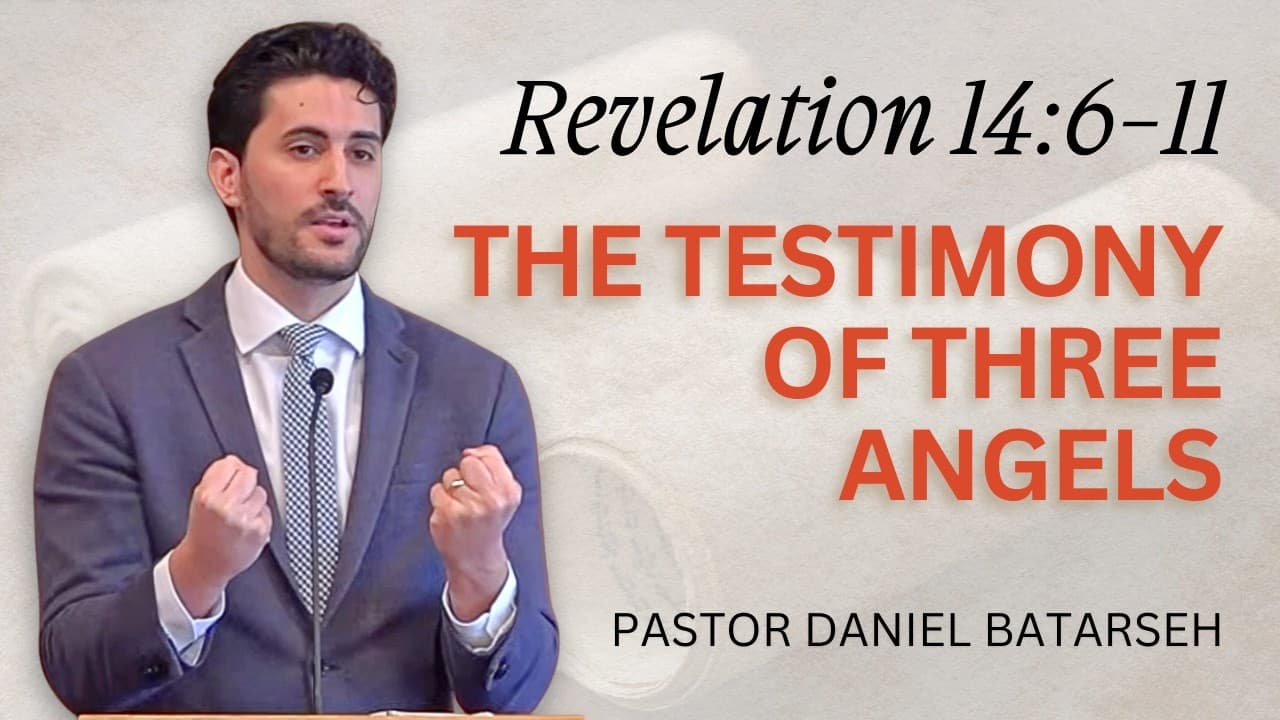
This article is drawn from the sermon "The Testimony of Three Angels | Revelation 14:6-11 | Pastor Daniel Batarseh (3/8/26)" by Pastor Daniel Batarseh at Maranatha Bible Church Chicago. Watch the full sermon →
Based on the sermon