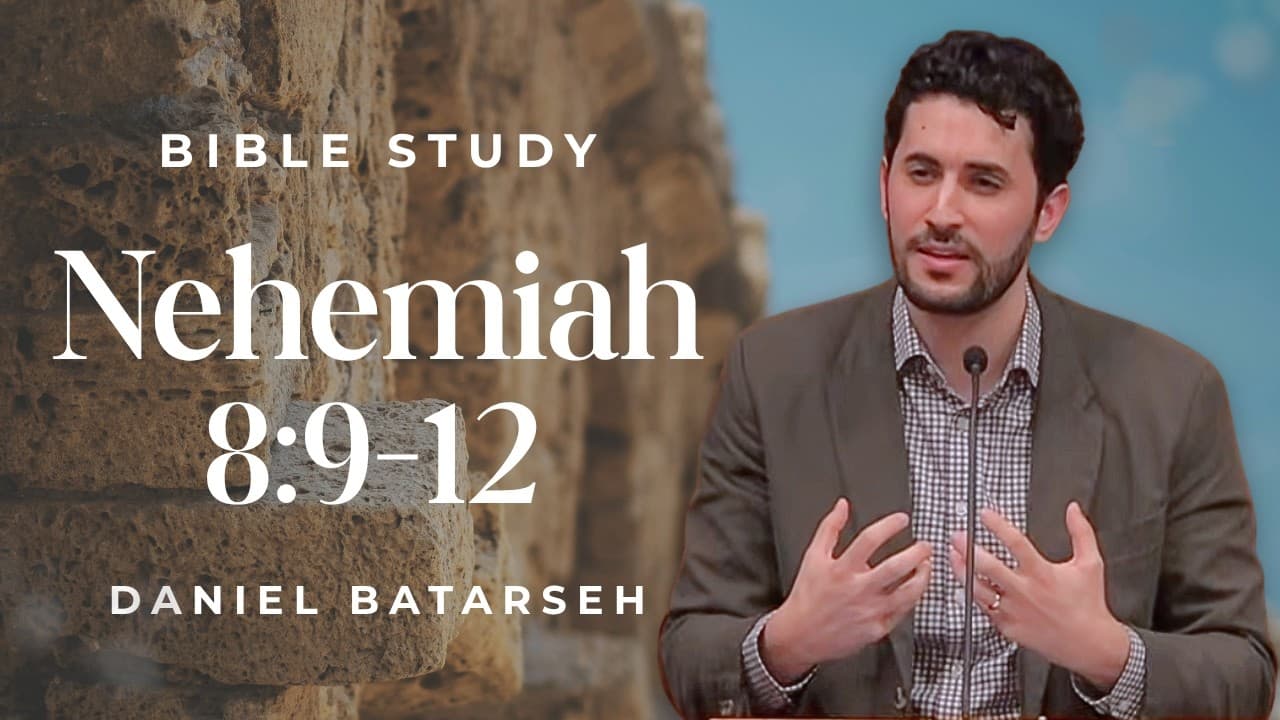
Nehemiah 8 doesn't just tell us to read God's Word — it shows us that Scripture can actually govern our emotions. And that's better news than you think.
Can God really command what you feel?
It sounds like an overreach. Emotions feel involuntary — they rise before we choose them, they flood in before we can think. And yet Nehemiah 8:9–12 records one of the most striking scenes in all of Scripture: an entire assembly of people weeping under the weight of God's Word, and their leaders telling them — three times — to stop. Not because their grief was wrong, but because the truth about this day was bigger than their feelings. "This day is holy to the Lord your God. Do not mourn or weep." And the people obeyed. They dried their eyes, they ate, they drank, and they sent portions to the poor. What happened here is not emotional suppression. It's something far more powerful and far more needed: the Word of God putting a harness on the human heart.
The Bible Doesn't Just Inform Your Mind — It Trains Your Emotions
We are comfortable with the idea that Scripture teaches us what to think. We are less comfortable with the idea that it teaches us what to feel. But the text won't let us off the hook. In four short verses, the command is hammered home with unmistakable repetition: "Do not mourn or weep" (v. 9). "Do not be grieved" (v. 10). "Do not be grieved" (v. 11). Each time, the reason is the same: this day is holy.
The people's sorrow was genuine. They had just heard the Law of God read aloud — perhaps for the first time in their lives with real understanding — and the gap between what God required and how they had lived hit them like a wall. Tears were streaming. This was raw, unscripted, revival-level conviction. And the leaders didn't dismiss it. They honored it. But then they redirected it, because God had already prescribed how this day — the Feast of Trumpets — was to be observed, and prolonged mourning was not part of the prescription.
Here is the tension that makes this passage so relevant: the grief was real, but the truth was higher. As Pastor Daniel Batarseh put it, "The people had to choose not to allow their grief to dictate how the Lord prescribed them to worship Him on this particular day. And remarkably, the people listened to a standard that was greater" (watch at 16:50).
This is not the cold logic of someone who doesn't understand pain. This is the liberating reality that you do not have to be a slave to whatever you happen to feel in a given moment. Think about how many decisions you've justified with the phrase, "I just felt like..." Think about how many destructive patterns you've excused because the emotion felt too strong to resist. Nehemiah 8 stands as a witness: the Scriptures are so authoritative, so persuasive, that when they are rightly believed, rightly applied, and rightly understood, they can actually govern the way you feel — not by crushing your emotions, but by sanctifying them.
"Distance yourself from this book and you'll find yourself more and more submitting to your emotions instead of the truth. But the closer you are to God through his word, the more you'll be able to realize this wonderful restraint — and not just a restraint, a sanctification of your feelings and mine, where we grieve about the right things and we rejoice over the right things" (hear this moment).
That distinction matters. Sanctification of feelings is not the same as suppression of feelings. Maturity is not numbness. It's grieving about the right things and rejoicing over the right things — and knowing the difference because you've spent enough time in the Word to recognize which is which.
"I Told Myself I Was Going to Pick Up Jesus"
The teaching took a deeply personal turn with a story that, once heard, is not easily forgotten.
Pastor Daniel Batarseh recalled a conversation with his father from years ago. When his dad was young in the faith, he had no formal ministry, no platform, no title. What he did have was a car — barely enough gas money to fill it — and a brother in Christ who needed a ride to church. So he drove. Far. Frequently. Regularly. Week after week, spending money he didn't have to bring someone to a place where they could grow in Christ.
What kept him going? "He looked at me and says, you know what motivated me to do it when I didn't really have much in my own possessions? He said, I told myself I was going to pick up Jesus. That changed everything" (watch at 25:03).
That single reframe — I'm going to pick up Jesus — is an insight into what Deuteronomy 28:47 is actually after. That verse doesn't merely say Israel failed to serve God. It says they failed to serve God with joyfulness and gladness of heart. The indictment isn't about the absence of service. It's about the absence of joy in the service. And that distinction, according to God himself, was the reason for their departure from him.
Let that land. God didn't say, "You stopped serving me." He said, "You served me without joy." The action was present. The heart was absent. And that was enough to unravel everything.
This is why joy is not a luxury in the Christian life — it is structural. It is load-bearing. You cannot survive in ministry, in marriage, in parenting, in any sustained act of faithfulness without it. Duty alone will carry you for a season. Guilt will carry you for less. But joy? Joy is the fuel that outlasts every circumstance, because its source is not in the circumstance but in the God behind it.
The application is devastatingly simple: include God in what you're doing for God. Make it personal. See him in the errand, in the sacrifice, in the inconvenience. His father didn't just drive a car — he drove toward Jesus. And that made the empty gas tank irrelevant.
Holy Days Demand Generosity, Not Just Celebration
There's a detail in verse 10 that would be easy to skim past: "Send portions to anyone who has nothing ready." In the middle of commands to eat the fat and drink sweet wine — to celebrate lavishly — Nehemiah inserts an obligation toward the poor. And this is not Nehemiah freelancing. He grounds it in the same refrain: "for this day is holy to our Lord."
The Old Testament feasts were never meant to be private celebrations for the comfortable. Woven into the very fabric of Israel's worship calendar was a relentless concern for those on the margins. Deuteronomy 15:7–8 commanded open hands toward the poor brother. Leviticus 23:22, tucked between the Feast of Weeks and the Feast of Trumpets — the very feast being observed in Nehemiah 8 — instructed farmers not to harvest their fields to the edge but to leave the gleanings for the poor and the sojourner. And in Deuteronomy 16, when the Lord elaborates on the pilgrimage feasts, he specifically names the fatherless, the widows, and the sojourners as those who must be included (watch at 15:16).
The pattern is unmistakable: every time God calls his people to feast, he simultaneously calls them to share. Worship and generosity are not two separate categories. They are one act. You cannot claim to celebrate God's faithfulness while ignoring the neighbor who has nothing ready. The holiness of the day demands the generosity, not merely suggests it.
This challenges the way many of us approach worship. We come to receive — to be fed, encouraged, strengthened — and those are good instincts. But the biblical model insists that true celebration overflows outward. The fat and the sweet wine are not just for you. They are for the one who has nothing. And if your worship doesn't eventually reach someone who can't reciprocate, something essential is missing.
Nehemiah understood this because he was a leader who consistently noticed the least fortunate. But more than personal sensitivity, he was simply reading what God had already said. The Law itself — the very scroll Ezra had been reading aloud that morning — made provision for the poor inseparable from the act of worship. Nehemiah wasn't adding a social justice agenda to a religious event. He was being faithful to a text that had always held the two together.
The Joy of the Lord Is a Stronghold, Not a Suggestion
The final phrase of verse 10 — "for the joy of the Lord is your strength" — is one of the most quoted lines in all of Scripture. It decorates coffee mugs and wall art. But in context, it is not a greeting card sentiment. It is a battle cry spoken to a weeping nation.
These people were devastated. They had just encountered the holiness of God through his Word and it exposed everything. And into that devastation, the leaders spoke not comfort in the therapeutic sense but truth in the most urgent sense: the joy that comes from the Lord — not from your circumstances, not from your performance, not from your emotional state — is your stronghold. Your fortress. The thing that holds when everything else gives way.
This is why the command to stop grieving was not cruel. It was strategic. Prolonged sorrow over sin, when God has declared a day of celebration, is not deeper spirituality — it is disobedience dressed in humility. The same Word that convicted them of sin also prescribed joy for this day. You don't get to obey the conviction and ignore the celebration. Both come from the same book.
And this is the great hope for the person who says, "I can't help it. I'm just an emotional person." That may be true. But do you believe Jesus can sanctify that part of who you are? The means are right here — in the Word, read with hunger, heard with humility, rehearsed with patience. The more Scripture shapes your thinking, the more it will shape your feeling. Not overnight. Not perfectly. But progressively, incrementally, in a direction that looks more and more like the heart of Christ — grieving what he grieves, rejoicing in what he rejoices in, and holding steady when the waves come.
As the teaching closed, the prayer was simple and fierce: "May we nurture that joy. May we strengthen that joy. May we protect that joy. May we always believe that this joy in you, of you, is greater than anything else that this world has to offer" (hear this moment).
Joy is not the absence of sorrow. It is the presence of God in the sorrow, declaring a truth your feelings haven't caught up to yet — and giving you the grace to believe it anyway.
What to Remember
- Your emotions are real, but they are not supreme — God's Word has the authority to redirect what you feel, not by suppressing it, but by sanctifying it.
- The indictment of Deuteronomy 28:47 is not that Israel stopped serving God, but that they served him without joy — making joy a structural necessity, not a spiritual bonus.
- Every Old Testament feast included explicit provision for the poor, the fatherless, and the sojourner — worship that doesn't overflow into generosity is incomplete worship.
- Prolonged grief over sin on a day God has declared holy is not deeper spirituality; it is disobedience wearing the mask of humility.
- The joy of the Lord is not a feeling you manufacture — it is a stronghold you inhabit by including God himself in every act of service, even the smallest errand.
- Spiritual maturity is proven not when your emotions disappear, but when they are progressively trained by God's revelation to grieve the right things and celebrate the right things.
Questions to Sit With
- When was the last time you justified a sinful response — anger, despair, bitterness — by saying "I just couldn't help it"? What would it look like to bring that specific emotion under the authority of Scripture?
- If God's indictment of Israel was not that they stopped serving but that they served without joy, how would he evaluate your current service to him?
- Who in your life "has nothing ready" — and what would it cost you to send them a portion this week?
- Are there areas where your grief over past sin has actually become an excuse to avoid the celebration God is calling you into right now?
- What would change in your most mundane act of obedience if you told yourself, like that father with an empty gas tank, "I'm going to pick up Jesus"?
Scripture Referenced
- Nehemiah 8:9–12 (primary text)
- Deuteronomy 28:47
- Deuteronomy 15:7–8
- Leviticus 23:22
- Deuteronomy 16
- Matthew 10
This summary was generated by AI from the sermon "Nehemiah 8 (Part 2) Bible Study (This Day Is Holy) | Pastor Daniel Batarseh (10/9/26)" preached by Pastor Daniel Batarseh at Maranatha Bible Church Chicago. Watch the full sermon →
Preached by
Pastor Daniel BatarsehSenior Pastor
This summary was generated by AI from the sermon transcript.
Based on the sermon