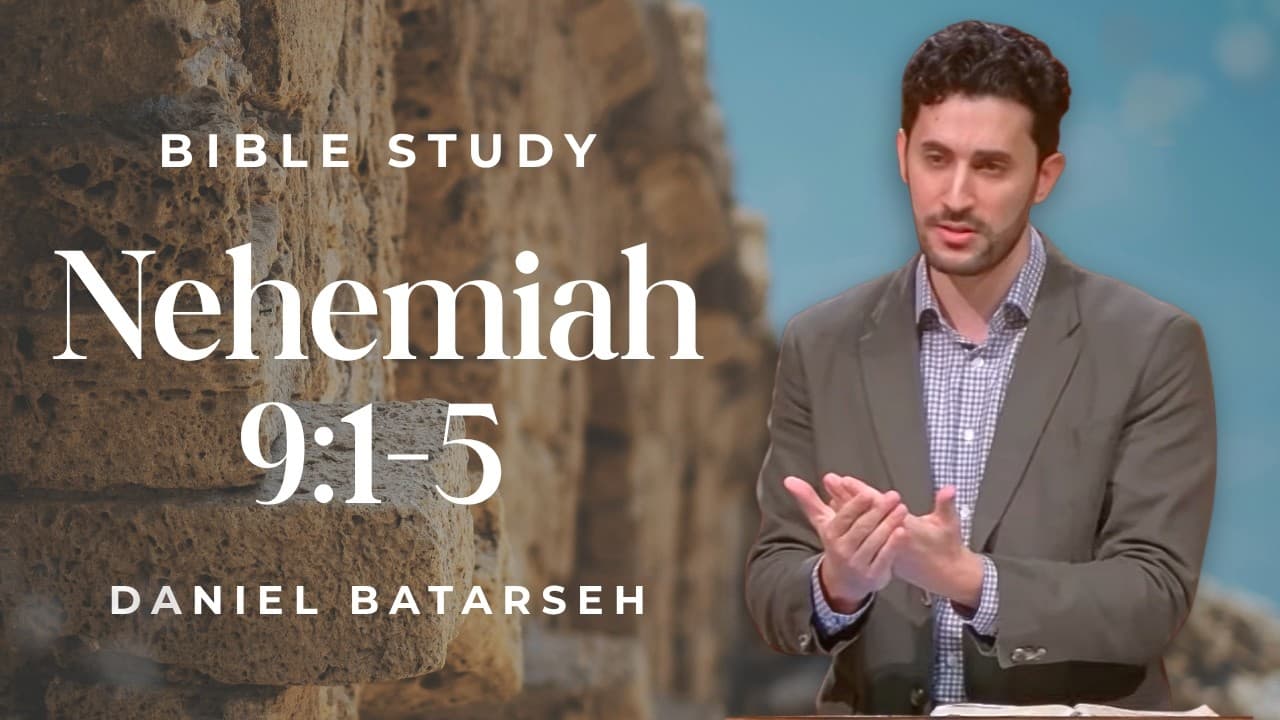
The Bible's longest recorded prayer reveals something uncomfortable: there are conditions to God hearing us. Nehemiah 9:1-5 shows what must happen before we open our mouths.
There are prayers God refuses to hear.
That sentence should unsettle you. It unsettles me. We've been trained to think of prayer as a spiritual vending machine — insert words, receive blessing. But Nehemiah chapter 9, which contains the longest recorded prayer in the entire Bible, opens not with eloquent words directed heavenward but with something far more demanding: obedience, separation from sin, and a fresh saturation in God's Word. Before a single syllable of supplication leaves their lips, the people of Israel do the hard work that most of us skip. And what the first five verses of this chapter reveal is that the groundwork before prayer matters as much as the prayer itself — maybe more.
This is not a popular message. But it is a biblical one. And what Pastor Daniel Batarseh walked through in this study of Nehemiah 9:1–5 is one of those teachings that reframes how you think about your entire prayer life.
Nobody Went Home — And That's the Point
Consider the timing. The twenty-fourth day of the seventh month. That detail seems like bookkeeping until you understand the calendar. The seventh month was the most spiritually packed month on Israel's schedule — the Feast of Trumpets on the first day, the Day of Atonement on the tenth, and the Feast of Tabernacles running from the fifteenth through the twenty-second. By the twenty-fourth, every required feast was finished. The booths had been disassembled. The shelters on the rooftops and in the courtyards of Jerusalem were packed up. The city returned to its normal state.
But nobody went home.
Two days after the last feast on the calendar, with no divine mandate requiring their presence, the people gathered again. They wanted more. They weren't done. As the teaching put it, "It would be like reaching the closing moments of our usual Friday night Bible studies, but nobody leaves their seats when the benediction is given. Nobody goes to the lobby. Nobody makes their way to the parking lot. Everybody remains where they are because they're not ready to go home yet" (watch at 38:16).
That is revival. Not manufactured emotion. Not a conference high. Revival is when time stops mattering because God's presence matters more. These people had already observed the Day of Atonement — a feast specifically designed for reflection and repentance. They'd already confessed. They'd already humbled themselves. And yet here they are, two weeks later, saying: It wasn't enough. We have more to bring before God.
The personal application cuts deep. If your only engagement with prayer happens in organized church settings — the brief pauses of supplication before a sermon, the closing prayer you half-listen to — that may reveal something about how little you understand what prayer actually is. These people didn't gather because it was expected. They gathered because prayer had become a privilege, not an obligation. And the distance between those two words is the distance between dead religion and living faith.
The Sin You Won't Deal With Is the Wall Between You and God
Here is where the text gets uncomfortable. Verse 2: "The Israelites separated themselves from all foreigners and stood and confessed their sins and the iniquities of their fathers." They showed up in sackcloth. They had earth on their heads. They were dressed for brokenness. But before they opened their mouths to pray, they dealt with something first.
The separation from foreigners points back to a problem Ezra had addressed thirteen years earlier — interfaith marriages and entanglements that violated God's law. Apparently, new cases had surfaced, or old compromises had been revisited. The details aren't given. But the principle is unmistakable: they recognized that there was no point in dressing the part of repentance while harboring the substance of rebellion.
As Pastor Daniel Batarseh stated plainly: "Never forget that prayer ceases to be effective when we dismiss practical repentance whenever it is required of us. Heaven becomes brass when there is an area in our lives that we've tried to justify even though the Bible condemns" (hear this moment).
The prophets had been saying this for centuries. Zechariah 7:12–13 delivers one of the most chilling warnings in all of Scripture. The people had made their hearts "diamond hard" — not just stone, diamond hard — against God's revealed Word. And the consequence? "As I called and they would not hear, so they called and I would not hear, says the Lord of hosts." Read that twice. God essentially says: You ignored me when I spoke. Now I will ignore you when you speak.
Proverbs 28:9 puts it even more starkly: "If one turns away from hearing the law, even his prayer is an abomination." Not merely ineffective. Not simply unheard. Abominable. And notice — the verse doesn't say "turns away from reading the law" or "turns away from knowing the law." It says hearing — which in Hebrew carries the weight of obedience, of responding, of letting the Word have its way with you.
The practical examples make this impossible to dodge. If you know Matthew 18 calls you to confront a brother or sister in sin and you've made every excuse not to do it — you've rehearsed why it's not your place, why the timing isn't right, why it would be awkward — and then you kneel beside your bed and ask God to use you, He has something to say about that. If you've been harsh with your spouse, impatient, cutting with your words, and then you come before the Lord asking Him to reveal His glory to you, 1 Peter 3:7 says your prayers are hindered. If you've developed a habit of tarnishing people's reputations — sharing unverified information because you enjoy being the bearer of news — and then you ask God to sanctify your mouth for evangelism, Titus 3:2 stands in your way: "Speak evil of no one."
The equation is simple and severe: obedience is not the result of effective prayer. It is the prerequisite.
The Bible Doesn't Just Teach You to Pray — It Makes You Want To
Verse 3 reveals a sequence that most readers rush past: "And they stood up in their place and read from the book of the law of the Lord their God for a quarter of the day. For another quarter of it, they made confession and worshiped the Lord their God." A quarter of the day reading Scripture. Another quarter praying and worshiping. We're talking roughly six hours — three hours in the Word, three hours in prayer. Nobody checked their watch.
But notice the order. Word first. Prayer second. They didn't start by pouring out their hearts. They started by filling their minds. And this isn't accidental — it's instructive. Engaging with God's Word is designed to electrify your prayer life. The testimonies of the Lord, the character of Christ, the promises of the gospel, even the warnings about the flesh and the devil — all of it is fuel. Without it, prayer sputters and stalls.
If you struggle to pray — and most honest Christians will admit they do — the first diagnostic question isn't about your prayer habits. It's about your Bible habits. The psalmist wrote, "At midnight I rise to praise you because of your righteous rules" (Psalm 119:62). He couldn't sleep. Not because of anxiety, but because he had so feasted on God's Word that worship was erupting out of him at midnight. That's the relationship between Scripture and prayer — the one ignites the other.
And there's a second gift the Word gives to prayer: language. The prayer that unfolds in Nehemiah 9:6–37 is essentially a retelling of Israel's entire history — creation, Abraham's calling, the Exodus, the wilderness, the conquest, the judges, the prophets, the exile. These people had been sitting under the preaching and reading of God's Word for an entire month, and now they had so much to say because they had so much to draw from. Scripture doesn't just motivate prayer; it provides the vocabulary, the references, the confidence of knowing whom you are addressing and how to approach Him.
Leaders Who Pray Before They Tell You to Pray
Verses 4 and 5 give us a list of Levites — names most of us stumble over — but embedded in those names is a principle that deserves attention. The Levites first cried out to the Lord themselves. Then they turned to the people and said, "Stand up and bless the Lord your God from everlasting to everlasting."
The same leaders who had helped the people understand the law in chapter 8 are now modeling how to respond to it. They didn't delegate prayer. They demonstrated it. And then they invited the congregation to follow.
This connects to one of the most overlooked details in Luke 11:1. We celebrate that the disciples asked Jesus, "Lord, teach us to pray." But what prompted the request? Luke tells us plainly: "Now Jesus was praying in a certain place, and when he finished, one of his disciples said to him, Lord, teach us to pray" (watch at 74:03). They had heard Pharisees pray. They had heard Sadducees pray in synagogues and the temple. But there was something different about the way Jesus prayed — "It wasn't ritualistic. It wasn't vain repetition. It wasn't lifeless. It wasn't cold orthodoxy. There was passion. There was sincerity. There was love for others. There was real adoration for the Father."
A story was shared that drove this home. A man speaking at his parents' fiftieth wedding anniversary told close friends and family that his earliest memory — at just a few years old — was sitting in family devotions and thinking, God is real. What convinced a toddler of God's existence? Not an argument. Not a miracle. The way his father talked about God and the way he talked to God.
This is why Paul told young pastor Timothy, before establishing anything else in the church at Ephesus, to prioritize prayer: "First of all, I urge that prayers and supplications and intercessions and thanksgiving be made for all people" (1 Timothy 2:1). First of all. Top of the list. Before programs. Before strategies. Before building campaigns. Get the people praying.
Why Prayerless Churches Go to War
One of the most striking connections in this teaching was the link between Nehemiah 9 and James 4:1–3. James diagnoses the quarrels and fights in his churches, and his diagnosis is startling: "You do not have because you do not ask." The civil wars in their congregations weren't caused by theological disagreements or personality clashes at their root. They were caused by unprayed desires.
Here's how it works: "When we lose the war with our passions within, inevitably, we will go to war with other Christians" (watch at 43:39). When longings and desires — not inherently sinful ones, even — are never brought to God in trust, they get managed through carnal means. You start seeing others who have what you want as threats. Competition creeps in. Then manipulation. Then slander. Then gossip. Then full-blown relational destruction.
James is saying: Do you want to know why your church is tearing itself apart? Because your people have never learned to trustingly bring their wants, their needs, their dreams, their longings before God and leave them there. Prayer has the power to quiet a restless heart, reshape distorted perspectives, and realign wayward desires with God's will. Without it, a church is a powder keg.
The better we become at communion with God, the sweeter our churches become. Fill a congregation with people who have no prayer life, and conflict is inevitable. Fill it with people who genuinely believe God hears them and is willing to answer, and you will know a harmony that no conflict resolution seminar could manufacture.
What to Remember
- Prayer that exists only inside church services is prayer that hasn't yet become real to you — these Israelites gathered beyond what was required because they had tasted something they couldn't walk away from.
- Disobedience doesn't just grieve God — it makes your prayers abominable to Him. The sin you refuse to address is the wall between your words and His ears.
- If you can't pray, check your Bible intake first. Scripture is the fuel that ignites prayer, the vocabulary that shapes it, and the confidence that sustains it.
- The most powerful way to teach someone to pray is to let them hear you pray — not performed prayers, but honest ones. Jesus' disciples asked to learn prayer because they watched Him pray.
- Prayerless churches don't just lack spiritual power — they breed conflict. James 4 draws a direct line from unanswered desires to church warfare, and the remedy is devastatingly simple: ask.
Questions to Sit With
- If God told you tonight that He would no longer hear a single prayer you prayed, what would that do to you? And what does your honest answer reveal about how much you actually value prayer?
- Is there an area of known disobedience in your life right now — a conversation you won't have, a relationship you won't address, a habit you won't confront — that may be making your prayers fall flat?
- When was the last time reading Scripture made you want to pray — not out of duty, but because something you read made worship erupt from the inside?
- Who in your life has made God seem real simply by the way they talk to Him? What was different about their prayers compared to the religious prayers you've heard elsewhere?
- If James is right that church conflict is rooted in prayerlessness, what would change in your community if even half the members developed a serious prayer life?
Scripture Referenced
- Nehemiah 9:1-5 — The preparation for Israel's longest corporate prayer
- Philippians 4:8 — Think on whatever is lovely
- James 4:1-3 — The link between prayerlessness and church conflict
- Zechariah 7:12-13 — God's refusal to hear a disobedient people
- Proverbs 28:9 — Turning from the law makes prayer an abomination
- Psalm 119:62 — Rising at midnight to praise God because of His Word
- Luke 11:1 — The disciples asking Jesus to teach them to pray
- 1 Timothy 2:1 — Paul's first charge to Timothy: get the church praying
- 1 Peter 3:7 — Prayers hindered by how you treat your spouse
- Titus 3:2 — Speak evil of no one
- 1 Kings 8 — Solomon's prayer of dedication, the Bible's second-longest prayer
This summary was generated by AI from the sermon "Nehemiah 9 (Part 1) Bible Study (The People of Israel Confess Their Sin) | Pastor Daniel Batarseh" preached by Pastor Daniel Batarseh at Maranatha Bible Church Chicago. Watch the full sermon →
Preached by
Pastor Daniel BatarsehSenior Pastor
This summary was generated by AI from the sermon transcript.
Based on the sermon