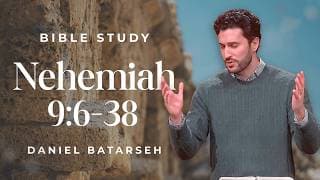
Nehemiah 10 shows us that real repentance isn't complete at the altar. It requires a sober mind, a specific plan, and a personal decision no one else can make for you.
Most people think repentance ends with tears. A broken prayer. A hand raised at an altar. A whispered confession in the dark. And all of those things matter — deeply. But Nehemiah chapter 10 confronts us with a startling reality: repentance that never produces a plan is repentance that never produces change. The people of Israel had just offered the longest recorded prayer in all of Scripture — a sweeping, gut-honest confession of centuries of national failure. It was beautiful. It was raw. And it was incomplete. What makes Nehemiah 10 so remarkable is what comes after the weeping. Not more emotion, but a written document. Names on a page. Specific commitments. A covenant with teeth.
Crying Has Very Little Value Without a Blueprint
This is the statement that should stop us cold. Chapter 9 gave us the prayer — the sackcloth, the ashes, the national confession. Chapter 10 gives us the action. And without the action, the prayer is hollow.
As Pastor Daniel Batarseh put it with striking directness: "There is very little value to crying. There is very little value to wearing sackcloth and ashes. There is very little value to gathering for a month-long revival series of meetings, if there is no intention to actually change in accordance to God's Word" (watch at 3:31).
That sentence should rattle every one of us who has mistaken emotional experiences for spiritual transformation. How many conferences have we attended where conviction burned white-hot on Saturday night and had cooled to ash by Tuesday morning? How many journal entries have we written — "Lord, I'm done with this sin" — only to find ourselves circling back within days?
The people of Israel understood something we often miss: the gap between conviction and transformation is bridged by specificity. Look at what they did in Nehemiah 10:30-31: "We will not give our daughters to the peoples of the land, or take their daughters for our sons. And if the peoples of the land bring in goods or any grain on the Sabbath day to sell, we will not buy from them." They named the sin. They named the boundary. They named the exact behavioral change that had to happen.
This wasn't a vague promise to "do better." This was a blueprint. Intermarriage with pagan nations? Done. Sabbath-breaking commerce? Finished. Neglecting the seventh-year rest for the land? Over. They went down to what the teaching called "the minutiae" — the step-by-step, measurable changes that needed to take place.
And here is the practical challenge for anyone reading this: if you say you need to get right with God, can you articulate what specifically needs to change? Can you put it in bullet points? Can you tell a trusted friend exactly what accountability looks like for you? Because if your repentance can't be measured, it probably can't be trusted.
Enter Into a Curse — The Part of the Covenant Nobody Wants
There's a phrase buried in Nehemiah 10:29 that most readers glide past: the people "enter into a curse and an oath to walk in God's law." Not just an oath. A curse.
This is not the language of people swept up in a worship experience. This is the language of people who have read the fine print. They knew — because Ezra had been reading the Law of Moses to them for weeks — that God's covenant came with both blessings for obedience and terrifying consequences for disobedience. And they accepted all of it.
This is what it means to repent with a sober mind. The teaching drew a sharp distinction between emotional commitment and informed commitment. There are people who make vows to God in the swirl of a conference, in the heat of a powerful sermon, in a moment of personal encounter with God's mercy — and those moments are real, they should move us. But we should never become so blinded by our emotions that we fail to grasp the seriousness of what we're pledging or the consequences of breaking it.
The people of Nehemiah's generation weren't creating new terms. They were renewing their commitment to obligations God had already established. They understood the weight. And they signed anyway. That's what sober-minded repentance looks like — not less passionate, but more informed. Not colder, but clearer.
John the Baptist modeled this same principle in the New Testament. After preaching a message of repentance so fierce it shook the crowds to their core, people came to him asking the most important follow-up question in all of Scripture: "What then shall we do?" (Luke 3:10-14). And notice — John didn't give them a generic spiritual pep talk. He gave each group a specific prescription. Tax collectors: stop collecting more than you're authorized. Soldiers: stop extorting people. Everyone: share what you have. He knew how to prescribe the right remedy for each person's particular disease (watch at 12:36).
True repentance takes a magnifying glass to your life and identifies what's out of alignment with God's Word — then adjusts it.
Nehemiah Put His Name First — And His Title Underneath It
The list of names in Nehemiah 10:1-27 is easy to skim past. Eighty-four names, most of them unpronounceable, organized into four groups: the governor, the priests, the Levites, and the chiefs of the people. But something remarkable happens at the very top of the list.
Nehemiah's name appears first. And unlike every other name on the document, his comes with a description: "Nehemiah the governor, the son of Hacaliah." He includes both his occupation and his family lineage — the longest description of anyone on the list. Part of the reason is practical: there are other men named Nehemiah mentioned in chapters 3 and 7, and he wants to make absolutely clear which Nehemiah is signing this covenant.
But there's something deeper. By placing his title under his name on a covenant with God, Nehemiah is making a declaration about his priorities. His career, his political office, his position of authority — all of it is subordinate to his worship. He's not governor first and worshiper of God second. Everything he is and everything he does submits to who God is and who God says he is.
This is what sincere relationship with the Lord looks like: choosing not to define your purpose by what you do, the authority you wield, what you earn, or who knows your name — but by taking God's Word and allowing it to shape your identity and define your priorities.
And there's another layer. Nehemiah had been largely absent from the narrative for two full chapters. Ezra had the spotlight throughout chapters 8 and 9. Nehemiah stepped aside, let another leader take center stage, and then re-emerged — not to reclaim attention, but to put his name on a binding commitment to God. That's leadership.
The People Who Prayed in Chapter 9 Are the Same Ones Who Signed in Chapter 10
Here is a detail that rewards careful readers. Several of the Levites named in Nehemiah 10:9-13 — Jeshua, Bani, Kadmiel, Shebaniah, Sherebiah — also appear in Nehemiah 9:4, where they stood on the stairs and "cried out with a loud voice to the Lord their God" before the national prayer began.
The men who prayed most passionately were the same men who followed through with personal, permanent commitment. And that's how you know prayer is real.
As the teaching put it with a quote that deserves to be written on every prayer journal: "You cannot live wrong and pray right" (watch at 28:25). If you and I claim to be praying consistently, and those prayers never move us to make practical changes, something is broken. Because genuine communion with God will convict, illuminate, and motivate. It will alter you. The connection was drawn to Luke 9:29, where Jesus was praying on the Mount of Transfiguration and "the appearance of his face was altered." Could Jesus have manifested His glory without praying? Of course — He's the Son of God. But Luke tells us He was praying when it happened, and He prayed long enough for the disciples to fall asleep and wake up to His glory. The point is inescapable: if we are truly praying, we will truly change.
Your Repentance Can't Ride on Someone Else's Faith
The list of names in Nehemiah 10 carries one more conviction that cuts close to the bone. This was a corporate commitment — a national covenant. But the fact that individual names appear reminds us that covenant with God boils down to a personal choice.
The teaching named a reality that haunts many churches: people whose only connection to God is through someone they love. A husband who attends because his wife is in covenant with God. A friend who serves because their closest companion serves. A child who prays because their parents pray. And then — the most sobering version — people who are ready to abandon the faith entirely, held back only because they don't want to disappoint a family member or a spiritual leader. As Pastor Daniel Batarseh observed: "I've had conversations with people whose only obstacle of actually turning their backs on Christ is not even Christ himself. It's somebody else who claims him. That reveals a lot, doesn't it?" (watch at 17:34).
It reveals everything. It reveals that one's faith is ultimately built on someone else's. And borrowed faith cannot survive the furnace.
Yet the same passage that warns us also invites us. Verse 28 lists an extraordinary range of people who joined this covenant: priests, Levites, gatekeepers, singers, temple servants, Gentile converts, wives, sons, daughters — "all who have knowledge and understanding." The singer didn't need to become a gatekeeper. The wife didn't need to become a priest. Whatever their occupation, social class, gender, or background, every single one was invited to walk with God right where they were.
This connects beautifully to Paul's instruction in 1 Corinthians 7:17-24, where he tells new believers to remain in whatever condition they were called. Don't quit your job the moment you get saved. Don't uproot your life out of spiritual anxiety. "So brothers, in whatever condition each was called, there let them remain with God." Those last two words change everything. God isn't more present on the mission field than He is in your cubicle. He isn't closer to the seminary student than to the electrician. If you are in Christ, God is with you — fully, completely, right now, right there.
What to Remember
- Repentance without a specific plan is just regret wearing spiritual clothing — name the sin, name the change, and build accountability around it
- Entering covenant with God means accepting both the blessings and the consequences — you don't get to cherry-pick the comfortable parts of His Word
- Your career, your title, your platform — none of it defines you. Like Nehemiah, place your identity under God's authority, not alongside it
- If the only reason you haven't walked away from the faith is because you don't want to disappoint someone, your faith isn't yours yet — and it won't hold
- God holds people accountable according to their knowledge and understanding, not an arbitrary age — this is both a mercy and a responsibility for how we disciple children
- You don't need to change your zip code or your career to serve God fully — He is with you in your current circumstances just as powerfully as anywhere else
Questions to Sit With
- If someone asked you right now to list the specific sins you're repenting of and the concrete steps you're taking to change, could you do it — or would you only have vague intentions?
- Is there an area of your life where you've accepted God's blessings but quietly ignored the obligations and consequences He's attached to them?
- If the people closest to you in faith suddenly walked away, would your relationship with God survive — or would it collapse because it was never truly yours?
- What would it look like to stop treating your job, your neighborhood, and your daily routine as obstacles to spiritual growth and start seeing them as the exact place God has called you to walk with Him?
Scripture Referenced
- Nehemiah 9:38
- Nehemiah 10:1-31
- Luke 3:10-14
- Nehemiah 9:4
- Luke 9:29
- Nehemiah 8:2-3
- Deuteronomy 1:39
- Isaiah 7:14-16
- 1 Corinthians 7:17-24
This summary was generated by AI from the sermon "Nehemiah 10 (Part 1) Bible Study (People & Obligations of the Covenant) | Pastor Daniel Batarseh" preached by Pastor Daniel Batarseh at Maranatha Bible Church Chicago. Watch the full sermon →
Preached by
Pastor Daniel BatarsehSenior Pastor
This summary was generated by AI from the sermon transcript.

Based on the sermon