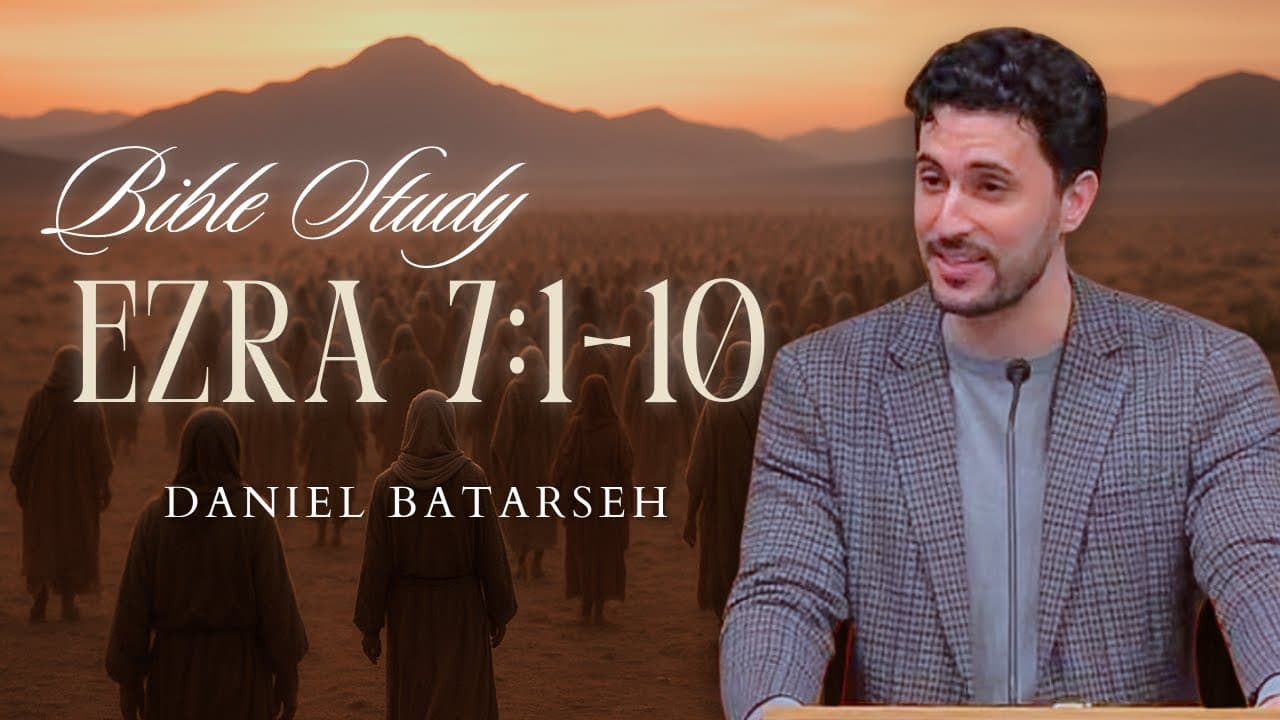
Ezra 7:10 isn't just a famous memory verse — it's the answer to how God's hand rested on Ezra's life. Most people skip the middle step. That's the problem.
Most people who quote Ezra 7:10 treat it like an inspirational poster for Bible teachers: study it, do it, teach it. A tidy little formula. But ripped from its context, you miss the entire point. Verse 10 is not a standalone motto — it's the explanation for something extraordinary that happened in verse 9. The text says "the good hand of his God was on him" and then immediately tells you why. That connecting word — "for" — changes everything. Ezra 7:10 is not a bumper sticker about Bible study. It's the answer to a question every believer is asking: How do I live under the tangible favor and power of God?
And the answer is more demanding than we'd like.
Sixty Years of Silence — and a Man Who Didn't Wait for the Right Conditions
Between Ezra chapter 6 and chapter 7, roughly sixty years vanish. The second temple has been completed. The story of Esther has played out in the Persian court. Darius has died and a new king named Artaxerxes now sits on the throne. And somewhere in Babylon, a priest named Ezra has been doing something remarkable with his time.
He's been studying.
Not in Jerusalem, with the rebuilt temple gleaming before him and the worship of God swirling around him. Not in the promised land, surrounded by fellow believers and the momentum of revival. He's in Babylon. The empire of exile. The place of distraction, comfort, and spiritual compromise. And the text says he became skilled in the law of Moses — a Hebrew word used rarely in the Old Testament, meaning he achieved a level of expertise, a mastery of the scriptures (watch at 23:11).
This detail should stop us cold. Ezra didn't need the right environment to pursue God's Word. He didn't wait for better circumstances, a ministry position, or a change of scenery. He pushed away the distractions of Babylonian life — and there were many — and gave himself to knowing what God had said.
Scrolls of sacred scripture had been carried into exile. Portions and fragments had made their way to Babylon over the decades. And Ezra devoted himself to every piece he could find. As Pastor Daniel Batarseh put it: "Ezra was able to push away all the worldly distractions, to not be discouraged by the limiting circumstances, and he devoted his life to knowing the word of God. And that made him prepared for God to recruit him" (watch at 23:32).
Here's the conviction for us: we live in an age of unprecedented access to Scripture. Multiple translations on our phones. Commentaries a click away. Audio Bibles for the commute. And yet the average Christian has never read the whole Bible once. Ezra had fragments of scrolls in a foreign empire — and he mastered them. We have everything — and coast.
Notice how Ezra himself describes the scriptures in verse 6: "the law of Moses that the Lord, the God of Israel had given." He saw God's Word as a gift. Not an obligation. Not a textbook. A gift from God — and he was determined to open every compartment of it. "If some Christians gave 50% of their energy from looking at conspiracy theories and the news to the word of God, they would explode in their growth" (hear this moment). That line landed hard in the room. It should land hard here.
A Scribe Who Believed What He Studied
Ezra wasn't just a scholar. He was a man who let the scriptures move him to action.
At some point, after years of studying God's promises about the restoration of Israel, Ezra walked into the throne room of Artaxerxes — the most powerful man on earth — and asked permission to lead a second wave of Jewish exiles back to Jerusalem. The text says simply: "the king granted him all that he asked" (Ezra 7:6). But think about what that required. This was audacity born of conviction. Ezra had read what God promised about his people's future, and he believed it enough to stake his life on it.
There's a direct line between knowing the Word and bold action. Ezra studied the prophecies, and those prophecies propelled him before the king with a request that could have been denied — or worse. But a man who truly comprehends who God is will not shrink before any human authority. If you really believe what the Bible says about the God you worship, you can stand before anyone.
And yet — how many people teach the Bible but collapse when real life presses in? The observation was pointed: "You'd be amazed to know how many people teach the Bible but when it comes to stressful situations, persecution, trials, temptation... they don't really believe what the Bible has to say. They collapse. And sometimes in those conversations, you just have to ask, do you really believe what you've been preaching all these years?" (watch at 29:19).
Ezra's story exposes a fault line in much of modern Christianity. We celebrate Bible knowledge while tolerating a gap between what we know and how we live. Ezra didn't have that gap. His study led to conviction. His conviction led to action. His action required sacrifice — a four-month journey on foot through hostile territory with children, elderly, and enemies lurking along the way (Ezra 8:21-23). He fasted. He prayed. He refused a military escort because he had told the king that God's hand protects those who seek him — and he meant it.
Anyone who yearns to be used by God cannot idolize comfort. Ezra paid a price. And many in Babylon looked at that price and said, "No thanks." The text is honest about it: "some" of the people went with him. Not all. Not most. Some.
The Word That Only Some Will Accept
That word — "some" — appears twice in Ezra 7:7, and it carries a weight that's easy to miss. This was the second opportunity for Jewish exiles to return to Jerusalem. The first wave under Zerubbabel had already gone decades earlier, and not everyone joined then either. Now Ezra arrives with royal backing, financial resources, and a clear mandate from God — and still, only some followed.
This is a hard truth for anyone who burns with passion for God and wonders why the people around them don't share it. Why doesn't everyone want this? Why can't they see what's at stake? Ezra was godly, consistent, deeply insightful in the scriptures — and he couldn't convince everybody.
The counsel here was practical and liberating: "Resist the urge of focusing on those in the church who don't even really want to be there to begin with. Reserve your energy and your service to those who do come. Don't gear your messages to those who are not paying attention during the service. Look at those who have come with an open heart and open Bible and focus on them" (watch at 38:23).
Every person has a choice. Some will choose comfort in Babylon over the costly journey to where God is working. That doesn't discredit your faithfulness. It just means you pour yourself into those who do want it.
The Equation Most People Break
Now we arrive at the verse everyone quotes and almost nobody obeys in full.
"For Ezra had set his heart to study the law of the Lord and to do it and to teach his statutes and rules in Israel." — Ezra 7:10
Three actions. One order. And the order is non-negotiable.
Study it. Do it. Teach it.
The fatal mistake — the one that produces hypocrites and hollow ministries — is skipping the middle step. People study the Word so they can teach it. They gather golden nuggets for Sunday and skip right past the part where those truths are supposed to reshape their own lives first. "You can't skip the middle part and expect God's hand on your life. In fact, that's a recipe for personal disaster. To study it, just to tell other people about it" (hear this moment).
This isn't just a warning for pastors. Psalm 1 doesn't say "Blessed is the preacher who meditates on the law of the Lord day and night." It says blessed is the man. Blessed is the woman. The equation belongs to every Christian.
And notice the phrase that governs the whole verse: "he had set his heart." This wasn't duty. This wasn't professional obligation. This was an all-consuming passion. Ezra's heart was set — fixed, determined, immovable — on knowing God through his Word, letting that Word change him, and then sharing it with others.
When was the last time you opened your Bible and asked: God, what are you going to say to me as a father? As a wife? About my private life? About my relationship with money? If that question doesn't cross your mind when you open the scriptures, the equation is broken. And if the equation is broken, don't expect the result — God's hand resting on your life.
The connection to the New Testament is striking. In Acts 11:20-21, when unnamed believers preached the Lord Jesus to Gentiles in Antioch, the text says "the hand of the Lord was with them, and a great number who believed turned to the Lord." The same metaphor. The same reality. God's power, provision, protection, and providential guidance resting on ordinary people who gave themselves to his Word and his mission. It happened with Ezra. It happened in the early church. It's available now.
Jesus himself, at the end of his parables in Matthew 13:51-52, looked at his unschooled, rough-around-the-edges disciples and called them scribes — trained for the kingdom of heaven, bringing out treasures old and new. Fishermen. Tax collectors. No seminary degrees. And Christ said: you are my scribes now. That should give every ordinary believer the courage to pursue this way of life.
What to Remember
- Ezra 7:10 is the explanation for Ezra 7:9 — the threefold equation of studying, doing, and teaching God's Word is what caused God's hand to rest on Ezra's life, not his credentials or title.
- The middle step is the one most people skip. Studying the Bible to teach it while bypassing personal obedience produces hypocrisy, not blessing.
- You don't need ideal conditions to master God's Word. Ezra became an expert in Scripture while living in Babylon — not in Jerusalem, not near the temple, not surrounded by revival.
- "Some" is not a failure. Even Ezra, one of the godliest men in the Old Testament, could only convince some to follow. Pour yourself into those who want it.
- God's hand is a metaphor for his power, provision, protection, and providential guidance — and it's available in the new covenant just as it was in the old (Acts 11:21).
- A passion for comfort and a desire to be used by God are irreconcilable. Ezra's four-month journey through hostile territory was the cost of his calling.
Questions to Sit With
- If Ezra could master the scriptures in Babylon with limited access to scrolls, what's your real reason for not knowing God's Word more deeply?
- When you open your Bible, is your first instinct to find something to share with others — or to hear what God is saying to you?
- Are you pouring emotional energy into people who don't want the things of God while neglecting those who are hungry for them?
- What would change in your daily life this week if you actually believed that God's hand rests on those who study, obey, and share his Word?
- Is there a step of bold obedience — like Ezra approaching the king — that you've been avoiding because the cost feels too high?
Scripture Referenced
- Ezra 7:1-10 (primary passage)
- Ezra 8:21-23
- Ezra 2
- 1 Peter 2:9
- Hebrews 4:15-16
- Matthew 13:51-52
- Acts 11:20-21
- Psalm 1
This summary was generated by AI from the sermon "Ezra 7 (Part 1) Bible Study (Ezra Sent to Teach the People) | Pastor Daniel Batarseh" preached by Pastor Daniel Batarseh at Maranatha Bible Church Chicago. Watch the full sermon →
Preached by
Pastor Daniel BatarsehSenior Pastor
This summary was generated by AI from the sermon transcript.
Based on the sermon