
Behind the 32 verses of names and gates in Nehemiah 3 lies a mirror for every church — seven types of servants, from the zealous to the absent. Which one are you?
Most people skip Nehemiah 3. It reads like a construction manifest — 38 names, 10 gates, and 32 verses of who repaired what and where. But buried inside this ancient registry is something the Holy Spirit wants you to see: a mirror of every local church that has ever existed. The zealous and the lazy. The restored and the ruined. The women who showed up when the men stayed home. The man who consecrated a gate but never bothered to consecrate his own heart.
This chapter is not a genealogy to endure. It is a catalog of character types that God, through Nehemiah's pen, recorded for our instruction. And if you're honest with yourself as you walk through these seven types of servants, you'll find your own reflection staring back — for better or for worse.
The Leader Who Never Appears in the List
Here's a detail that's easy to miss: Nehemiah himself is nowhere in chapter 3. His name does not appear among the workers. And yet the very first word of the chapter — then — tells us everything.
"Then Eliashib the high priest rose up with his brothers the priests, and they built the Sheep Gate" (Nehemiah 3:1). That word then connects directly back to Nehemiah 2:20, where Nehemiah stood before the enemies of Israel — Sanballat, Tobiah, Geshem — and declared, "The God of heaven will make us prosper and we his servants will arise and build, but you have no portion or right or claim in Jerusalem."
Full stop. And then the people rose.
Nehemiah's courageous declaration was the catalyst. His confidence in God became contagious. And this is the first principle embedded in the chapter: the attitude of leadership in the church plays a significant role in inspiring those under their direction — whether for better or worse (watch at 38:55).
But confidence alone isn't enough. You can be confidently wrong. What made Nehemiah effective was that he was both confident and competent. Read through chapter 3 carefully and you'll see the fingerprints of organized leadership everywhere — division of tasks, rotation of crews, strategic assignment by location. This wasn't accidental. It was the fruit of a prayerful visionary who understood that the church of Jesus Christ is not a free-for-all.
And notice the harmony: Nehemiah honored the workers by recording their names. The workers honored Nehemiah by trusting his guidance. This is the dynamic Hebrews 13:17 envisions — leaders who serve with joy, not groaning, because the people cooperate rather than constantly resist. As Pastor Daniel Batarseh put it: "Those who constantly resist and want their own way, those who ignore protocol, those who disregard instruction — you can cause leaders to groan. You know what that means? It means that when your name is called in some context, pastors go..." — and he let out a heavy sigh that said more than any sentence could (watch at 43:15).
The High Priest Who Consecrated the Gate but Not His Heart
Eliashib the high priest appears at the top of the list, and at first glance, he's admirable. He and the priests are the first to build. They consecrate the Sheep Gate — the only time in all 32 verses where the word consecrated appears. There's a spiritual weight to this moment: the rebuilding project is being inaugurated as worship, not merely construction.
But Eliashib is a ticking time bomb.
Fast forward to Nehemiah 13, after years have passed and Nehemiah has temporarily returned to Babylon. When Nehemiah comes back to Jerusalem, he discovers that Eliashib — this same high priest — has emptied a room in the temple to rent it out to Tobiah, one of the very enemies who tried to stop the wall from being built (watch at 47:52). If you know the Old Testament, you understand how heinous this is. Tobiah, by virtue of his ancestry, should have come nowhere near the temple. Nehemiah calls it "evil" — not a mistake, not an oversight. Evil.
And it gets worse. Nehemiah 13:28 reveals that Eliashib's own grandson married the daughter of Sanballat — the other chief antagonist of God's people. The contamination went all the way to the family tree.
The lesson cuts deep: "Eliashib took the time to consecrate a gate, but he didn't take the time to consecrate his own heart." He was concerned about the Sheep Gate. He wasn't concerned about the gate of his own affections — the gate that protects against temptation and compromise.
This is the sobering warning for anyone active in ministry. Never make the error of thinking that serving in ministry will somehow sanctify you on its own. You don't go into ministry to be sanctified. Judas was part of the greatest ministry team in human history, and he was filled with the devil. Paul told Timothy to "keep a close watch on yourself and the teaching" (1 Timothy 4:16) — your life first, then your work. All true ministry flows out of intimacy with God. Without that anchor, you're just a religious professional drifting toward disaster.
The People Who Went the Distance — and the God Who Counted Every Mile
Scattered throughout chapter 3 are geographic markers that are easy to skip. The men of Jericho. The Gibeonites. The inhabitants of Zanoah. Rulers from Beth Zur, Beth Hakkerem, Keilah. These weren't Jerusalem locals. They traveled — some considerable distances — to work on walls that weren't even in their hometown.
Why does Nehemiah record where they came from? Because serving God is not always convenient, and the Holy Spirit wants you to know that He notices every inconvenient mile.
As Pastor Daniel Batarseh shared from his own early ministry days: he was a college student in Toronto who had been leading a small group out of his apartment. When the lease ended, he moved back to his parents' house — an hour away. But the meetings kept going. So he drove, week after week, in a car he described as "like a go-kart — I don't know how it was legal to get on the street." And he said: "I remember vividly thinking to myself... I know God sees me doing this. I know he sees every drop of gasoline that I put into this thing" (hear this moment).
There's not a mile you drive, not a meal you miss, not a minute into the night that the Lord does not take into account when you serve Him. The people from Jericho and Gibeon and Mizpah could have stayed home. Nobody would have blamed them. But they came, and God immortalized their effort in Scripture.
The Nobles Who Wouldn't Stoop — and the Sixth Son Who Went Alone
Verse 5 delivers one of the sharpest lines in the chapter: "And next to them the Tekoites repaired, but their nobles would not stoop to serve their Lord."
Tekoa — the hometown of the prophet Amos. A place with a noble spiritual heritage. And yet the leaders, the officials, the men of high standing refused to participate. Maybe they thought manual labor was beneath them. Maybe they resented taking orders from an outsider like Nehemiah. Maybe they calculated that rebuilding Jerusalem's walls didn't serve their local interests. Whatever the reason, God didn't accept it. He recorded their refusal for all of history to read.
In the same way that the Lord meticulously considers every ounce of sacrifice you spend for His name, He also takes note of those who are presented opportunities and refuse them. Not every announcement is for you. Not every need requires your hand. But if opportunity after opportunity bounces off of you and nothing ever sticks — never makes you pray, never makes you move — that pattern should concern you.
But here's the flip side, and it's stunning. The common Tekoites did go. Their leaders set a terrible example, and they went anyway. And in verse 27, they show up again, repairing a second section. They went above and beyond while their own nobles sat at home.
And then there's verse 30: "Hanun the sixth son of Zalaph repaired another section." Not Hanun the son of Zalaph. The sixth son. The Holy Spirit doesn't waste words. Five older brothers stayed home. Number six said, "I'm going." No godly role models ahead of him. No older brothers to follow. He just went.
Your friends don't want to serve? Let them be. Your family won't go to church? You go. Your spouse is in a spiritual drought? Pray for them and be the example. Serve God for God.
Malchiah's Second Chapter: When God Rewrites a Failure's Story
Verse 11 names "Malchiah the son of Harim." Obscure — unless you've read Ezra 10:31, where the same Malchiah, son of Harim, appears on a very different list: the registry of men found guilty of unlawful intermarriage. The last time we saw this man in Scripture, he was a failure who had put the entire Jewish community at risk.
And now here he is, not on a list of the condemned, but of the commended. Thirteen years have passed between Ezra's record and Nehemiah's. Somewhere in those years, Malchiah repented. He made things right. And God didn't just forgive him — God restored him to active service and then recorded his name among the honored workers forever.
The Holy Spirit did not have to include this man's name. But He did, so that you would see the kind of God we serve. As the teaching pressed home: "It is so easy for us to let our past failures, our mistakes, our foolery, our immaturity of yesterday paralyze us and think, Lord, if you just put me on the shelf, I'm happy. Just let me slip in at the end of the day. And yet God wants to do far more than that" (watch at 1:13:17).
This is also a word for leaders: we must be willing to do more than just forgive those who have fallen. We must be willing to let them be active again. God forbid that you and I would be more rigid than our holy God. Even Paul — the same apostle who split from Barnabas over John Mark's desertion — later wrote to Timothy: "Bring Mark back to me, for he is useful to me in the ministry" (2 Timothy 4:11).
If there's repentance, see them with the eyes of Christ.
Shallum's Daughters and the Women God Refuses to Overlook
Verse 12: "Next to him, Shallum the son of Hallohesh, ruler of half the district of Jerusalem, repaired — he and his daughters."
Shallum likely had no sons. When the call came, he brought his girls to the construction site. And the Holy Spirit made sure their presence was recorded. In Romans 16, Paul greets Mary "who has worked hard for you," Tryphena, Tryphosa, and "the beloved Persis, who has worked hard in the Lord." That phrase — worked hard in the Lord — is attributed more to women in Romans 16 than to anyone else.
The historical illustration drove this home powerfully: Selina Hastings, the Countess of Huntingdon, who bankrolled George Whitefield's entire ministry. She hired him as her personal chaplain to shield him from prosecution. She gave over £100,000 — millions in today's currency — to fund the Methodist movement. She built 60 to 64 chapels across England and Wales so Whitefield would have places to preach when churches kicked him out. Contemporaries called her the Queen of Methodism.
Shallum's daughters showed up to the construction site while Hanun's five older brothers played — as the sermon memorably put it — "video games" at home. Sisters, you don't need a pulpit for the Lord to use you in ways that shake the earth.
Baruch's Fire: The Servant Whose Heart Was Burning
Verse 20 describes Baruch the son of Zabbai repairing his section. Most English translations add a word the ESV omits due to manuscript differences: zealously. The Hebrew word carries the idea of burning, of being hot. It's the same root used elsewhere to describe someone's anger burning within them — but here it describes the quality of a man's labor.
Nehemiah saw something different in Baruch. He was sweating. He was running, not walking. He arrived early and left last. His work ethic was so visible, so unmistakable, that it earned a unique descriptor in the entire chapter. Romans 12:11 commands the same: "Do not be slothful in zeal. Be fervent in spirit. Serve the Lord." The Greek word for fervent means boiling — the same word used of Apollos in Acts 18.
It's not enough to serve. How you serve matters to God. And if that fire has gone cold, you don't need a motivational speech. You need the Holy Spirit.
What to Remember
- God records both your sacrifice and your refusal — the miles you drove to serve and the opportunities you let pass without a prayer.
- Ministry activity is not the same as personal holiness. Eliashib consecrated a gate and desecrated a temple. Watch your own heart before you build anything else.
- Your past failure is not your final chapter. Malchiah went from the list of the condemned to the list of the commended because he repented — and God restored him completely.
- Women are not secondary contributors in God's kingdom. Scripture attributes the phrase "worked hard in the Lord" more to women than to men in Romans 16.
- You don't need godly role models to be a godly servant. The sixth son went alone. The Tekoites served despite their nobles' indifference. Serve God for God.
- Zeal is not a personality trait — it's a spiritual reality. If you can't generate it in your own strength, that's the point. You need the Holy Spirit.
Questions to Sit With
- If you're honest, which of the seven types of servants most resembles you right now — and which one did you wish described you?
- Is there a gate you've been consecrating in public while neglecting the gate of your own heart in private?
- What excuse have you been using to avoid serving — and would it hold up if you wrote it down and read it back to yourself?
- Is there someone in your church who failed and repented, and you've forgiven them in word but still won't let them serve? What does that say about your view of God's restoration?
- When was the last time you did something for God's kingdom that was genuinely inconvenient — and did you notice that it felt like an adventure?
Scripture Referenced
- Nehemiah 3:1-32 — The rebuilding registry
- Psalm 119:129-136 — Opening reading on the unfolding of God's Word
- Proverbs 20:6 — "A faithful man, who can find?"
- Nehemiah 2:18-20 — The people's verbal pledge and Nehemiah's confrontation
- Nehemiah 13:4-9, 28 — Eliashib's betrayal and Sanballat's grandson
- Hebrews 13:17 — Leading with joy or groaning
- 1 Timothy 4:16 — Watch your life and your doctrine
- Ezra 10:31 — Malchiah's appearance on the list of the guilty
- 2 Timothy 4:11 — Paul's restoration of Mark
- Romans 16:6-12 — Women commended for hard labor in the Lord
- Romans 12:11 — Be fervent in spirit, serve the Lord
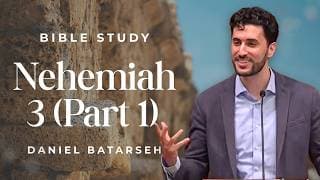
This summary was generated by AI from the sermon "Nehemiah 3 (Part 1) Bible Study (Rebuilding the Wall) | Pastor Daniel Batarseh (5/22/26)" preached by Pastor Daniel Batarseh at Maranatha Bible Church Chicago. Watch the full sermon →
Preached by
Pastor Daniel BatarsehSenior Pastor
This summary was generated by AI from the sermon transcript.
Based on the sermon