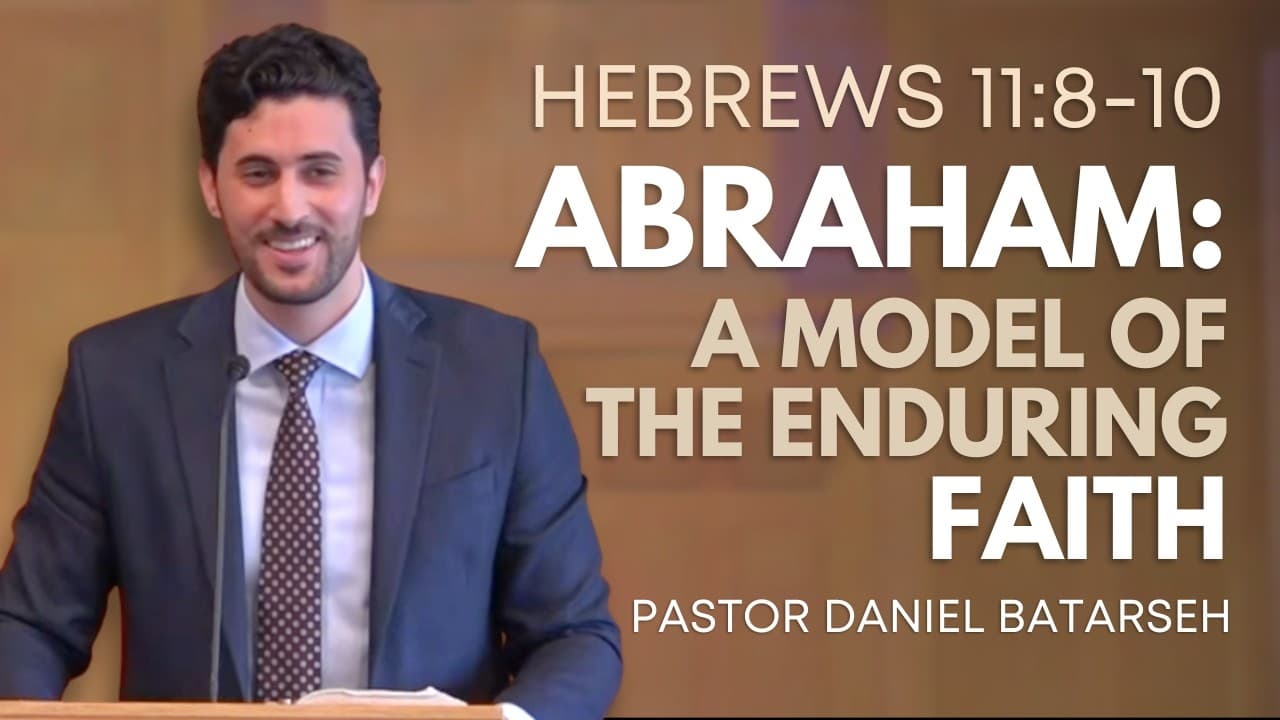
Abraham was wealthy enough to build a palace, yet he chose tents. Hebrews 11:8-10 reveals why — and what his example demands of every believer still inching toward Sodom.
Most people read Hebrews 11 as a highlight reel of spiritual heroes — a kind of biblical hall of fame. But the author of Hebrews had something far more unsettling in mind. He was writing to Christians who were buckling. Jewish believers crushed under social pressure, losing property, watching friends get thrown in prison — and seriously considering abandoning Jesus to return to the safety of the old Levitical system. Into that moment of crisis, the Spirit holds up Abraham. Not to inspire admiration, but to provoke a question: Does your faith look anything like his?
Hebrews 11:8-10 gives us three marks of the faith that actually pleases God — and each one cuts against the grain of comfortable religion. Abraham obeyed without knowing the outcome. He lived as a stranger in a land he was promised. And he fixed his gaze on a city he would never see in his lifetime. These are not abstract theological categories. They are a mirror.
He Walked Into the Dark — and That Was the Point
Verse 8 is breathtaking in its simplicity: "By faith Abraham obeyed when he was called to go out to a place that he was to receive as an inheritance, and he went out not knowing where he was going." Not knowing. That phrase should stop us cold.
Abraham was not some lifelong monotheist groomed for this moment. According to the book of Joshua, this man was an idolater in Mesopotamia. He worshiped false gods. And then, as Stephen recounts in Acts 7:2, "the God of glory appeared to our father Abraham." That phrase — the God of glory — was itself a provocation to Stephen's audience. You mean God's glory showed up outside of Israel? Outside the temple? Yes. In pagan Mesopotamia, to a man who had done nothing to deserve it (watch at 15:14).
Whatever Abraham saw of God's glory that day, it was enough. Enough to make him leave country, kindred, and father's house for a destination he could not name. As Pastor Daniel Batarseh put it: "True faith does not need a comprehensive map for the future in order to trustingly obey what God asks of you and I today" (hear this moment).
That truth lands like a hammer on every delayed obedience in our lives. The believer who knows God has convicted them about a relationship with someone who does not love Christ — but will not end it because what if God doesn't bring someone else? The business owner running dishonest financial dealings because cutting that income stream feels reckless. The professing Christian who has never been baptized because they need to poll their family for approval first. In each case, the logic sounds reasonable. And in each case, it is the opposite of faith.
Faith is not I will do this because of what it will produce. Faith is I know the One who asked this of me, and He deserves my obedience no matter what it leads to. The difference between those two sentences is the difference between Abraham and a consumer who wants a guarantee before buying.
So what gave Abraham the nerve? Not a five-year plan. Not a divine presentation of future outcomes. A glimpse of glory. "You need to know God more. I need to know God more. I need to so understand who he is, his heart, his mind, his ways, his consistency. So that when he does ask me of anything, I can trustingly walk ahead" (watch at 16:56). The remedy for paralyzed obedience is not more information about the future. It is a deeper encounter with the God who holds it.
Pitch the Tent, Then Build the Altar
Verse 9 introduces a detail that seems almost trivial on first reading: Abraham lived in tents. He was enormously wealthy — Scripture says very wealthy — and yet he never built himself a permanent home in the land God had promised him. Why?
Because the tent said something. To the Canaanites watching, it announced: This man is passing through. His treasure is not here. To Isaac and Jacob who shared those tents, it taught a theology without words. And to the Hebrew Christians who first read this letter — believers who had "joyfully accepted the plundering of your property" according to Hebrews 10:34 — it was a reminder that their hero in the faith had also held his possessions with an open hand.
But there is a pattern buried in Genesis that most readers miss. In Genesis 12:8, Abraham pitches his tent and builds an altar. In Genesis 13:3-4, he returns to the place where his tent had been and where he had made an altar. In Genesis 13:18, he moves his tent to Hebron and builds an altar. Every single time: tent first, then altar.
That sequence is not accidental. "You and I can't truly worship unless we are first separate from the world. We have to be tent dwellers before we have altars built for God. Only exiles can build true altars to God" (hear this moment). Separation precedes worship. Detachment from the world is not the result of a vibrant spiritual life — it is the precondition for one.
Peter knew this. "Beloved, I urge you as sojourners and exiles, to abstain from the passions of the flesh which war against your soul" (1 Peter 2:11). The identity comes first — sojourner, exile — and from that identity flows the power to resist what would otherwise consume you.
Lot Had a Tent Too — and Look Where It Ended Up
The contrast is devastating. Abraham's nephew Lot also had a tent. But while Abraham pitched his tent and built an altar, Lot pitched his tent toward Sodom (Genesis 13:12). The trajectory from that moment is a slow-motion catastrophe that should terrify every comfortable believer.
First, he looked. The Jordan Valley was "well watered everywhere like the garden of the Lord, like the land of Egypt" (Genesis 13:10). Notice both comparisons. Lot had been to Egypt with Abraham during that earlier lapse of faith. Abraham left Egypt and returned to the altar. But Egypt never left Lot. "That's a lesson for leaders. Be very careful. Your decisions and mine, we may be able to recover from, but not those who are under our leadership" (watch at 28:19).
Then Lot pitched his tent as far as Sodom (Genesis 13:12). Then he was dwelling in Sodom (Genesis 14:12). Then he was sitting in the gate of Sodom (Genesis 19:1) — and gates in the ancient world were not doorsteps. They were courtrooms, legislative chambers, the seat of civic authority. Lot had become one of Sodom's leaders. From a curious glance to a pitched tent to a permanent address to a position of influence in a city whose men were "wicked, great sinners against the LORD."
It is always a slippery slope. The entertainment that once made you flinch now plays in the background. The language you once avoided now rolls easily off the tongue. The zeal that once marked your Sundays has given way to reluctant attendance. You are not building altars. You are inching closer to Sodom.
And here is the most sobering part: 2 Peter calls Lot righteous (2 Peter 2:7-8). He was saved. But his faith produced no altars, no worship in the places he traveled, no legacy of trust passed to the next generation. He was rescued from Sodom, but everything he had built there burned. A worldly Christian is still a Christian — but what a tragic, scorched kind of Christianity it is.
"Abraham shared the soil of Canaan, but not the soul of the Canaanites. And that must be true of you and I" (watch at 34:36). Which faith out of the two reflects yours?
Faith That Shapes a Household
Hebrews 11:9 does not merely say Abraham lived in tents. It says he lived in tents "with Isaac and Jacob, heirs with him of the same promise." The Holy Spirit is not being redundant. He is telling us something about the reach of Abraham's faith.
Do the math. Abraham was 100 when Isaac was born and died at 175. Isaac was 60 when Jacob was born. That means Jacob was about 15 when his grandfather died. They overlapped. They shared meals. They shared tents. And Abraham, in his old age, shared his faith. Can you imagine it? Abraham sitting there, Jacob on his knee: Let me tell you what it means to walk by faith. Let me tell you why we live in tents.
God Himself testifies to this in Genesis 18:19. The Hebrew word rendered "chosen" in some translations more literally means "to know." God says: I know him — that he will command his children and his household after him to keep the way of the Lord. What a precious thing for God to say about any man or woman.
Abraham was wealthy, and yet what Isaac saw in his father was not a man living for this world. What Jacob heard from his grandfather was not the boasting of a rich man but the testimony of a tent-dwelling worshiper. The faith was real at home. It was not a weekly performance. "May the greatest inheritance that you leave your children and their children be a walk with God. Amaze them with God. Show them the beauty of the Bible. Show them the beauty of a holy life" (hear this moment).
Abraham was far from perfect. He brought Lot when God told him to leave his family. He lied about Sarah in Egypt. He had lapses. But Hebrews honors him not for perfection but for the persistent direction of his gaze.
Eyes Fixed on a City Not Yet Built
The final mark of enduring faith is the one that holds all the others together. Hebrews 11:10 tells us why Abraham could live this way: "For he was looking forward to the city that has foundations, whose designer and builder is God."
While Lot lifted his eyes toward Sodom, Abraham lifted his eyes toward heaven. And the word for "looking" here is not a casual glance. It carries the force of an intense, sustained gaze — an anticipation that restructures the way you live today.
This is how he held his wealth with a loose grip. This is how he lived contentedly in canvas while Canaanites built in stone. This is how he endured decades of waiting for a son who had been promised. He saw something better coming.
Jesus Himself confirms the depth of Abraham's forward-looking faith in John 8:56: "Your father Abraham rejoiced that he would see my day. He saw it and was glad." Abraham did not merely anticipate a heavenly city in the abstract. At some point in his pilgrimage, God granted him a glimpse of Christ Himself — and the sight of it filled him with gladness. Knowing certain things about the future and believing them can transform your experience of the present.
The author of Hebrews circles back to this truth one final time in Hebrews 13:14 and broadens the lens from one patriarch to every believer: "For here we have no lasting city, but we seek the city that is to come." Not just Abraham. We. The question is whether our lives actually reflect that claim. Are the promises of eternity more exciting than anything we possess in this world? Or has the glitter of this age eclipsed the vision that once burned so brightly?
Abraham shows us the secret: you can endure the tent when you are captivated by the city.
What to Remember
- True faith obeys God even when it cannot see the full results of that obedience — demanding a full explanation of the consequences is not trust, it is negotiation with God.
- Abraham was an idolater before God's glory found him in Mesopotamia; no past disqualifies you from a life of radical faith.
- The pattern is always tent first, then altar — separation from the world is the precondition for genuine worship, not a byproduct of it.
- Lot's descent from curious glance to civic leader of Sodom happened gradually; the slide toward worldliness is never sudden, always incremental.
- Abraham's tent-dwelling faith was not private — Isaac and Jacob lived in those tents with him, and God Himself testified: "I know him, that he will command his children" (Genesis 18:19).
- The ability to endure in faith is directly tied to the intensity of your gaze on eternity; Abraham held this world loosely because he was gripped by the world to come.
Questions to Sit With
- Is there a clear command from God you have been delaying because you are afraid of what obedience might cost — and have you been disguising that fear as wisdom?
- If your neighbors observed the way you spend your time, money, and emotional energy, would they conclude you are passing through this world or building your permanent home in it?
- Lot was righteous but left no legacy of faith. What will your children and grandchildren inherit from your spiritual life — altars or ashes?
- When was the last time the reality of the city to come — not as a doctrinal fact but as a living hope — actually changed a decision you made?
- Abraham saw Christ's day and was glad. Does the promise of seeing Jesus face to face produce gladness in you right now, or has that anticipation grown dim?
Scripture Referenced
- Hebrews 11:8-10
- Genesis 15:6
- Genesis 12
- Acts 7:2-4
- Hebrews 10:34
- 1 Peter 2:11
- Genesis 12:8
- Genesis 13:3-4, 10-12, 18
- Genesis 14:11-12
- Genesis 19:1
- Genesis 18:17-19
- John 8:56
- Hebrews 13:14
- 2 Peter 2:7-8
This article is drawn from the sermon "Abraham: A Model of the Enduring Faith | Hebrews 11:8-10" by Pastor Daniel Batarseh at Maranatha Bible Church Chicago. Watch the full sermon →
Preached by
Pastor Daniel BatarsehSenior Pastor
This summary was generated by AI from the sermon transcript.
Based on the sermon
Abraham: A Model of the Enduring Faith | Hebrews 11:8-10 | Pastor Daniel Batarseh (2/15/26)
Watch Full SermonRelated Articles
What Revelation 21 Says About Heaven That You've Never Noticed
Pastor Daniel Batarseh · October 11, 2026
What Revelation 21 Says About Eternity (It's Not What You Picture)
Pastor Daniel Batarseh · October 11, 2026
Hebrews 9 and Why Christ's Second Coming Isn't About Sin
Pastor Daniel Batarseh · October 4, 2026