Christ didn't enter a tent made with hands. He entered heaven itself, with His own blood, once for all. Hebrews 9 tells us why that changes everything.
You are appointed to die once. After that comes judgment.
That sentence from Hebrews 9:27 is one of the most sobering lines in all of Scripture — and one of the most ignored. We build entire lives around avoiding its implications. We plan, we accumulate, we distract. But the writer of Hebrews doesn't flinch. He states it plainly, the way a doctor states a diagnosis. One death. Then judgment. No appeals. No second chances.
But here's what makes Hebrews 9 extraordinary: that terrifying sentence is not the climax. It's the setup. Because the very next verse pivots to the most staggering promise in the Bible — that Christ, having been offered once to bear the sins of many, "will appear a second time, not to deal with sin, but to save those who are eagerly waiting for him" (hear this moment).
Not to deal with sin. That work is finished. He's coming back for something else entirely.
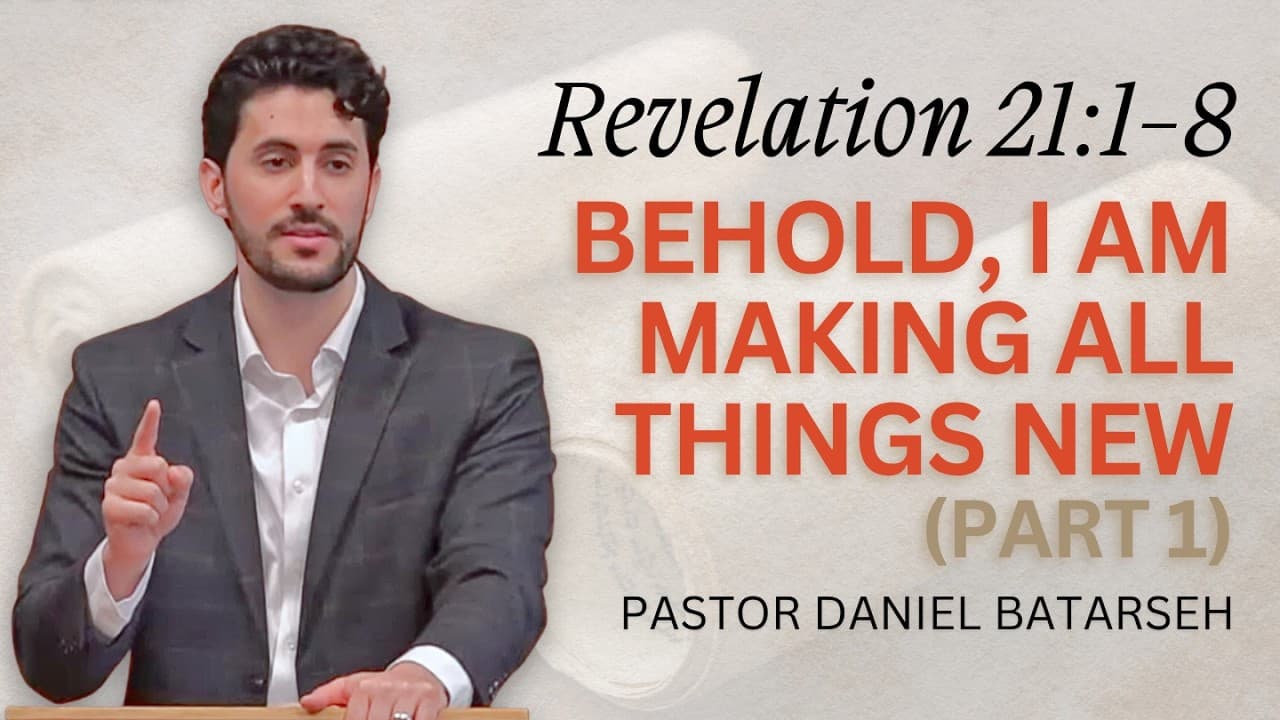
As Pastor Daniel Batarseh opened this first installment of a series on Revelation 21:1-8 — "Behold, I Am Making All Things New" — he didn't begin where you'd expect. He didn't start with the new heaven and the new earth. He started with the blood that made them possible.
The Copies Were Never the Point
The Old Testament sacrificial system was elaborate, bloody, and relentless. Year after year, the high priest entered the Most Holy Place with the blood of goats and calves. Year after year, the ritual repeated — because it never actually finished the job.
Hebrews 9 calls this entire system a "copy." The tabernacle? A copy. The sacrifices? Copies. The purification rites? Copies of copies. The writer isn't dismissing them — he's saying they were always pointing somewhere. They were architectural blueprints, not the building itself. They were the shadow, not the substance.
This is a distinction most casual readers miss. We tend to read the Old Testament sacrificial laws as primitive religion — as if ancient Israel was groping in the dark and God eventually upgraded the system. But Hebrews 9 says the opposite. The earthly tabernacle was modeled on a heavenly reality that already existed. The copies came second. Heaven came first.
So when the text says Christ "entered not into holy places made with hands, which are copies of the true things, but into heaven itself" (watch at 2:19), the force of that statement is enormous. Every priest before Jesus walked into a room designed to look like heaven. Jesus walked into heaven.
Every priest brought borrowed blood — the blood of animals that didn't choose to die. Jesus brought His own.
Every priest came back out and had to do it again next year. Jesus sat down.
"How Much More" — The Argument That Should Silence Every Doubt
There's a rhetorical move in Hebrews 9:13-14 that deserves to be carved into stone and placed wherever anxious Christians gather. The writer sets up a comparison — what scholars call an argument from lesser to greater — and it's devastating in the best possible way.
Here's the logic: If the blood of goats and bulls and the ashes of a heifer could purify the flesh — could make someone ceremonially clean on the outside — then "how much more will the blood of Christ, who through the eternal Spirit offered himself without blemish to God, purify our conscience from dead works to serve the living God" (watch at 1:06).
Catch the precision. Animal blood handled the outside. Christ's blood handles the conscience.
Animal blood addressed ritual impurity. Christ's blood addresses the thing that keeps you awake at three in the morning — the guilt, the shame, the nagging sense that you are not clean enough, not sorry enough, not changed enough to stand before a holy God.
The phrase "dead works" is worth pausing over. It doesn't just mean sins. It means the religious efforts we perform trying to earn what has already been given. The frantic spiritual activity that comes from a conscience that hasn't been quieted by the gospel. You can be busy for God and still be enslaved to dead works — if your busyness is driven by the fear that Christ's sacrifice wasn't quite enough for someone like you.
Hebrews says: it was enough. The blood of an animal — a creature with no moral agency, no will to sacrifice, no love for the sinner — even that blood had real purifying power under the old covenant. How much more the blood of the eternal Son, who chose the cross, who offered Himself "without blemish," who acted not under compulsion but through the eternal Spirit?
If the lesser sacrifice accomplished something real, the greater sacrifice accomplished something infinite.
Once for All — The Most Dangerous Phrase for Religious Performance
Three times in this passage, the writer emphasizes that Christ's sacrifice happened once. Not annually. Not repeatedly. Once.
"He entered once for all into the holy places" (v. 12). He "has appeared once for all at the end of the ages to put away sin" (v. 26). He was "offered once to bear the sins of many" (v. 28).
This repetition is intentional and confrontational. It confronts every system — religious or psychological — that requires you to keep paying for what has already been purchased. Every time you drag yourself back to the altar of your own guilt, convinced that this time you need to really mean it, that this time you need to cry harder or promise more sincerely — you are, functionally, denying the "once for all" of Hebrews 9.
The text even makes this explicit with a kind of reductio ad absurdum: if Christ's sacrifice wasn't sufficient, "then he would have had to suffer repeatedly since the foundation of the world" (v. 26). The logic is airtight. Either the cross worked, or Christ is still dying. There is no middle ground. There is no version of Christianity where Jesus mostly saved you and you have to supply the rest.
This doesn't mean obedience is irrelevant. It means obedience flows from a settled conscience, not a terrified one. You serve the living God — the text says so explicitly — but you serve Him from a purified conscience, not in order to obtain one.
The Question That Frames Everything
As the Scripture reading concluded and the congregation was called to worship, Pastor Daniel Batarseh posed a question that hung in the air like a lit match near dry timber: "Are you eagerly waiting for him?" (hear this moment).
It's a question drawn directly from Hebrews 9:28 — Christ "will appear a second time, not to deal with sin, but to save those who are eagerly waiting for him." And it's a question that divides the room more honestly than any theological quiz ever could.
Because here's the truth: many of us are not eagerly waiting. We are nervously waiting. Or we are not waiting at all — we are building, acquiring, scrolling, and planning as though this world is the main event and eternity is the afterparty.
The connection to Revelation 21 is unmistakable. "Behold, I am making all things new" — those words from the throne are the answer to every groan of creation, every tear shed in the dark, every funeral, every diagnosis, every marriage that shattered, every child who wandered. But that promise lands differently depending on whether you are eagerly waiting or merely aware.
Eager waiting is not passive. It's the posture of someone who has tasted enough of Christ to know that what's coming is better than what's here. It's the widow who loved her husband deeply but knows the resurrection will not diminish that love — it will complete it. It's the missionary who spent forty years in obscurity and never saw the harvest, but who knows the Lord of the harvest keeps His books perfectly. It's the cancer patient who weeps honestly about leaving her children but who can say, with trembling voice, "To depart and be with Christ is far better."
Are you eagerly waiting?
Or have you made yourself so comfortable in the copy that you've forgotten about the original?
Hebrews 9 was read before a sermon on Revelation 21 for a reason. The new creation — the new heaven, the new earth, the wiping away of every tear — none of it happens without blood. Specifically, without His blood. The Lamb who was slain is the architect of the world to come. The cross is not just how you get forgiven. It is how the cosmos gets remade.
And if that blood was sufficient to purify heaven itself (Heb. 9:23), it is more than sufficient to purify you.
What to Remember
- The Old Testament tabernacle was a copy of a heavenly reality — Christ didn't enter a replica; He entered heaven itself with His own blood.
- "How much more" is the argument that should end every anxious night: if animal blood purified the flesh, Christ's blood purifies the conscience.
- "Once for all" means you can stop re-sacrificing. The cross is not a down payment — it is full purchase.
- Dead works are not just sins — they include the religious performance driven by a conscience that hasn't rested in the finished work of Christ.
- Christ's second coming will not be to deal with sin again. That is done. He is coming to save, to complete, to make all things new.
- The honest question is not "Do you believe He's coming back?" but "Are you eagerly waiting for Him?"
Questions to Sit With
- If the blood of Christ truly purifies the conscience, why do you keep returning to guilt over sins you've already confessed? What would it look like to actually believe Hebrews 9:14 tomorrow morning?
- What in your life reveals that you are building for permanence in a world that Revelation 21 says is passing away?
- "Are you eagerly waiting for Him?" — answer honestly. If not, what has replaced that eagerness, and when did the exchange happen?
- The text says Christ offered Himself "through the eternal Spirit" and "without blemish." What does it mean that His sacrifice was voluntary and perfect — and why does that matter more than the fact that it was painful?
- If someone watched your weekly calendar and your bank statement, would they conclude you are living for the copy or the original?
Scripture Referenced
This summary was generated by AI from the sermon "Behold, I Am Making All Things New (Part 1) | Revelation 21:1-8 | Pastor Daniel Batarseh (10/4/26)" preached by Pastor Daniel Batarseh at Maranatha Bible Church Chicago. Watch the full sermon →
Preached by
Pastor Daniel BatarsehSenior Pastor
This summary was generated by AI from the sermon transcript.
Based on the sermon
Behold, I Am Making All Things New (Part 1) | Revelation 21:1-8 | Pastor Daniel Batarseh (10/4/26)
Watch Full SermonRelated Articles
What the New Jerusalem Reveals About Your Future (Rev 21)
Pastor Daniel Batarseh · October 18, 2026
What the New Jerusalem Reveals About Eternity (Rev 21:9-27)
Pastor Daniel Batarseh · October 18, 2026
What Revelation 21 Says About Heaven That You've Never Noticed
Pastor Daniel Batarseh · October 11, 2026