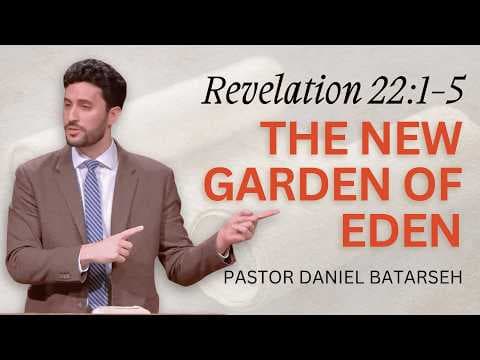
Revelation 22 isn't just a vision of heaven — it's the Garden of Eden restored, expanded, and made permanent. Everything Adam forfeited, Christ purchased back.
We fell at a tree. Jesus conquered on a tree. And one day, we will eat from a tree in a world where eating is no longer associated with curse but with unending life.
That single thread — tree to tree to tree — runs from the opening pages of Genesis to the closing verses of Revelation, and it tells the whole story of redemption in miniature. Most people read Revelation 22:1-5 as a dreamy postcard of heaven: crystal rivers, golden streets, eternal light. But look closer. What the apostle John is actually describing is the Garden of Eden — expanded, perfected, and made permanently irreversible. Every detail in these five verses answers something that went wrong in Genesis 3. The river, the tree, the unmediated presence of God, the reign of his people, the absence of curse — all of it is restoration language. But it's more than restoration. As Pastor Daniel Batarseh put it in his exposition of this passage, "This is not just a restoration. This is a glorious renovation" (watch at 2:08).
And the details of that renovation will make you lean forward.
A River That Tells You What God's Presence Feels Like
John's tour of the New Jerusalem reaches its climax with a river — "the river of the water of life, bright as crystal, flowing from the throne of God and of the Lamb." If that language sounds familiar, it should. Genesis 2:10 records a river flowing out of Eden to water the garden. Ezekiel 47 describes a river issuing from a future temple that has never yet existed. And now, at the end of all things, a river flows from the very throne of God.
The Holy Spirit is clearly drawing a line through history with this image. But what does it mean?
John himself gives us the dictionary. In John chapter 4, Jesus tells the Samaritan woman that whoever drinks the water he gives will never thirst again. In John 7:38-39, Jesus describes the indwelling Holy Spirit as "rivers of living water" flowing from the believer's heart. So when we encounter this river in Revelation 22, we're not encountering a new idea. We're encountering the fulfillment of every promise Jesus ever made about spiritual satisfaction.
This river is a symbol of the all-satisfying, ever-enduring, life-giving fullness that comes from the presence of God. In the new creation, we will drink directly from the source — no intermediary, no dimness, no interruption.
But why a river specifically? Why not a lake, or a well, or a fountain?
Because a river signifies abundance. Picture it: a wide, cold, gushing river. Does stagnation come to mind? Does scarcity? No. You stand on the bank and you perceive an inexhaustible source of life. That's the point. God's presence will never run low. It will never thin out. It will never become routine.
David knew this centuries before John ever saw the vision. Psalm 36:8 says, "They feast on the abundance of your house, and you give them drink from the river of your delights." Psalm 46:4 prophesies, "There is a river whose streams make glad the city of God, the holy habitation of the Most High." That prophecy finds its ultimate fulfillment in the New Jerusalem. We will drink from that river one day.
And here's something worth noting: some scholars argue that this river is actually a representation of the Holy Spirit himself. If so, then you have a stunning portrait of the Trinity in a single verse — the throne of the Father, the Lamb beside him, and the Spirit flowing out from them both into the city. Either way, the message is the same: we will be immersed in God, and we will never want for anything again.
The Tree of Life Is Not What You Think It Is
The tree of life appears on either side of the river, so massive that its branches can be reached from any direction. It bears twelve kinds of fruit, yielding a different fruit each month. And its leaves, John says, are "for the healing of the nations."
This immediately raises questions. If we're in eternity, why are there months? If there's no more pain or death (Revelation 21:4), why do the nations need healing? These aren't trivial questions — some interpreters use them to argue that this passage doesn't describe the eternal state at all, but rather the millennium or even a symbolic picture of present salvation.
But verse 3 settles it: "No longer will there be anything accursed." That single line eliminates the millennium as a possibility. During Christ's thousand-year reign on earth, conditions will be extraordinary — but not perfect. Isaiah 65:20 describes the millennial age and still mentions that "the sinner a hundred years old shall be accursed." Isaiah 65:25 paints the famous picture of the wolf and the lamb grazing together, the lion eating straw — but then adds, "and dust shall be the serpent's food." That's not a change. That's a continuation of the curse from Genesis 3:14 (hear this moment). Even in the millennium, a residue of rebellion remains. Only in the eternal state is every trace of curse finally, permanently erased.
So what do we do with the months and the healing?
The mention of months is likely what theologians call an accommodation — a familiar reference point to help finite minds grasp an infinite reality. The same way Scripture attributes nostrils and arms to God (who is spirit), it uses temporal language to communicate something about the quality of eternal life: variety, anticipation, dynamic experience. Heaven will not be static. It will not be dull. Even one tree will offer a diverse buffet of blessings — a different fruit every month. That alone should dismantle the tired caricature of eternity as an endless, monotonous church service.
As for the healing, the Greek word is therapeia — the root of our English word "therapy." It doesn't necessarily mean treating illness. It points to enrichment, to well-being, to the continual enhancement of our existence. Think of how Jesus ate after his resurrection. Did his glorified body need food? No. But he ate anyway — because there is pleasure in it. The leaves of this tree will function the same way: not solving a problem, but adding to a bliss that never peaks and never fades.
And then there's the theological poetry of it all. What act of rebellion brought sin into the world? Eating. Eating a forbidden fruit from a forbidden tree. And what do we find in the new world? Eating — but now connected to life and blessing instead of curse and death. As the sermon drove home: "We all fell at a tree. Jesus conquered on a tree. And we will be eating from a tree in a new world" (watch at 27:32). What a reversal. What a triumph.
Seeing His Face Means Knowing His Heart
Of all the glories described in these five verses, one stands above the rest: "They will see his face."
What Moses was denied in Exodus 33 — "You cannot see my face, for no man shall see me and live" — will be freely given to every redeemed person in the new creation. We will see God's face and live. In fact, it will be our very source of life.
But this means far more than visual access to God. It means intimacy without barrier. It means communication without mediator. When you look someone in the face, there is a closeness that no other posture can replicate. That's what's being promised here — unbroken, unhindered, face-to-face fellowship with the living God.
Paul takes this even further in 1 Corinthians 13:12: "For now we see in a mirror dimly, but then face to face. Now I know in part; then I shall know fully, even as I have been fully known." This verse stopped the sermon in its tracks (watch at 30:33). Paul is saying that seeing God face to face will unlock a depth of knowledge we have never experienced — not omniscience, but an understanding of God's love, wisdom, sovereignty, mercy, and compassion that no teacher, no commentary, no lifetime of study has been able to fully convey.
Consider the implications. How well does God know you? Completely. Exhaustively. Down to the number of hairs on your head and the thoughts you haven't yet formed. Paul says there is a day coming when we will know God with that same depth of clarity. Not infinite knowledge — but zero confusion about his character. Zero uncertainty about his ways.
Now consider this: if you've ever experienced a jolt of joy when a verse suddenly opened up to you in a new way — when a cross-reference clicked, when a truth landed in your chest and you couldn't sit still — that was you looking into a dim mirror. As Pastor Daniel Batarseh said with palpable intensity: "If that's how you and I experience the joy of truth, though we look into it dimly, what will happen to us when the veil is completely removed and we will know fully?" (hear this moment). The answer, he suggested, is unending praise and the eruption of unending joy. You'll never reach a limit. God is eternal. Just when you think you've grasped it, something new will open — and a fresh explosion of adoration will follow.
This is why verse 5 can say with such finality that there will be no need for sun or lamp. Light is sweet — Ecclesiastes 11:7 says so plainly: "Light is sweet, and it is pleasant for the eyes to see the sun." We know this instinctively. A sunny day after a gray week lifts something in us. But if natural light can do that, what will the unfiltered light of God's presence do? Every good thing the sun ever gave you was a faint preview of what's coming.
The River That Settles Every Restless Soul
The sermon closed not with more information but with an invitation — and it was as direct as anything you'll hear from a pulpit. The water of life, the tree, the face of God, the eternal light — none of it is available to the person who hasn't been cleansed by the blood of the Lamb.
And the appeal was aimed squarely at the restless soul: the one who gets a small rush from a promotion, a fleeting thrill from a new purchase, a momentary satisfaction from a relationship — and then finds themselves empty again. Always searching. Always dissatisfied. "Is there something that can settle my restlessness? Is there something that can quench my thirst? Yes. Living water. The water of life. The presence of God flooding your soul" (watch at 39:19).
But the order matters: "Get the cleansing before you get the water of life. Let him wash you with his blood so that you can drink from this river."
Everything in Revelation 22:1-5 was purchased at the cross. The river, the tree, the face, the light, the reign — all of it flows from the finished work of Christ. And it is offered freely to anyone who will repent and believe.
What to Remember
- Revelation 22:1-5 is not a vague picture of heaven — it is the Garden of Eden restored, expanded, and made eternally irreversible, with every consequence of Adam's fall finally undone.
- The river of the water of life represents the inexhaustible, all-satisfying presence of God — the same "living water" Jesus promised the Samaritan woman, now flowing in its fullness forever.
- The tree of life bearing twelve fruits each month tells us that eternity will be marked by variety, anticipation, and dynamic experience — not monotony or boredom.
- "They will see his face" means more than visual access to God — it means knowing his heart with the same depth and clarity with which he has always known ours (1 Corinthians 13:12).
- Everything we enjoy about natural light — the sweetness of a sunny day, the lift in our spirits — is a dim preview of what it will mean to walk in God's unfiltered light forever.
- Every blessing described in these verses was purchased by the blood of the Lamb and is freely offered to anyone who repents and believes.
Questions to Sit With
- If the joy you feel when a single verse opens up to you is just a dim mirror, what does that tell you about what's waiting on the other side — and are you living in light of it?
- What "cisterns" are you still drinking from — promotions, purchases, relationships, experiences — that leave you thirsty again within days? What would it look like to actually stop going back to them?
- The curse entered the world through eating. The curse is reversed in a world where eating brings life. What does this reversal reveal about how thoroughly God redeems — not just removing the bad, but transforming the very thing that broke us?
- If you will one day know God as fully as he knows you, how should that change the way you respond to the parts of his character you currently find confusing or uncomfortable?
- Moses was denied the sight of God's face. You are promised it. What have you done with that promise this week?
Scripture Referenced
- Revelation 22:1-5 (primary passage)
- Genesis 2:10
- Genesis 3:14
- Psalm 36:8
- Psalm 46:4
- Ecclesiastes 11:7
- Isaiah 65:20, 25
- Ezekiel 47
- John 4:10-14
- John 7:38-39
- Exodus 33
- 1 Corinthians 13:12
- Revelation 21
This summary was generated by AI from the sermon "The New Garden of Eden | Revelation 22:1-5 | Pastor Daniel Batarseh (11/1/26)" preached by Pastor Daniel Batarseh at Maranatha Bible Church Chicago. Watch the full sermon →
Preached by
Pastor Daniel BatarsehSenior Pastor
This summary was generated by AI from the sermon transcript.
Based on the sermon
The New Garden of Eden | Revelation 22:1-5 | Pastor Daniel Batarseh (11/1/26)
Watch Full SermonRelated Articles
What Jesus' "I Am" Statements in Revelation 22 Actually Claim
Pastor Daniel Batarseh · November 15, 2026
Why Dismissing Revelation Means Questioning Christ Himself
Pastor Daniel Batarseh · November 8, 2026
Are You Worthy of the New Jerusalem? (Revelation 21:15-27)
Pastor Daniel Batarseh · October 25, 2026