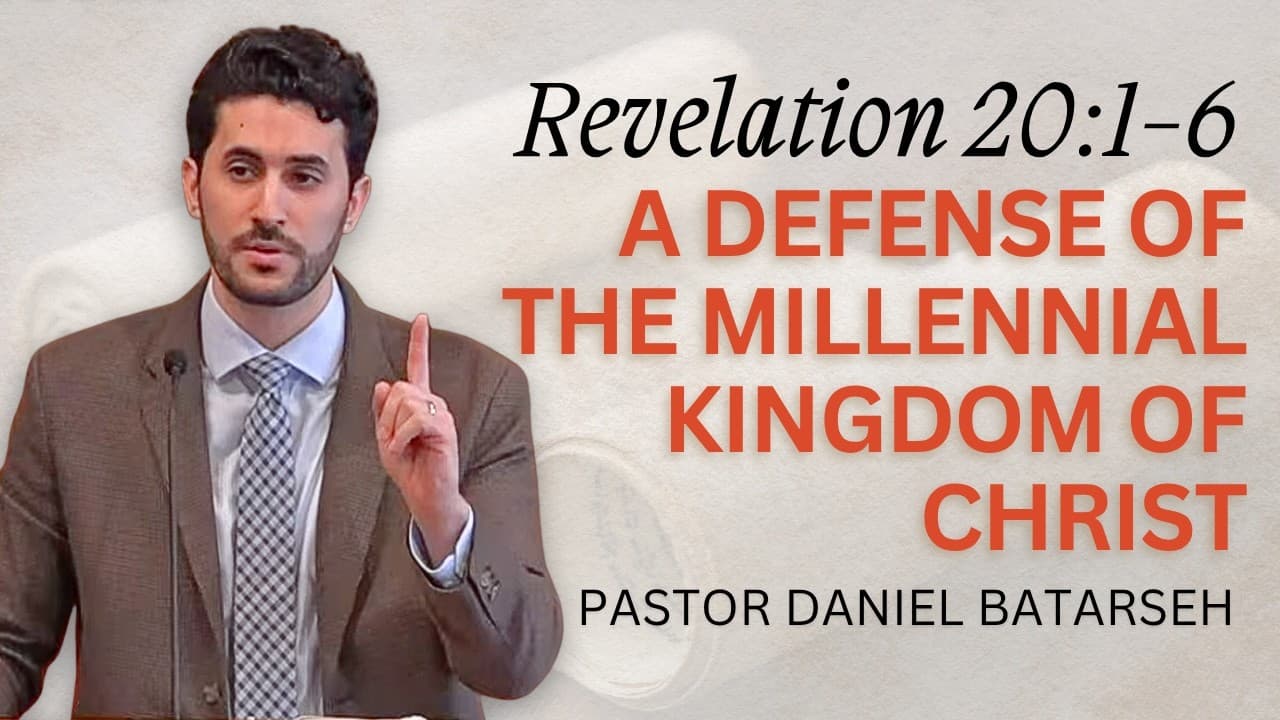
Revelation 20 repeats 'a thousand years' six times. Five compelling reasons from the text itself show why this points to a future, literal reign of Christ on earth.
Have you ever tasted something so good — so peaceful, so saturated with the presence of God — that you wanted it to last forever? A retreat weekend. A worship service where heaven felt close enough to touch. A conversation with believers where the world's noise went silent for a few hours.
Now imagine that atmosphere covering not a conference center, but the entire globe. Not for three days, but for a thousand years. Uninterrupted.
That is what Revelation 20:1–6 promises. And it is one of the most contested passages in the entire Bible. The question is not whether the text says "a thousand years" — it says it six times. The question is whether we will take it at face value. Pastor Daniel Batarseh walked through five reasons why Revelation 20 describes an actual, future, earthly kingdom ruled by Christ after His return — and the case is stronger than most people realize.
The Book of Revelation Has a Direction, and You Can't Rearrange It
One of the first things that gets sacrificed when interpreters try to spiritualize the millennium is the chronological flow of Revelation itself. If you've read the book from chapter 1 to chapter 22, you've felt it — there is a forward-moving narrative. John uses transitional phrases like "after this I looked," "then I saw," and "then I heard" to carry us through a sequence of events. Revelation 20:1 begins with exactly that kind of language: "Then I saw an angel coming down from heaven."
What comes right before this? Revelation 19 — Christ breaking open the heavens on a white horse, destroying the Antichrist and the false prophet, and slaying the armies that allied with them. What comes after Revelation 20? Chapters 21 and 22 — the new heavens and the new earth, the eternal state.
The sequence is unmistakable: tribulation (chapters 6–18), Christ's return (chapter 19), the millennial kingdom (chapter 20), and then eternity (chapters 21–22). As the sermon put it plainly: "The only way you can make this say something else is if you just massage it and bend it to the point where it's out of place, chronologically speaking" (watch at 18:06).
Chapter divisions were added in the thirteenth century. They're helpful for navigation, but they can trick us into reading Revelation 20 as if it's a standalone unit disconnected from what John just described in chapter 19. It isn't. John didn't put a break there. He said, "Then I saw." That's a continuation, not a reset.
Six Repetitions of "A Thousand Years" Is Not an Accident
The phrase "a thousand years" appears in Revelation 20:2, 3, 4, 5, 6, and again in verse 7. Six times in seven verses. If the Holy Spirit wanted to communicate an indefinite, symbolic period of time, this is a remarkably clumsy way to do it.
The standard objection is that Revelation is a symbolic book, so numbers should be taken symbolically. Fair enough — Revelation is loaded with symbolism. But not everything in a symbolic book is symbolic. And here's where the argument starts to buckle under its own weight.
Consider Revelation 11:3: "And I will grant authority to my two witnesses, and they will prophesy for one thousand two hundred and sixty days." Is that literal? Most interpreters — including amillennialists — treat it as a real duration. What about the "three and a half days" in Revelation 11:9 when the nations gaze at the dead bodies of the two witnesses? What about the seven churches? The four living creatures? The one-third of the earth destroyed under certain judgments? If those numbers are actual numbers, what grounds do we have for converting "a thousand years" into a metaphor for "a long time"?
There's another angle that deserves more attention. If John wanted to describe an indefinite period of time, he knew how. In the very same passage — Revelation 20:3 — he writes that Satan will be released "for a little while." No number. No specificity. Just "a little while." John was perfectly capable of being vague when the Spirit led him to be vague. He was specific about a thousand years because a thousand years is what he meant.
And if a thousand is simply a rounded number for "a long time," why not use a bigger one? Revelation already gives us 144,000 and "twice ten thousand times ten thousand." A thousand is not the book's go-to number for "really big." It's a precise, repeated, intentional figure. "Give me some answers. Give me some evidence," as the challenge was put from the pulpit (hear this moment).
A Chained Satan Who Prowls Like a Lion?
Here is where the non-premillennial positions face their most uncomfortable tension.
Both amillennialism and postmillennialism teach that Satan's binding in Revelation 20:2–3 refers to his defeat at the cross. The idea is that since Christ's death and resurrection, Satan has been restricted from preventing the gospel's spread to the nations. He's still active, they acknowledge, but he's on a leash — unable to keep the nations in the pre-gospel darkness they once inhabited.
Read the text again slowly: "He seized the dragon, that ancient serpent who is the devil and Satan, and bound him for a thousand years, and threw him into the pit and shut it, and sealed it over him, so that he might not deceive the nations any longer."
Bound. Thrown into a pit. Shut. Sealed. That is not the language of partial restriction. That is total incarceration.
Now hold that imagery in your mind and read what the rest of the New Testament says about Satan's activity after the cross:
- 2 Corinthians 4:4 — "The god of this world has blinded the minds of unbelievers to keep them from seeing the light of the gospel."
- 1 Thessalonians 2:18 — "We wanted to come to you... but Satan hindered us."
- 2 Timothy 2:25–26 — False teachers are described as having been "captured by him to do his will."
- 1 Peter 5:8 — "Your adversary the devil prowls around like a roaring lion, seeking someone to devour."
As Pastor Batarseh put it with sharp wit: "As one preacher said it, that must be a long chain that Satan has" (watch at 30:37). A Satan who is blinding minds, hindering apostles, capturing false teachers, and devouring believers is not a Satan who has been thrown into a sealed pit. Something doesn't add up — unless the binding described in Revelation 20 hasn't happened yet.
And there's a further problem. Revelation 20:3 says that after the thousand years, Satan "must be released for a little while." Verses 7–9 describe what happens when he is released: he deceives the nations at the four corners of the earth, gathers them for war, and they surround "the beloved city" before fire from heaven consumes them. This is not a slight uptick in spiritual deception before Christ returns. This is a global military campaign against a physical city. If the binding is symbolic, the release must be symbolic too. And if the release is symbolic, what do you do with the army, the siege, the fire from heaven?
You either take it all literally or you spiritualize the entire passage. And if you spiritualize the entire passage, you've created a gap in the middle of an otherwise literal sequence — Christ's literal return in chapter 19, the literal eternal state in chapters 21–22, and a figurative chapter 20 sandwiched between them.
Dead Believers Don't Need to Be Born Again
This may be the most decisive point in the entire debate, and it deserves careful attention.
Revelation 20:4 says John saw "the souls of those who had been beheaded for the testimony of Jesus and for the word of God." These are martyrs — tribulation saints who refused the mark of the beast and paid for it with their lives. They were believers before they died. And then the text says: "They came to life and reigned with Christ for a thousand years."
If "came to life" means spiritual regeneration — being born again — then we have a serious problem. These people were already believers. They died because of their faith. You cannot describe someone who was beheaded for the testimony of Jesus as an unbeliever who then gets saved. The coming to life here is not conversion. It is resurrection. Bodies returning to life.
Verse 5 makes this even more airtight: "The rest of the dead did not come to life until the thousand years were ended. This is the first resurrection." The phrase "the rest of the dead" assumes that the people described in verse 4 were also dead — physically dead. And their coming to life is called "the first resurrection," distinguishing it from a second resurrection that will occur after the thousand years.
If this is regeneration, then what is "the rest of the dead" experiencing? A second regeneration? The language collapses under the weight of a spiritual interpretation. But if this is a bodily resurrection — the kind of resurrection that is a cornerstone of Christian hope — everything fits. Believers who died during the tribulation are raised to reign with Christ for a thousand years. The rest of the dead are raised later for final judgment. Two resurrections. One before the millennium, one after.
The choice you make here determines everything. "Is John referring to coming alive spiritually, or is he describing a future experience? Once you answer that question, you make a great leap towards the premillennial position" (hear this moment).
The Old Testament Already Described a World That Doesn't Fit Heaven or Earth
Revelation 20 did not invent the millennium. It confirmed what the prophets had been saying for centuries.
Isaiah 65:17–25 is one of the most striking examples. The passage begins with language about new heavens and a new earth — clearly pointing toward the eternal state. But then it describes something that doesn't match eternity at all. There is death: "the young man shall die a hundred years old." There are sinners: "the sinner a hundred years old shall be accursed." People build houses, plant vineyards, bear children. Wolves and lambs graze together. Lions eat straw.
This is not our current world — no one lives to see a hundred as "young," and wolves don't graze with lambs. But it's not the eternal state either — there's no death in heaven, no sinners, no curse. It is a third category. A transitional age. A kingdom on earth ruled from God's "holy mountain" where the effects of the curse are dramatically rolled back but not yet fully removed.
Zechariah 14 paints the same picture. After Christ returns to the Mount of Olives and destroys the armies surrounding Jerusalem, verse 9 declares: "The LORD will be king over all the earth." But then verses 16–19 describe nations going up to Jerusalem year after year to worship — and if they refuse, they get no rain. If Egypt doesn't come, they receive plagues.
Disobedience. Consequences. Drought as punishment. This cannot be heaven. As the sermon pressed with urgency: "If you say yes, then you have to also admit that there's disobedience in heaven. Are you ready to admit that?" (watch at 48:55).
Even Jesus Himself pointed to this kingdom. In Matthew 19:28, He told His apostles that in "the new world" — the Greek word is palingenesia, a regeneration of the world itself — they would sit on twelve thrones judging the twelve tribes of Israel. That never happened in their lifetimes. It doesn't describe heaven. It describes a future earthly reign.
And in Acts 1:3–7, after spending forty days teaching about the kingdom of God, the disciples' first question was: "Lord, will you at this time restore the kingdom to Israel?" Jesus didn't correct their expectation. He corrected their timing. These were men whose minds had been opened by Christ Himself to understand the Scriptures (Luke 24:45). Their question wasn't ignorance. It was the natural conclusion of everything Jesus had taught them.
What to Remember
- Revelation 20 sits in a clear chronological sequence: Christ returns in chapter 19, the kingdom is established in chapter 20, and eternity begins in chapters 21–22. Rearranging this order requires assumptions the text doesn't support.
- "A thousand years" is repeated six times in seven verses. John knew how to be vague — he uses "a little while" in the same passage. The repetition is intentional precision, not symbolic decoration.
- The New Testament describes Satan after the cross as blinding minds, hindering apostles, capturing people, and prowling like a roaring lion. That is not the profile of a being who has been thrown into a sealed pit.
- The martyrs in Revelation 20:4 were already believers when they died. Their "coming to life" cannot mean conversion — it must mean bodily resurrection, which is the plain reading of the text.
- The Old Testament prophets described a future world with death, sinners, agricultural life, and animal transformation — a world that fits neither our present age nor the eternal state. The millennium is the only category that accounts for these prophecies.
Questions to Sit With
- If you hold a non-premillennial view, can you explain what Satan's "release" in Revelation 20:7 means within your framework — and how it leads to a global military siege of a physical city?
- When Jesus spent forty days teaching about the kingdom of God and His disciples asked about Israel's restoration, why didn't He correct their expectation? What does that silence tell you?
- Where do you place Isaiah 65:20 — a world where dying at a hundred is considered young and sinners still exist? If it's not now and it's not heaven, what is it?
- Are you willing to let the text say what it says, even if the implications are unpopular or politically inconvenient in our cultural moment?
- If a thousand-year reign of Christ on earth is real, how should that shape what you hope for — and how you endure today?
Scripture Referenced
- Revelation 20:1–6 (primary text)
- Revelation 20:7–9
- Revelation 11:3
- Revelation 11:9
- Revelation 7:4
- Revelation 9:16
- 2 Corinthians 4:4
- 1 Thessalonians 2:18
- 2 Timothy 2:25–26
- 1 Peter 5:8
- Isaiah 65:17–25
- Zechariah 14:9, 16–19
- Matthew 19:28
- Acts 1:3, 6–7
- Luke 24:45
This summary was generated by AI from the sermon "A Defense of The Millennial Kingdom of Christ | Revelation 20:1-6 | Pastor Daniel Batarseh (9/6/26)" preached by Pastor Daniel Batarseh at Maranatha Bible Church Chicago. Watch the full sermon →
Preached by
Pastor Daniel BatarsehSenior Pastor
This summary was generated by AI from the sermon transcript.

Based on the sermon
A Defense of The Millennial Kingdom of Christ | Revelation 20:1-6 | Pastor Daniel Batarseh (9/6/26)
Watch Full SermonRelated Articles
What the New Jerusalem Reveals About Your Future (Rev 21)
Pastor Daniel Batarseh · October 18, 2026
What the New Jerusalem Reveals About Eternity (Rev 21:9-27)
Pastor Daniel Batarseh · October 18, 2026
What Revelation 21 Says About Heaven That You've Never Noticed
Pastor Daniel Batarseh · October 11, 2026