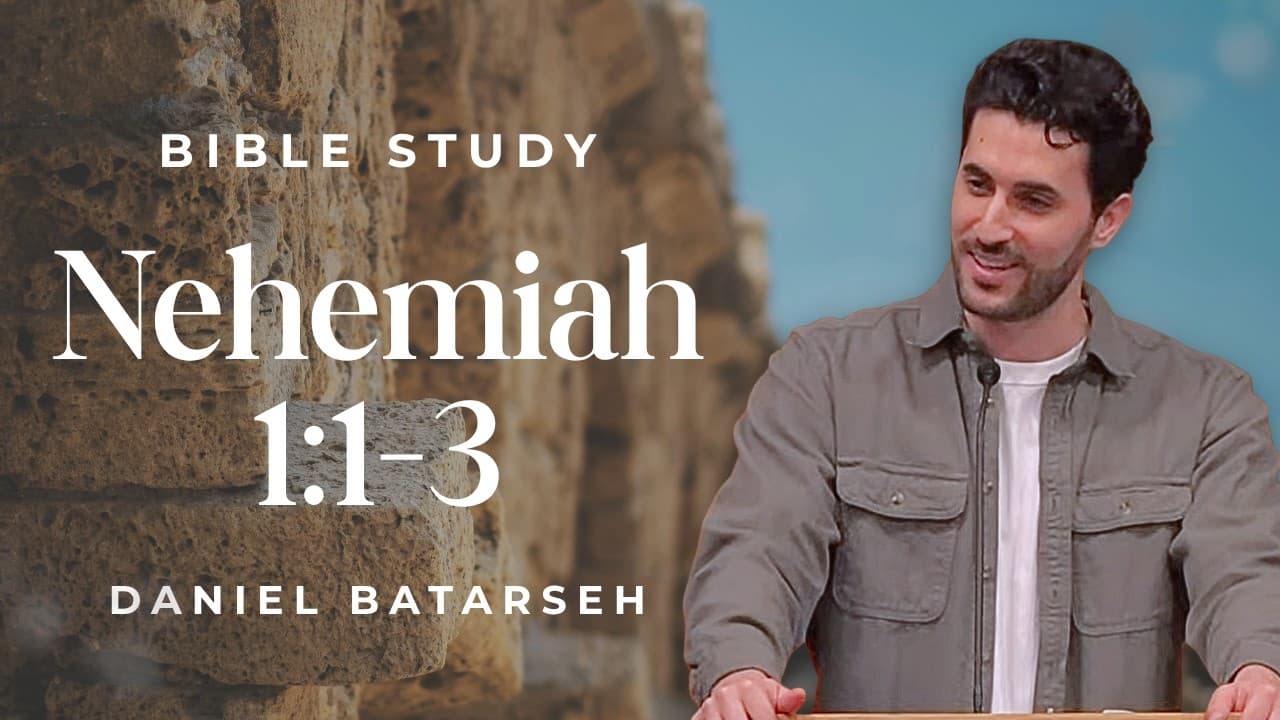
Nehemiah had no pedigree, no priestly line, no royal blood. But he had character and a heart that burned for God's people — and that's exactly the profile God was looking for.
Most people open Nehemiah when their church is about to build something. It's become the go-to book for capital campaigns and construction timelines — the ancient blueprint for getting a big project done fast. And while there's nothing wrong with drawing that kind of inspiration from the text, reducing Nehemiah to a building manual is like reading the Gospels for management tips. You'll find some. But you'll miss the Person at the center.
Nehemiah 1:1–3 introduces us to a man with no royal blood, no priestly credentials, and no prior ministry experience — just a cupbearer in a Persian palace who couldn't stop thinking about a city he'd never seen. What unfolds in these three verses is not the start of a construction project. It's the anatomy of how God prepares a leader from the inside out, long before anyone hands him a blueprint.
No Royal Blood, No Priestly Line — Just a Name and a Father
The opening line is almost comically sparse: "The words of Nehemiah the son of Hacaliah." That's it. No tribe listed. No genealogy. No impressive lineage stretching back to David or Aaron.
This is striking when you consider the two men who came before him in this restoration story. Zerubbabel had David's blood in his veins — you can trace his line straight back to the throne of Israel. Ezra was a priest, descended from Aaron himself, a man whose entire identity was wrapped up in the law and the temple. Both of them had the kind of résumé that made their callings feel almost inevitable.
Then comes Nehemiah. A nobody, by those standards. His father Hacaliah appears nowhere else in Scripture. There's no tribe claimed, no heritage celebrated. And yet this is the man God chose to lead the third and final movement of restoration for the Jewish exiles.
As Pastor Daniel Batarseh put it: "From time to time, you know what the Lord does? He often surprises the world and even his own people by whom he chooses to use to do great things for his name. And Nehemiah is one of those surprises" (watch at 44:07).
But here's the critical nuance: God can use anyone, yes — but that doesn't mean God uses everyone. Nehemiah couldn't control which family he was born into. He couldn't manufacture a pedigree. But he could control who he became. And by the time we meet him, he's risen to one of the most trusted positions in the entire Persian Empire.
The name itself is worth pausing over. Nehemiah means "the Lord comforts." His parents — exiles in a foreign land, far from the promises of God — looked at their newborn son and named him after divine consolation. Maybe they were simply grateful for the comfort his arrival brought them. But maybe they dared to hope that this boy would become an extension of God's comfort to others. If so, they had no idea how literally that prayer would be answered.
A Cupbearer Who Could Be Killed Any Morning
Verse 11 drops a detail almost as an afterthought: "Now I was cupbearer to the king." In our ears, that sounds like a glorified butler. In the ancient Persian court, it was anything but.
A cupbearer's job was to taste the king's wine before the king drank it. Every. Single. Day. If the wine was poisoned, the cupbearer died instead of the monarch. This was not a ceremonial role. It was a death-defying act of loyalty performed on a daily basis. And it meant that the man filling it had to be someone the king trusted with his life — literally.
So Nehemiah wasn't just employed in the palace. He was one of the closest people to King Artaxerxes in the entire kingdom. He had proximity to power, access to conversations, and a relationship built on years of proven integrity. The ancient historian Herodotus and other sources confirm that cupbearers often became confidants and advisors — men whose counsel kings actually sought.
This tells us something essential about how God prepares people for their callings. Nehemiah's character wasn't developed in a seminary classroom or a ministry internship. It was forged in a secular role, in a pagan court, under a foreign king. And it was precisely that character — that track record of reliability, honesty, and faithfulness in the mundane — that positioned him for everything that was about to happen.
If Nehemiah had been sketchy, inconsistent, or untrustworthy, the entire mission would have been dead on arrival. He never would have had the king's ear in chapter 2. He never would have received permission, resources, or letters of safe passage. Character came first. The calling came second.
Born in Exile, Burdened for a City He'd Never Seen
Here is what made the room lean forward. Verse 2 reads: "Hanani, one of my brothers, came with certain men from Judah. And I asked them concerning the Jews who escaped, who had survived the exile, and concerning Jerusalem."
Notice: Nehemiah is the one who asks. His brother and these men arrive from Judah, and before they can even settle in, Nehemiah is pressing them — What's happening with the people? What condition is the city in?
This is a man living in a Persian palace. He has proximity to royalty, comfort, security, influence. He could have been entirely consumed by his career and the advantages it offered. And yet his heart was somewhere else entirely. His mind was fixed on a people in distress and a city in ruins — a city, remarkably, that he had never once visited. Nehemiah was born in exile. He never walked the streets of Jerusalem, never saw the temple, never tasted the milk and honey Moses promised. Everything he knew about the holy city came from Scripture and from the stories passed down by his parents and community.
And still it burned in him.
"One of the ways that you and I can determine if our souls are healthy in the midst of success," the teaching pressed, "is if you can honestly identify a genuine, sincere concern for that which God cares about" (hear this moment).
That observation cuts deep. Because the test of spiritual health isn't whether you attend church or read your Bible — it's whether, in the middle of your promotions and your comfort and your personal momentum, you still care about the things God cares about. Do the needs of God's people move you? Does the state of the church — not just your church, but the church — register in your heart? Or has success quietly anesthetized you?
There's a parallel here that's impossible to ignore. In Acts 7:22–23, Stephen describes Moses in almost identical terms: "Moses was instructed in all the wisdom of the Egyptians, and he was mighty in his words and deeds. When he was forty years old, it came into his heart to visit his brothers, the children of Israel" (watch at 57:13). Born in a foreign land. Raised in privilege. Holding a position of influence among the powerful. And yet something came into his heart — an ache for the welfare of God's people that no amount of Egyptian prestige could smother. Both Moses and Nehemiah prove the same principle: God uses people whose hearts are already aimed at what He loves, long before He gives them their official assignment.
And notice the order of Nehemiah's inquiry. He asks about the people first, then the city. The Jews who survived — how are they? And then, almost secondarily, what about Jerusalem? This is the instinct of a true leader. The stones matter, but the souls matter more.
A City Without Walls Is a Soul Without Self-Control
The report comes back devastating: "The remnant there in the province who had survived the exile is in great trouble and shame. The wall of Jerusalem is broken down, and its gates are destroyed by fire" (Nehemiah 1:3).
For a modern reader, broken walls sound like a construction inconvenience. For an ancient Jew, it was an existential catastrophe. A city without walls was defenseless — open to raiders, invaders, predators of every kind. It was so unthinkable that it became a proverb. Proverbs 25:28 says: "A man without self-control is like a city broken into and left without walls" (watch at 65:55).
That connection reframes the entire book. The walls of Jerusalem weren't just military infrastructure. They were a safeguard for the people's hearts. Without them, the surrounding culture poured in unchecked. And we see exactly that in Nehemiah 13:20–21, where merchants and sellers camped outside the rebuilt walls on the Sabbath, trying to lure the people of God into breaking their rest with commerce. Even after the walls went up, the pressure was relentless. Without them, it would have been overwhelming.
The application here is uncomfortably direct. If a city without walls is like a person without self-control, then the question for every one of us is: What walls have you built around your own heart? What practical barriers exist between you and the temptations that keep defeating you? Or are you living like Jerusalem in ruins — exposed, vulnerable, wondering why the enemy keeps walking right in?
A story from seminary drove this home. In a spiritual discipleship class, students were paired as accountability partners. One young man kept falling into the same sexual sin, week after week, confession after confession. Finally, his partner looked him in the eyes and said something that most of us would be too polite to say: "The reason you're not overcoming this is because you don't hate your sin enough. You actually love it." The man receiving that observation was honest enough to admit it was true. And that honesty — that moment of genuine, God-inspired burden rather than routine guilt — became the turning point. He began praying differently. Not just for forgiveness, but for a hatred of what was destroying him. And over time, God changed his heart and gave him the strategy to build real walls.
This is the difference between guilt and burden. Guilt says I'm terrible. Burden says this has to change, and I believe it can. Nehemiah didn't hear the report about Jerusalem and simply feel bad. He sat with it. The timestamp in verse 1 says the month of Kislev — November or December. The next timestamp we'll encounter in chapter 2 is the month of Nisan — March or April. That's four months of sustained, deepening concern. This was not a spontaneous emotional reaction. It was a burden that took root and eventually bore fruit that reshaped history.
As the teaching concluded: "It's going to take a level of burden — not guilt, not condemnation, but God-inspired burden — to see similar change in our own lives" (hear this moment).
The Vow That Nehemiah Fulfilled Without Knowing It
The evening closed with a passage that tied a ribbon around everything. Psalm 137, written by Jewish exiles weeping beside the rivers of Babylon: "If I forget you, O Jerusalem, let my right hand forget its skill. Let my tongue stick to the roof of my mouth, if I do not remember you, if I do not set Jerusalem above my highest joy."
Nehemiah — born in exile, raised in Persia, promoted in a pagan court — lived out that vow. He never forgot. He never let the comfort of Susa replace the ache for Zion. And because he refused to let anything become his highest joy except the glory of God and the welfare of God's people, he became the instrument through which an entire city was restored.
The challenge for a room full of young believers with careers ahead of them, marriages to build, ambitions to chase, was unmistakable: Will you make the same vow? Not about a physical city, but about the presence of Christ, the people of Christ, the purposes of Christ. Will those remain your highest joy — or will you quietly trade them for something that glitters but cannot last?
What to Remember
- God does not require a pedigree to use you — but He does require character, and character is built in the ordinary, unglamorous faithfulness of daily life.
- The true test of spiritual health in the midst of success is whether you still carry a genuine concern for what God cares about — His people, His glory, His purposes.
- A leader's instinct is to ask about people before projects; Nehemiah inquired about the Jews before he asked about the city walls.
- A life without self-control is as defenseless as an ancient city without walls — and the first step toward building those walls is partnering with the Holy Spirit, not white-knuckling your way to discipline.
- There is a world of difference between guilt and God-inspired burden; guilt paralyzes, but burden mobilizes and births real change.
- Never let career, comfort, or success quietly replace the joy of knowing Christ and serving His church as your highest delight.
Questions to Sit With
- If someone who knows you well were to assess your life honestly, would they say you care more about your personal advancement or about the welfare of God's people? What evidence would they point to?
- Nehemiah's character was built in a secular role under a pagan king. What does that say about the spiritual significance of how you conduct yourself at work, at school, or in environments that have nothing to do with church?
- Is there a sin in your life that you keep confessing but secretly enjoy? What would it look like to stop asking God merely for forgiveness and start asking Him for a hatred of that sin?
- What practical "walls" — habits, boundaries, accountability structures — have you actually built to protect your heart? Or are you living like Jerusalem in ruins and wondering why you keep falling?
- The psalmist in Babylon vowed to set Jerusalem above his highest joy. What, honestly, is your highest joy right now — and would you be willing to lose it if it meant gaining more of Christ?
Scripture Referenced
- Nehemiah 1:1–3
- Nehemiah 1:11
- Nehemiah 7:2
- Nehemiah 13:20–21
- Psalm 119:33–40
- Ezra 7:8
- Nehemiah 2:1
- Proverbs 25:28
- Acts 7:22–23
- Psalm 137:1–6
This summary was generated by AI from the sermon "Nehemiah 1 (Part 1) Bible Study (Report from Jerusalem) | Pastor Daniel Batarseh (4/17/26)" preached by Pastor Daniel Batarseh at Maranatha Bible Church Chicago. Watch the full sermon →
Preached by
Pastor Daniel BatarsehSenior Pastor
This summary was generated by AI from the sermon transcript.

Based on the sermon