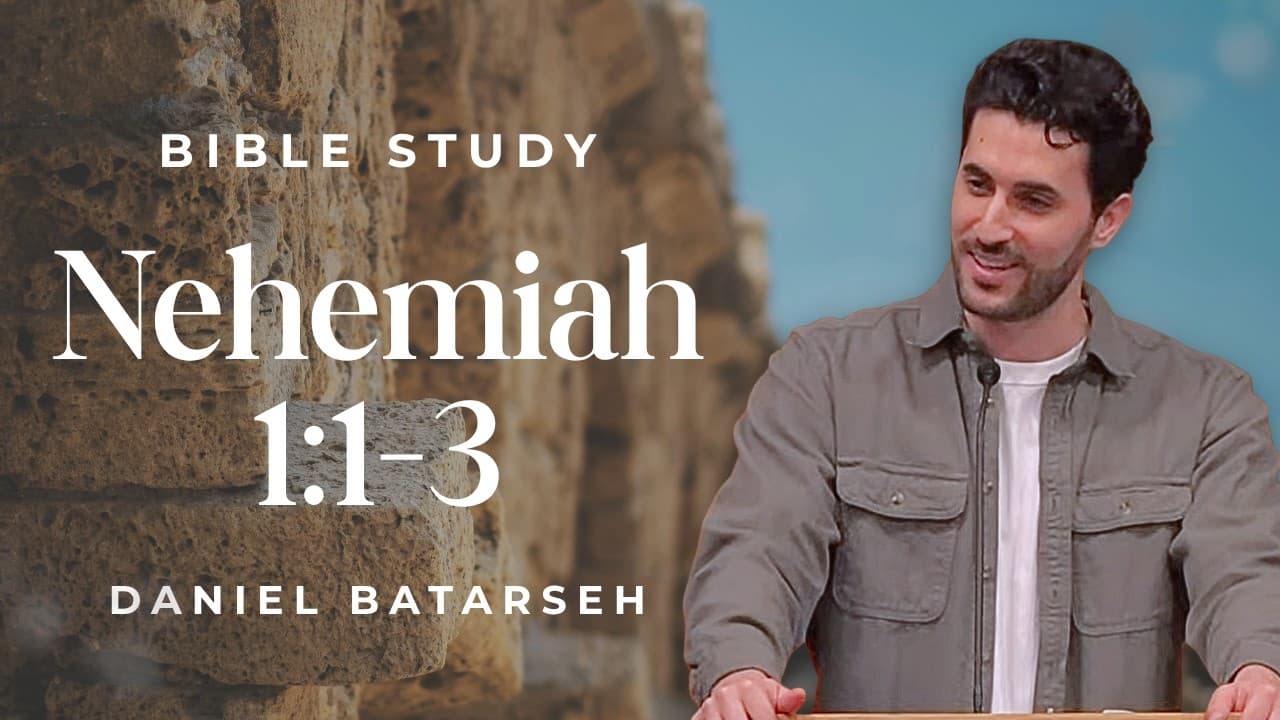
Nehemiah had no pedigree, no priestly lineage, no royal blood. Yet God chose him to rebuild a nation. What the first three verses of Nehemiah reveal about who God actually uses — and what he requires.
Nehemiah 1:1-3 — The Man Nobody Expected God to Use
God used a man with royal blood to rebuild the temple. He used a man from the priestly line to rebuild the people spiritually. And then — for the most dangerous mission of all — he chose a man with no pedigree at all.
That's the shock of Nehemiah 1:1-3. We expect God to reach for the obvious candidate: the one with the résumé, the lineage, the credentials. But Nehemiah son of Hacaliah doesn't have any of that. All we know about his family is his father's name. No tribe identified. No ancestry traced. And yet this is the man God raises up to complete the final movement of Israel's restoration — rebuilding the walls of Jerusalem and stabilizing an entire community's relationship with the Lord. The question this opening scene forces us to answer isn't just who does God use? It's what does God look for in the person he uses? And the answer, as this text reveals, has less to do with where you come from and everything to do with what's burning inside your chest.
A Name That Became a Mission
The book opens simply: "The words of Nehemiah the son of Hacaliah." Unlike Zerubbabel, who carried David's blood in his veins, or Ezra, who descended from the ancient priesthood, Nehemiah arrives on the scene without a notable family tree. Some scholars claim he was from the tribe of Judah, but there's no conclusive evidence. He's just a Jewish man in exile. A layperson.
And that, it turns out, is part of the point. God had already used the expected candidates — the royal descendant, the priestly scholar. Now he reaches for someone the world would overlook. As Pastor Daniel Batarseh observed during this study: "From time to time, you know what the Lord does? He often surprises the world and even his own people by whom he chooses to use to do great things for his name. And Nehemiah is one of those surprises" (watch at 44:07).
But there's a tender detail hiding in the text that most readers fly past. The name Nehemiah means "the Lord comforts." His parents, living in exile — displaced, grieving, far from the promised land — named their son after God's comfort. Perhaps because his birth brought comfort to them in that dark season. But perhaps, too, because they hoped their boy would become an extension of that comfort to others.
And he did. Nehemiah would become the vessel God used to bring comfort to a hurting, despairing, distressed people — not through soft words, but through fierce leadership, unshakable conviction, and a refusal to accept the status quo. He lived up to his name. The question for us is whether we're living up to ours — whether the identity God has given us as his children is shaping how we actually move through the world.
The Cupbearer Who Couldn't Stop Caring
Verse 1 tells us Nehemiah was in "Susa the Citadel" — the winter residence of the Persian kings. The same setting where Daniel received visions and where Esther became queen. Anyone operating in that environment held significant rank or had close proximity to the highest levels of government.
And Nehemiah confirms this at the end of the chapter: "Now I was cupbearer to the king" (Nehemiah 1:11). In our modern ears, that sounds like a butler. It was anything but. A cupbearer tasted the king's wine before the king drank it. If the wine was poisoned, the cupbearer died instead of the monarch. Every single day, this man put his life on the line. That kind of role demanded a person of impeccable trustworthiness, unimpeachable integrity, and proven loyalty. The king wouldn't hand his life to someone sketchy.
So here's what we learn about Nehemiah before his mission ever begins: he was a man whose character had already been tested and proven in the ordinary rhythms of daily work. He couldn't control which family he was born into. But he could control who he was as a man. And that distinction matters enormously.
God can use anyone — he won't hold against you things outside your control. But God has a standard. And that standard is achievable for every one of us. Nehemiah's character didn't just happen to him. It was forged in years of faithful, unglamorous service. Had he been unreliable, inconsistent, or untrustworthy, the entire mission would have been jeopardized before it started. The king never would have listened to his request in chapter 2. The door would have been shut.
This is the part that's easy to skip over when we're eager to get to the wall-building. But the wall-building was possible because of the character-building. Your faithfulness in the unseen, uncelebrated corners of your life is not wasted. It's preparation.
The Question That Reveals Everything
Now look at what happens when Nehemiah's brother Hanani arrives with men from Judah. Verse 2: "And I asked them concerning the Jews who escaped, who had survived the exile, and concerning Jerusalem."
Notice: Nehemiah initiates the conversation. They didn't come bearing an urgent report that forced his hand. He asked. He wanted to know. And the order of his inquiry is telling — he asked about the people before he asked about the city. The holy people before the holy place.
This is a man living in a palace, enjoying proximity to power, holding a prestigious position — and his heart is still fixed on the welfare of God's people and the glory of God's city. He hadn't even been born in Jerusalem. He'd never seen it. Never walked its streets, never tasted the milk and honey Moses described. Everything he knew about the promised land came from what he'd been taught.
And yet it burned in him.
This is where the sermon pressed hard into the room. The connection drawn was to Acts 7:22-23, where Stephen describes Moses: "Moses was instructed in all the wisdom of the Egyptians, and he was mighty in his words and deeds. When he was forty years old, it came into his heart to visit his brothers, the children of Israel" (hear this moment). Both Moses and Nehemiah were born in foreign lands. Both held positions of influence. Both interacted with people of power and prestige. And both had the welfare of God's people burning in their hearts. That's why God used them.
The uncomfortable application lands here: "One of the ways that you and I can determine if our souls are healthy in the midst of success is if you can honestly identify a genuine, sincere concern for that which God cares about" (watch at 53:42). Can God find that concern in your heart? What does it do to you when you hear the church is struggling, that believers are suffering, that there are needs going unmet? Or are you completely consumed with your career, your personal agenda, your comfort?
God does not — and he cannot — use somebody who does not have the ambition and the right motive in serving him. Character opens the door. But concern is what walks through it.
A City Without Walls Is a Soul Without Self-Control
The report Hanani delivers is devastating: "The remnant there in the province who had survived the exile is in great trouble and shame. The wall of Jerusalem is broken down and its gates are destroyed by fire" (Nehemiah 1:3).
For nearly a century, the returned exiles had been operating without walls. Think about that. Everything Zerubbabel built, everything Ezra taught — all of it happened in a city that was completely exposed. No barriers. No gates. No way to regulate who came in or what influences seeped through.
And here's where the sermon made a connection that stopped people mid-thought. The last thing we read in Ezra is the devastating sin of interfaith marriage — God's people intermingling with idolaters. The first thing we encounter in Nehemiah is the reminder that there were no walls. Is it a coincidence that a community without physical barriers struggled with spiritual boundaries? Perhaps not entirely.
Nehemiah chapter 13 offers a vivid illustration. After the walls are finally rebuilt, merchants and sellers camp outside the gates on the Sabbath, trying to lure the people of God into breaking their day of rest with commerce (watch at 39:41). The walls didn't eliminate temptation — but they provided a buffer. Separation between the pressure and the people.
This is more than ancient history. Proverbs 25:28 makes the spiritual application explicit: "A man without self-control is like a city broken into and left without walls." Without self-control, you become easy prey. The temptations of the flesh and the world invade the soul with almost no resistance. The impulses seize whatever good remains.
Self-control is a wall around the heart. And it's the last fruit of the Spirit listed in Galatians 5 — not because it's least important, but perhaps because it's the one that protects all the others.
The seminary story shared during the sermon drove this home with uncomfortable precision. Two students were accountability partners. One kept falling into the same sexual sin, week after week. Finally, the other student said something that most of us would be afraid to say: "The reason you are not overcoming — and you will never overcome — is because you don't hate your sin enough. You actually love it. You enjoy it." The man who received that observation was honest enough to admit it was true. And he began to pray differently — not for deliverance from consequences, but for God to show him how heinous and destructive his condition actually was. Over time, God changed his heart. God gave him the strategy. And that became the turning point in his walk with the Lord (hear this moment).
There are people sitting in churches every week who have not tasted what they could know in their walk with Christ because they have never considered how to build the right barriers around their own hearts. Years go by — like the years Jerusalem sat exposed — and the fullness of grace that could be known remains unknown. Not because God withholds it, but because we refuse to build.
What Psalm 137 Demanded — and Nehemiah Delivered
The evening closed with a passage that tied everything together. Psalm 137, written by exiles weeping in Babylon: "If I forget you, O Jerusalem, let my right hand forget its skill. Let my tongue stick to the roof of my mouth if I do not remember you, if I do not set Jerusalem above my highest joy."
As Pastor Daniel Batarseh put it, looking out at a room filled with young people: "I'm looking at a room filled with young people who have many aspirations, many dreams, many hopes and desires. Never forget the Lord Jesus wherever you go. No matter who you marry, no matter what you build, no matter what kind of success you are able to accomplish, do not forget your highest joy. Do not seek to replace it with anything else. It will never ever ever be able to compare" (watch at 1:27:05).
Nehemiah lived that vow. He sat in a palace, drank from the king's cup, and never let any of it replace the ache in his chest for God's people and God's glory. And that ache — not guilt, not condemnation, but God-inspired burden — is what changed history.
It can change yours too.
What to Remember
- God bypasses the pedigreed and the credentialed to use people whose character has been quietly forged in faithful, unglamorous service — Nehemiah had no lineage but he had integrity, and that's what opened the door.
- Your concern reveals your soul's health: if success has replaced your burden for God's people and God's purposes, something has gone dangerously wrong inside.
- Nehemiah asked about the people before the city — true ministry always prioritizes the welfare of God's people over the programs, buildings, or platforms that serve them.
- A life without self-control is a city without walls: exposed, vulnerable, and unable to resist what should have been kept out — and the Holy Spirit is the one who builds those walls.
- The reason some believers never overcome habitual sin isn't that God hasn't provided a way out — it's that they haven't yet learned to hate what's destroying them.
- Never let any achievement, relationship, or comfort replace the Lord Jesus as your highest joy — nothing else will ever compare.
Questions to Sit With
- If someone examined your daily concerns — what you think about, ask about, pray about — would they find evidence that the welfare of God's people matters to you, or would they only find personal ambitions?
- What area of your life looks like a city without walls — exposed, unguarded, with no practical strategy for resisting the influences that keep defeating you?
- Is there a sin you keep confessing but secretly enjoy? What would it take for you to be honest enough to admit that to God and to one trusted person?
- Nehemiah's character was built during years of quiet, faithful service in a role that had nothing to do with ministry. How are you stewarding the "cupbearer" season you may be in right now?
- If you applied the vow of Psalm 137 to your own life — let me lose my skill if anything replaces this joy — what would you have to surrender?
Scripture Referenced
- Nehemiah 1:1-3 — Primary passage
- Nehemiah 1:11 — Nehemiah as cupbearer
- Nehemiah 7:2 — Hanani's appointment
- Nehemiah 13:20-21 — Merchants outside the walls
- Psalm 119:33-40 — Opening reading
- Psalm 137:1-6 — The exiles' vow
- Proverbs 25:28 — A city without walls
- Ezra 7:8 — Ezra's arrival timeline
- Nehemiah 2:1 — Nehemiah's timeline
- Acts 7:22-23 — Moses's heart for his brothers
This summary was generated by AI from the sermon "Nehemiah 1 (Part 1) Bible Study (Report from Jerusalem) | Pastor Daniel Batarseh (4/17/26)" preached by Pastor Daniel Batarseh at Maranatha Bible Church Chicago. Watch the full sermon →
Preached by
Pastor Daniel BatarsehSenior Pastor
This summary was generated by AI from the sermon transcript.

Based on the sermon