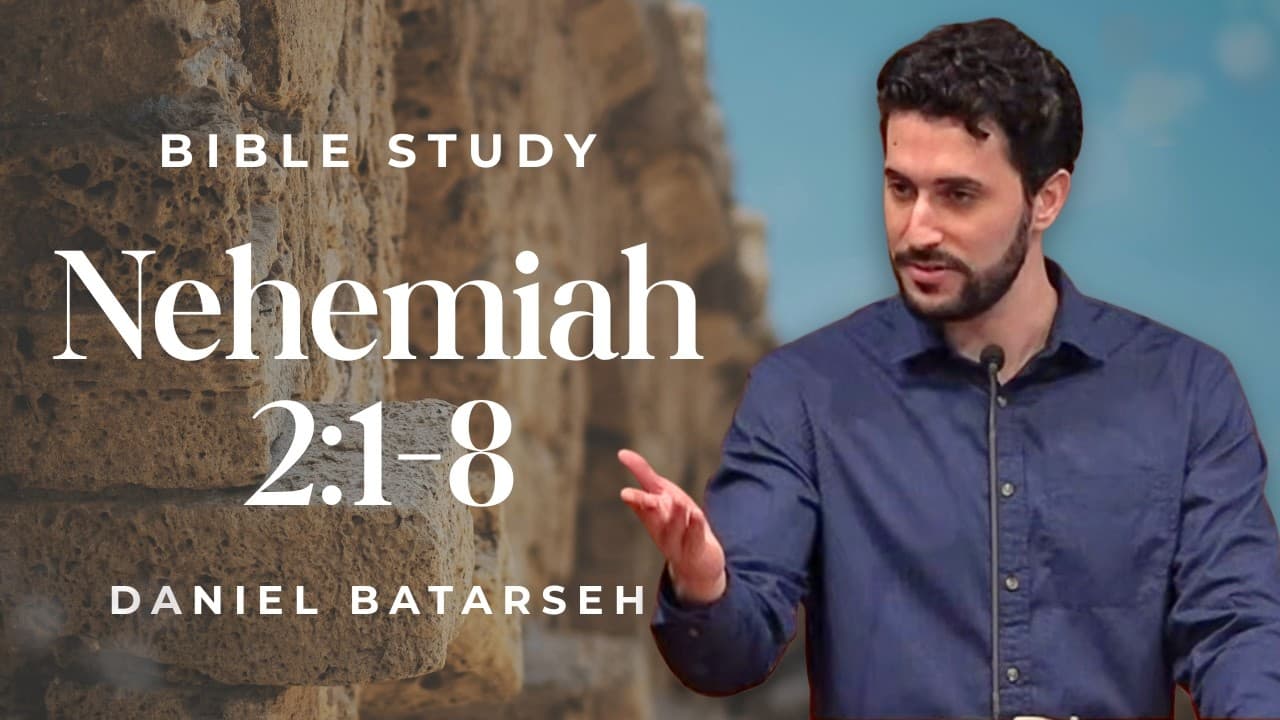
Nehemiah waited four months for God to answer. What he did during that silence reveals a truth about prayer that most of us overlook.
Most people read Nehemiah 2 as the moment God finally answers a desperate man's prayer. And it is that. But the deeper question — the one that will unsettle you if you sit with it — is this: what was Nehemiah doing during the four months of divine silence between his prayer in chapter one and the open door in chapter two? The answer reshapes how we think about waiting on God, how we approach people in authority, and what it actually looks like to pray without ceasing.
The passage is Nehemiah 2:1-8, and it covers the moment Nehemiah — a Jewish cupbearer serving the Persian king Artaxerxes — risks his life to request permission to rebuild the ruined walls of Jerusalem. But the story is far richer than a simple answered prayer. It's a masterclass in preparation, courage, emotional honesty, and the kind of faith that plans for the miracle before it arrives.
Pray Like You Expect God to Answer — Then Prepare Like You Believe It
Here's the timeline. In Nehemiah 1, the devastating news about Jerusalem's broken walls reaches Nehemiah in the month of Kislev — November or December on our calendar. He weeps. He fasts. He prays one of the most theologically rich prayers in the Old Testament. Then silence. Four months of it.
Chapter 2 opens in the month of Nisan — March or April. Four months of fasting, seeking, waiting. And it's tempting to picture Nehemiah simply on his knees the entire time, eyes closed, doing nothing but pleading. But look at what happens when the king finally asks what he wants. Nehemiah doesn't fumble. He doesn't ask for more time. He has a timeline for the trip. He knows the name of Asaph, the keeper of the king's forest. He knows exactly what materials he needs — timber for the gates of the fortress, for the wall, for the house he'll occupy. He has the permits mapped out, the governors he'll need letters for (watch at 9:02).
This man had been doing homework.
As Pastor Daniel Batarseh put it: "While he was praying, he was preparing. Those are not at odds against one another. They work together. In fact, when you and I prepare while we pray, that in itself is an act of faith. I am getting ready for God to answer this" (watch at 10:23).
That reframes everything. We tend to treat prayer and practical preparation as separate categories — the spiritual thing and the practical thing. Nehemiah merges them. His planning wasn't a lack of faith. It was an expression of faith. He was so convinced God would open a door that he refused to be caught unprepared when it swung wide.
So here's the uncomfortable question: You've been praying for something — a ministry opportunity, a restored relationship, a spouse, a new job. What are you doing with the waiting? Are you studying for the role you're asking God to give you? Are you becoming the kind of person who could steward the answer? Or are you just marking time, growing frustrated that the calendar keeps turning?
Nehemiah teaches us that any frustration with waiting can be converted into investment that enriches the answer when it finally arrives. The delay isn't wasted time. Sometimes God holds the door shut so the cement of your foundation can dry.
A King You Can Approach in Any Mood
The scene in verse 2 is more dangerous than a modern reader might realize. Nehemiah's face betrays his grief, and the king notices. "Why is your face sad, seeing you are not sick? This is nothing but sadness of the heart."
In the Persian court, this was potentially fatal. Historical records and the biblical text itself confirm that appearing despondent before the king was a breach of protocol that could be interpreted as disloyalty or dissatisfaction. Esther 4:1-2 makes this explicit: Mordecai couldn't even enter the king's gate wearing sackcloth. You didn't bring your grief into the throne room. Your job was to make the king happy (watch at 14:16).
Nehemiah himself signals how precarious this was. At the end of verse 1, he notes: "Now I had not been sad in his presence." For four months, he had walked into work with a composed face, concealing the volcanic grief underneath. But on this day, the sorrow was too severe. It broke through. His face told on him.
And then: "I was very much afraid."
Notice what the text is doing. This is a man of extraordinary faith — a man who calls God "the God of heaven," who quoted Scripture in his prayers, who fasted for months. And he is terrified. That's not a contradiction. That's honesty. Even the greatest saints get ambushed by fear. The question isn't whether fear visits you. It's whether you've been investing in the kind of spiritual reserves that let you stand when it does.
But here's where the passage turns from historical narrative into personal worship. The contrast between Artaxerxes and the King we serve is staggering. You never have to check God's mood before you approach Him. You never have to paste on a smile and hide your real condition. If you're discouraged, broken, confused, angry, ashamed — you can go to Him. Exactly as you are.
Hebrews 4:15-16 tells us that Jesus, our priestly King, sympathizes with our weaknesses. He doesn't merely tolerate our frailty — He feels it. And the word translated "confidence" or "boldness" in that passage? In the original Greek, it means freedom of speech — unreservedness. Go to your King and speak your mind. Open your heart. You have permission that Nehemiah never had with Artaxerxes (watch at 16:58).
We say "Jesus is King" and feel the stir of sovereignty and authority. But what kind of king? That makes all the difference. He is unlike any ruler history has ever produced — majestic enough to hold the universe together, tender enough to weep at a friend's grave.
One Sentence Tucked Between a Question and an Answer
Verse 4 contains one of the most powerful prayer moments in all of Scripture, and you could miss it if you blink.
The king asks, "What are you requesting?" Nehemiah responds with his detailed plan. But between the question and the answer, Nehemiah slips in five words: "So I prayed to the God of heaven."
No closed eyes. No bowed head. No audible murmur. The king didn't even notice. This prayer was entirely internal — a silent, split-second cry launched from the inner chamber of Nehemiah's soul while standing in the most intimidating room in the ancient world.
As Pastor Daniel Batarseh described it: "Nehemiah's praying was slipped between the king's request and his response. He was able to tuck it in there. And so in total silence in the inner parts of his soul, he seeks the Lord and it's spontaneous and brief yet warm and sincere" (watch at 33:47).
This is what Paul means when he says to pray without ceasing. Not marathon prayer sessions at every moment — though private, focused time with God is irreplaceable — but a constant, reflexive turning of the heart toward God throughout the day. Before you walk into the appointment. When good news arrives. In the grocery aisle. Between the car and the building.
Nehemiah does this roughly a dozen times throughout the book. Short breaths. One-sentence prayers. Asking God for remembrance, for mercy, for strength in a moment. And he kept doing it because he believed it was effective. Every sigh is heard.
But here's the critical balance: these arrow prayers — shot upward in an instant — draw their power from the long hours spent in private. Think of it like a marriage. The quick texts throughout the day are sweet and keep you connected, but they can never replace face-to-face, eye-to-eye time together. Nehemiah chapter 1 — the fasting, the weeping, the sustained seeking — is what made the split-second prayer of chapter 2 so potent. The reflex was trained in the secret place.
Why the King Didn't Want to Lose Him
There's a detail in verse 6 that's easy to glide past: "How long will you be gone, and when will you return?" The king is granting the request — but he wants Nehemiah back. He doesn't want to lose this man.
What does that tell you about how Nehemiah carried himself in a pagan court? His integrity, his competence, his character made him indispensable to a king who had the resources of the entire Persian Empire. Artaxerxes didn't worship Nehemiah's God. He had his own agenda, his own interests, his own worldview. And yet he valued this man so highly that the thought of losing him permanently was unacceptable.
This is convicting. Because some of us wear the name of Christ and are genuinely unpleasant to work with. We show up late. We complain as though there isn't a God on the throne. We're demanding and difficult. And when people pull away, we call it persecution.
That's not persecution. That's the natural consequence of poor character.
1 Peter 2:12 says to keep your conduct honorable among the Gentiles so that in seeing your deeds — not hearing your arguments — they may glorify God. People watch before they listen. The king worked alongside Nehemiah long enough to know his worth. That kind of testimony isn't built by Sunday morning impressions. It's built Monday through Saturday, in the mundane, in the frustrating, in the thankless tasks done with excellence because you serve a different King.
The goal isn't to be liked by everyone. It is to live so that if you leave, people feel the absence — because the fragrance of Christ was on you.
Prayer Moved a Royal Decree
Nehemiah closes this section with a statement that redirects all credit: "And the king granted me what I asked, for the good hand of my God was upon me." Not his cleverness in avoiding the name Jerusalem. Not the queen's softening presence beside the king. Not Nehemiah's strategic framing of the situation around his father's graves. God's hand.
And consider what that hand accomplished. Artaxerxes had previously issued a formal decree — recorded in Ezra 4:19-22 — declaring that Jerusalem was a city of rebellion and that its rebuilding should be stopped by force. That was the official royal position. One man's private praying dismantled a royal decree.
The connection extends even further. In Revelation 17:16-17, God puts it into the hearts of ten kings simultaneously to carry out His purpose. Any king, at any time, no matter the number — God can redirect hearts for His purposes and for the good of His people. If He can move ten kings at once at the end of history, He can certainly move the one person standing between you and the thing He's called you to.
So why do we hesitate to pray?
What to Remember
- Preparing while you pray is not a lack of faith — it is faith in action, getting ready for the door God is about to open.
- You never need permission to approach God with your real emotions. Unlike Artaxerxes, your King sympathizes with your weakness and grants you freedom of speech at His throne.
- Split-second prayers throughout the day are powerful — but they draw their strength from sustained private time with God. The reflex is trained in the secret place.
- Your character at work, at home, in the mundane hours of life is either confirming or contradicting every word you speak about Christ. People watch before they listen.
- One person's faithful, persistent praying can overturn what seems politically, relationally, or circumstantially impossible. Prayer moves the hearts of kings.
- Four months of waiting didn't weaken Nehemiah's burden — it intensified it. If your concern for the things of God fades with time, something has gone wrong.
Questions to Sit With
- You've been praying for something specific. What practical preparation have you done that shows you actually expect God to answer?
- Do you approach God more like Nehemiah approached Artaxerxes — cautious, guarded, performing composure — or with the boldness Hebrews 4:16 invites?
- If your employer, your coworkers, or your neighbors were asked whether losing you would leave a gap, what would they honestly say — and why?
- When was the last time you prayed a one-sentence prayer in the middle of an ordinary moment — and believed God heard it?
- Is there a situation you've stopped praying about because it felt impossible? What does Nehemiah's story say to that resignation?
Scripture Referenced
- Nehemiah 2:1-8 (primary text)
- Nehemiah 1:11
- Psalm 116:1
- Esther 4:1-2
- Ezra 4:19-22
- Hebrews 4:15-16
- 1 Peter 2:12
- Revelation 17:16-17
This summary was generated by AI from the sermon "Nehemiah 2 (Part 1) Bible Study (Nehemiah Sent to Judah) | Pastor Daniel Batarseh (5/8/26)" preached by Pastor Daniel Batarseh at Maranatha Bible Church Chicago. Watch the full sermon →
Preached by
Pastor Daniel BatarsehSenior Pastor
This summary was generated by AI from the sermon transcript.
Based on the sermon