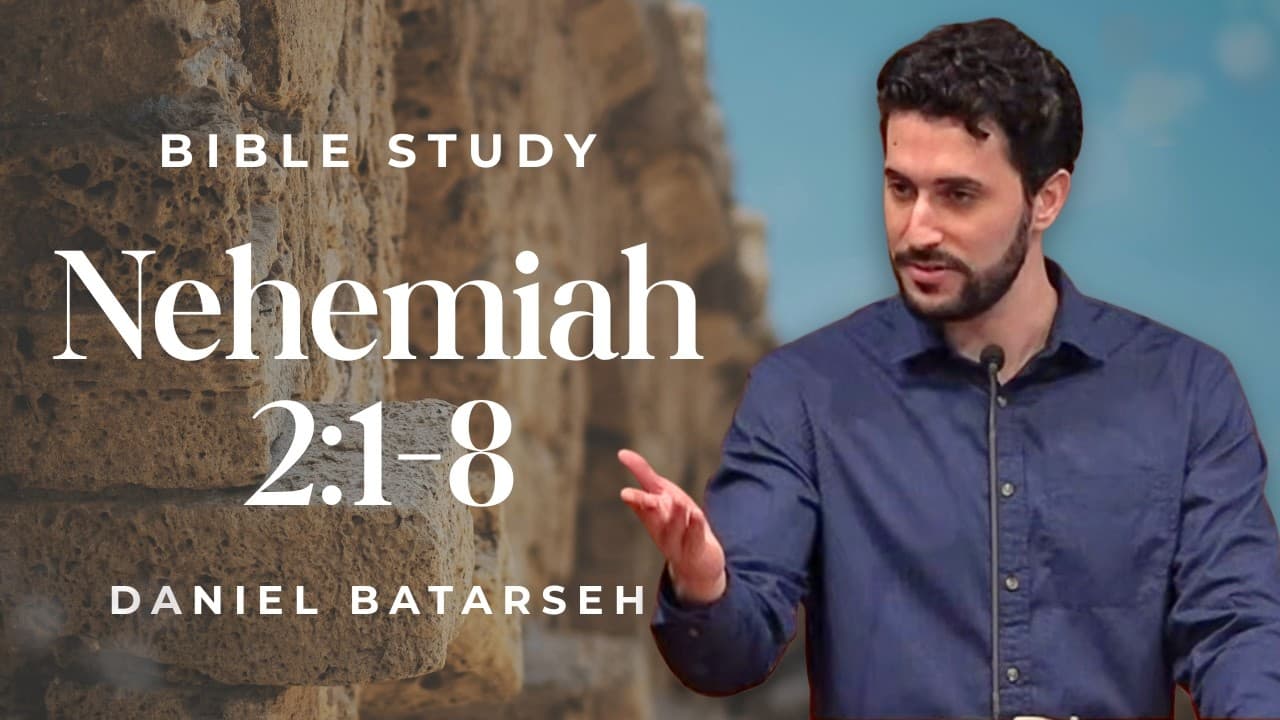
Nehemiah prayed for four months before God opened the door. But the waiting wasn't wasted — it was preparation. Here's what Nehemiah 2:1-8 teaches about the hidden power of prayer.
Nehemiah 2:1-8 — What Prayer Was Doing While Nehemiah Waited
Four months. That's how long Nehemiah prayed before God answered. And when the answer finally came, it didn't arrive in a prayer closet. It arrived in the most dangerous room in the Persian Empire — standing before a king who had already decreed that Jerusalem's walls should stay broken.
Most people read Nehemiah 2:1-8 as a story about God's faithfulness in answering prayer, and it is that. But there's a detail buried in these eight verses that changes how you think about waiting on God: Nehemiah wasn't just praying during those four months. He was preparing. He knew the name of the king's forest manager. He'd calculated travel time. He'd figured out what materials he'd need for the gates, the walls, and his own housing. When the door swung open, he didn't stumble through it — he sprinted.
The implications of that are enormous. And they press a question most of us would rather not answer: What are you doing with the time between your prayer and God's response?
The Delay Wasn't a Denial — It Was a Construction Zone
The timeline matters. In Nehemiah 1, the devastating news about Jerusalem's ruins reached Nehemiah in the month of Kislev — November or December on our calendar. Chapter 2 opens in the month of Nisan — March or April. Four months of fasting. Four months of seeking God. Four months of silence from heaven.
Why didn't God answer sooner? There are many possible reasons, but this text surfaces one we rarely consider. As Pastor Daniel Batarseh put it: "Sometimes there is divine delay to give us time to practically prepare. If the Lord were to open the door that you so desperately want to open at your desired time, it's very possible that you and I would not even be ready to manage the provision" (watch at 7:37).
That reframes everything. The delay isn't God ignoring you. It's God giving the cement time to dry.
Look at the evidence. When the king asks Nehemiah how long he'll be gone, Nehemiah has a number ready (v. 6). He doesn't stammer. He doesn't ask for time to think. When the king shows openness, Nehemiah immediately requests specific letters for specific governors, names a specific forest keeper — Asaph — and lists exactly what timber he needs for the gates of the fortress, the city wall, and his personal residence (v. 7). This isn't improvisation. This is a man who spent four months on his knees and on his feet, praying and planning.
Those two things are not at odds. In fact, preparing while you pray is itself an act of faith. You're saying to God, I believe you're going to answer this, and I intend to be ready when you do.
So here's the uncomfortable question: You may be asking God for an opportunity in ministry — what are you doing right now to become the kind of person who can handle it? You may be praying desperately for a spouse — what adjustments are you making to be ready for that responsibility? Nehemiah teaches us that any frustration we feel in waiting can be converted into investment that enriches the answer when it finally arrives.
A King Who Couldn't Handle Sadness — and a King Who Can
Verse 2 introduces two emotions that collide in Nehemiah's chest: sadness and fear. The king notices that Nehemiah's face is different. "Why is your face sad, seeing you are not sick? This is nothing but sadness of the heart."
That observation nearly got Nehemiah killed.
In the Persian court, appearing sad before the king was a violation of protocol. It could signal disloyalty, dissatisfaction, or worse — a plot. Esther 4:1-2 confirms this: Mordecai couldn't even enter the king's gate while wearing sackcloth. You didn't bring your grief into the king's presence. Period. Nehemiah himself tells us he'd been careful about this — "Now I had not been sad in his presence" (v. 1). For months, he wore a mask. But on this day, the sorrow was too severe. It leaked through. His face told on him (watch at 14:16).
And that's when the fear hit. "Then I was very much afraid." This is not a man lacking faith. This is a man who understands the stakes. He knows the court protocol. And he knows something else that makes this even more precarious: Artaxerxes had already issued a decree in Ezra 4:19-22 declaring that Jerusalem had a history of rebellion and sedition. The last thing this king wanted was to see those walls go back up. So Nehemiah isn't just risking a frown in the wrong room — he's about to ask the king to reverse his own ruling.
But here's where the text turned luminous in this study. The contrast between Artaxerxes and Jesus Christ is staggering. You could not approach the Persian king with sorrow on your face without risking your life. But Hebrews 4:16 tells us to "draw near to the throne of grace with confidence." That word confidence — in the Greek, it means freedom of speech, unreservedness. Go to your King and speak your mind. Open your heart before Him.
As the teaching made vivid: "Unlike Artaxerxes, I serve a king who gives me permission to enter into his presence just as I am. If I'm discouraged, I can go to him. If I'm worried, I can go to him. If I'm angry, I can go to him. If I'm broken, I can go to him. And I never have to worry if he will be angry with me" (hear this moment).
We say "Jesus is King" and feel the weight of His authority. But what kind of King is He? That makes all the difference. He's a King who sympathizes with your weaknesses because He took on flesh and experienced temptation. You don't need permission. You don't need to check His mood. You can go freely, as many times as you need.
The Prayer That Fit Between Two Sentences
Verse 4 contains one of the most powerful prayer moments in all of Scripture, and you'd miss it if you blinked.
The king asks, "What are you requesting?" Nehemiah records: "So I prayed to the God of heaven." And then, without a breath, he answers the king.
No closed eyes. No bowed head. No murmured words. The king didn't even notice it happened. Nehemiah's prayer was slipped between the king's question and his own response — tucked into the silence of his soul. It was spontaneous, brief, and completely internal. And it changed everything (watch at 32:08).
This is what Paul means when he writes "pray without ceasing." It's not monastic isolation. It's this — a reflex of the spirit. Before you walk into the appointment: Lord, give me peace. When you hear good news: Thank you, Father. When fear grips you in the middle of a conversation: God, I need you right now.
But here's the critical nuance: these short, spontaneous prayers draw their power from the long, private ones. Nehemiah could pray a one-sentence prayer before the king because he'd spent four months in sustained, deliberate communion with God. The analogy is marriage — brief texts to your spouse throughout the day are sweet and keep you connected, but they can never replace face-to-face time. The quick prayers work because the deep prayers came first.
Nehemiah will pray like this a dozen more times throughout the book. Short breaths. One-sentence cries. And the reason he keeps doing it is simple: he believed it was effective. Every sigh is heard by God. Remember Abraham's servant Eleazar at the well, surrounded by camels and approaching women, exhausted from travel — and he lifts his heart to God in a moment, and God answers that very prayer. These awkward, in-the-moment prayers are scattered throughout Scripture for those willing to look for them.
So the question presses: Do you talk to the Lord throughout the day? If you have unending, unbroken access to the mercy seat, why not visit it frequently?
The Testimony That Made a Pagan King Reluctant to Let Him Go
The king's response in verse 6 is revealing: "How long will you be gone, and when will you return?" He's not just granting permission. He wants Nehemiah back. This man — who had the resources of the entire Persian Empire at his disposal — saw irreplaceable value in one Jewish cupbearer.
That says something about Nehemiah's character. His competence. His integrity. His daily conduct in a pagan court.
And it raises an uncomfortable mirror for us. As much as the New Testament prepares Christians to be hated for the faith, our character and work ethic should make that hatred difficult. "There are some Christians who believe they are being persecuted because of their relationship with Christ, when in reality, they're just unpleasant to be around. They show up to work late. They murmur and complain like there wasn't a God sitting on a throne in heaven" (watch at 41:19). That's not persecution. That's consequence.
1 Peter 2:12 says to let your conduct be honorable in the sight of the Gentiles so that "in seeing your deeds, they may glorify God." Not hearing your arguments. Seeing your deeds. People watch. They notice. And the fragrance of Christ on a person's life is something no apologetic argument can replicate.
Nehemiah closes this section with a line that should govern how we interpret every success in our lives: "And the king granted me what I asked, for the good hand of my God was upon me" (v. 8). He doesn't credit his own cleverness in avoiding the name "Jerusalem." He doesn't highlight the queen's softening presence beside the king. He points — immediately, in the same breath — to God.
And yet, you cannot separate God's hand from Nehemiah's knees. One man's private praying changed a royal decree. The slander against Jerusalem in Ezra 4 was dismantled — not by political maneuvering, but by prayer. Revelation 17:16-17 confirms the same principle on a cosmic scale: God puts purposes into the hearts of kings — ten of them, simultaneously — to accomplish His will. If He can do that at the end of the age, He can certainly touch the heart of one difficult person in your life today.
So why do we hesitate to pray?
What to Remember
- Waiting on God is not wasted time — it's preparation time. Pray and plan, because both are acts of faith.
- You never need permission to approach Jesus with your grief, your confusion, or your failure. He doesn't check your mood at the door — He sympathizes with your weakness.
- One-sentence prayers throughout the day are powerful, but they draw their strength from sustained, private communion with God. The texts work because the face-to-face time came first.
- Your daily conduct in a secular environment is a sermon people watch before they ever hear your words. Make persecution difficult by being excellent, not just vocal.
- Prayer can reverse royal decrees. One person's private intercession moved God to change a king's heart. Don't underestimate what sustained, believing prayer can accomplish.
- Nehemiah's sorrow didn't fade over four months — it intensified. When our concern for the things of God grows stronger with time rather than weaker, we are in a spiritually dangerous and beautiful place.
Questions to Sit With
- What door are you asking God to open — and what are you doing right now to be ready when He does?
- Do you approach God more like Nehemiah approached Artaxerxes — carefully, guardedly, checking His mood — or like Hebrews 4:16 invites you to, with unreserved freedom of speech?
- When was the last time you prayed a one-sentence prayer in the middle of an ordinary moment? What would change if you started doing it reflexively?
- If the people you work with were asked to describe your character, would they want you back — or would they be relieved to see you go?
- Is there a situation in your life where you've stopped praying because you stopped believing God could change a person's heart?
Scripture Referenced
- Nehemiah 2:1-8 (primary text)
- Nehemiah 1:11
- Psalm 116:1
- Esther 4:1-2
- Ezra 4:19-22
- Hebrews 4:16
- 1 Peter 2:12
- Revelation 17:16-17
This summary was generated by AI from the sermon "Nehemiah 2 (Part 1) Bible Study (Nehemiah Sent to Judah) | Pastor Daniel Batarseh (5/8/26)" preached by Pastor Daniel Batarseh at Maranatha Bible Church Chicago. Watch the full sermon →
Preached by
Pastor Daniel BatarsehSenior Pastor
This summary was generated by AI from the sermon transcript.
Based on the sermon