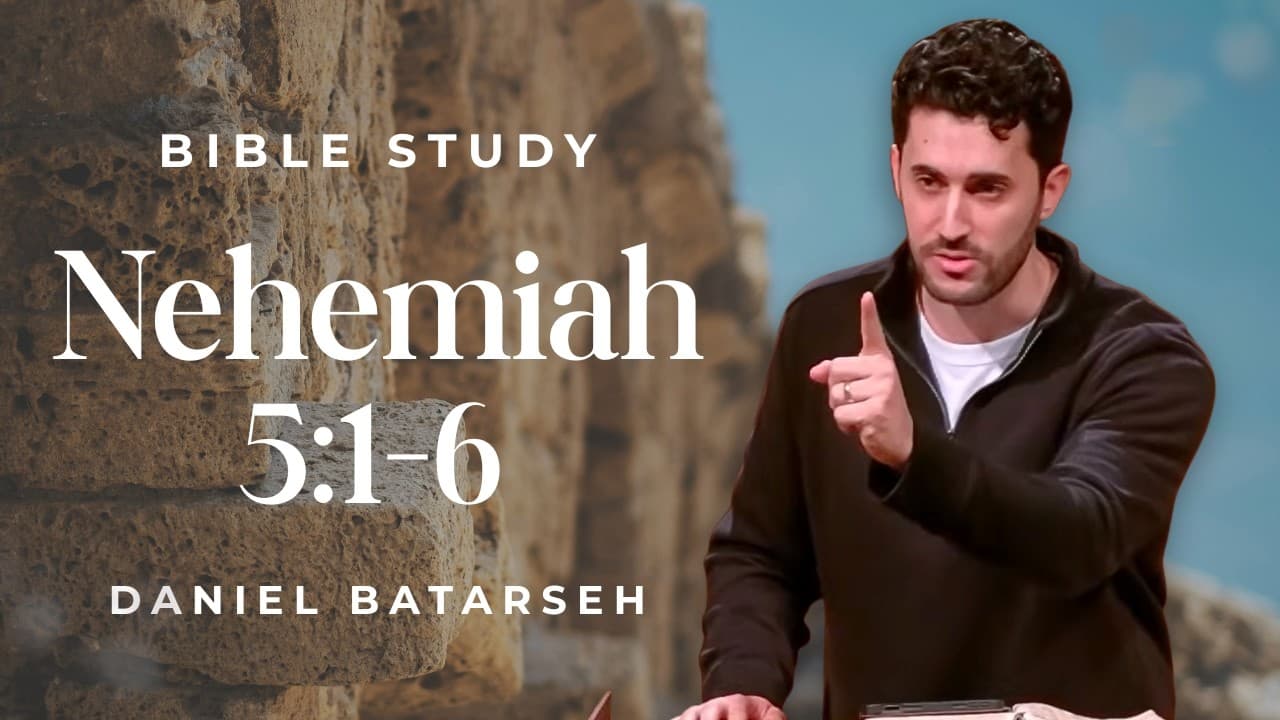
The greatest threat to the rebuilding of Jerusalem's walls wasn't Sanballat or Tobiah. It was wealthy Jews exploiting their own brothers. Nehemiah 5 exposes what selfishness does to a community of faith.
The walls of Jerusalem were going up. The enemies outside had tried mockery, threats, and conspiracy — and failed. Then came the threat that nearly ended everything, and it didn't come from Sanballat or Tobiah. It came from inside the camp.
Nehemiah 5:1-8 records a crisis that every church, every ministry, every Christian community should study carefully: the moment when God's own people began devouring one another. Wealthy Jewish nobles were exploiting their poorer brothers — the very people sacrificing their time and labor to rebuild the city walls. And if Nehemiah had not intervened with speed and godly wisdom, the entire project would have collapsed. Not from an enemy siege. From a civil war.
This is the threat nobody talks about. And it's the one most likely to destroy you.
The Word the Holy Spirit Won't Let You Ignore
Here's something easy to miss if you're reading Nehemiah 5 quickly: in the span of just six verses, the Holy Spirit through Nehemiah uses the word brother four times. Four times. That repetition is not accidental. It's a theological hammer striking the same nail again and again until you feel it.
The people exploiting the poor weren't foreigners. They weren't pagans. They were brothers — covenant members of the same community, worshippers of the same God, laborers on the same wall. And that's what made the sin so grotesque. The text wants you to feel the betrayal before you analyze the economics.
Pastor Daniel Batarseh drew a stunning connection to Romans 14, where Paul is navigating tensions between Jewish and Gentile believers in Rome — disputes about food laws, holy days, matters of conscience. In the middle of that discussion, Paul drops this charge: Do not destroy your brother whom Christ died for. (watch at 3:52)
Let that sink in. Can Christians annoy each other? Yes. Can Christians hurt each other? Absolutely. Can Christians give you every reason to give up on Christians? Without question. But Paul's argument cuts through all of it: Jesus died for that person. If Christ placed such infinite value on your brother that He was willing to be crushed for them, then who are you to discard them so easily?
As Pastor Daniel Batarseh put it: "If he put such value on you, if he was willing to go to such great lengths in order to have you, then who am I to give up on you so easily?" (hear this moment)
This is the lens Nehemiah 5 demands. The nobles weren't just committing economic fraud. They were destroying people for whom Christ would die. They were treating blood-bought brothers as expendable resources. And the text won't let you look away from that word — brother, brother, brother, brother — until you reckon with what it means.
Enthusiasm Won't Save Your Church — Only Brotherhood Can
There's a line from this sermon that should be printed on the wall of every church foyer in America. It's not flashy. It's not the kind of thing that goes viral. But it's devastatingly true.
"We're only gonna run on enthusiasm and the excitement of a new building and new people coming. That's great. That's not gonna sustain a ministry. Only true brotherhood can." (watch at 4:55)
Read that again slowly. Every church plant that fizzled after three years, every ministry that imploded despite packed rooms, every small group that dissolved into gossip and resentment — how many of them had plenty of enthusiasm but no real brotherhood? The excitement of something new can carry you for months, maybe even a couple of years. But when the novelty wears off and someone offends you, when a leader disappoints you, when a fellow member's convictions rub against yours — what holds you together then?
Nothing. Unless you have the kind of love that sees a brother, not a rival. Not an inconvenience. Not a project. A brother.
This is exactly what was missing among the nobles in Jerusalem. The wall was going up. The work was exciting. God was moving. And underneath the surface, wealthy Jews were charging interest to their own people, seizing their fields and vineyards, even taking their children as collateral. The mission looked healthy from the outside. Inside, it was rotting.
How many churches look exactly like this right now?
Animals in the Sanctuary: What Unchecked Selfishness Becomes
The root of the crisis in Nehemiah 5 was not complicated. It was selfishness. Wealthy Jews saw an opportunity — poorer families stretched thin by the building project, unable to feed their children, desperate for grain — and they exploited it. They loaned money at interest to their own people (something the Law explicitly forbade between Israelites), took their land as security, and when the debts couldn't be paid, took their sons and daughters as servants.
This wasn't a gray area. This was predatory. And it was happening while they were all supposedly working together for the glory of God.
The connection to Galatians 5:15 is where the teaching became visceral. Paul warns the Galatian believers: "If you bite and devour one another, watch out that you are not consumed by one another." The imagery is deliberate — wild animals tearing at each other's flesh. And the observation that followed was haunting: "Do you know that there are some animals who in desperate situations are willing to eat their own kin, to consume their own cubs? What Paul is saying is, it's equally possible to so attack one another that you devour each other until the point of extinction." (watch at 10:50)
Extinction. Not decline. Not struggle. Extinction. Churches that cease to exist because the people inside consumed each other. That's not hypothetical. "I know churches that have gone extinct because they have bitten and devoured one another until nobody existed anymore. The ministry was shut down. That service is shut down. That local church shut down."
This is what was about to happen in Jerusalem. If Nehemiah had not stepped in — quickly, wisely, with the authority of God's Word — the rebuilding project would have become a graveyard. Not because Sanballat breached the walls, but because the builders turned on each other.
And here's what should unsettle every one of us: Paul isn't talking about the world in Galatians 5:15. He's talking about people who profess the name of Jesus Christ. The sermon pressed this point without flinching: "This is not the world that he's talking about. This is those who profess the name of Jesus Christ." When the flesh is not restrained, when we drift from the Holy Spirit's governance, when the Word of God no longer shapes our conduct — we don't just become ineffective Christians. We become animalistic ones. The sanctuary becomes a feeding ground.
The Speed of the Response Matters More Than You Think
One of the most practical insights from this study is something that could save your church, your small group, your marriage: the speed at which you address internal problems determines whether they heal or metastasize.
1 Corinthians 5:6 warns that "a little leaven leavens the whole lump." The principle is simple: sin left unaddressed doesn't stay contained. It spreads. It infects. It normalizes. And the longer you wait to confront it, the more damage it does — not just to the individuals involved, but to the entire body.
What's remarkable about Nehemiah 5 is the team effort on display. The people brought the complaint forward. They didn't gossip about it in corners or post veiled grievances. They brought it to leadership. And Nehemiah didn't table it for next quarter's elder meeting. He acted. He confronted the nobles. He demanded change.
This is what healthy church life looks like — and it requires courage from both sides. Members have to be willing to say, "I don't know if the elders know this. I don't know if my spiritual mentor knows this. Maybe I should bring this up so that we don't give Satan any more time or ground to gain." And leaders have to be willing to be confrontational when necessary — "not in anger, not in the flesh, in love, in patience, in holiness, always guided by the word of God." (hear this moment)
Too many churches die not because nobody saw the problem, but because everyone saw it and nobody said anything. They waited. They hoped it would resolve itself. They didn't want to be "that person." And by the time someone finally spoke up, the leaven had worked through the whole lump. The damage was done.
Nehemiah didn't make that mistake. And neither should we.
Three Cries from the Desperate
The chapter presents three specific complaints brought to Nehemiah, each representing a different dimension of the suffering. The first, found in verse 2, comes from families who were simply too large to feed. They had many sons and daughters, and they could not afford grain. The text is careful here — the problem was not that their families were too big. Large families in the Old Testament are consistently presented as blessings, not burdens. The problem was that a convergence of factors — the labor demands of the wall project, the economic strain of living in a rebuilding city, and the exploitation by wealthier neighbors — had made it impossible for these families to survive.
This distinction matters. It's easy to read verse 2 and think, "Well, they shouldn't have had so many kids." But the text refuses that reading. The blame falls squarely on the system of exploitation, not on the size of the family. The nobles had created conditions where faithful families couldn't feed their children — and then profited from their desperation.
This is what selfishness does in a faith community. It doesn't just hurt individuals. It punishes faithfulness. It makes obedience to God feel like a trap. And it turns the people of God against the purposes of God.
What to Remember
- The Holy Spirit repeats the word "brother" four times in six verses to force you to see the real horror of exploitation within God's people — it's not just injustice, it's betrayal of family.
- Enthusiasm for a new building, a growing church, or a fresh ministry season will never sustain a community. Only genuine, sacrificial brotherhood can hold God's people together when the excitement fades.
- Unchecked selfishness in a church doesn't just cause discomfort — it can drive a community to extinction. Paul's imagery of believers biting and devouring one another like wild animals is not hyperbole. It's a documented pattern.
- The speed at which internal sin is addressed determines whether a church heals or dies. A little leaven leavens the whole lump, and delay is the leaven's best friend.
- Healthy confrontation requires two things simultaneously: members courageous enough to surface problems, and leaders willing to act on them with love, patience, and the authority of Scripture.
- When wealthy believers exploit struggling believers — especially those sacrificing for God's work — they aren't just committing economic sin. They're destroying people for whom Christ died.
Questions to Sit With
- Is there a conflict or grievance in your church community right now that everyone sees but nobody is willing to name? What would it cost you to be the one who brings it to leadership?
- If Jesus died for the brother or sister who most frustrates you, what does that say about how you're currently treating them — or talking about them when they're not in the room?
- Has your church been running on enthusiasm — the energy of something new — rather than on genuine brotherhood? What happens when the novelty wears off?
- Are you, in any way, benefiting from another believer's sacrifice or struggle without even noticing it? Could your comfort be coming at someone else's cost?
- When was the last time you confronted a problem in your faith community quickly rather than hoping it would go away on its own? What happened?
Scripture Referenced
This summary was generated by AI from the sermon "Nehemiah 5 (Part 1) Bible Study (Nehemiah Stops Oppression of the Poor) | Pastor Daniel Batarseh" preached by Pastor Daniel Batarseh at Maranatha Bible Church Chicago. Watch the full sermon →
Preached by
Pastor Daniel BatarsehSenior Pastor
This summary was generated by AI from the sermon transcript.

Based on the sermon