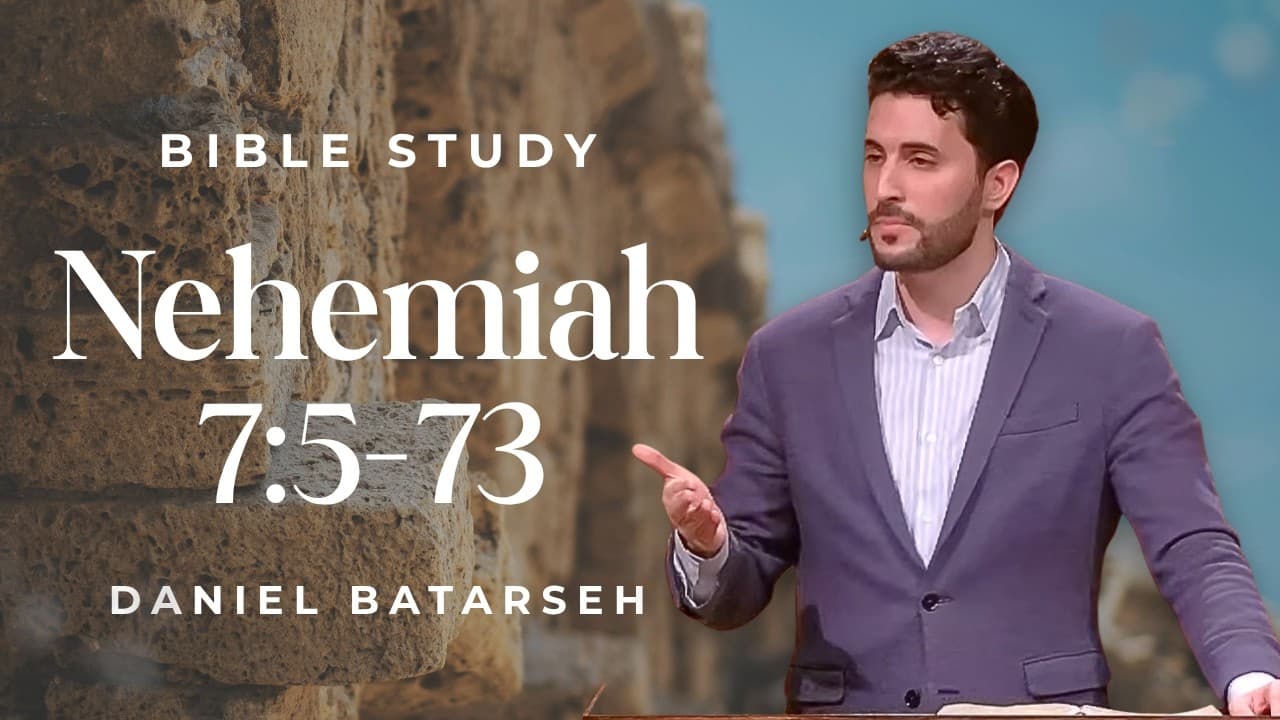
The largest family in Nehemiah 7's genealogy is one nobody recognizes. That's exactly the point — and it rebukes everything our age believes about significance.
The largest group of people listed in Nehemiah 7's genealogy — 3,930 individuals under a single family name — belongs to a clan that virtually nobody has ever heard of. The sons of Sena'ah. They appear once in chapter 3 for helping rebuild the Fish Gate, and once here in the registry. That's it. No fame. No backstory. No theological treatise attached to their name. And yet God numbered every single one of them, inscribed them in Holy Scripture, and made them stand out above every other household in the list.
This is one of many startling details buried inside what most Bible readers skip as a tedious roll call of unpronounceable names. But Nehemiah 7:4–73 is not filler. It is a chapter about how God confirms His guidance, how He guards the purity of His people, and how the greatest contributions to His kingdom often emerge from total obscurity.
God Doesn't Just Stir Your Heart — He Paves the Road
Nehemiah had finished the walls. The work was done. He could have returned to his comfortable life as cupbearer in the Persian court. Instead, he looked at Jerusalem and saw a city that was wide and large but nearly empty — few residents, no rebuilt houses (Nehemiah 7:4). The walls meant nothing without people living inside them.
What happens next is one of the most instructive verses in the book for anyone trying to discern God's will. Nehemiah writes: "Then my God put it into my heart to assemble the nobles and the officials and the people to be enrolled by genealogy" (Nehemiah 7:5). And in the very same breath, he tells us he found the ancient registry of the first wave of exiles who had returned from Babylon decades earlier.
That timing is not a coincidence. As Pastor Daniel Batarseh observed: "The same God who put it in Nehemiah's heart to get people into Jerusalem also orchestrated for him to be able to find a genealogy that would help him to that end" (watch at 41:00).
Here is a principle worth tattooing on your decision-making process: if God is genuinely stirring you toward something, He will providentially support it. Not all at once. Not with a five-year strategic plan. But He provides the next step. Opportunities begin to present themselves. Partnerships emerge. Resources appear. You realize you can at least move forward in the direction you're sensing.
Plenty of people claim divine stirring for every entrepreneurial itch or ministry fantasy. But there's a difference between emotional impulse and divine prompting, and one way to tell them apart is this: look around. Is there any providential evidence? Any confirming hints? Nehemiah felt the stirring and found the genealogy. The internal conviction was matched by an external provision. Pay attention to that pattern in your own life — and be honest when it's absent.
Nehemiah Needed People — But He Didn't Lower the Standards
This genealogy wasn't just a census tool. It was a filter. Nehemiah needed to repopulate Jerusalem, but he did not want just anyone filling the city. He understood that Jerusalem was holy ground — a place with divine origins, a history of worship, and a future tied to God's redemptive plan. The people who lived there had to be rightful members of the covenant community, descendants of Abraham, Isaac, and Jacob who could prove their lineage.
The genealogy allowed him to validate who actually belonged.
This carries a sharp edge for the modern church. One story from the sermon cut deep: a believer once asked the pastor of a very large congregation what percentage of his thousands of weekly attendees were actually born again. The pastor leaned back, thought for a moment, and said, "Maybe 20%." Twenty percent. Out of thousands of people comfortably attending a service designed to worship the living God (hear this moment).
The issue isn't that unbelievers should never walk through our doors. The issue is engineering the entire experience around them — watering down the message, softening the requirements, manufacturing an atmosphere of false belonging — all to give the appearance of success. Nehemiah had a massive need. He could have opened the gates to anyone breathing. He didn't. He checked the registry.
And this principle runs from Genesis to Revelation. In Revelation 21:27, John writes that nothing unclean will enter the New Jerusalem — "only those who are written in the Lamb's Book of Life." From Nehemiah's ancient genealogy to the Lamb's Book of Life, God is the one who sets the requirements for belonging. Leaders in His church do not have the liberty to revise them. Thank God the entrance requirement is grace through faith — but it is a faith that transforms, and a grace that changes you from the inside out.
The Priest Who Traded His Identity for Someone Else's Name
Buried in the middle of this registry is a strange parenthetical note that most readers glide past. In verses 63–65, we learn that certain priestly families were excluded from service because they couldn't prove their lineage. Among them were "the sons of Barzillai, who had taken a wife of the daughters of Barzillai the Gileadite and was called by their name."
Unpack that slowly. A priest — from the tribe of Levi, from the line of Aaron — married a daughter of Barzillai the Gileadite. Nothing wrong with that. But then he did something inexplicable: he abandoned his own priestly name and adopted Barzillai's. He chose to be identified with his father-in-law's household instead of Aaron's.
Why does this matter? Because the Gileadites descend from Manasseh, not Levi (Numbers 26:29). So when later generations tried to trace this family's priestly credentials, the trail went cold. The genealogical records pointed to Manasseh, not Aaron. And the result was devastating: "They were excluded from the priesthood as unclean" (Nehemiah 7:64).
Who was Barzillai that a priest would trade his sacred calling for this man's name? Second Samuel 19:31–32 tells us. Barzillai was an 80-year-old man of great wealth who had been fiercely loyal to King David during Absalom's rebellion, providing food and shelter when it could have cost him his life. David loved him. He was genuinely admirable. But admiration for a man — even a righteous man — is no reason to abandon the identity God gave you.
Whatever this unknown priest's motivation — whether it was the allure of Barzillai's wealth, the prestige of his name, or simply deep respect for his father-in-law — the consequence echoed for centuries. His descendants lost access to the priesthood. One man's choice cost generations their calling.
The application lands hard: do not waste your life trying to be someone God did not create you to be. If God has given you effectiveness in business, don't covet full-time ministry unless He calls you there. If He has summoned you to pastoral work, don't spend your energy envying the prosperity or platform of others. "If God hasn't given you the grace for it, you're going to fail, and it's going to hurt you and hurt others. Stay where God has called you. Fulfill your ministry" (watch at 1:26:23).
Dissatisfaction with your calling is a real temptation. It comes frequently. But if you let it overtake you, it has the power to pull you out of the exact place where God's blessing rests.
The Sons of Sena'ah and the Power of Obscurity
Now back to that number that should stop every reader in their tracks. Verse 38: "The sons of Sena'ah, 3,930." The largest contingent under any single name in the entire genealogy. And we know almost nothing about them.
They helped rebuild the Fish Gate in chapter 3. They show up in this registry. That is the sum total of their biblical biography. No patriarch associated with their name. No prophet. No famous battle. No dramatic story. Just faithful, anonymous obedience — and more of it than any other family on the list.
As Pastor Daniel Batarseh put it with quiet conviction: "I believe that when we stand before the Bema Seat of Christ, we're going to be shocked to see who God is going to reward the most... I'm convinced that the greatest men and women of God, no one knows about, virtually no one knows about" (watch at 1:12:39).
This rebukes an age that equates visibility with significance. We despise quiet lives. We assume that being known means being effective. But fame does not automatically mean fruitfulness. You can be known for stupid things. The sons of Sena'ah were unknown to men and known to God, and He gave them more space in His eternal record than households with far greater reputations.
The Governor Gave First — And Not Everyone Followed
The final section of the chapter records the assets and contributions of the returned exiles (verses 66–73). One detail appears here that Ezra chapter 2 omits: the governor — Zerubbabel — gave to the treasury first. A thousand darics of gold, fifty basins, thirty priests' garments, five hundred minas of silver.
Leadership means going first. Not standing at the back issuing instructions. Not waiting to see who else steps up. Zerubbabel gave before he knew whether anyone would follow.
And here's the sobering reality: not everyone did. Verse 70 says "some of the heads of father's houses gave to the work." Some. Not all. The governor's radical generosity did not guarantee universal participation.
That's just how obedience works. We pray that our faithfulness inspires others — and sometimes it does, and we praise God when it happens. But it doesn't always. Your children may not follow you into faith. Your coworkers may not be moved by your integrity. Your sacrifice may go unmatched. And the text shows us plainly: God is still worthy of your obedience whether anyone joins you or not. Zerubbabel did not let the reluctance of other leaders keep him from giving to the Lord.
And consider the contrast one final time. Every person in this genealogy is named because they left Babylon to go to Jerusalem. They made the sacrifice. They're remembered. But think about the thousands who stayed behind in Babylon — comfortable, prosperous, unwilling to change. We don't know their names. They're forgotten.
The call is not to be remembered by men. The call is to give God the pleasure of obedience — even hidden obedience — because He is worthy of it.
What to Remember
- When God stirs your heart toward something, look for providential confirmation — the internal conviction should be matched by external provision, even if it's just the next step.
- God never lowers His standards to fill a need, and neither should His church — the requirements for belonging to His people are His to set, from Nehemiah's genealogy to the Lamb's Book of Life.
- Abandoning the identity and calling God gave you — no matter how attractive the alternative looks — can cost not just you but your descendants for generations.
- The largest contribution in Nehemiah 7 came from the most obscure family, proving that visibility has nothing to do with significance in God's economy.
- Leaders are called to act first, give first, and sacrifice first — and to keep doing it even when others refuse to follow.
- Your obedience is worth offering to God whether it inspires a movement or goes completely unnoticed by everyone except Him.
Questions to Sit With
- Is there something you believe God is stirring in your heart right now? What providential evidence — or lack of it — do you see around you?
- Have you ever been tempted to abandon the specific calling or gifting God gave you because someone else's path looked more impressive or rewarding? What happened?
- If the greatest servants of God are people nobody knows about, what does that say about how you measure your own effectiveness?
- Are you the governor in this story — giving first regardless of who follows? Or are you among the "some" who gave only after watching others go first? Or are you among those not mentioned at all?
- If God is keeping a detailed record of your life the way He recorded these names, what would the entry say?
Scripture Referenced
- Nehemiah 7:4–73 (primary passage)
- Psalm 119:97–104
- Psalm 119:96
- Revelation 21:10–12, 27
- Nehemiah 11:1–2
- Numbers 26:29
- 2 Samuel 19:31–32
- Hebrews 12
- Ezra 2
This summary was generated by AI from the sermon "Nehemiah 7 (Part 2) Bible Study (Lists of Returned Exiles/Totals and Gifts) | Pastor Daniel Batarseh" preached by Pastor Daniel Batarseh at Maranatha Bible Church Chicago. Watch the full sermon →
Preached by
Pastor Daniel BatarsehSenior Pastor
This summary was generated by AI from the sermon transcript.
Based on the sermon