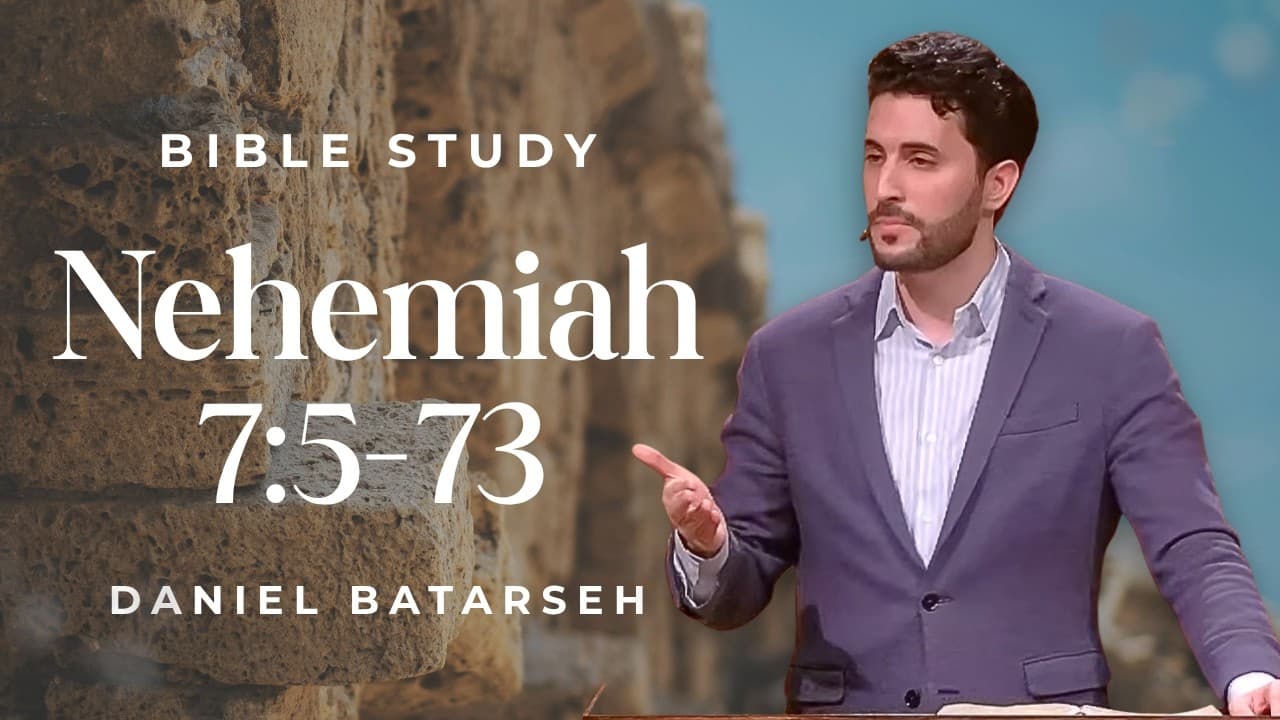
The largest group of returning exiles in Nehemiah 7 was a family nobody remembers — the sons of Senaah. What their obscurity reveals about God's view of faithfulness will challenge everything you think about significance.
Out of every family name listed in Nehemiah 7 — names linked to famous towns, royal bloodlines, and storied prophets — the single largest group of returning exiles belongs to a clan virtually no one has heard of. The sons of Senaah: 3,930 people strong. They appear once in the genealogy, once as builders of the Fish Gate in chapter 3, and then they vanish from the biblical record. No backstory. No famous ancestor. No dramatic narrative. And yet God inscribed every single one of them into His Word. If that doesn't rearrange your assumptions about what it means to matter in the kingdom of God, you haven't sat with it long enough.
This is the heart of what makes Nehemiah 7 — a chapter most readers skip as a dry list of names and numbers — pulse with life. It is a chapter about identity, about divine record-keeping, about the kind of faithfulness that doesn't need an audience. And it carries warnings as sharp as any prophetic oracle.
God Still Had Work for Nehemiah — And He Has Work for You
The walls of Jerusalem were finished at the end of chapter 6. The great project was complete. And it would have been the most natural thing in the world for Nehemiah to dust off his hands and return to his comfortable life as cupbearer to the king of Persia. But he didn't.
Instead, he looked around and noticed a problem: the city was wide and large, but the people within it were few, and no houses had been rebuilt (Nehemiah 7:4). The walls stood. The gates were hung. But Jerusalem was a shell — fortified on the outside, hollow on the inside. And Nehemiah couldn't unsee it.
What happens next is one of the most quietly stunning verses in the book. Nehemiah 7:5: "Then my God put it into my heart to assemble the nobles and the officials and the people to be enrolled by genealogy." As Pastor Daniel Batarseh reflected on that phrase: "Do you know it's possible for God to inspire your heart? Do you know that it is totally possible for Him to lead your heart and for the Holy Spirit to nudge your heart and for Him to deposit a plan into that heart?" (watch at 37:00)
But here's the crucial qualifier: Nehemiah didn't just feel a stirring and run with it. God confirmed the direction providentially. At the very moment Nehemiah needed to identify who belonged in Jerusalem, he found the original genealogy of the first wave of exiles who had returned under Zerubbabel decades earlier. The timing was not coincidental. The same God who planted the idea also provided the tool to execute it.
This is a principle worth tattooing on your decision-making: if God is genuinely prompting you toward something — especially something requiring significant time, investment, or sacrifice — He will pave the way providentially. Not all at once. Not with a roadmap. But with the next step. Opportunities begin to present themselves. Partnerships emerge. Resources appear. And you realize, slowly, that the stirring in your chest has fingerprints on it that aren't your own.
The flip side is equally important. Plenty of people claim divine leading with zero providential evidence. No open doors. No confirming counsel. No resources materializing. Just a feeling and a plan. Nehemiah's example cuts through that fog: look for the God who not only stirs but supports.
The Sons of Senaah and the Fragrance of Obscurity
Now we come to the genealogy itself — that long cascade of names and numbers that stretches from verse 8 through verse 38. Families identified as "the sons of" and towns identified as "the men of." Bethlehem appears. Anathoth, Jeremiah's hometown. Kiriath-jearim, where the Ark of the Covenant was sheltered for twenty years. Bethel, the place where Jacob met God in a dream. These are names that ring with history.
But the largest number under a single banner? Not Bethlehem. Not any of the famous clans. It's the sons of Senaah — 3,930 people — and we know almost nothing about them. The only other mention of this family in Nehemiah is in chapter 3, where they helped rebuild the Fish Gate. That's it. A construction credit and a census number.
And that's precisely what makes them extraordinary.
"It's a beautiful thing when obedience comes from unexpected places and unknown people," the teaching pressed. "The sons of Senaah teach us that sometimes the most impactful contributions to God's work come from servants, ministers, intercessors, and even local churches that nobody else knows about" (hear this moment).
We live in an age that equates visibility with value. If it isn't posted, it didn't happen. If it isn't platformed, it doesn't count. The sons of Senaah obliterate that lie. Fame does not automatically mean fruitfulness. You can be known for stupid things. The deepest wells of faithfulness in the history of God's people have almost certainly been dug in places no camera ever captured and no biography ever recorded.
Pastor Daniel Batarseh put it with a conviction that silenced the room: "I believe that when we stand before the Bema Seat of Christ, we're going to be shocked to see who God is going to reward the most. I'm sure we're gonna have our own versions of the sons of Senaah thinking, I have never heard of your name... And yet from the place of obscurity and from hiddenness, I'm sure will be the strongest perfume of piety and the greatest testimonies of power" (watch at 1:12:39).
Let that settle. The strongest perfume of piety. The greatest testimonies of power. Not from the stage. From the shadows.
The Priest Who Traded His Identity for a Name
Buried in the section about those connected to the temple is a parenthetical statement that most readers glide right past. Verses 63-65 describe priests who could not prove their genealogical legitimacy and were therefore excluded from serving — at least until a priest with Urim and Thummim could settle the matter.
One group stands out: the sons of Barzillai. And here the text pauses to explain why. An ancestor of theirs — a priest from the line of Aaron — had married one of the daughters of Barzillai the Gileadite. That alone wasn't the problem. The problem was that this priest then took Barzillai's name. He chose to have his entire household identified with his wealthy, respected father-in-law rather than with the priestly line of Aaron.
Why does this matter? Because the Gileadites descend from the tribe of Manasseh (Numbers 26:29), not Levi. So centuries later, when Nehemiah's generation tried to trace this family's priestly credentials, the records pointed to Manasseh, not Aaron. The genealogy was hopelessly tangled. And these descendants — who may well have had legitimate priestly blood — were barred from serving.
All because one man, generations earlier, didn't value what God had given him.
Who was Barzillai? Second Samuel 19:31-32 tells us. He was the wealthy, courageous Gileadite who provided for King David during Absalom's rebellion — an eighty-year-old man who risked his life to feed and shelter the exiled king. He was admirable. He was godly. David loved him. There was nothing wrong with Barzillai.
But there was something deeply wrong with a priest who looked at this man's wealth, reputation, and legacy and decided, I want that to be my identity instead. He abandoned the treasure of his own calling — to stand before God as a mediator for the people — in exchange for social prestige and possibly financial inheritance.
The application cuts to the bone: do not waste your time trying to be someone God did not create you to be. If God has placed you in business, don't covet the pulpit unless He clearly calls you there. If God has called you to ministry, don't spend your nights scrolling through the lifestyles of people in industries you left behind. If God hasn't given you the grace for it, you will fail, and it will hurt you and others.
This unnamed priest's decision didn't just affect him. It disqualified his descendants from the very service God had ordained for their family. One generation's covetousness became another generation's exclusion. The warning is severe: when you step outside the lane God has marked for you, you step outside His blessing — and the consequences can ripple further than you imagine.
Zerubbabel Gave First — and Not Everyone Followed
The final section of the genealogy (verses 66-73) records the assets and contributions the returning exiles brought with them. This is where Nehemiah's account diverges most noticeably from Ezra 2. Nehemiah provides more detail — and specifically highlights that the governor, Zerubbabel, gave to the treasury first: 1,000 darics of gold, 50 basins, 30 priests' garments, and 500 minas of silver.
Leaders give first. That's the principle embedded here. If leaders expect sacrifice from others, they must model it. Zerubbabel didn't wait to see who else would step up. He moved.
But notice the sobering realism of verse 70: "Now some of the heads of fathers' houses gave to the work." Not all. Some. The governor gave without hesitation. The sub-leaders? Mixed response. And this is the honest reality of obedience: your faithfulness does not guarantee that everyone around you will follow. You would hope so. You would pray so. But it doesn't always happen.
And here's the critical lesson: God is still worthy of obedience whether people follow or not. Zerubbabel didn't let the reluctance of other leaders keep him from giving. He gave because giving was right, not because giving was popular.
This connects directly to what happens in Nehemiah 11:1-2, where the repopulation of Jerusalem finally takes place. The leaders lived in Jerusalem first. Then lots were cast to bring one out of every ten citizens into the city. And the people blessed those who volunteered to go — men who didn't need a lottery to compel them. The genealogy of chapter 7 was the catalyst. Learning what their ancestors had sacrificed — leaving Babylon, crossing hostile territory, rebuilding from rubble — stirred some in Nehemiah's generation to say: if they could do that, surely I can do this (watch at 51:11).
The genealogy wasn't just a registry. It was a sermon in names. It preached sacrifice, identity, and the faithfulness of a God who preserved the royal line of David through Zerubbabel and the priestly line of Aaron through Jeshua — ensuring that the messianic promise survived exile, empire, and every attempt to snuff it out. These two men standing at the head of the list declared to every reader: the King is still coming. The Priest who will sit on David's throne is still coming. And He did.
What to Remember
- The largest group of returning exiles in Nehemiah 7 — the sons of Senaah — are virtually unknown, yet God recorded every one of them. Visibility has nothing to do with significance in God's economy.
- When God stirs your heart toward a new assignment, He will confirm it providentially — not with a full roadmap, but with the next step. Look for the open door, the unexpected resource, the partnership that materializes.
- One priest's decision to abandon his God-given identity for the name and wealth of Barzillai cost his descendants their place in the priesthood. Coveting someone else's calling can disqualify those who come after you.
- Zerubbabel gave to the treasury first, before asking anyone else to sacrifice. Leadership that demands what it won't model is not biblical leadership.
- God's discipline of Israel — decades of exile, the destruction of the temple — did not erase Israel's identity. If you are undergoing God's chastening, it does not mean He is finished with you. He is treating you as a son (Hebrews 12).
- The twelve leaders at the head of the genealogy symbolize the reconstitution of the twelve-tribe nation. Israel's failure did not cancel God's purpose.
Questions to Sit With
- If the sons of Senaah represent the kind of hidden faithfulness God most rewards, what does your desire to be recognized reveal about what you actually value — God's approval or human applause?
- Is there an area of your life where you've abandoned the calling God gave you because someone else's lane looked more attractive? What has that cost you — and others?
- Nehemiah could have retired after the walls were built. He didn't. Have you mentally "retired" from active service to God while your heart is still beating?
- When you sense God stirring you toward something new, what providential confirmations do you look for — or do you skip that step and run on feeling alone?
- Zerubbabel gave first and not everyone followed. Is there an area of obedience where you've been waiting for others to move before you will?
Scripture Referenced
- Nehemiah 7:4-73 (primary text)
- Psalm 119:97-104
- Psalm 119:96
- Revelation 21:10-12, 27
- Nehemiah 11:1-2
- Numbers 26:29
- 2 Samuel 19:31-32
- Hebrews 12
- Ezra 2
This summary was generated by AI from the sermon "Nehemiah 7 (Part 2) Bible Study (Lists of Returned Exiles/Totals and Gifts) | Pastor Daniel Batarseh" preached by Pastor Daniel Batarseh at Maranatha Bible Church Chicago. Watch the full sermon →
Preached by
Pastor Daniel BatarsehSenior Pastor
This summary was generated by AI from the sermon transcript.
Based on the sermon