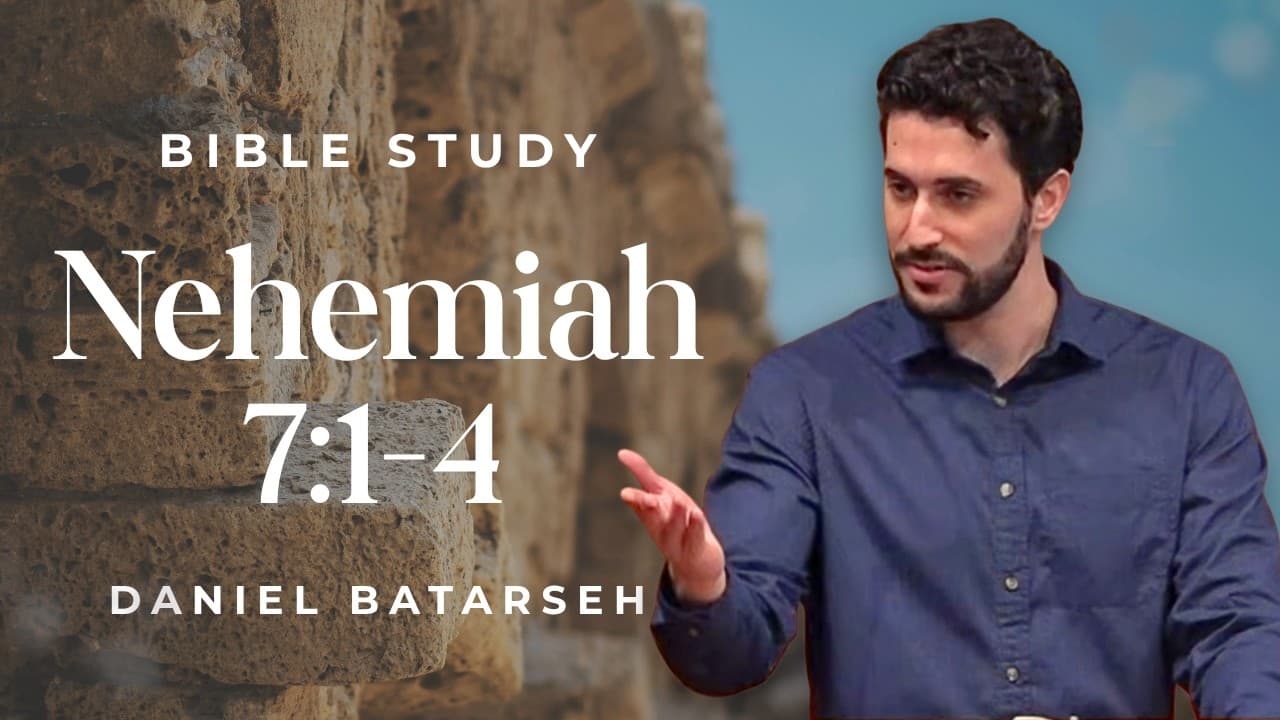
The walls of Jerusalem are rebuilt — so why does Nehemiah keep writing? Because structures don't protect God's people. Obedience does.
The walls are up. The gates are hung. The enemies have failed. And Nehemiah keeps writing.
That's the surprise of Nehemiah chapter 7. If you've been following this book as a story about a construction project, the climax already happened in chapter 6. The walls are rebuilt. The mission is accomplished. So why does the book continue for another seven chapters? Because Nehemiah understood something most of us forget: the security of God's people has never depended on any physical structure. It rests on obedience. The walls fell the first time not because Babylon was too strong, but because Israel refused to repent. And if the people inside those walls didn't change, the walls would come down again.
This is where Nehemiah pivots — from builder to shepherd. And what he does in the opening verses of chapter 7 reveals the essential ingredients for any community that wants to protect what God has built.
The Walls Fell Because of Sin, Not Because of Babylon
Before we touch a single verse in chapter 7, we need to remember why these walls needed rebuilding in the first place. It's easy to read Nehemiah as a leadership manual or a motivational story about perseverance. But the backstory is devastating. Jerusalem's walls were rubble because God himself had brought them down — using Babylon as his instrument of discipline against centuries of unrepentant rebellion.
This is not a minor footnote. It's the engine that drives everything Nehemiah does from this point forward. He knew, as any student of Israel's history would know, that you can stack stones as high as you like. You can forge iron gates and post armed guards at every entrance. But if the people inside those walls are living in defiance of the God who gave them the city, no fortification will save them.
So when we read Nehemiah 7:1 — "Now when the wall had been built and I had set up the doors and the gatekeepers, the singers, and the Levites had been appointed" — we're watching a leader shift his entire focus. The bricks are in place. Now comes the harder work: cultivating the faith of the people who live behind them (watch at 16:04).
This is the tension for every church, every family, every Christian institution. We build structures — programs, buildings, organizational charts, statements of faith — and then assume the structure will do the protecting. It won't. Structures without spiritual vitality are just decorated ruins waiting to happen.
The Kind of Leader Who Makes Things Grow
Nehemiah's first move is to appoint leaders over Jerusalem. And his criteria is striking in its simplicity: he chooses men who fear God more than others.
Not men with the most impressive résumés. Not the most charismatic communicators. Not the ones with political connections or administrative genius. Men who fear God. And not just men who fear God occasionally or in certain compartments of their lives — men whose reverence for the Lord was consistent, pervasive, and observable.
As Pastor Daniel Batarseh put it, drawing from 2 Samuel 23:3-4: "When you have somebody ruling in the fear of God, there is a manifold blessing that awaits those who are under such a rule" (watch at 0:00). David's poetry in that passage is breathtaking — a God-fearing leader "dawns on them like the morning light, like the sun shining forth on a cloudless morning, like rain that makes grass to sprout from the earth." Warmth. Growth. Life. That's what a leader who fears God produces.
But then came the inversion — the portrait of what happens when leaders lack the fear of God. And this is where the teaching cut close to the bone. "Most of the trouble that you bump into with people in the church is due to this single issue — they don't fear God. They think a pastor is in charge of the church, they think people are in charge of the church, they're so humanistic, they're so carnal, they're so fleshly" (hear this moment).
That sentence deserves to sit with you. How many church conflicts — the gossip, the power grabs, the petty grievances nursed for years — trace back to this single root? People who have forgotten, or perhaps never truly grasped, that the church belongs to God. That touching it carelessly is a dangerous thing. That every word spoken about a brother or sister is spoken in the hearing of the One who bought them with his blood.
The fear of God is not a personality trait some people have and others don't. It's a conviction. And it's contagious. Put a God-fearing leader in a community and watch what happens — people begin to grow, to flourish, to feel safe. Put someone in leadership who lacks that reverence, and people begin to cringe, to shrink, to leave. "They don't make things grow, they destroy. They don't bring more warmth, they make people cringe" (watch at 2:09).
If you're looking for a church, this is the diagnostic question that matters most. Not the worship style. Not the building. Not the size of the youth group. How do the leaders handle God's Word? How do they speak about Christ? Are they casual? Are they flippant? Are they irreverent? That tells you everything you need to know about where that community is headed.
Don't Open the Gates Until the Sun Is Hot
Nehemiah's instructions to the gatekeepers in verse 3 are practical and military: don't open the gates of Jerusalem until the sun is high enough to see clearly. Why? Because in the dim light of early morning, you can't identify who's coming in. People can sneak things past you. Threats can slip through disguised as harmless visitors.
The literal instruction is fascinating enough — ancient urban security at its most basic. But the spiritual principle beneath it is what makes this passage sing. Discernment requires light. You cannot guard what you cannot see. And the light that enables spiritual discernment is the Word of God, prayer, and a community that refuses to be naive about the reality of false teaching.
The connection to Jude 1:4 is devastating: "For certain people have crept in unnoticed." That phrase — crept in unnoticed — should haunt every church leader. These weren't obvious threats. They had Bibles in their hands. They wore nice clothes. They sang the songs. They seemed friendly. And they brought with them a theology of cheap grace: "God's so merciful, he's so forgiving. Surely he will not condemn us if we continue in sin. Surely he understands that we are flesh" (watch at 5:55).
This is the doctrine that always creeps in when the gates are unguarded. Not outright atheism — that's too obvious. Not blatant heresy — that's too easy to spot. No, it's the slow, smiling perversion of grace into permission. The quiet suggestion that God is too kind to care about holiness. The gentle erosion of the fear of God in favor of a deity who exists primarily to make us comfortable.
But there's good news. The church at Ephesus, commended by Christ himself in Revelation 2:2, proved that gatekeeping can be done well: "I know your works, your toil and your patient endurance and how you cannot bear with those who are evil, but have tested those who call themselves apostles and are not and found them to be false." Jesus praised this. He celebrated it. He commended a church that had the courage to say, "We checked your credentials, and they don't hold up."
This is not legalism. This is love. A church that lets anyone teach anything is not generous — it's negligent. It's a city with no gatekeepers, open to whatever wanders in under cover of darkness.
Worship Comes Before Strategy
There's a detail in verse 1 that's easy to read past: Nehemiah appoints gatekeepers, then singers, then Levites. The singers. In the middle of establishing security protocols and governmental structures, Nehemiah makes sure worship is institutionalized.
This wasn't Nehemiah inventing something new. King David had established the ministry of singers and musicians in Israel's worship long before. But Nehemiah understood that a community without worship at its center is a community running on fumes. You can have the best walls, the most vigilant gatekeepers, the most God-fearing leaders — but if the people are not regularly, corporately, passionately worshiping the God who gave them all of it, the whole enterprise is hollow.
Worship does something that strategy cannot. It reorients the heart. It reminds a community who they belong to and why they exist. It takes the fear of God — that essential quality Nehemiah looked for in his leaders — and makes it communal, contagious, and sustainable. A church that worships well will discern well. A church that worships well will guard its gates well. A church that worships well will produce leaders who fear God, because they've been in his presence together and they know he is not to be trifled with.
Nehemiah could have filled this chapter with nothing but military strategy and administrative appointments. Instead, he put singers in the same sentence as gatekeepers. Because he knew that the song of God's people is itself a wall — an invisible fortification that no enemy can breach when it rises from hearts that genuinely revere the Lord.
What to Remember
- The walls of Jerusalem fell not because Babylon was powerful, but because Israel was disobedient. No structure — physical or institutional — can protect a community that refuses to walk with God.
- The fear of God is the single most important qualification for spiritual leadership. Skill, charisma, and experience matter, but without genuine reverence for the Lord, a leader will destroy what they've been entrusted to build.
- False teachers don't arrive with warning labels. They carry Bibles, sing the songs, and smile warmly — then slowly convince you that God's grace means God doesn't care about your sin.
- Discernment requires light. Don't open the gates until you can see clearly. A church that refuses to examine what people believe and teach is not being gracious — it's being reckless.
- Worship is not an add-on to the mission; it is the mission's foundation. Nehemiah listed singers alongside gatekeepers because a community that worships well is a community that guards well.
Questions to Sit With
- If the fear of God is what separates a leader who brings warmth from one who makes people cringe, how would you honestly evaluate the leaders you follow — and your own leadership in your home?
- Have you ever watched someone "creep in unnoticed" to a church or community and slowly introduce ideas that sounded gracious but undermined holiness? What did you do? What do you wish you had done?
- Nehemiah shifted from builder to shepherd once the walls were complete. Is there an area of your life where you've finished building something but neglected to cultivate what's inside it — a marriage, a family, a ministry?
- If Jesus evaluated your church the way he evaluated Ephesus in Revelation 2, would he commend your willingness to test what's being taught — or would he find the gates wide open and unattended?
Scripture Referenced
This summary was generated by AI from the sermon "Nehemiah 7 (Part 1) Bible Study (Hanani & Hananiah Governors) | Pastor Daniel Batarseh (9/18/26)" preached by Pastor Daniel Batarseh at Maranatha Bible Church Chicago. Watch the full sermon →
Preached by
Pastor Daniel BatarsehSenior Pastor
This summary was generated by AI from the sermon transcript.
Based on the sermon