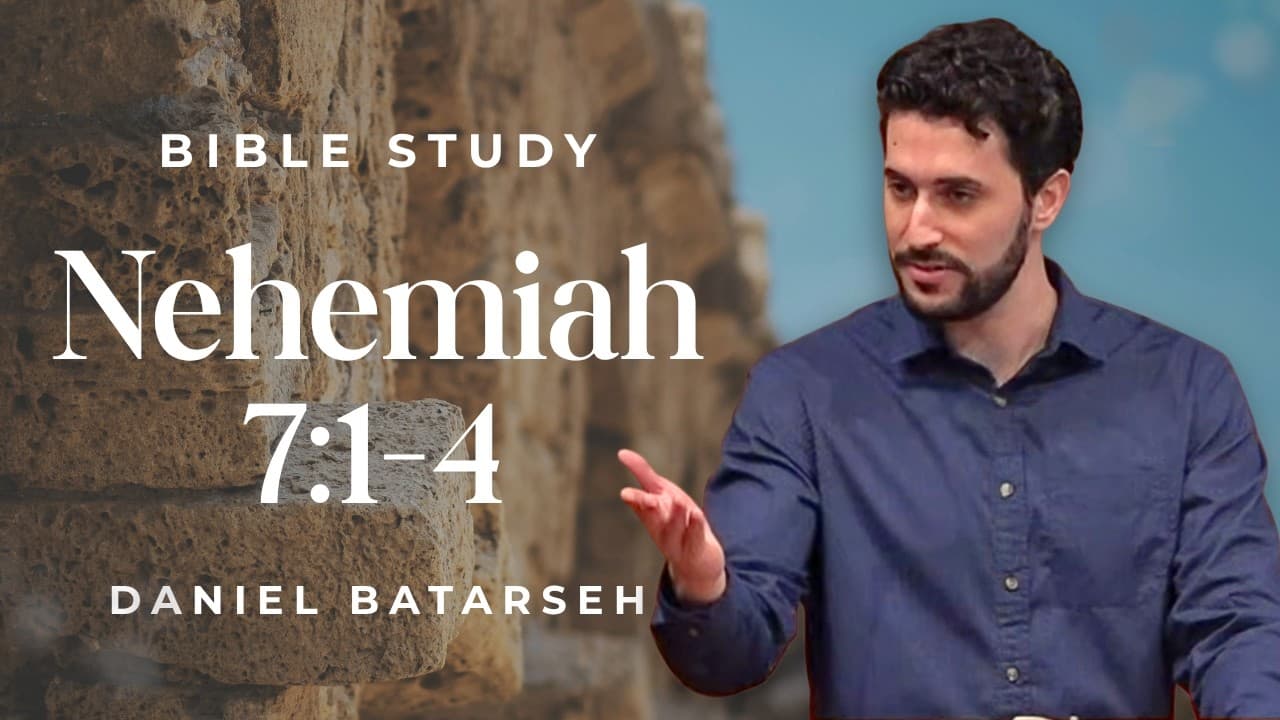
Nehemiah finished the walls — but his work wasn't done. Six principles from Nehemiah 7:1-4 reveal what it takes to sustain and protect what God builds.
The walls are up. The gates are set. The enemies have failed. So why does Nehemiah keep writing?
That's the question that makes chapter seven so unexpectedly important. Most people treat the rebuilding of Jerusalem's walls as the climax of Nehemiah's story — and in one sense, it is. But Nehemiah understood something that too many churches, ministries, and individual believers miss: building something for God is not the hardest part. Protecting it is. The walls of Jerusalem didn't fall the first time because Babylon was strong. They fell because the people of God were disobedient. And Nehemiah, standing inside freshly rebuilt walls with a population too small to fill them, knew that physical structures don't guarantee spiritual safety. What he does next — in just four short verses — lays out a blueprint for sustaining the work of God that is as urgent for the church today as it was for Jerusalem twenty-five centuries ago.
Gatekeepers: Why Discernment Is Not Optional
The first thing Nehemiah establishes after the walls are complete is gatekeepers (watch at 9:37). In the Old Testament, gatekeepers were assigned to the temple precincts — their job was to screen who and what entered and exited the house of God, ensuring that the sanctity of God's dwelling place remained intact. You can read the detailed account of their responsibilities in 1 Chronicles chapter nine. But here in Nehemiah's day, something shifts. The gatekeepers are stationed not just at the temple but at the city walls themselves. Nehemiah is expanding the perimeter of protection. He's taking extra precautions.
And here's the application that should make every believer sit up: the church needs gatekeepers too. Not bouncers. Not suspicious hall monitors who make visitors feel unwelcome. The gatekeepers opened the doors every morning — they expected and wanted people to come. But they understood that not everyone who enters a fellowship has good or holy intentions.
This is where the New Testament becomes blunt. In 2 Peter 2:1, Peter warns that false teachers "will secretly bring in destructive heresies" — not obviously, but under cover. Jude verse 4 says, "certain people have crept in unnoticed." As Pastor Daniel Batarseh put it with sharp clarity: "They had Bibles in their hands. They had a nice suit jacket on. They seemed so friendly. They were singing the songs when you were singing them. They crept in unnoticed" (hear this moment).
Where were the gatekeepers? Where was the church? How did people slip in undetected?
But there is a success story. In Revelation 2:2, Jesus commends the church in Ephesus — the same church He would criticize for abandoning their first love — because they "tested those who call themselves apostles and are not, and found them to be false." Christ praises discernment. He wants His church to be welcoming and watchful at the same time. Those two things are not contradictions. They are both expressions of love — love for the stranger who walks in, and love for the flock already inside.
Singers and Levites: Worship and Word Are Inseparable
The second and third things Nehemiah establishes are singers and Levites — and the fact that he mentions them together in the same breath is no accident.
The singers were not a new invention. King David established this ministry when he brought the Ark of the Covenant to the tabernacle, and it continued through Solomon's reign. These were designated people whose sole responsibility was ongoing praise — twenty-four hours a day, seven days a week, as recorded in 1 Chronicles 6:31-32. But Nehemiah wasn't simply maintaining tradition. By prioritizing the singers immediately after the walls were rebuilt, he was making a declaration: the ultimate purpose of these walls is not defense. It is worship. The walls exist to protect and facilitate the devotion of God's people.
And then there's the devastating illustration of what happens when that purpose gets hijacked. When Jesus cleansed the temple — twice — most people assume it was because He didn't want anything sold there. But that misses the point entirely. Deuteronomy 14 records that God Himself instituted a system where worshipers traveling from distant parts of Israel could purchase animals for sacrifice at the temple rather than hauling livestock across the country. The selling wasn't the problem. The problem was that what was designed to assist worship had become a vehicle for greed — extortion, inflated exchange rates, exploitation of pilgrims who had no other option. As the teaching made plain: "What was meant to help the people in their devotion to God was used by certain people to benefit them. It was a grace given by God and like so many other graces, it was perverted for personal gain" (watch at 23:26).
The Levites, meanwhile, reveal the third condition: the spiritual care of teaching. In Nehemiah 8:7-8, the Levites' primary function becomes unmistakable — they "helped the people to understand the law," reading from it "clearly" and giving "the sense, so that the people understood the reading." Not just reading Scripture aloud. Explaining it. Making it clear. And the people wept when they heard it — because truth, rightly taught, does that to the human heart.
Paul carried this same urgency to Timothy. In 2 Timothy 2:2, facing his own execution, he left marching orders: "What you have heard from me in the presence of many witnesses, entrust to faithful men who will be able to teach others also." A church built around one teacher is a recipe for a short-term ministry. The goal is multiplication — not cloning the pastor, but instilling the convictions and tools necessary to draw out the depths of God's Word so the teaching ministry can sustain the entire community.
And here is where the connection between singers and Levites becomes electric: authentic worship is impossible without knowledge of God's truth, and God's truth must in turn produce authentic praise. If the teaching is shallow, the singing is just noise — "the right keys and the right build up," as the sermon put it. But if truth is really at work and the worship is still lifeless? Something is equally wrong. "I'm stunned sometimes when I go to some places — you'd think Jesus didn't rise from the grave the way people sing. Is this a funeral service or are we a people who know that our Christ has resurrected?" (hear this moment).
The Fear of God in Leadership Changes Everything Under It
Verse two introduces the fourth condition, and it may be the most consequential of all. Nehemiah appoints his brother Hanani and a man named Hananiah to govern Jerusalem, and the reason he gives is stunning in its simplicity: "for he was a more faithful and God-fearing man than many" (Nehemiah 7:2).
Not the most skilled. Not the most politically connected. Not the most impressive résumé. The most God-fearing.
And notice the precision — Nehemiah doesn't just find someone who fears God. He finds someone who fears God more than others. There is a spectrum to the fear of the Lord, and Nehemiah could discern where people fell on it because he himself walked in that fear. That's how spiritual discernment works: when you fear God deeply, you can recognize who else does — and who merely claims to.
The reason this matters for leadership is found in 2 Samuel 23:3-4, where David reflects on his career in his final words: "When one rules justly over men, ruling in the fear of God, he dawns on them like the morning light, like the sun shining forth on a cloudless morning, like rain that makes grass to sprout from the earth." A God-fearing leader doesn't just benefit personally. The people under that leadership flourish. They feel warmth. Safety. Growth. They are watered.
And the inverse is equally true. A leader who lacks the fear of God brings the opposite effects — strife, manipulation, draining relationships. As Pastor Daniel Batarseh observed with characteristic directness: "Most of the trouble that you bump into with people in the church is due to this single issue — they don't fear God. They think a pastor is in charge of the church, they think people are in charge of the church... And when you fear God, you'll be very careful to touch the church. Very careful" (watch at 36:49).
Someone once asked what to look for in a local church. The answer is simple: look no further than the leadership. How do they handle God's Word? How do they speak about Christ? Are they flippant, casual, irreverent? That tells you nearly everything you need to know.
Guard Your Own Front Door
The fifth condition is the one most people overlook, and it's tucked into the end of verse three: "Appoint guards from among the inhabitants of Jerusalem, some at their guard posts and some in front of their own homes."
Nehemiah doesn't stop at the walls. He stations watchmen at individual households. Why? Because the strength of the broader community is inseparable from the welfare of individual homes. If you don't have healthy homes in a church, you will eventually get a sick church.
The New Testament confirms this repeatedly. In 1 Timothy 5:16, Paul tells Timothy that believing women with widowed relatives should care for them personally — "let the church not be burdened, so that it may care for those who are truly widows." The instinct to run to the church for every problem, while understandable, can overwhelm the community and neglect the responsibility God has placed on individual families.
And in 2 Timothy 3:6, Paul warns of those who "creep into households and capture weak women, burdened with sins and led astray by various passions." These infiltrators understand that shepherds are not omnipresent. They can't walk into the church undetected, so they invite themselves to dinner. They sit on your couch. They befriend you. And slowly, household by household, they introduce heresy and division that eventually poisons the whole body.
This is a call especially to men. You have been granted a unique authority to protect your family — in your prayers, your instruction, your example. Don't think little of it. That dismissiveness is already the first step of losing the battle. Every home that is guarded contributes to the strength of the church. Every home left unguarded is an open gate for the enemy.
Faith to Build Bigger Than What You Can See
The final verse of the passage contains what might be the most quietly powerful detail in the entire chapter: "The city was wide and large, but the people within it were few, and no houses had been rebuilt" (Nehemiah 7:4).
Nehemiah knew the city was underpopulated. He knew most of the inhabitants had scattered to the countryside during the years Jerusalem lay unprotected. And yet he built the walls to their original parameters. He didn't downsize. He didn't scale back the borders to match the current headcount. He didn't say, "Let's make it cozier so people don't feel the emptiness."
He built for what God had promised, not for what his eyes could see.
And there's reason to believe his vision was biblically informed. Zechariah 8:3-8 — a prophecy delivered before Nehemiah's time — paints a picture of a restored Jerusalem where "old men and old women shall again sit in the streets" and "the streets of the city shall be full of boys and girls playing." God cared about elderly people feeling safe on their patios. He cared about children's games. And He promised to bring His people back from east and west to dwell in Jerusalem again.
Did Nehemiah have this prophecy in mind when he drew up his plans? We can't say conclusively. But we can say this: he built with faith for more. And in verse five, we catch a glimpse of what happens to people who finish one work for God with that kind of faith — "Then my God put it into my heart to assemble the nobles and the officials and the people to be enrolled by genealogy." A fresh touch. A new assignment. God had more for Nehemiah because Nehemiah believed there was more.
The saddest thing in ministry is meeting leaders whose eyes are empty of vision. No faith for more conversions. No expectation of deeper growth. No belief that God might do something extraordinary in their homes, their neighborhoods, their city. Just event-oriented survival — making it to another Sunday. And when that vision dies, the people drag their feet. Prayer meetings thin out. Joy evaporates. Not because God has stopped working, but because His people have stopped believing He would.
What to Remember
- Physical structures — buildings, programs, budgets — cannot protect a church. Only the obedience and spiritual health of God's people can sustain what God builds.
- Discernment is not suspicion. The church must be welcoming to all people while refusing to admit destructive heresies and abominable practices — and Jesus Himself commends churches that test false claims.
- Worship and biblical teaching are inseparable. If the teaching is hollow, the singing is just noise. If the teaching is rich and the worship is lifeless, something is equally broken.
- The fear of God in leadership is not a bonus — it is the single most important quality Nehemiah looked for, and its presence or absence determines whether a community flourishes or fractures.
- Every healthy home is a contribution to the health of the church. Guarding your household — what you allow in, what you teach, how you pray — is not separate from guarding the body of Christ.
- Faith to believe God for more is not wishful thinking. It is the posture that positions you to receive a fresh assignment from God after the current one is complete.
Questions to Sit With
- If someone examined the entertainment, conversations, and spiritual habits inside your home this week, would they find a guarded household or an open gate?
- Nehemiah chose leaders based on who feared God most — not who was most talented or well-liked. How would your church's leadership look different if that were the only criterion?
- Is there an area of your life or ministry where you've quietly stopped believing God would do more — and started just surviving week to week?
- When was the last time the teaching of God's Word moved you to tears, like it did for the people in Nehemiah 8? If it's been a while, what has changed — the teaching, or your heart?
- Are you dumping spiritual responsibilities on your church that God has actually assigned to you in your own home?
Scripture Referenced
- Nehemiah 7:1-4 (primary passage)
- 2 Samuel 23:3-4
- 1 Chronicles 6:31-32; 9
- Deuteronomy 14
- 2 Peter 2:1
- Jude 1:4
- Revelation 2:2
- Nehemiah 8:7-9
- 2 Timothy 2:2
- 2 Timothy 3:5-7
- 1 Timothy 5:16
- Acts 2:42
- Zechariah 8:3-8
This summary was generated by AI from the sermon "Nehemiah 7 (Part 1) Bible Study (Hanani & Hananiah Governors) | Pastor Daniel Batarseh (9/18/26)" preached by Pastor Daniel Batarseh at Maranatha Bible Church Chicago. Watch the full sermon →
Preached by
Pastor Daniel BatarsehSenior Pastor
This summary was generated by AI from the sermon transcript.

Based on the sermon