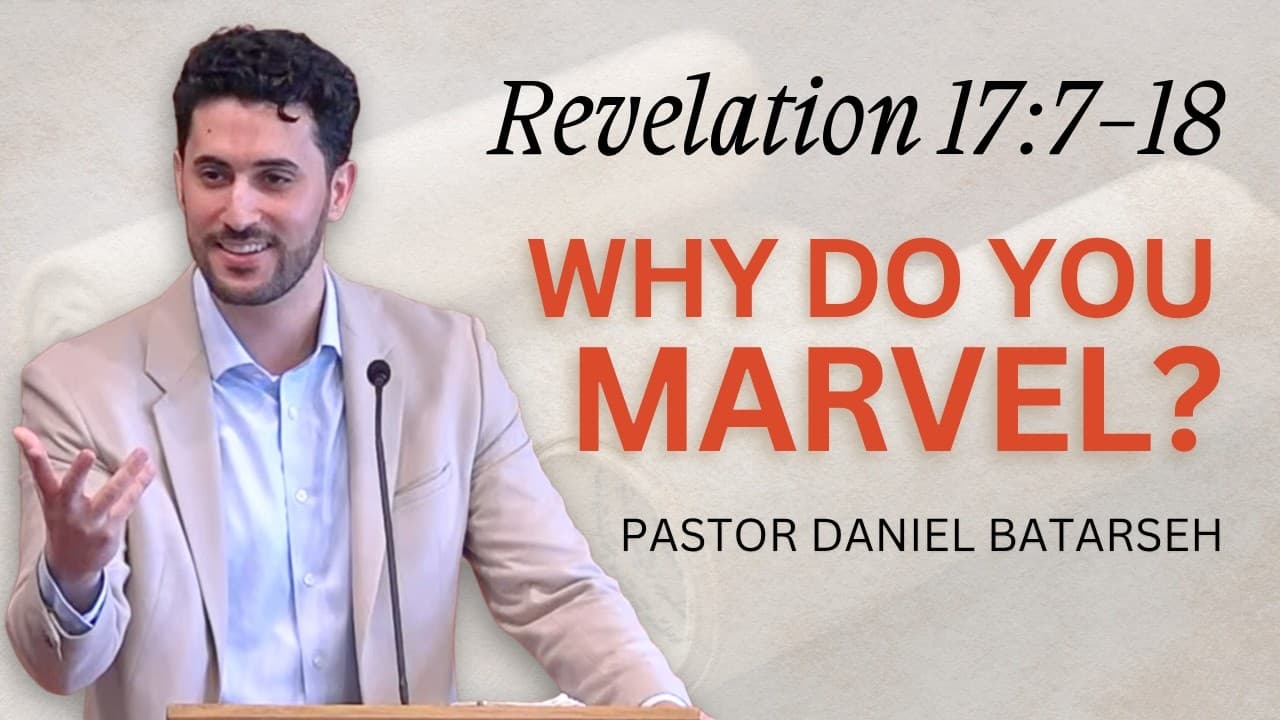
Revelation 17:14 crowns Jesus with a title the Old Testament reserves for Yahweh alone. This overlooked verse is one of the strongest proofs of Christ's deity in all of Scripture.
Revelation 17:14 Proves Jesus Is God — Here's How
There is a title in the Old Testament that belongs to Yahweh and Yahweh alone: Lord of lords. You'll find it in Deuteronomy 10:17. You'll find it in Psalm 136:2–3. You'll find it on the lips of a pagan king in Daniel 2:47. It is the exclusive property of the one true God — the declaration that He stands above every authority, every power, every so-called deity that the nations have ever fashioned. And then John, the apostle who leaned against Jesus' chest at supper, takes that very title and places it squarely on the Lamb.
Revelation 17:14 is not just another line in a dense prophetic chapter. It is one of the most potent declarations of Christ's deity in the entire New Testament — and most readers fly right past it on their way to decoding beasts and horns. Pastor Daniel Batarseh stopped the congregation cold on this verse, and what he showed from the Old Testament connections is the kind of insight that changes how you read both Testaments.
The Title No One Else Can Wear
Most discussions of Revelation 17 get consumed by the spectacle — the scarlet beast, the prostitute, the ten horns. And understandably so. The imagery is staggering. But buried in the middle of this prophetic vision is a single verse that functions like a theological anchor dropped into the chaos:
"They will make war on the Lamb, and the Lamb will conquer them, for he is Lord of lords and King of kings." — Revelation 17:14
To a modern reader, "Lord of lords and King of kings" sounds like generic royal language — impressive but vague, like calling someone "the greatest of all time." But to a first-century Jewish reader steeped in the Hebrew Scriptures, this phrase would have detonated like a bomb.
Consider the evidence. In Deuteronomy 10:17, Moses declares: "For the LORD your God is God of gods and Lord of lords, the great, the mighty, and the awesome God." This is Yahweh's résumé. It is His and His alone. In Daniel 2:47, even Nebuchadnezzar — the most powerful man on earth at the time — confesses that the God of Daniel is "God of gods and Lord of kings." And in Psalm 136:2–3, the psalmist calls Israel to worship with this refrain: "Give thanks to the God of gods... Give thanks to the Lord of lords, for his steadfast love endures forever."
Three passages. Three witnesses. One unmistakable conclusion: this title is the fingerprint of deity. (Watch this connection traced at 2:33)
And then John — not carelessly, not accidentally, but with full apostolic authority — stamps it on Jesus the Lamb.
The Objection That Actually Strengthens the Case
Now, someone will object. They always do. The objection goes like this: "The Old Testament calls Yahweh 'God of gods,' but Revelation 17:14 only calls Jesus 'Lord of lords' and 'King of kings' — not 'God of gods.' So this doesn't prove Jesus is God."
It sounds careful. It sounds scholarly. But it collapses under its own weight.
Here's why: nowhere in the entire New Testament is the phrase "God of gods" applied to anyone — not even the Father. The New Testament simply doesn't use that particular formulation. Instead, the emphasis shifts based on context. The Old Testament needed to establish Yahweh's supremacy over the false gods of the surrounding nations — hence "God of gods." The New Testament, operating in a different theological landscape, emphasizes Christ's supreme authority over earthly rulers and powers — hence "Lord of lords and King of kings."
The underlying claim is identical: absolute, unrivaled sovereignty. The vocabulary adjusts to the audience and context, but the substance never wavers. As Pastor Daniel Batarseh put it with characteristic directness: "If you are one who really wants to know how to prove that Christ is God, lean in and pay attention to these references. You can even prove Jesus being God here from verse 14 of Revelation 17" (hear this moment).
This is not proof-texting. This is the New Testament doing exactly what it does throughout — taking the exclusive prerogatives of Yahweh and applying them to Jesus of Nazareth, daring you to draw the obvious conclusion.
The Lamb Will Conquer — Not the Lion
There is a detail in verse 14 that is easy to miss but impossible to forget once you see it. The verse describes ten kings — powerful political rulers operating under the Antichrist's regime — who will actually take up arms against Christ at His return. They will marshal their armies. They will stand in formation. They will wage war against the returning King.
And they will be obliterated. But notice how the text describes their defeat.
It does not say, "The Lion of Judah will conquer them." It does not say, "The Mighty Warrior will conquer them." It says, "The Lamb will conquer them."
As the sermon drove home: "It would have made sense if it said the lion will conquer them, but no, the lamb is going to conquer them" (watch at 1:34).
Why does this matter? Because the title "Lamb" points to sacrifice. It points to Calvary. It points to blood poured out and a body broken. And it is precisely this Jesus — the slaughtered, crucified, pierced Jesus — who will dismantle every empire that has ever set itself against God. Not despite His sacrifice, but because of it. The cross was not a detour on the way to power. The cross is the power.
Every dictator who has ever crushed the church, every system that has ever tried to silence the gospel, every regime that has ever demanded worship for itself — they will not be defeated by a Jesus who finally stops being gentle and starts being strong. They will be defeated by the Lamb. The same Jesus who bled on Friday will reign on that final day. His gentleness and His omnipotence are not contradictions. They are the same glory viewed from different angles.
Ten Kings, One Delusion, and the Danger of Borrowed Power
The ten horns of Revelation 17 represent ten kings — real political rulers who will operate under the Antichrist's authority during the final period of human history. They will govern in zones, administrating the beast's regime across the earth. They are organized. They are unified. And they are utterly deceived.
Think about the scale of that delusion. These are not ignorant men. They are rulers — shrewd, calculating, powerful. And yet they will be so thoroughly blinded that they will believe they can wage war against the Son of God and win. They will look at the Lamb and see weakness. They will look at His church and see vulnerability. And they will march straight into their own annihilation.
As the sermon soberly noted: "Foolish is the preacher who depends on his eloquence. Ignorant is the man who thinks that he can do this without your help" (watch at 5:53). That prayer, offered before the exposition even began, carried a warning that extends far beyond the pulpit. The same self-sufficiency that will doom the ten kings operates in miniature every time we approach God's Word — or God's world — convinced that our intelligence, our strategy, our resources are enough.
The ten kings surrender their authority to the beast. That is their fatal error. Every human being surrenders authority to something — to ambition, to comfort, to ideology, to appetite. The question Revelation 17 forces you to answer is not whether you will serve, but whom. The kings chose the beast and received temporary power. The saints choose the Lamb and receive an eternal kingdom.
There is no middle ground in this chapter. There never was.
Why the Angel Said "Don't Marvel"
The chapter opens with John standing slack-jawed before the vision — the prostitute, the beast, the blasphemous names. And the angel's response is striking: Why do you marvel? It is not a rebuke so much as a redirection. The angel is saying: Don't be paralyzed by the spectacle. Let me explain it to you.
And that is exactly what God does throughout this passage. He does not leave His people mystified. He does not hand them a puzzle and walk away. He provides four layers of explanation — the beast, the seven heads, the ten horns, and the prostitute — because He wants His church to understand the times, not merely survive them.
This is the deep end of the book of Revelation. The imagery is dense. The theology is layered. The temptation is either to obsess over every speculative detail or to throw up your hands and skip to chapter 21 where everything is beautiful. But the angel's words push back against both extremes: Don't marvel. Listen. I will explain.
God's intention in prophecy has never been to confuse the faithful. It has been to prepare them. To steady their hands. To fix their eyes on the Lamb who conquers — not by matching the world's violence, but by being exactly who He has always been: the sacrificed and risen King who holds every title that belongs to God, because He is God.
What to Remember
- Revelation 17:14 applies Yahweh's exclusive Old Testament title — Lord of lords — directly to Jesus the Lamb, making it one of the strongest implicit declarations of Christ's deity in the New Testament.
- The Lamb conquers, not the Lion. Jesus does not set aside His sacrificial identity to exercise power — His power flows from the cross, not in spite of it.
- The ten kings represent the pinnacle of human political power united against God — and their total defeat proves that no coalition of earthly authority can stand against Christ, no matter how organized or unified.
- The objection that Jesus isn't called "God of gods" in the New Testament actually proves too much — the Father isn't called that either. The New Testament shifts the emphasis to lordship and kingship while preserving the identical claim of absolute sovereignty.
- God gives prophecy not to mystify but to prepare. The angel's explanation of the vision is an act of pastoral care — God wants His people informed, not terrified.
Questions to Sit With
- If Revelation 17:14 crowns Jesus with a title reserved for Yahweh alone, what does that demand of your worship — not in theory, but this week?
- The ten kings surrendered their authority to the beast in exchange for temporary power. What have you surrendered your authority to — and what did you receive in return?
- Why do you think John marveled at the prostitute and the beast? What spectacles in our own cultural moment have the power to paralyze Christians into silence or fascination instead of faithful action?
- If the Lamb conquers — not the Lion — what does that say about the kind of power the church is supposed to embody while we wait for His return?
- The angel told John not to marvel and then immediately offered explanation. When you encounter something in Scripture that confuses or overwhelms you, do you press in for understanding or walk away?
Scripture Referenced
This summary was generated by AI from the sermon "Why Do You Marvel? | Revelation 17:7-18 | Pastor Daniel Batarseh (5/17/26)" preached by Pastor Daniel Batarseh at Maranatha Bible Church Chicago. Watch the full sermon →
Preached by
Pastor Daniel BatarsehSenior Pastor
This summary was generated by AI from the sermon transcript.
Based on the sermon