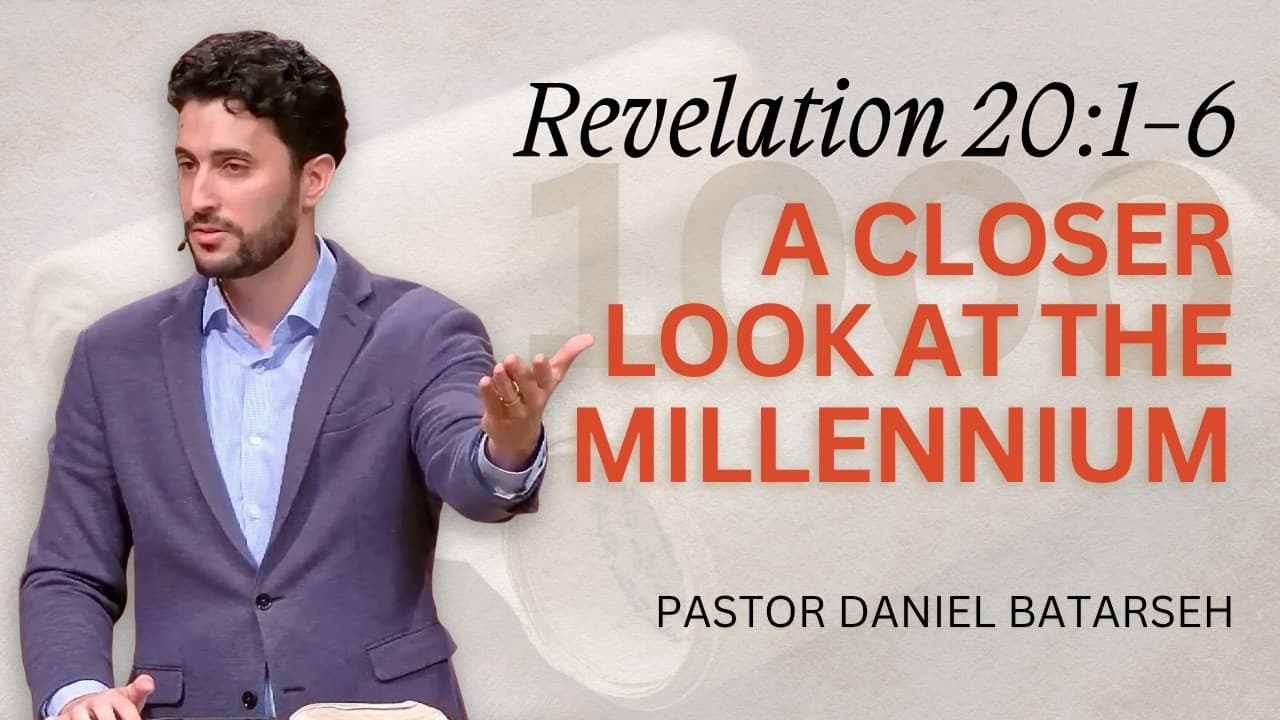
Revelation 20 doesn't just predict Satan's imprisonment — it exposes what's really wrong with the human heart. Even a perfect world under Christ's rule won't fix everyone.
What if every problem you blame for the state of the world — corrupt politicians, broken systems, cultural decay — was stripped away overnight? What if the devil himself was locked in a cell and the Son of God sat visibly on a throne, governing with flawless justice and uninterrupted peace? You'd expect utopia. You'd expect universal worship. And according to Revelation 20:1-6, that's exactly what happens during the millennial reign of Christ. But here's the part that should unsettle you: even then, when Satan is released after a thousand years, he finds willing recruits. The millennium doesn't just reveal what the world looks like without a devil. It reveals what the human heart looks like without a new birth.
That's the nerve this passage strikes, and it's the truth Pastor Daniel Batarseh pressed into the congregation at Maranatha Bible Church with unmistakable urgency. This isn't a speculative theology lesson. It's a mirror.
Satan's Imprisonment Is Total — Not Partial
The language of Revelation 20:1-3 is deliberate and layered. An angel descends from heaven with a key and a great chain. He seizes the dragon — and then John piles up four titles as if to eliminate any ambiguity: "the dragon, that ancient serpent, who is the devil, and Satan." This is no symbolic figure. This is the same adversary who deceived Eve, who accused Job, who tempted Christ in the wilderness, who has prowled through every century of human history like a roaring lion.
And what happens to him isn't a demotion. It's a total lockout. He's thrown into the abyss, shut in, and sealed over. His activity on earth won't be reduced or minimized — it will be non-existent. Consider the progression: in Revelation 12, Satan was expelled from heaven and confined to earth. Now in chapter 20, he's expelled from earth and confined to the abyss. Each stage tightens the noose. Each fall strips him of another domain.
And notice the humiliation embedded in the details. Christ doesn't even deal with Satan personally. He dispatches an angel — a creature — to do the job. As the sermon put it plainly: "He's an opponent to God, but don't make the mistake — he's not on the same level as our king" (watch at 1:17:39). There's a beautiful contrast here. Jesus descended from heaven voluntarily, in humility and meekness. Satan descends involuntarily, dragged down by pride and stripped of power. Christ went low to save. Satan goes low because he's defeated.
Why does this matter? Because the prophetic visions of the millennium — the peace of Isaiah 9:7, the humility of Zephaniah 3:12, the disarmament of Isaiah 2:4 — are impossible to fulfill with a roaming, deceiving devil. Isaiah says of the Messiah's government that "of the increase of his government and of peace there will be no end." Uninterrupted peace. Unbroken righteousness. That can't coexist with a being whose entire vocation is deception and destruction. He has to go.
A World Without Pride — And Why It Requires Christ as King
One of the most striking moments in the sermon came from an unexpected passage. Not from Revelation, but from the minor prophet Zephaniah. In chapter 3, after describing God's final judgment on the nations — language that echoes the return of Christ in Revelation 19 — the prophet immediately pivots to describe the world that follows. And the details are stunning.
God says He will change the speech of the peoples to "a pure speech, that all of them may call upon the name of the Lord and serve him with one accord" (watch at 64:04). Universal worship. Then the focus shifts to Israel: "I will remove from your midst your proudly exalted ones, and you shall no longer be haughty in my holy mountain. But I will leave in your midst a people humble and lowly."
Pause on that. When Christ takes the throne, He eradicates pride. Not through suggestion. Not through conviction you can ignore. He removes it. Can you fathom a world without pride? World leaders without it? Neighbors without it? The question was posed with quiet force: "Can you imagine this quality dominating the masses? And is this kind of attitude possible if there's a devil out there tempting people to be proud?" (hear this moment).
But then the application turned inward, and the room got quiet. This is prophecy, yes — but it's also a principle. If Jesus Christ is truly king of your heart today, one of the first casualties should be pride. "You wanna know if Jesus Christ rules your heart today? How strong is pride in your life?" That question doesn't let you hide behind eschatology. It follows you into Monday morning, into your marriage, into how you respond when someone corrects you.
The same principle applies to a local church. Are the leaders arrogant? Do members look down on one another? Is there strife driven by clashing preferences? The millennium shows us what Christ's reign produces on a global scale — humility, worship, peace. If those qualities are absent in the small kingdom of your own life, you have to ask who's really sitting on the throne.
The Millennium's Most Terrifying Revelation: Your Heart
Here is the part of this sermon that should make every person — believer or not — sit up straight. At the end of the thousand years, Satan "must be released." Not "might escape." Not "will break free." He must be released. God plans it. And the moment he's out, Satan does exactly what he's always done: he deceives the nations and gathers them for war against Christ.
After a thousand years in the abyss, he hasn't changed. That's damning enough. But here's what's worse: he finds people willing to follow him.
How? During the millennium, survivors of Christ's return enter the kingdom in unglorified bodies. They marry, have families, repopulate the earth. Their descendants grow up in a world without war, without crime, without satanic influence. Children will learn about weapons from history books the way we learn about medieval catapults — as relics of a barbaric past. And yet, when given the chance, many of these people will choose Satan over the Christ who gave them paradise.
As Pastor Daniel Batarseh declared with the weight of someone who'd been wrestling with this truth: "Even when Jesus Christ is president of the world, you will have people who will deny Him" (watch at 1:24:03). And then the connection that landed like a thunderclap: "Do you remember Adam and Eve? In the Garden of Eden, there are only two of them. And all it required was one devil to lie to them."
This is the millennium's most devastating lesson. Humanity's fundamental problem was never environment, government, economics, or education. It's the heart. Mark 7:21-23 says it plainly: "From within, out of the heart of man, come evil thoughts, sexual immorality, theft, murder..." All of it comes from within. The millennium will serve as a thousand-year historical demonstration that Jesus was right about the human condition all along.
The implications for today are enormous. "Having a conservative Supreme Court, having a more diplomatic and intelligent president, having more strict and even righteous laws may curb evil, but it will never solve it" (hear this moment). That's not cynicism. That's a diagnosis. And the only prescription is the gospel — not political reform, not cultural improvement, but heart surgery performed by the Spirit of God. The church must never lose focus on this mission, no matter how tempting it is to believe the right policies will save us.
From Prisoners to Princes: The Vindication of the Faithful
The final movement of this passage is breathtaking in its justice. Verse 4 introduces thrones — plural — occupied by those "to whom the authority to judge was committed." These aren't decorative thrones. They represent real governmental authority given to real people: the beheaded martyrs of the tribulation, the saints of all ages, the faithful church that endured.
Think about the reversal. In Revelation 2:10, Jesus told the church at Smyrna that "the devil is about to throw some of you into prison" for ten days. Now, in chapter 20, the devil himself is thrown into prison for a thousand years. The persecuted become the princes. The imprisoned become the judges. And this isn't a new idea invented by John on Patmos. Daniel 7:27 promised that "the kingdom and the dominion and the greatness of the kingdom under the whole heaven shall be given to the people of the saints of the Most High." 1 Corinthians 6:2 asks pointedly: "Do you not know that the saints will judge the world?" In Luke 19:17, Jesus rewards the faithful servant with "authority over ten cities." Revelation 5:9-10 says the redeemed "shall reign on the earth" — not in heaven, on the earth.
What will this look like in practice? Honestly, we don't fully know. But the principle is clear: faithfulness now determines authority then. What you do with the little Christ has entrusted to you in these seventy or eighty years matters eternally. And the greatest comfort in this passage isn't even the thrones. It's verse 6: "Blessed and holy is the one who shares in the first resurrection. Over such the second death has no power." The millennium will end. But those who belong to Christ will not. Death itself has lost its jurisdiction over the redeemed. That's the promise that makes every sacrifice worth it.
What to Remember
- Satan's removal during the millennium isn't a reduction of his influence — it's a total elimination, and it's what makes the prophesied peace of Isaiah 9:7 and the humility of Zephaniah 3:12 possible.
- The millennium will prove once and for all that humanity's deepest problem is not bad government, bad circumstances, or satanic temptation — it's the unregenerate human heart.
- Even a thousand years of perfect governance under Christ will not transform a heart that has never been born again — external compliance is not the same as internal conversion.
- Faithfulness to Christ in this life determines the authority He entrusts to you in the next — the persecuted church will become the ruling church.
- The first resurrection guarantees that the second death has no power over the redeemed — the millennium ends, but Christ's people do not.
Questions to Sit With
- If you removed every external obstacle from your life — financial stress, difficult relationships, health problems — would your heart naturally gravitate toward worship, or would new idols simply fill the space?
- The millennium proves that a perfect environment doesn't produce perfect people. What does that say about the solutions you're currently banking on to fix your life, your family, or your country?
- If Christ's kingship over a heart always produces humility, what does the presence of stubborn pride in your life actually reveal about who's on the throne?
- The believers in Smyrna were told to "be faithful unto death." What small, daily faithfulness is Christ asking of you right now that you keep postponing because it doesn't feel significant enough?
- If you truly believed you would one day rule and reign with Christ, how would that change the way you handle being overlooked, mistreated, or dismissed today?
Scripture Referenced
- Revelation 20:1-6 (primary text)
- Isaiah 9:7
- Zephaniah 3:8-17
- Isaiah 2:4
- Isaiah 26:3-4
- Micah 5:2
- Mark 7:21-23
- Revelation 2:10
- Revelation 2:26-28
- Revelation 5:9-10
- Daniel 7:27
- 1 Corinthians 6:2
- 1 Corinthians 5:12
- Luke 19:17
- Ephesians 1:3-14
This summary was generated by AI from the sermon "A Closer Look at The Millennium | Revelation 20:1-6 | Pastor Daniel Batarseh (9/13/26)" preached by Pastor Daniel Batarseh at Maranatha Bible Church Chicago. Watch the full sermon →
Preached by
Pastor Daniel BatarsehSenior Pastor
This summary was generated by AI from the sermon transcript.
Based on the sermon
A Closer Look at The Millennium | Revelation 20:1-6 | Pastor Daniel Batarseh (9/13/26)
Watch Full SermonRelated Articles
What the New Jerusalem Reveals About Your Future (Rev 21)
Pastor Daniel Batarseh · October 18, 2026
What the New Jerusalem Reveals About Eternity (Rev 21:9-27)
Pastor Daniel Batarseh · October 18, 2026
What Revelation 21 Says About Heaven That You've Never Noticed
Pastor Daniel Batarseh · October 11, 2026