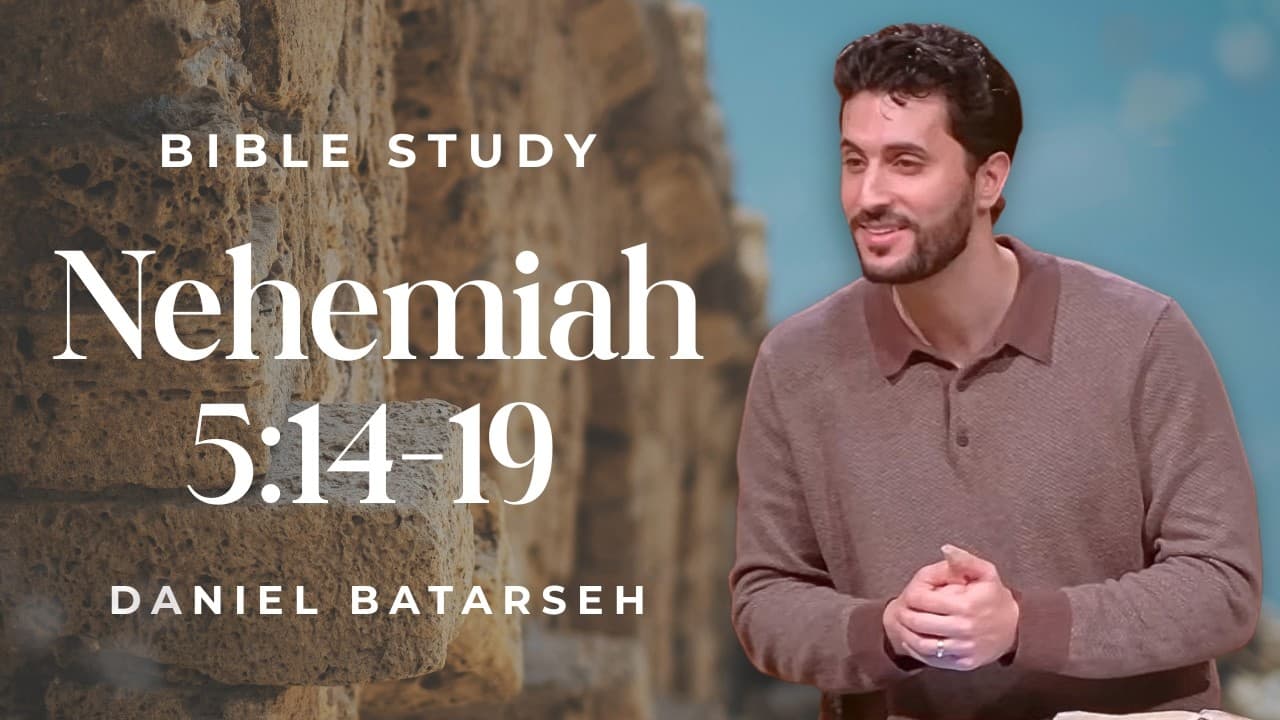
Nehemiah's secret wasn't willpower or discipline — it was the fear of God. And it produced something most people never associate with that phrase: radical, costly generosity.
Most people think the fear of God is about what it keeps you from. Don't steal. Don't lie. Don't commit adultery. It's the divine hand on your shoulder pulling you back from the cliff's edge. And it is that — but if that's all it is to you, you've only understood half the doctrine. In Nehemiah 5:14–19, we encounter a man whose fear of God didn't just restrain him from evil. It propelled him into extraordinary, costly, self-emptying generosity — the kind that went far beyond what anyone required of him. The kind that dipped into his own life savings. And in these six verses, written like a journal entry near the end of a chapter about economic exploitation, Nehemiah quietly reveals the single conviction that kept his character spotless across twelve years of political power.
The answer is tucked into verse 15, almost as a parenthetical: "But I did not do so, because of the fear of God."
That phrase — because of the fear of God — is the hinge on which this entire passage swings, and arguably the hinge on which every faithful life turns.
A Person Who Fears God Asks a Different Question
Here's what you need to understand about Nehemiah's situation. As governor of Judah, appointed by Artaxerxes himself, Nehemiah was entitled to a daily food allowance. This wasn't a gray area. It was a legitimate benefit of his office, funded through the taxation of the people. Previous governors had taken it without a second thought. It was standard operating procedure — the way things had always been done.
And it wasn't sin for Nehemiah to take it.
That's the part that should stop you. Because most of us, when we face a decision, ask one question: Is this sin or not? If the answer is no, we proceed. If yes, we refrain (hopefully). And we think we've done our moral duty.
But Nehemiah didn't ask that question. He asked a far more searching one. As Pastor Daniel Batarseh framed it: "A person who fears God doesn't just ask, is this sin? A person who fears God asks, is this the most helpful to my cause as I serve God? Is this the most beneficial to my testimony? Is this the most gracious thing that I can do for my fellow man?" (watch at 37:29)
That distinction is devastating. It means the fear of God doesn't just raise the floor of your behavior — it raises the ceiling. It makes you ask not what can I get away with? but what is the most God-honoring course of action available to me? And sometimes the answer to that question means voluntarily surrendering a right that is entirely yours to claim.
The Apostle Paul operated from the same conviction. In 1 Corinthians 9:12, he wrote to a church that questioned his motives: "We have not made use of this right, but we endure anything rather than put an obstacle in the way of the gospel of Christ" (watch at 40:12). Paul had every legal and theological right to be compensated by the Corinthians. He chose not to exercise it — not because it was wrong, but because something more right was at stake. His enemies were whispering that he was in it for the money. Rather than fight for his rights, he laid them down so the gospel could run unhindered.
Nehemiah did the same. He learned that his food allowance was financed by taxing people who could barely afford grain for their families. And he refused to take a single bite. Not because it was illegal. Because the fear of God made him see those struggling families as more important than his own comfort.
Here's the uncomfortable application: if your entire moral framework is built on the question "Is this technically sin?" you may be operating at a level of spiritual immaturity you haven't recognized. The fear of God graduates you from that question into a far richer one — What would bring God the most glory in this moment?
The Fear of God Makes You Immune to "Everyone Else Is Doing It"
Verse 15 contains a contrast that's easy to read past but devastating when you stop to feel its weight: "The former governors who were before me laid heavy burdens on the people and took from them for their daily ration forty shekels of silver. Even their servants lorded it over the people. But I did not do so, because of the fear of God."
Nehemiah is making a deliberate statement here. He looked backward at the established pattern — what governors before him had done — and he refused to follow it. The previous governors (likely those who served in the decades between Zerubbabel and Nehemiah, though their names are lost to history) had taken the food allowance, taxed the people heavily, and even allowed their personal servants to exploit the population. It was the norm. It was how governors governed.
And it is human nature — deeply, almost irresistibly human nature — to look at what everyone else in your position is doing and conclude that it must be acceptable. If every other governor took the allowance, who am I to refuse it? If every other church is doing it this way, why would I swim against the current? If every other marriage around me operates with this level of disengagement, maybe that's just what marriage is.
The fear of God shatters that logic. It replaces the question "What is customary?" with the question "What does God require of me?" And those two questions often lead to very different places.
Consider Joshua 24:14–15, that famous declaration: "As for me and my house, we will serve the Lord." It's on wall art in half the Christian homes in America. But look at what immediately precedes it — verse 14: "Now therefore fear the Lord and serve him in sincerity and in faithfulness" (watch at 51:00). Joshua didn't make that stand because he was naturally brave. He made it because his God was bigger than an entire nation. The fear of God preceded the courage. It always does.
Nehemiah couldn't be pulled by the current of cultural expectation — Persian or Jewish — because he was anchored to something heavier than culture. He was anchored to the living God. And a man anchored to God can afford to be countercultural, because he's not looking to the crowd for his security.
Nehemiah's Wallet Matched His Words
Verses 17–18 reveal something that goes beyond personal sacrifice into the realm of the almost absurd. As governor, Nehemiah had diplomatic responsibilities. He hosted 150 men regularly — Jewish officials and foreign dignitaries — and the menu was not modest: one ox, six choice sheep, birds, and every ten days, wine in abundance. These were working meals, the ancient equivalent of high-level business dinners. They were part of the job.
And the bill for all of it? Nehemiah paid it himself. Out of his own savings.
Think about what's happening here. He had already given up his personal food allowance — a sacrifice most of us would consider more than generous. But then he discovered that the cost of hosting these diplomatic meals was also being passed along to the overtaxed population. And he said no to that too. He opened his own wallet — wealth accumulated during his years as cupbearer to the king of Persia — and absorbed the entire cost.
The contrast with the nobles and officials in the earlier part of chapter 5 is staggering. They looked at the suffering people of Judah and asked, How can we profit from this? Nehemiah looked at the same people and asked, How can I alleviate this? That's the difference the fear of God makes. It doesn't just change your theology. It changes your checkbook.
And notice — there is no hint that Nehemiah expected repayment. No suggestion that he was building political capital or angling for a memorial. His only appeal is heavenward: "Remember for my good, O my God, all that I have done for this people" (v. 19). He says variations of that prayer throughout the entire book. Remember me, O God. Remember me. This man lived his entire governorship before an audience of One.
The Fear of God Is a Stimulus, Not Just a Restraint
This is perhaps the most overlooked truth in the entire passage. As Pastor Daniel Batarseh put it with striking clarity: "Most people have reduced the doctrine of the fear of God as a restraint, as a force to keep one from committing evil. It's more than that. It's far more than that. The fear of God is so profound that it is a stimulus. It is a motivator to do great good because it understands God doesn't just see the bad that I might be doing. God sees all the good that I am doing" (watch at 1:07:02).
That reframing changes everything. The fear of God isn't a leash. It's a launch pad. It doesn't just keep you from stealing; it compels you to give. It doesn't just keep you from abandoning your marriage; it fuels you to serve your spouse with sacrificial joy. It doesn't just keep you from quitting your ministry; it drives you to persevere with a fervor that baffles onlookers.
Nehemiah says in verse 16: "I also persevered in the work on this wall, and we acquired no land." He stayed on mission. He didn't use his authority to flip real estate during an economic crisis when desperate people were selling their fields and vineyards. He came to build a wall, and he built a wall. Twelve years. No deviation. No side hustles. No distractions.
And the connection to Christ himself is breathtaking. Isaiah 11:1–3 describes the sevenfold Spirit that would rest upon the Messiah — wisdom, understanding, counsel, might, knowledge — and then singles out one for special emphasis: "And his delight shall be in the fear of the Lord" (watch at 1:14:11). Jesus Christ — the eternal Son, the one through whom all things were made — delighted in fearing God. Every miracle, every teaching, every act of mercy flowed from that posture. And in John 13:3–5, we see the mechanism at work: "Jesus, knowing that the Father had given all things into his hands, and that he had come from God and was going back to God, rose from supper... and began to wash the disciples' feet." He knew his identity in God and his destiny with God. That knowledge — that reverential, awe-filled confidence in who God was and what God would do — enabled him to take the lowest place without a shred of insecurity.
Nehemiah operated from the same well, though at a far lesser depth. He could empty his savings account for the people of God because he trusted that the God he feared would register every sacrifice, repay every cost, and reward every act of faithfulness. That's not cowering. That's confidence.
What to Remember
- The fear of God doesn't just keep you from doing wrong — it compels you to pursue what is most right, even when the lesser option is perfectly permissible.
- Asking "Is this sin?" is the starting line of moral reasoning, not the finish line. Mature faith asks, "Is this the most God-honoring action I can take?"
- Cultural norms, professional traditions, and the examples of predecessors have no authority over a conscience anchored to God. The fear of the Lord makes you immune to "everyone else is doing it."
- Nehemiah's generosity wasn't funded by surplus — it cost him his savings. The fear of God changes your relationship with money because it changes your understanding of who actually provides for you.
- Jesus Christ himself delighted in the fear of the Lord (Isaiah 11:3). If the Son of God lived this way, the doctrine cannot mean slavish dread — it means awe-filled trust in a God who sees and rewards.
- The fear of the Lord is not automatic. Proverbs 2:1–5 says you must seek it like silver and search for it like hidden treasure. It is a grace to be pursued, not a feeling to wait for.
Questions to Sit With
- In the last major decision you made, did you stop at "Is this sin?" — or did you press further to ask what would bring God the most glory?
- Where in your life are you following the pattern of "former governors" — doing something simply because it's how it's always been done in your field, your family, or your church — without ever asking whether God is calling you to a different standard?
- If someone audited your financial decisions over the past year, would they find evidence that you believe God is your ultimate provider — or that you're hedging your bets?
- Nehemiah prayed, "Remember me, O my God." If that were your only prayer for the next month — no requests, no complaints, just "See me, God" — how would it change the way you live?
- What would it look like to delight in the fear of the Lord the way Isaiah 11:3 says Christ did — not endure it, not tolerate it, but find genuine pleasure in standing in awe of God?
Scripture Referenced
- Nehemiah 5:14–19 — Primary text: Nehemiah's testimony of generosity as governor
- Psalm 19:7–11 — The perfection and reward of God's Word
- Psalm 16:3 — Delight in the saints of God
- Nehemiah 4:14 — "Remember the Lord who is great and awesome"
- 1 Corinthians 9:12 — Paul waiving his right to compensation
- Joshua 24:14–15 — "Fear the Lord... as for me and my house"
- John 13:3–5 — Jesus washing the disciples' feet
- Isaiah 11:1–3 — The Spirit of the fear of the Lord upon the Messiah
- Proverbs 2:1–5 — Seeking the fear of the Lord like hidden treasure
This summary was generated by AI from the sermon "Nehemiah 5 (Part 3) Bible Study (Nehemiah's Generosity) | Pastor Daniel Batarseh (8/14/26)" preached by Pastor Daniel Batarseh at Maranatha Bible Church Chicago. Watch the full sermon →
Preached by
Pastor Daniel BatarsehSenior Pastor
This summary was generated by AI from the sermon transcript.
Based on the sermon