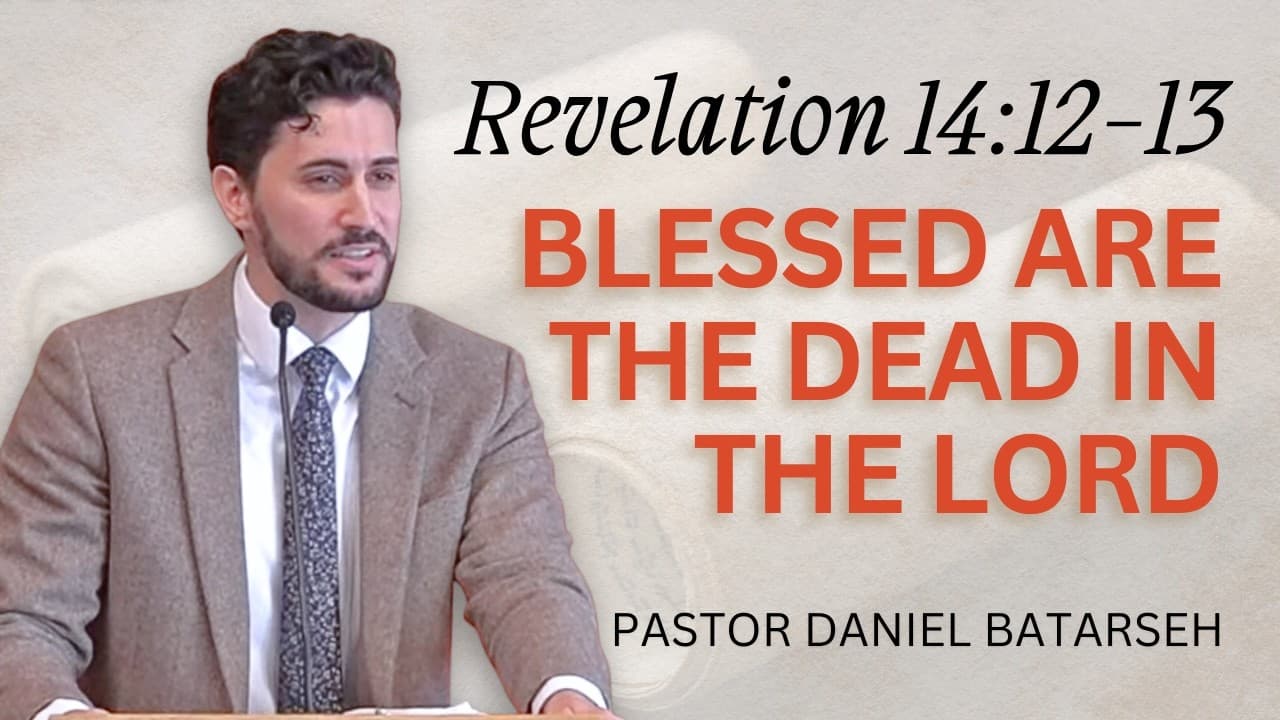
Revelation 14:13 pronounces a blessing on those who die in the Lord. Three reasons why death in Christ is not a tragedy but a portal into rest, reunion, and reward.
Death is the one appointment no amount of technology, medicine, or money can cancel. And yet the Bible makes a staggering claim in Revelation 14:13: "Blessed are the dead who die in the Lord." Not pitied. Not mourned. Blessed. That word should stop us cold — because everything in our culture tells us death is the ultimate loss, the final defeat, the thing to be avoided at all costs. But the Holy Spirit himself interrupts the vision of John on Patmos to personally guarantee that for those in Christ, death is not an ending. It is an entrance. And the reasons why are richer than most of us have ever considered.
Pastor Daniel Batarseh walked his congregation through this single verse with a kind of reverent urgency that made you feel like you were being handed something precious — something the church needs to hear far more often than it does. What emerged was not a morbid meditation on mortality, but a breathtaking look at three reasons the Christian can face death not just with peace, but with genuine confidence.
The Voice That Speaks This Blessing Changes Everything
It's easy to gloss over the setup of verse 13: "And I heard a voice from heaven saying, 'Write this.'" We read past it to get to the blessing. But the origin of this voice matters enormously.
Heaven is a place of perfect holiness. There are no liars there. No exaggerators. No manipulators spinning half-truths. So when a voice from heaven pronounces a blessing on the dead in Christ, you are receiving testimony from the most reliable source in existence — and from someone who is speaking from the very realm that death ushers believers into. This isn't theory. This is a report from the other side.
Consider the parallel with what Jesus told Nicodemus in John 3:11-13: "We speak of what we know and bear witness to what we have seen... No one has ascended into heaven except he who descended from heaven, the Son of Man." Jesus' authority to speak about heavenly things came from the fact that heaven was his home. He had firsthand experience. And in the same way, this voice in Revelation carries weight precisely because of where it originates — the place that death will take every believer (watch at 44:23).
But there's more. After the heavenly voice speaks, the Holy Spirit himself interjects: "Blessed indeed, says the Spirit." This is extraordinary. The Spirit's words are rarely quoted directly in the New Testament. In all of Revelation, there are only two places where the Holy Spirit is directly quoted — here, and at the end of the book where the Spirit and the Bride say "Come." The author of Scripture pauses his own work of inspiration to personally confirm this promise. As Pastor Daniel Batarseh put it: "Here's the author who's inspiring John to write it, and he takes the time now to actually interject and make his own personal pledge in order to offer even more guarantee — a double guarantee to this single blessing" (hear this moment).
And then there's the command itself: "Write this." John has been faithfully writing since Revelation 1:11, when Christ first commissioned him. He's been obedient the entire time. So why tell him again? Unless the point is emphasis — unless this voice is saying, John, don't miss this. Of everything you've recorded, make sure my people get this one. The redundancy is the point. God wants his suffering, enduring, weary saints to have this promise documented.
The Rest That Awaits Is Not What You Think
The contrast in Revelation 14 is devastating. Verse 11 describes those who worship the beast: "They have no rest, day or night." Verse 13 describes those who die in Christ: "They may rest from their labors." Two kinds of worshipers. Two eternities. And the dividing line is rest.
But what kind of rest? Not idleness. Not some eternal nap. Work existed before sin entered the world — Adam was given a garden to tend in paradise. Heaven will almost certainly involve activity, purpose, meaningful engagement. The rest being promised here is rest from a specific kind of labor. The word carries the sense of trouble, sorrow, grief — labor that comes through affliction.
The primary audience for this promise was believers living under the antichrist's regime during the great tribulation. They would face threats, loss, danger at every turn. The Spirit wanted them to know: death in Christ will be the greatest relief you will ever experience. But this truth isn't locked behind a dispensational gate. It applies to every believer in every age. All of Satan's harassments, every allurement of the world, all the frustration our flesh causes, all the sadness from disease and the evil people inflict on one another — it all comes to a sudden, permanent end.
Someone once observed that because of sin, death was brought into the body. But for the redeemed, death casts sin out of the body. That's not just clever wordplay. It's the gospel applied to our final breath. A new body. A new mind. A new heart. A new world. And it starts the instant you leave this one.
Some have tried to use this verse to argue for "soul sleep" — the idea that believers remain unconscious after death until the final resurrection. But the text undermines that reading entirely. For the Spirit to promise rest implies conscious experience. You cannot enjoy rest if you don't exist to experience it. As the sermon made clear: "For the spirit to say that there is rest that awaits us assures us that we will be fully alive the moment we die. In fact, you will be more alive than ever" (watch at 55:28).
The Hidden Math in Job That Should Comfort Every Grieving Heart
This was the moment in the sermon where the room got very quiet.
Job 1:2-3 tells us Job had seven sons, three daughters, and vast wealth. After his trial, Job 42:10-13 tells us God gave Job twice as much as he had before. The math is precise: 7,000 sheep became 14,000. 3,000 camels became 6,000. 500 yoke of oxen became 1,000. Everything doubled.
Except the children.
Job 42:13 says he had seven sons and three daughters. Not fourteen sons and six daughters. The same number as before. Is this an error? A divine oversight?
It's neither. It's theology hidden in arithmetic. If God promised to double everything and the children weren't doubled, there's only one explanation that holds: the first children were not gone. They were alive — just not in this world. Job's original ten children plus his new ten children equals twenty. Double. The math works perfectly, but only if death does not mean the cessation of life for the righteous.
This means Job would be reunited with every son and daughter he lost in chapter one. They were waiting for him. And your believing loved ones are waiting for you.
The tenderness of what followed was unmistakable: "If it's been three years and you can't still get out of bed, you can't go on your normal life, may God give you a revelation of the rest that your loved one is enjoying now... They're on vacation right now and they're waiting for you on the shores of eternity" (hear this moment). There is a time for grief — even Jesus wept at Lazarus's tomb, and he knew he was about to raise him. Christ hates death. But he has rewritten what it means for those who belong to him.
A Puritan writer captured it perfectly in words read during the sermon: "What wise man will grieve at his friend's gain? The day of death for your believing friend is his day of jubilee in which he is restored to the possession of his eternal inestimable portion... It does for them what none of the ordinances of God, the providences of God, or graces of the Spirit ever did for them. It sends the weary soul to its sweet and eternal rest."
Your Deeds Follow You — And God Forgets Nothing
The final phrase of verse 13 is easy to miss: "for their deeds follow them." Death separates us from our possessions, our positions, our earthly relationships. But it does not separate us from our faithfulness. Every act of service done in Christ's name crosses the threshold with you.
This is meant to fuel endurance, not feed pride. Verse 12 sets the context: "Here is a call for the endurance of the saints, those who keep the commandments of God and their faith in Jesus." The promise of reward is aimed at people who are tempted to quit — to stop serving, stop sacrificing, stop being publicly identified with Jesus because the cost has become too high.
Hebrews 6:10-11 makes the same appeal to a weary congregation: "For God is not unjust so as to overlook your work and the love that you have shown for his name in serving the saints." Notice what motivates the service: love for his name. Not love for the saints alone — because the saints, honestly, will give you plenty of reasons to stop serving them. It's love for Christ's name that sustains love for Christ's people. And God's justice is at stake in remembering your labor. If he forgot, he would be unjust. And he will never be unjust (watch at 69:12).
Every minute spent. Every dollar given. Every mile driven. Every visit made. Every soul served, whether anyone noticed or not — it follows you through death into reward.
Balaam's Tragedy: Desiring the Death of the Righteous Without Living Their Life
The sermon closed with a warning drawn from an unlikely source. In Numbers 23:10, the false prophet Balaam — a sorcerer, a man the New Testament holds up as a picture of greed and deception — catches a glimpse of what awaits the righteous in death and cries out: "Let me die the death of the upright, and let my end be like his!"
He desired it. He never received it. By Numbers 31, Balaam is killed under God's judgment.
Why? Because he wanted the death of the upright without living the life of the upright. And he couldn't live the life of the upright because he loved money. Money was his god. He obeyed it, submitted to it, oriented his life around it.
The application landed like a blade: it is entirely possible to sit in a church, be moved by these truths, desire the blessings of dying in Christ — and never possess them. Desire without devotion is just sentiment. And the life of the upright doesn't begin with moral effort. It begins with surrender — receiving the alien righteousness of Christ, being clothed in what you could never earn, and then living from that grace rather than toward it.
The sermon ended with the illustration of a father and son driving on a summer day when a bee flew into the car. The boy was allergic — terrified, screaming. The father grabbed the bee, held it, then released it. The boy panicked again. But the father opened his hand and showed his son: the stinger was embedded in his palm. The bee was still buzzing, still making noise. But it had no power. The sting was taken.
"Death has been swallowed up in victory. O death, where is your victory? O death, where is your sting?"
The bee is still in the car. But the Father took the sting.
What to Remember
- The blessing of Revelation 14:13 carries a double guarantee — a voice from heaven and the direct confirmation of the Holy Spirit himself, one of only two places in Revelation where the Spirit is quoted directly.
- Rest from labor in heaven means rest from sorrow, affliction, and the trouble of a sin-wrecked world — not rest from meaningful activity. You will be more alive after death than you have ever been.
- The math of Job's restoration reveals that his first children were still alive in glory — God gave him double of everything, and the children count only works if the dead in the Lord are not gone.
- Every deed done for Christ follows you through death. God's justice guarantees he will not overlook a single act of faithful service, no matter how hidden or unnoticed it was by others.
- Desiring the blessings of dying in Christ without surrendering your life to Christ is the tragedy of Balaam — and it is possible to repeat his mistake from a church pew every Sunday.
- Christian righteousness does not begin with moral effort but with receiving the righteousness of Christ as a gift, and then living from gratitude rather than toward approval.
Questions to Sit With
- If you truly believed that death was a portal into rest and reward, how would it change the way you handle the pressures and losses of this week?
- Is there a loved one you've lost in Christ whose death you are still grieving in a way that has become debilitating — and could the truth of their present joy in glory begin to free you?
- What service or sacrifice for Christ have you quietly abandoned because no one seemed to notice? What would it mean to resume it knowing that God's justice guarantees he sees?
- Are you more like Balaam than you'd like to admit — attracted to the benefits of faith without the surrender it requires? What is the "money" in your life that competes with devotion to Christ?
- When was the last time you seriously contemplated your own death — not morbidly, but as a way of clarifying what actually matters?
Scripture Referenced
- Revelation 14:12-13 — primary text
- Revelation 14:11
- Revelation 1:11, 19
- John 3:11-13
- Job 1:1-3
- Job 42:10-13
- Hebrews 6:10-11
- Numbers 23:10
- Psalm 144:12-15
- Acts 3:1-8; 4:5-12
This summary was generated by AI from the sermon "Blessed are The Dead in The Lord | Revelation 14:12-13 | Pastor Daniel Batarseh (3/15/26)" preached by Pastor Daniel Batarseh at Maranatha Bible Church Chicago. Watch the full sermon →
Preached by
Pastor Daniel BatarsehSenior Pastor
This summary was generated by AI from the sermon transcript.
Based on the sermon
Blessed are The Dead in The Lord | Revelation 14:12-13 | Pastor Daniel Batarseh (3/15/26)
Watch Full SermonRelated Articles
What Revelation 21 Says About Heaven That You've Never Noticed
Pastor Daniel Batarseh · October 11, 2026
What Revelation 21 Says About Eternity (It's Not What You Picture)
Pastor Daniel Batarseh · October 11, 2026
Hebrews 9 and Why Christ's Second Coming Isn't About Sin
Pastor Daniel Batarseh · October 4, 2026