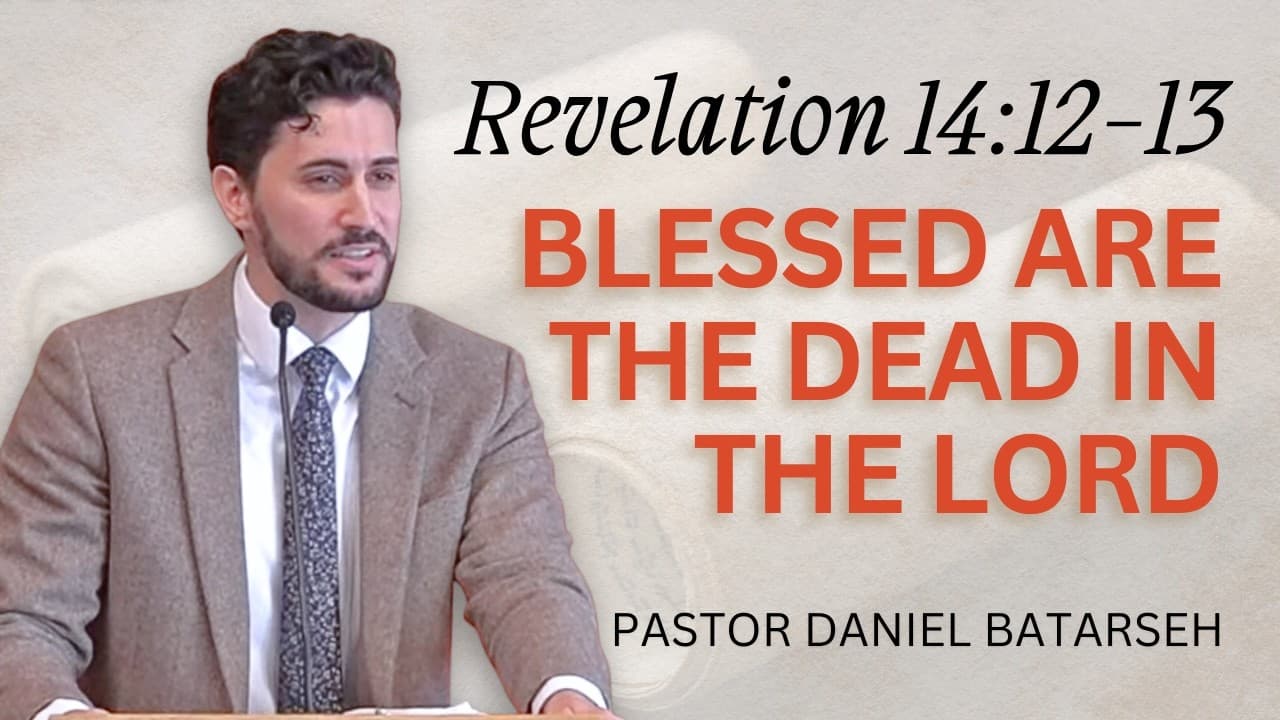
Revelation 14:13 pronounces a blessing on those who die in the Lord. Three reasons why death becomes a portal to glory for every believer in Christ.
Death is the king of terrors — Job tells us that. And yet here in Revelation 14:13, the Holy Spirit himself interrupts the vision to pronounce a blessing on the dead. Not a consolation. Not a silver lining. A blessing. What kind of faith makes death itself a gift? And what does this verse reveal about what actually happens the moment a believer takes their final breath?
This is not the verse you expect to find where you find it. John has just finished describing the most horrifying scene in all of Scripture — the unending torment of those who worship the beast, smoke rising forever, no rest day or night. And then, without transition, a voice from heaven says: Write this down. The contrast is the point. Two kinds of worshipers. Two eternal destinies. And the dividing line between them is sharper than we tend to think.
Pastor Daniel Batarseh walked his congregation through this single verse with the care of a surgeon and the warmth of a pastor who knows his people are carrying real grief. What emerged were three reasons the Christian can face death not just with courage, but with something closer to anticipation.
A Voice from the Other Side
The first thing to notice is where this blessing originates. John writes, "I heard a voice from heaven saying, write this." The Bible doesn't identify whose voice this is. But knowing the address is enough.
Heaven is a place of perfect holiness. There are no liars there. No manipulators. No exaggeration. If a voice speaks from that realm, it is dependable, trustworthy, and true. But there's a second layer: heaven is the realm that death ushers believers into. This announcement is coming from someone on the other side — someone who is witnessing what awaits the saints and reporting back (watch at 43:52).
This is exactly the argument Jesus made to Nicodemus in John 3:11-13. When Christ wanted to establish why his teaching carried more authority than any rabbi's, he said: "No one has ascended into heaven except he who descended from heaven, the Son of Man." His point was devastating in its simplicity — I can tell you about heavenly things because I came from heaven. I have firsthand experience. Listen to me. The voice in Revelation 14 carries that same weight. It speaks about the blessedness of dying from the very place that death delivers us to.
But then something extraordinary happens. The Holy Spirit interjects. "Blessed indeed," says the Spirit. This is not a footnote. In the entire New Testament, the Holy Spirit is rarely quoted directly with his own recorded words. In Revelation, there are only two places where this occurs — here, and at the very end of the book, when "the Spirit and the bride say, 'Come.'" For the Spirit to speak up at this precise moment — where a promise is being made to suffering saints about the nature of their death — says something about his eagerness to confirm it.
As Pastor Daniel Batarseh put it: "Here's the author who's inspiring John to write it and he takes the time now to actually interject and make his own personal pledge in order to offer even more guarantee, a double guarantee to this single blessing" (hear this moment).
And then there's the command itself: write this. John has been writing faithfully since chapter 1. He was commissioned to write, and he obeyed — we know because we have the completed book. So why tell him again here? Unless the redundancy is intentional. Unless the voice is saying: John, don't miss this one. This is for my people who are enduring great pressure for their faith. Make sure they see it.
The reassurance about death is layered and deliberate. A voice from heaven. The Spirit's own confirmation. A specific command to record it. God himself wants you to know that death in Christ is not an ending. It is a portal.
The Rest That Sin Could Never Steal
The Spirit's words are precise: "that they may rest from their labors." This raises an obvious question — is heaven going to be an eternal nap? A cosmic retirement where glorified saints drift around in idle bliss?
Not likely. Work existed before sin entered the world. Adam had a vocation in Eden. Many of us will be very busy in the age to come. So what kind of rest is this?
The word translated "labors" carries a meaning beyond mere hard work. It communicates trouble — labor that comes through sorrow, grief, and affliction. That makes sense given the context. The primary audience is believers living under the antichrist's regime, trying to survive physically and spiritually while a Christ-hating tyrant demands the devotion of the masses. The Spirit is telling them: In Christ, death will be the greatest relief you will ever know (watch at 53:30).
But this truth isn't locked behind a future dispensation. Most of us have lived long enough to know that the human experience has plenty of trouble without a great tribulation. Satan's harassments. The allurements of the world. The maddening frustration of our own flesh. The sadness of disease. The evil people inflict on each other. All of it — every last thread of sorrow — will suddenly come to an end. And death will be the instrument that brings it about.
One insight from the sermon landed with particular force: "Because of sin, death is brought into the body. But for the redeemed, death will cast sin out of the body" (hear this moment). A new body. A new mind. A new heart. A new environment. A new world. That is what rest means.
Some have tried to use this verse to argue for "soul sleep" — the idea that believers remain unconscious after death until the final resurrection. But the text argues the opposite. For the Spirit to promise rest means we will be fully alive to enjoy it. You will be more conscious, more aware, more yourself than you have ever been. And that truth doesn't just comfort us about our own appointment with death. It speaks directly to those still managing the pain of losing someone they love.
Job's Children Are Still Alive
This is where the sermon made an unexpected turn into Job — and it was the moment that changed the room.
Job 1 tells us he had seven sons and three daughters, along with staggering wealth. Then catastrophe struck and he lost everything, including all ten children. After enduring his trial and receiving a fresh revelation of God's sovereignty, the Lord restores Job's fortunes — double what he had before. Job 42:12 confirms it: 14,000 sheep (double), 6,000 camels (double), 1,000 yoke of oxen (double), 1,000 female donkeys (double).
And then verse 13: "He also had seven sons and three daughters."
Wait. Seven and three. Not fourteen and six. If God doubled everything, why didn't he double the children?
This is not a scribal error. It's theology hidden in arithmetic. The best explanation is breathtaking: Job's first children did not cease to exist. They died, yes — but they did not stop living. They were waiting for him on the other side. Count them: seven sons and three daughters who died, plus seven sons and three daughters born after the trial. That is double. God didn't need to replace them because they were never truly lost (watch at 1:00:41).
This is the kind of cross-reference that makes you set your Bible down and stare at the ceiling. The wider testimony of Scripture — from Job to John to Revelation — teaches the same thing: for those who die in the Lord, death is not the cessation of life. It is a relocation.
The pastoral application was direct and unflinching: "If it's been three years and you can't still get out of bed, you can't go on your normal life, may God give you a revelation of the rest that your loved one is enjoying now... They're on vacation right now and they're waiting for you on the shores of eternity" (hear this moment). Grief is appropriate. Jesus wept at Lazarus's tomb, and he didn't even need to — he was about to raise the man. Christ hates death. But he has changed our experience of it. The separation is temporary. The reunion is coming.
A Puritan writer was quoted from The Fading of the Flesh and the Flourishing of Faith: "What wise man will grieve at his friend's gain? The day of death for your believing friend is his day of jubilee in which he is restored to the possession of his eternal, inestimable portion." Death is a serpent turned into a rod — and with that rod, God works wonders for our good.
Your Deeds Follow You Through the Door
The final phrase of Revelation 14:13 is easy to rush past: "for their deeds follow them." One of the hardest things about death is that it separates us from everything we've known — possessions, positions, relationships. But the Bible says there is one thing that follows you immediately into the next world: what you did with the name, the will, and the message of Jesus Christ.
This is meant to fuel endurance, not earn salvation. Verse 12 makes the audience clear: "Here is a call for the endurance of the saints, those who keep the commandments of God and their faith in Jesus." The promise is for the faithful, the sacrificial, those paying a real price to serve the Lord. Every minute spent. Every dollar given. Every mile driven. Every visit made. Every soul served. Remembered. Recompensed.
Hebrews 6:10 confirms it: "For God is not unjust so as to overlook your work and the love that you have shown for his name in serving the saints." Notice the motivation embedded in that verse — it's not love for the saints that sustains you (the saints will give you plenty of reasons to quit). It's love for his name. Your love for Christ's name will help you love people even when they are unlovable.
And notice the danger the author of Hebrews addresses in the very next verse: losing your earnestness over time. Not because of temptation, but because of pressure. The nature of your service may change over the years, but the conviction and passion behind it shouldn't. God sees the ones working in the background. People may overlook you. Even elders may overlook you. God does not. His character is at stake. If he forgot, he would be unjust — and he will never be unjust.
Balaam Wanted It But Never Got It
The sermon closed with a haunting warning from Numbers 23:10. Balaam — a false prophet, a sorcerer, a man the New Testament condemns as covetous and wicked — catches a glimpse of the death of the righteous while delivering one of his oracles. And he can't help himself: "Let me die the death of the upright, and let my end be like his!"
He desired it. But he never realized it. By Numbers 31, Balaam is killed under God's judgment. He wanted the death of the upright without living the life of the upright. And the reason he never lived the life of the upright? Money was his god. He obeyed money instead of Yahweh. He submitted to the impulses of wealth instead of the will of God.
Desires are tricky things. You can desire righteousness, desire Christ, even desire heaven — and die without any of it. The distance between desire and devotion is the distance between Balaam and the saints of Revelation 14. And the bridge is not moral effort. It's surrender. As the sermon pressed: "Living the life of the upright doesn't mean that you pull your bootstraps and become more moral... That's pride to think that you can attain your own righteousness. It primarily means that you surrender to an alien righteousness outside of yourself" (watch at 1:17:28).
The closing illustration brought it home. A father and son driving on a summer day. A bee enters the car. The boy is allergic, panicking, screaming. The father grabs the bee, holds it, then releases it. The boy's terror returns — the bee is still buzzing. But the father opens his hand and reveals the sting embedded in his palm. The bee was still in the car. But it had no power.
Death is still buzzing. You can hear it. But Christ took the sting. It cannot claim you if you are in him.
What to Remember
- The blessing of Revelation 14:13 carries a double guarantee — a voice from heaven and the direct confirmation of the Holy Spirit, who rarely speaks with recorded words in Scripture.
- Rest from "labors" does not mean unconscious sleep — it means the permanent end of every sorrow, temptation, sickness, and affliction that marks life in a fallen world.
- Job receiving seven sons and three daughters after his trial — not fourteen and six — is quiet, mathematical proof that his first children were still alive, waiting for reunion.
- Your deeds follow you through death. Not to earn salvation, but because God's justice requires that every act done for his name be remembered and rewarded.
- Balaam desired the death of the righteous but never lived the life of the righteous. Desire without devotion saves no one.
- The sting of death belongs to Christ's hand. The bee is still buzzing, but it has no power over those who are in him.
Questions to Sit With
- If you truly believed that death was a portal into rest and reward, how would it change the way you spend this week — your money, your time, your courage in sharing Christ?
- Is there a loved one whose death you are still carrying in a way that has moved from grief into despair? What would it mean to believe that they are more alive right now than you are?
- Are you more like the saints of Revelation 14:12 — enduring in faith — or more like Balaam, who admired the destination but refused the road that leads there?
- Where in your service to Christ have you grown weary because you feel overlooked? What changes if you take Hebrews 6:10 seriously — that God's own justice is at stake in remembering your work?
- What is the "money" in your life — the thing that, like Balaam, you obey instead of God?
Scripture Referenced
- Revelation 14:12-13 (primary text)
- Revelation 14:11
- Revelation 1:11, 19
- John 3:11-13
- Job 1:1-3
- Job 42:10-13
- Hebrews 6:10-11
- Numbers 23:10
- Psalm 144:12-15
- Acts 3:1-8; 4:5-12
This summary was generated by AI from the sermon "Blessed are The Dead in The Lord | Revelation 14:12-13 | Pastor Daniel Batarseh (3/15/26)" preached by Pastor Daniel Batarseh at Maranatha Bible Church Chicago. Watch the full sermon →
Preached by
Pastor Daniel BatarsehSenior Pastor
This summary was generated by AI from the sermon transcript.
Based on the sermon
Blessed are The Dead in The Lord | Revelation 14:12-13 | Pastor Daniel Batarseh (3/15/26)
Watch Full SermonRelated Articles
What Revelation 21 Says About Heaven That You've Never Noticed
Pastor Daniel Batarseh · October 11, 2026
What Revelation 21 Says About Eternity (It's Not What You Picture)
Pastor Daniel Batarseh · October 11, 2026
Hebrews 9 and Why Christ's Second Coming Isn't About Sin
Pastor Daniel Batarseh · October 4, 2026