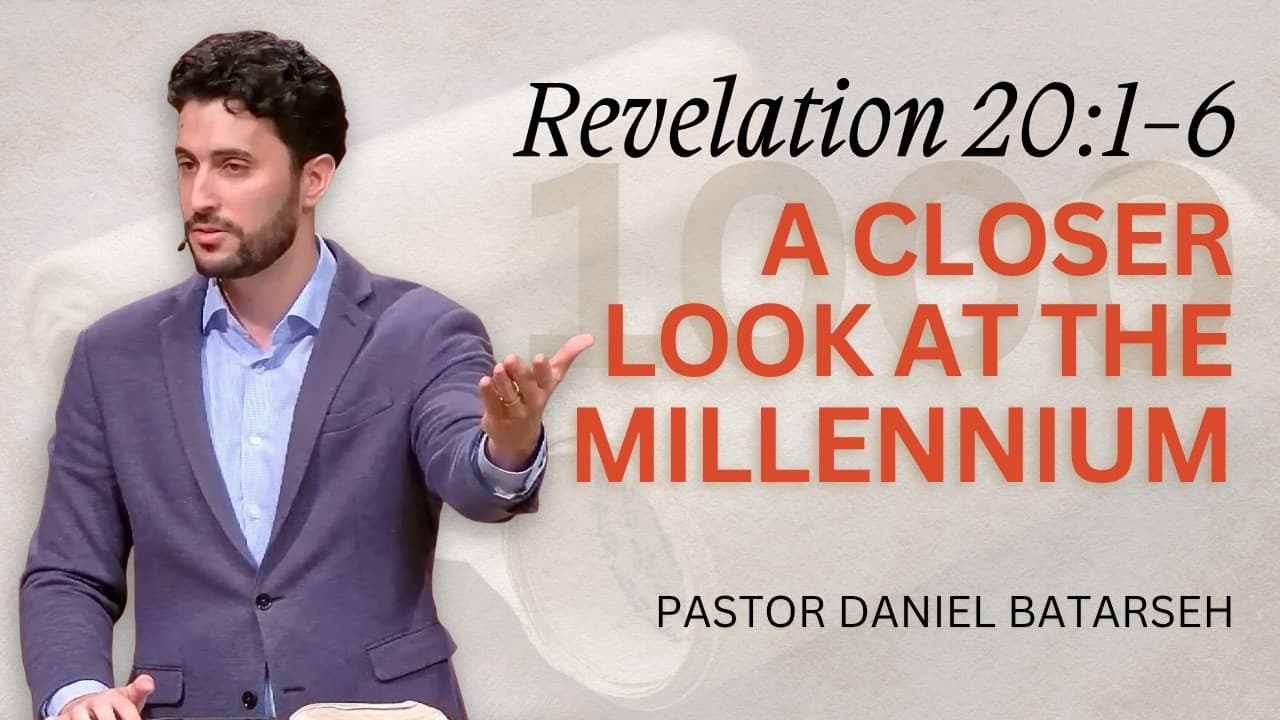
The millennium proves that humanity's fundamental problem was never bad government, bad circumstances, or even Satan himself. It's the human heart.
Here is the most unsettling truth about the millennium: even with Satan locked in a pit, even with Jesus Christ physically reigning from Jerusalem, even with a world that has known a thousand years of unprecedented peace and justice — people will still choose rebellion.
That should stop you cold.
We instinctively blame our environment for the evil in our world. Bad leadership. Broken systems. The devil made me do it. But Revelation 20:1-6 dismantles every one of those excuses. The millennial kingdom, that future thousand-year reign of Christ on earth, is not just a reward for the faithful or a fulfillment of ancient prophecy — it is God's final, decisive demonstration that the problem was never outside of us. It was always within.
Satan's Imprisonment Is More Than Justice — It's a Setup
When Christ returns at the end of Revelation 19, his first order of business is not building a palace or assembling a cabinet. It's binding Satan. And the language John uses is deliberately excessive: an angel seizes the dragon, chains him, throws him into the abyss, shuts it, and seals it over him. Every verb communicates total, inescapable confinement.
Notice the progression of Satan's defeat throughout Revelation. In chapter 12, he was expelled from heaven and confined to earth. Now in chapter 20, he's expelled from earth and confined to the abyss. His territory keeps shrinking. His power keeps diminishing. And here's the detail that should humble every proud heart: Jesus doesn't even deal with Satan directly. He dispatches an angel to do it. Satan isn't a rival to God. He's not on the same level. He's a creature being handled by another creature at the King's command.
But why bind him at all? Because the prophecies about the millennium would be impossible otherwise. Consider Isaiah 9:7: "Of the increase of his government and of peace there will be no end, on the throne of David and over his kingdom, to establish it and to uphold it with justice and with righteousness from this time forth and forevermore" (watch at 62:27). Uninterrupted peace. Unbroken justice. Righteousness without end. How can that possibly coexist with a roaming, roaring, devouring devil who specializes in deceiving nations? It can't. He has to go.
Or take Isaiah 2:4 — "Nation shall not lift up sword against nation, nor shall they learn war anymore." Children in the millennium will read about weapons in history books the way we read about chariots. What's a bomb? What's a gun? It will be ancient. That world is coming. It has been promised.
But the binding of Satan isn't the end of the story. It's a setup for something far more revealing.
The Most Terrifying Proof That Your Heart Is the Problem
Here is where the millennium becomes deeply uncomfortable.
Verse 3 tells us Satan "must be released for a little while" after the thousand years end. Not that he breaks free. Not that he escapes. He must be released. God plans it. God ordains it. And the moment Satan is unleashed, he immediately deceives multitudes from the nations and gathers them for a final assault on Christ.
Who are these people? They're not the resurrected saints who returned with Christ. They can't be deceived. These are the descendants of those who entered the millennium in unglorified bodies — people who were born into a perfect world, raised under a perfect government, who never experienced war or corruption or systemic injustice. They had every advantage imaginable. And they still chose rebellion.
As Pastor Daniel Batarseh put it with a kind of holy astonishment: "Here's Christ going to establish a utopia. And after a thousand years of it, you're gonna have people side with Satan because their hearts have never been transformed" (watch at 1:26:16).
This is the millennium's devastating verdict on every political ideology, every social program, every utopian dream that says, If we just fix the system, we fix the people. Socialism won't save us. Capitalism won't save us. The right president won't save us. A conservative Supreme Court may curb evil, but it will never solve it. Because the problem isn't the system. It's the organ beating in your chest.
Jesus said it two thousand years before the millennium proves it: "From within, out of the heart of man, come evil thoughts, sexual immorality, theft, murder, adultery, coveting, wickedness, deceit" (Mark 7:21-23). The millennium will serve as a thousand-year historical demonstration that Christ's diagnosis was right all along.
And here's the insight that should make you examine your own soul: much of the obedience during the millennium will be outward compliance. External conformity. People will look righteous. Crime rates will plummet. There will be civility, respect for authority, order. But when the opportunity arrives through Satan's release, the mask comes off. As the sermon pressed the point: "Just because you wear a suit doesn't mean you're righteous. There are bad guys who wear suits" (hear this moment).
Don't miss the parallel to Eden. Only two people. A perfect environment. One serpent. One lie. That's all it took. The millennium will replay that tragedy on a global scale — and the lesson will be the same. Environment doesn't determine destiny. The heart does.
A Forgotten Prophet Paints the Millennium in Vivid Color
One of the most striking moments in the sermon was a turn to a passage most people skip entirely when studying the millennium: Zephaniah 3:8-17. It's a short book — easy to miss. But it contains a breathtaking sequence that mirrors the structure of Revelation 19-20.
First, universal judgment: God gathers the nations, pours out his indignation, and consumes the earth in the fire of his jealousy (v. 8). Then, immediately after — universal worship: "For at that time I will change the speech of the peoples to a pure speech, that all of them may call upon the name of the Lord and serve him with one accord" (v. 9). The same order. Judgment, then kingdom. Wrath, then worship. Revelation 19, then Revelation 20.
But Zephaniah adds details that should make your heart ache with longing. When the King takes his throne, he will "remove from your midst your proudly exalted ones" (v. 11). He will leave behind "a people humble and lowly" (v. 12). Pride — erased. Not just confronted, not just convicted. Removed. (watch at 64:04)
Can you imagine a world without pride? World leaders without pride? Neighbors, coworkers, family members — without pride? That question landed hard in the room, because we all know what pride does to relationships, to churches, to nations. And the implication cuts both ways. If the reign of Christ produces humility on a cosmic scale, then his reign in your heart right now should be producing it on a personal scale.
"You wanna know if Jesus Christ rules your heart today? How strong is pride in your life?" That question hung in the air. "You wanna know if Jesus Christ is king over a local church? How is pride dealt with in that local church? Look to the leaders. Are they arrogant? Do they look down on the members? What about the members? Do they look down upon one another?" The millennium is future, yes. But its principles are present tense.
Zephaniah also gives us this line about Israel that has never once been fulfilled in history: "You shall never again fear evil" (v. 15). Has there ever been a moment — a single generation — when the Jewish people knew no fear? The question answers itself. This awaits. The King of Israel, the Lord, will be in their midst. Not Hezekiah. Not David. The Lord himself, ruling and reigning from Jerusalem.
From Prison to Thrones: How Christ Vindicates His Church
The third feature of the millennium that John highlights is perhaps the most personal: the saints will rule and reign with Christ.
Verse 4 opens with a stunning image: "Then I saw thrones" — plural — "and seated on them were those to whom the authority to judge was committed." These are the beheaded. The persecuted. The ones who refused the mark of the beast. The ones who chose faithfulness over survival. And now they're seated on thrones.
Think about John's original audience. He's an old man writing from a prison island. His readers are being hunted, tortured, killed. And he tells them: There's a reversal coming. The very devil who was permitted to throw Christians into prison for ten days (Revelation 2:10) will himself be thrown into a pit for a thousand years. The persecuted become princes.
This isn't a new promise. It echoes through the whole Bible. Daniel 7:27 — the kingdom shall be given to the people of the saints of the Most High. 1 Corinthians 6:2 — "Do you not know that the saints will judge the world?" Paul actually uses this future reality to shame the Corinthians for not being able to settle disputes among themselves. You're going to judge the world and you can't solve your own church conflicts? Luke 19:17 — the faithful servant receives authority over ten cities. Revelation 5:9-10 — "You have made them a kingdom and priests to our God, and they shall reign on the earth." On the earth. Not in some ethereal cloud. On the earth (watch at 98:11).
What will this administration look like in practice? As Pastor Daniel Batarseh admitted with characteristic honesty: "I don't know. Whatever it does mean, what we know for certain is that this is one way that Christ expresses his rewards for those who were devoted to him and who were faithful to him with the little that you and I have in this life" (hear this moment).
But the greatest reward isn't the throne. It's what verse 6 declares: "Blessed and holy is the one who shares in the first resurrection. Over such the second death has no power." The millennium will end. The thrones will transition into something even greater in the eternal state. But death? Death is finished. Permanently. Irreversibly. You will never die again.
And that brings us to the choice that sits before every person hearing these truths. All people will be resurrected — but into two very different destinies. The resurrection of the just, and the resurrection of the unjust. One leads to thrones. The other leads to judgment. There is no third option.
What to Remember
- The millennium proves that humanity's deepest problem is not environment, government, or even demonic influence — it is the unregenerate human heart that will rebel against God even in paradise.
- Satan's binding during the thousand years is not merely punitive; it is what makes the unprecedented peace, justice, and humility of Christ's kingdom possible on earth.
- The reign of Christ produces humility wherever he is truly King — in the future millennium, yes, but also right now in your heart and in your church. Pride is the litmus test.
- God deliberately releases Satan at the end of the millennium to expose that external compliance is not the same as internal transformation — a warning to anyone whose Christianity is merely behavioral.
- Every believer from every age will be resurrected and rewarded — some with authority over cities and nations — fulfilling promises that stretch from Daniel to Revelation.
- The greatest promise of the first resurrection is not the throne; it is that death will never touch you again.
Questions to Sit With
- If Jesus Christ were physically ruling the world and Satan were completely removed, would anything change about the way you live — or are you already living under his lordship now?
- What does your relationship with pride reveal about whether Christ is truly King of your heart?
- If a perfect environment isn't enough to change the human heart, why do you keep believing that a change in your circumstances will finally make you the person you want to be?
- The millennium shows that outward compliance can mask inward rebellion for a thousand years. What areas of your life look obedient on the outside but resist Christ's authority on the inside?
- If you knew you would one day judge nations alongside Christ, how would that change the way you handle the small conflicts and responsibilities in front of you today?
Scripture Referenced
- Revelation 20:1-6 (primary text)
- Ephesians 1:3-14
- Isaiah 26:3-4
- Micah 5:2
- Isaiah 9:7
- Zephaniah 3:8-17
- Isaiah 2:4
- Mark 7:21-23
- Revelation 2:10
- Revelation 2:26-28
- Daniel 7:27
- 1 Corinthians 6:2
- 1 Corinthians 5:12
- Luke 19:17
- Revelation 5:9-10
This summary was generated by AI from the sermon "A Closer Look at The Millennium | Revelation 20:1-6 | Pastor Daniel Batarseh (9/13/26)" preached by Pastor Daniel Batarseh at Maranatha Bible Church Chicago. Watch the full sermon →
Preached by
Pastor Daniel BatarsehSenior Pastor
This summary was generated by AI from the sermon transcript.
Based on the sermon
A Closer Look at The Millennium | Revelation 20:1-6 | Pastor Daniel Batarseh (9/13/26)
Watch Full SermonRelated Articles
What the New Jerusalem Reveals About Your Future (Rev 21)
Pastor Daniel Batarseh · October 18, 2026
What the New Jerusalem Reveals About Eternity (Rev 21:9-27)
Pastor Daniel Batarseh · October 18, 2026
What Revelation 21 Says About Heaven That You've Never Noticed
Pastor Daniel Batarseh · October 11, 2026