
Paul's one-line introduction in Romans 1:1 contains three principles of true servanthood that most readers rush past. One master, one voice, one kingdom.
Most of us rush past Romans 1:1 like it's a return address on an envelope. Paul, a servant of Christ Jesus, called to be an apostle, set apart for the gospel of God. We treat it as a formality — the ancient equivalent of "Dear Church" — and hurry toward the theological thunder that follows. But what if this single verse is not just an introduction? What if it's a blueprint for every believer's life?
Here's what's easy to miss: Romans is the only letter Paul addressed to a church where he introduces himself alone, individually as a servant. He uses the word elsewhere — in Titus, in the opening of Philippians alongside Timothy — but never quite like this. Standing alone. Stripped of credentials. Just a servant, one master, one calling, one kingdom. And buried inside that single verse are three principles that, if we took them seriously, would rearrange the way we live.
Christ Is Named Seven Times Before Paul Gets to Verse Eight
The first principle is disarmingly simple: a servant of Christ serves only one master. But simple truths are the ones we most easily ignore.
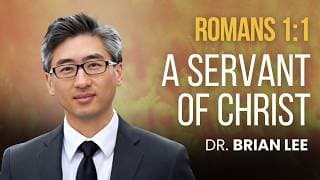
Dr. Brian Lee walked the congregation through the opening six verses of Romans and pointed out something hiding in plain sight — Jesus Christ is named in nearly every verse, each time under a different title. Verse one: Christ Jesus. Verse three: his Son. Verse four: the Son of God, then Jesus Christ our Lord. Verse five: for the sake of his name. Verse six: called to belong to Jesus Christ. Verse seven: the Lord Jesus Christ (watch at 5:17).
Seven references. Different names. One supreme authority. Paul isn't being redundant — he's saturating the opening of his most theologically dense letter with the single reality that governs everything that follows. Before he writes a word about justification, sanctification, election, or the future of Israel, he establishes this: there is one Lord, and everything else is commentary.
Jesus himself said it plainly in Matthew 6:24 — no one can serve two masters. You will love one and despise the other. And while Jesus was speaking about the seduction of money in that passage, the principle reaches further than our wallets. If Christ is not the single authority over your life, something else will fill the vacuum. And the most common replacement isn't a golden calf or a bank account.
It's yourself.
As Dr. Brian Lee put it: "If we wander away from his authority in our lives, the other authority or master we often serve is ourselves. Self. Our own will, our desires, our preferences. We make ourselves the master of our minds, our bodies, our souls" (watch at 7:44). Selfish ambition. Selfish gain. Self-reliance. Self-pity. Every compound word with "self" at the front is a confession that we've installed a rival king on the throne of our hearts.
And here's the twist that cuts against every self-help instinct in our culture: "It is the refusal to die to self that makes one miserable." Not the dying — the refusing. The white-knuckled grip on our own autonomy is not freedom. It's a prison we've decorated to look like a palace. A servant of Christ is broken and empty before him so that Christ may fill and satisfy. One master. His authority. His will.
Paul Didn't Know His Calling Until After He Was Saved
The second principle takes us deeper: a servant of Christ knows the voice of the master. And this unfolds in three layers — salvation, service, and commendation.
Start with salvation. The word "called" appears three times in the first seven verses of Romans. Paul was called as an apostle (v. 1). Believers in Rome were "called to belong to Jesus Christ" (v. 6). They were "called to be saints" (v. 7). And this is the opening of a book that will become the New Testament's most thorough treatment of election and calling. The frequency is not accidental.
But here's the tension the sermon named honestly: God calls everyone to belong to Christ. Romans 1:16 declares the gospel is the power of God for salvation to everyone who believes. Second Peter 3:9 says God is not wishing that any should perish. First Timothy 2:4 says God desires all people to be saved. And the parable in Matthew 20 pictures a master inviting laborers into his vineyard up to the eleventh hour — the last possible moment. The door stays open wider and longer than we tend to imagine.
And how does this call reach people? Romans 10:17 answers it: "Faith comes from hearing, and hearing through the word of Christ." Not through programs. Not through production value. Not through a particular style of music. There is nothing inherently wrong with any of those tools — God can use whatever he pleases. But the sermon pressed a conviction that too many churches have quietly abandoned: the ministry of the Word is central to the salvation of souls and the sanctification of God's people. Strip that away, and you've removed the engine while polishing the hood.
But beyond the call to salvation, there is a specific call to service within the body of Christ. And here the life of Paul becomes a powerful illustration. On the road to Damascus, Paul was saved — struck blind, brought to his knees, surrendered to the voice of Jesus. But notice what Jesus told him in Acts 9:6: "Rise and enter the city, and you will be told what you are to do." Not "here is your ministry plan." Not "here is your five-year strategy." Just: go, and you will be told.
Paul's specific calling as an apostle to the Gentiles came after salvation, delivered through a disciple named Ananias. And even then, Paul didn't rush to the pulpit. Galatians 1:17 tells us he went to Arabia for three years. Three years. The Hebrew of Hebrews, the most educated man in the room, sat in the desert with the scriptures and confirmed through God's Word the calling he had received (hear this moment).
That picture should stop us cold. If Paul needed three years in the Word to confirm his calling, what makes us think we can discern ours through a personality test and a weekend retreat? The connection is right there in the text: Romans 1:1 says Paul was "set apart for the gospel of God," and the very next verse adds, "which he promised beforehand through his prophets in the holy scriptures." The calling and the scriptures are bound together. You cannot separate them without losing both.
And the honest question was posed to the room: "What is your calling? Do you know what your calling is here tonight?" Not as guilt — but as genuine pastoral concern. Because there are Christians serving in roles they were never called to, driven by selfish ambition or a desire for visibility, without ever having sought confirmation from God's Word. Romans 12:4-8 lays out the diversity of gifts — prophecy, service, teaching, exhortation, generosity, leadership, mercy — and the instruction is clear: "Having gifts that differ according to the grace given to us, let us use them." Not someone else's gifts. Yours. The ones God actually gave you.
The Approval That Should Mean Nothing to You
The third layer of knowing the master's voice is the one that cuts deepest: a servant of Christ only desires the commendation of the master.
This is where the sermon moved from instruction to confrontation. As Dr. Brian Lee said, quoting Galatians 1:10: "If I were still trying to please man, I would not be a servant of Christ" (watch at 28:14).
The logic is devastating. People-pleasing and Christ-serving are mutually exclusive categories. You cannot inhabit both. And the flesh fights this truth with everything it has, because our flesh wants to be noticed. Whether you serve on a stage or behind a mop in an empty hallway, the craving is the same: See me. Acknowledge me. Tell me I matter.
Paul — brilliant, educated, a Roman citizen from a likely privileged background — wrote in 1 Corinthians 4:3 that being judged by any human court was "a very small thing" to him. He didn't even judge himself. Why? Because it is the Lord who judges. In 2 Corinthians 10:18: "It is not the one who commends himself who is approved, but the one whom the Lord commends."
And the question that should haunt every servant of Christ: what belongs to us anyway? The resources are his. The giftings are his. The blessings, the provision, the protection, the ministry, the church, the house — all his. We are merely servants and stewards. Taking credit for what God has done through us is like a paintbrush boasting about the Sistine Chapel.
Transferred Into a Kingdom With Better Boundaries
The third principle brings everything home: a servant of Christ belongs to their master. Being "set apart for the gospel of God" means more than having a mission statement. It means you have been relocated. Colossians 1:13 says God "has delivered us from the domain of darkness and transferred us to the kingdom of his beloved Son." Transferred. That's a citizenship change, not a membership card.
And the boundaries of this new kingdom — the commands, the standards of holiness, the moral framework of Scripture — are not a killjoy. They are a fortress. They exist to keep out the things that destroy us. The parable of the prodigal son is the permanent warning: venture outside the boundaries of the Father's house, and you will end up feeding pigs and starving.
But here is where the sermon landed with breathtaking tenderness. We are not merely servants. We are children. Heirs. Romans 8:17 says we are "heirs of God and fellow heirs with Christ." First Peter 1:4 describes an inheritance that is imperishable, undefiled, unfading, kept in heaven for you.
The sermon closed where it had to close — at the cross. Philippians 2:5-8 was read slowly, deliberately. Christ, in the form of God, did not grasp equality with God but emptied himself, took the form of a servant, and humbled himself to the point of death on a cross. The only perfect servant who ever lived did not serve to be noticed. He served to die. And because he did, you and I — broken, selfish, glory-hungry sinners — can be called servants of Christ at all.
As the closing prayer put it with raw honesty: "We need your help because without you, we live in the flesh and we hear other things, other people" (hear this moment). That is the confession of a true servant. Not competence. Dependence.
What to Remember
- A servant of Christ has one master — and the most common rival to Christ's authority is not the world, but your own will dressed up as wisdom.
- Paul did not receive his specific calling until after salvation, and he spent three years in Arabia confirming it through Scripture — discerning your calling requires patience, the Word, and prayer, not ambition.
- People-pleasing and Christ-serving are mutually exclusive; Galatians 1:10 makes this an either/or, not a both/and.
- The boundaries of God's kingdom are not restrictions on your freedom — they are walls that protect you from the things that would consume you.
- You are not merely a servant; you are a child of God, an heir with Christ, with an inheritance that is imperishable, undefiled, and unfading.
- To serve Christ is to know him; to know him is to serve him. The two cannot be separated.
Questions to Sit With
- If you examined your daily decisions honestly, who is actually functioning as the master of your life — Christ, or yourself under a Christian label?
- Have you ever sought genuine confirmation from Scripture and prayer for the role you currently serve in your church — or did you volunteer for it because it felt good, looked impressive, or no one else would do it?
- When was the last time you served faithfully and no one noticed — and how did your heart respond? What did that reaction reveal?
- Paul spent three years in Arabia before stepping into public ministry. What would it look like for you to slow down and listen before your next move?
- If the approval of other people were suddenly and permanently removed from your life, would your service to Christ continue unchanged?
Scripture Referenced
- Romans 1:1-6 (primary text)
- Romans 8:17
- Romans 10:14-17
- Romans 12:4-8
- Romans 13:1
- Acts 9:6
- John 16:13
- Philippians 2:3-8
- Philippians 4:9
- Galatians 1:10, 17
- Colossians 1:13
- Matthew 6:24
- Matthew 20 (Parable of the Laborers)
- 1 Corinthians 4:3
- 2 Corinthians 10:18
- 1 Timothy 2:4
- 2 Peter 3:9
- 1 Peter 1:4
This summary was generated by AI from the sermon "A Servant of Christ | Romans 1:1 | Dr. Brian Lee (7/10/26)" preached by Dr. Brian Lee at Maranatha Bible Church Chicago. Watch the full sermon →
Related Articles
Nehemiah 9: Why the Bible's Longest Prayer Has Only One Request
Pastor Daniel Batarseh · October 30, 2026
Nehemiah 6: What Happens When the Enemy Gets Desperate
Pastor Daniel Batarseh · September 4, 2026
Who Was the First Person Filled with the Spirit? (Exodus 31)
Pastor Daniel Batarseh · August 28, 2026