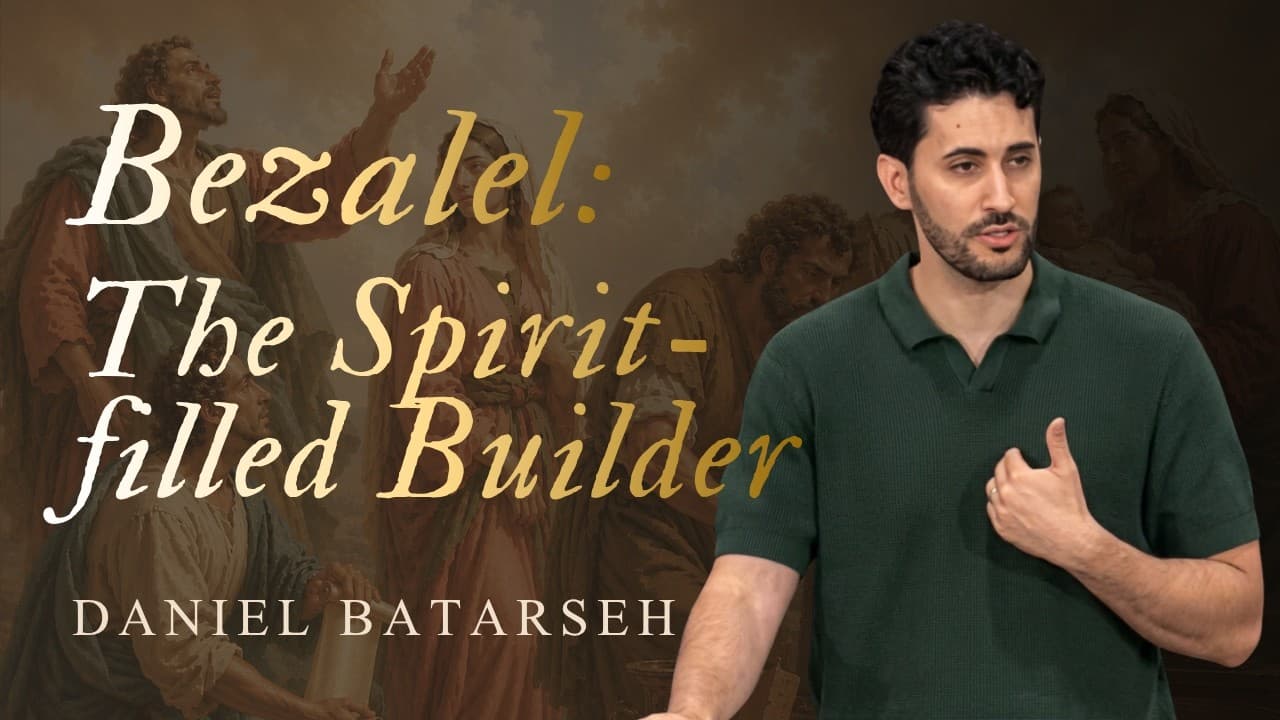
The first person Scripture records as filled with the Spirit of God wasn't an apostle, prophet, or king — he was a builder. And the reason changes how we think about the Holy Spirit's work.
Here is a question most Christians have never paused to consider: Who is the first person in the entire Bible explicitly described as being filled with the Spirit of God?
Not Moses. Not Elijah. Not David. Not any apostle. The answer is a man most believers have never heard a sermon about — Bezalel, son of Uri, son of Hur, from the tribe of Judah. A craftsman. A contractor. A man who worked with his hands and never wrote a single line of Scripture. And the fact that God chose this moment, this man, and this task to introduce the filling of the Spirit tells us something profound about who the Holy Spirit is and what He actually does.
Exodus 31:1–6 records the scene, and Pastor Daniel Batarseh opened it up at the Maranatha 2026 conference in a way that reframes how we think about the Spirit's work, the sacredness of the church, and the kind of heart God is looking for.
God Called This Man by Name — and That Should Stop Us
The passage begins with a phrase that sounds routine but isn't: "See, I have called by name Bezalel the son of Uri, son of Hur, of the tribe of Judah" (Exodus 31:2). Why would God specify that He called Bezalel by name? Because it tells us two things simultaneously.
First, Bezalel was not a volunteer. God did not put out a general call for skilled laborers and wait to see who showed up. He selected this man personally, sovereignly, deliberately. This was not a committee decision. Not even Moses' idea. God Himself chose who would oversee the construction of His dwelling place on earth.
Second, whenever God calls someone by name in Scripture, an extraordinary assignment follows. Abraham. Samuel. Cyrus. And now Bezalel. The calling-by-name signals that the task ahead is monumental. And what was the task? Build God's house.
Pause there. The fact that God was this selective — this protective, this particular — about who would construct the tabernacle tells us how precious His dwelling place is to Him. This is no casual project. As Pastor Daniel Batarseh put it: "God's dwelling place is so precious and He is so protective of it that He chose who would be in charge to oversee its construction" (watch at 37:48).
And if that was true of a tent in the wilderness — a temporary structure made of acacia wood and animal skins — how much more is it true of the church? The church is not a social club. It is not a religious organization. It is God's dwelling place on earth, and He is fiercely protective of it. The Corinthians learned this the hard way. They treated their gatherings casually, acted however they wanted, and Paul leveled a warning that should make every believer sit up straight: "If anyone destroys God's temple, God will destroy him. For God's temple is holy, and you are that temple" (1 Corinthians 3:17).
Why were the Corinthians acting like the Corinthians? Because they lost sight of the holiness of what they were. And we are in constant danger of the same drift.
What Bezalel's Name Reveals About the Investments That Shape a Life
God doesn't explain why He chose Bezalel. He doesn't have to. But He does give us Bezalel's lineage, and that invites us to look closer.
His grandfather was Hur — the same Hur who stood beside Aaron holding up Moses' hands during the battle with the Amalekites in Exodus 17. The same Hur entrusted with shepherding the people when Moses ascended the mountain for forty days in Exodus 24. A man of proven faithfulness, trusted with the highest responsibilities.
His father was Uri. We know almost nothing about Uri — no recorded accomplishments, no described role. But there is one clue that speaks volumes: the name he gave his son. Bezalel in Hebrew means "in the shadow of God." Throughout the Old Testament — Psalm 91:1, the shadow of the Almighty; the shadow of His wings — God's shadow denotes His protective, intimate presence over those who stay near Him.
So Uri named his boy with a prayer embedded in the syllables: Live near God. Stay close. Walk in His shadow. And it appears Bezalel did exactly that. When God went looking for a man to build His house, He didn't have to look far. He found someone already living in His shadow.
This is not to say Bezalel was chosen because of his pedigree. But the investments of a godly grandfather and a praying father prepared the soil. Before Timothy became the pastor of one of the most influential churches in Asia Minor, he received the Scriptures in his grandmother Lois's living room and heard the oracles of God at his mother Eunice's bedside. When Paul came to town, Timothy was ready — not by accident, but because someone had planted seeds years before.
Do not underestimate the prayers you pray over that child. Do not dismiss the faithfulness you model when no one seems to be watching. Someone is always watching. And God remembers every seed.
The Spirit's First Recorded Purpose Wasn't Ecstasy — It Was Obedience
Here is where the sermon turned a corner that made the room go quiet.
The filling of the Holy Spirit in the Old Testament is rare. When it appears, we expect it to be connected to prophesying, to military deliverance, to some dramatic display of divine power. But the first time? It's for a man to cut stones, carve wood, and work in gold, silver, and bronze. As Batarseh said with visible astonishment: "The first time a person was filled with the Spirit of God was a construction worker. He was an artist. He was someone who didn't preach a sermon. He didn't write any book in the Bible. He was someone who silently built a tent" (hear this moment).
That alone should reshape how we think about the Spirit's work. If God is willing to fill a man with His Spirit so he can build furniture for a tent, then no honest work falls outside the Spirit's interest. Your job, your craft, your daily labor — it is not beneath the Holy Spirit's attention.
But the purpose of the filling goes deeper than empowerment for skill. Look at the end of verse 6: "that they may make all that I have commanded you." God had already given Moses a detailed blueprint in Exodus 25–30 — exact dimensions, exact materials, exact designs. The Spirit filled Bezalel not to innovate, not to improvise, but to obey. Precisely.
And the text proves it. In Exodus 25:10, God commands: "They shall make an ark of acacia wood. Two cubits and a half shall be its length, a cubit and a half its breadth, and a cubit and a half its height." Then in Exodus 37:1, the execution: "Bezalel made the ark of acacia wood. Two cubits and a half was its length, a cubit and a half its breadth, and a cubit and a half its height." Word for word. Measurement for measurement. No adjustments. No personal flair. No deviations (watch at 53:12).
This is what the filling of the Spirit produced: faithful, exact obedience to what God said. Not just an energizing work, but a restraining work — the discipline to do only what God commanded and nothing more.
The implications are sharp. "People have all these wild ideas of what the filling of the Holy Spirit is and what it produces. You have an entire movement out there who think that the filling of the Holy Spirit is so that you can manifest physically in some way in a service. What's the purpose of any of those kind of manifestations if you go back out there and live as though God doesn't exist?" (watch at 55:36). The Spirit's first purpose is not sensation. It is obedience. It is lifestyle. It is ongoing, stable, Christ-like conformity to the Word of God.
The Wisdom That Built the Universe Also Built the Tabernacle
Verse 3 describes Bezalel as filled with "wisdom, understanding, and knowledge" — that's how most translations render the Hebrew. Those three terms appear together in only a few places in Scripture, and the connections are staggering.
The same grouping appears in 1 Kings 7:13–14, describing Hiram, the master craftsman who built Solomon's temple. The same wisdom for the tabernacle was given for the temple. But it goes further. Proverbs 3:19–20 declares: "The Lord by wisdom founded the earth; by understanding He established the heavens; by His knowledge the deeps broke open."
Read that again. The capacities God exercised when He constructed the cosmos — wisdom, understanding, knowledge — are the same ones He granted to His servants to build His house on earth. The God who engineered galaxies and ocean currents poured the same category of creative intelligence into a man building a tent in the desert. That is how much God's dwelling place matters to Him.
And it carries into the New Testament. Ephesians 3:10 says the church exists "so that through the church the manifold wisdom of God might now be made known to the rulers and authorities in the heavenly places." The church is not just for evangelism or fellowship. It is a cosmic display case for the wisdom of God. Angels watch. Demons are silenced. Every time believers from different tribes and tongues and backgrounds gather under the blood of Christ — former enemies made family, the human race that killed the Son of God now worshiping Him — the invisible realm sees the wisdom of God on full display.
As Job 38 tells us, the angels sang at creation because they saw God's power and wisdom. They stand in equal awe of the church.
Why God Paired Judah with Dan
Bezalel, as gifted and Spirit-filled as he was, did not work alone. God appointed a partner: Oholiab, from the tribe of Dan. That pairing is not accidental.
In Numbers 10, when God organized the tribes for their wilderness procession, Judah marched first. Dan marched last — the rear guard, the end of the line. And throughout Scripture, Dan is not seen in a favorable light. Idolatry. Compromise. Even in Revelation, Dan is conspicuously absent from certain lists. So God chose His lead builder from the royal tribe and His second-in-command from the tribe at the back of the parade.
This gives courage to every believer who looks at their background and feels disqualified. No impressive spiritual pedigree? No generations of faithful churchgoers behind you? God selected a man from Dan. He looks at your heart, not your heritage.
And what did Bezalel and Oholiab have in common? Exodus 36:2 gives us the answer: they were men "whose heart stirred him up to come to do the work." The stirring came from within them — a longing to be used by God. God supplied the skill. God supplied the wisdom. But the desire? That was theirs. That was the one thing God was looking for, and He found it in a man from Judah and a man from Dan alike.
The Greater Builder from the Tribe of Judah
God chose a man from Judah to build the tabernacle, even though the tribe of Levi — not Judah — would serve in it. That detail is prophetically loaded. Thousands of years later, another man from the tribe of Judah would build something: "On this rock I will build my church, and the gates of hell shall not prevail against it" (Matthew 16:18).
Jesus is the greater Bezalel. The son of a carpenter and the Son of the Heavenly Father. But where Bezalel's tabernacle was eventually disassembled, and where Solomon's temple was toppled until not one stone stood on another, what Jesus builds cannot be destroyed. Not by persecution. Not by unfaithfulness. Not by the gates of hell itself.
And He is building more than the church. 2 Corinthians 5:1 says: "If the tent that is our earthly home is destroyed, we have a building from God, a house not made with hands, eternal in the heavens." These bodies are tents — flimsy, temporary, destined to come apart. But Christ the architect is fashioning resurrection bodies. And in John 14:1–2, He says He is also preparing a place for us in His Father's house.
How does He do it all? Build the church, prepare a place, fashion resurrection bodies, work on every individual temple of the Holy Spirit simultaneously — and never break a sweat? Because He is God. That is how.
What to Remember
- The first person filled with the Spirit of God in Scripture was not a prophet or king but a craftsman — no honest work falls outside the Spirit's interest or help.
- The Spirit's primary purpose is not ecstatic experience but faithful obedience to what God has already said. Bezalel built exactly to God's blueprint, and the Spirit enabled that precision.
- God called Bezalel by name because His dwelling place is precious to Him. The church today deserves the same reverence — it is the manifold wisdom of God on display to angels and demons.
- Your spiritual heritage does not determine your usefulness to God. He chose a man from Dan — the last tribe in line, the least reputable — because He looks at the heart, not the pedigree.
- The wisdom, understanding, and knowledge God used to create the universe are the same capacities He gives His people to build His house. Stop living as though you are under-resourced.
Questions to Sit With
- If the filling of the Spirit is primarily for obedience, what specific instruction from God's Word are you currently resisting — and what would it look like to obey it exactly?
- Do you treat your local church with the same reverence God showed when He hand-selected the builder of His tabernacle? Or has it become casual to you?
- What name — what prayer — did your parents or grandparents place over your life? And if no one prayed for you, what name are you placing over the next generation?
- Bezalel's Spirit-empowered work was not adding his own ideas to God's design but restraining himself to follow the blueprint. Where in your life have you been improvising where God has already given clear instructions?
- If God looks at the heart and finds a longing to be used by Him, what would He find if He looked at yours this morning?
Scripture Referenced
- Exodus 31:1-6 — The calling and filling of Bezalel
- Exodus 25:10 — God's blueprint for the ark
- Exodus 37:1 — Bezalel's faithful execution
- Exodus 36:2 — Hearts stirred to do the work
- Romans 8:26-39 — Nothing can separate us from God's love
- 1 Corinthians 3:17 — Warning about destroying God's temple
- 1 Kings 7:13-14 — Hiram's wisdom for the temple
- Proverbs 3:19-20 — Wisdom, understanding, knowledge at creation
- Ephesians 3:10 — The church displays God's manifold wisdom
- Numbers 10:13-25 — The tribal order of procession
- Matthew 16:18 — Jesus will build His church
- 2 Corinthians 5:1 — Our resurrection body, a building from God
- John 14:1-2 — Jesus prepares a place for us
This summary was generated by AI from the sermon "Bezalel: The Spirit-filled Builder | Exodus 31:1-6 | Pastor Daniel Batarseh | Maranatha 2026 (Thur.)" preached by Pastor Daniel Batarseh at Maranatha Bible Church Chicago. Watch the full sermon →
Preached by
Pastor Daniel BatarsehSenior Pastor
This summary was generated by AI from the sermon transcript.
Based on the sermon
Bezalel: The Spirit-filled Builder | Exodus 31:1-6 | Pastor Daniel Batarseh | Maranatha 2026 (Thur.)
Watch Full SermonRelated Articles
Moses' Parents: The Faith That Formed a Deliverer (Hebrews 11:23)
Pastor Daniel Batarseh · August 30, 2026
Moses' Parents: The Faith That Shaped a Deliverer (Hebrews 11:23)
Pastor Daniel Batarseh · August 30, 2026

Exodus 12 and the Blood That Started History Over
Pastor Daniel Banna 8/21 · August 21, 2026