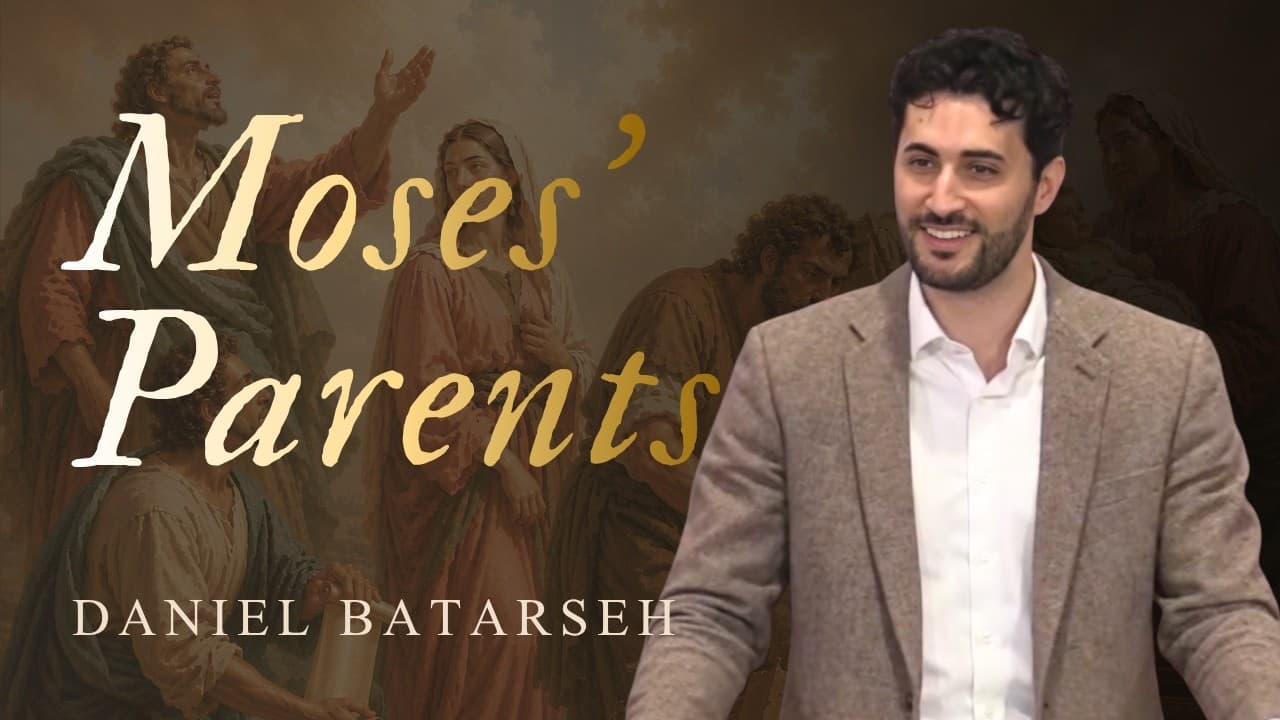
Before Moses confronted Pharaoh, his parents confronted fear. Hebrews 11:23 reveals a faith that started in a slave's home and ended with a nation crossing the Red Sea.
Moses' Parents: The Faith That Shaped a Deliverer
Before Moses ever stood before Pharaoh, before the plagues, before the Red Sea parted, there was a living room. A slave's quarters. Two parents who looked at their newborn son and made a decision that would alter the trajectory of an entire nation. Hebrews 11:23 celebrates their faith in a single verse — but buried inside that verse is a truth most readers walk right past: the way the Holy Spirit phrases this sentence tells us that Moses' extraordinary faith was not self-generated. It was inherited. The verse doesn't say "by faith Moses' parents." It says, "By faith Moses, when he was born, was hidden for three months by his parents." The grammar is deliberate. We're being introduced to Moses' faith — and the Spirit immediately redirects our attention to the home that made it possible.
This is a sermon about parenting, but not the kind that gives you a checklist. It's about the atmosphere of a home. The invisible curriculum that children absorb long before they can articulate what they believe.
The Verse That Doesn't Read the Way You'd Expect
Most English translations smooth this out, but a faithful word-for-word rendering of Hebrews 11:23 opens with "By faith Moses" — and then pivots immediately to his parents. It's structurally awkward, and that's the point. The Holy Spirit is preparing us to consider the towering faith of Moses that spans verses 23 through 29, but He wants us to first see where that faith came from.
As Pastor Daniel Batarseh put it: "It's as though the Spirit of God, by phrasing it in this manner, wants us to first acknowledge and recognize the history of Moses' faith. The influence and the atmosphere that Moses grew up in before he exercised his own trust in God" (watch at 59:38).
This doesn't teach that faith is automatically inherited — plenty of godly parents have watched their children walk away. But it does reveal something we desperately need to hear: the home is the first school of faith. Not Sunday school. Not youth group. Not a Christian college campus. The living room, the kitchen, the bedtime conversations.
And notice: both parents are celebrated. "His parents." Amram and Jochebed — names we learn from Numbers 26:59. Amram means "exalted people." Jochebed means "Jehovah is glory." Both from the tribe of Levi, a tribe that, according to Genesis 49, had received not a blessing from Jacob but a bleak prophetic future because of their barbaric violence against the Shechemites. That the deliverer of Israel would emerge from Levi — before the tribe distinguished itself at the golden calf incident — says something staggering about the reach of God's grace.
Pharaoh's Blind Spot: He Dismissed the Women
Here's what makes the early chapters of Exodus quietly subversive: Pharaoh was terrified of Hebrew boys. He could see them growing into soldiers, forming a militia, igniting a revolt. So his edict was surgical — kill the sons, spare the daughters. He dismissed the women entirely.
That was his fatal mistake.
Look at who actually dismantles his decree. In Exodus 1:17, the midwives Shiphrah and Puah fear God and refuse to comply. In Exodus 2:2, it's Jochebed — "the woman" — who sees that her son is fine and hides him. It's Miriam who stands watch by the river. It's Pharaoh's own daughter who pulls Moses from the water. At every turn, the women are the ones frustrating the machinery of evil.
Hebrews celebrates the faith of both parents, but Exodus spotlights the mother. And this isn't incidental. The Spirit is building up the faith of women, of mothers, of wives. Don't underestimate how your faith, directed at your children, dismantles decrees that powerful men have set in motion. The deliverance of an entire nation started not with a military campaign but with a mother who refused to let her baby die.
There's another detail worth lingering on. In Exodus 2, the word "faith" never appears. It's all action — she conceived, she saw, she hid, she made a basket, she placed him in the reeds. Hebrews calls it faith. Exodus shows it as movement. They complement each other perfectly. Faith in this household wasn't a label slapped on the family name. It wasn't something experienced for an hour and a half on a holy day. It was observable. Tangible. It had legs.
"The greatest disservice that we do for our little ones, to the next generation, is give them a faith that lasts an hour and a half on a Sunday and doesn't exist the other days of the week. That kind of faith will not win the next generation" (hear this moment).
Beautiful in God's Sight — And It Doesn't Mean What You Think
Every parent thinks their baby is beautiful. So why does the Holy Spirit tell us that Amram and Jochebed "saw that the child was beautiful" as though it explains their courageous defiance? Is this just saying Moses was an exceptionally cute baby?
The answer is in Acts 7:20, where Stephen adds a phrase that changes everything: "At this time Moses was born, and he was beautiful in God's sight." Not just beautiful to his parents — beautiful to God. And God doesn't measure beauty by outward appearance.
The key is the phrase Stephen uses just before: "as the time of the promise drew near" (Acts 7:17). God had promised Abraham that his descendants would be enslaved in a foreign land for four hundred years and then delivered. Stephen is telling us that the clock was running out on that prophecy. And at this time — at the time of promised deliverance — Moses was born.
The beauty, then, is less about how Moses looked and more about the calling he would fulfill. He was beautiful in God's sight because of the timing of his birth, because of the purpose woven into his existence. And when Hebrews says his parents saw he was beautiful, it suggests they had some kind of instinct, some tug in their hearts, that this boy was marked for something extraordinary. Not necessarily a full prophetic vision — the text doesn't say that — but enough conviction to risk their lives.
Here's the application that landed hardest in the room: the faith that enabled these parents to see past the threats came from aligning their perspective with God's. Pharaoh looked at Hebrew boys and saw disposable threats. God looked at Moses and saw a deliverer. Amram and Jochebed chose to see as God sees. And that is what faith does — it recalibrates your vision until you interpret reality the way God does, not the way the culture demands.
In an age where children are routinely treated as inconveniences, as burdens, as obstacles to personal fulfillment — even by professing Christians — this text thunders: that child is beautiful in God's sight.
The Seeds Survived Egypt
Here is where the sermon reached its crescendo, and where many in the room felt the full weight of the text.
When Jochebed could no longer hide Moses, she placed him in a basket among the reeds. Pharaoh's daughter found him, adopted him, and — in one of the most delicious ironies in all of Scripture — hired Moses' own mother to nurse and raise him, and paid her for it. Pharaoh, who had commanded the slaughter of Hebrew boys, was now unknowingly funding the upbringing of the man who would destroy his empire.
During those formative years, Amram and Jochebed wasted nothing. We can imagine them rehearsing the story of Abraham, Isaac, and Jacob. Telling him about the promises. Planting seeds of identity and faith into a heart that would soon be transplanted into the most sophisticated pagan culture on earth.
Because Moses did go to Egypt. He received the finest education available. He would have studied Egyptian history, Egyptian religion, the ideological justifications for Hebrew enslavement. Graduation after graduation, immersed in a worldview designed to erase everything his parents had planted.
And yet — Hebrews 11:24: "By faith Moses, when he was grown up, refused to be called the son of Pharaoh's daughter."
The seeds survived Egypt.
But the literary artistry of the Holy Spirit goes even further. Look at the end of verse 23: his parents "were not afraid of the king's edict." Now look at verse 27: Moses "left Egypt, not being afraid of the anger of the king." The mirror is intentional. The fearlessness of the son echoes the fearlessness of the parents. Where did Moses learn to stare down a tyrant? He saw it first in his mother and father.
Pastor Daniel Batarseh paused here and spoke personally, with the kind of honesty that silenced the room: "I'm somebody who lived in Egypt for a while and intended to stay there for the rest of my life. But something happened to me when I was living at home... I've seen enough and I've heard enough to not be able to sin comfortably. All my conscience would keep me up some nights. I could not fight it off. Why? Because of those seeds" (watch at 1:28:59).
From One Home to an Entire Nation
The discourse on Moses' faith in Hebrews 11 spans verses 23 through 29. It begins with two parents hiding one child. It ends with an entire nation crossing the Red Sea by faith. But look at verse 28 just before that: "By faith he kept the Passover and sprinkled the blood, so that the Destroyer of the firstborn might not touch them."
Do you see it? It begins with two parents protecting the life of their child. It ends with an entire generation of parents trusting God to protect theirs. The faith of one household became the faith of a nation.
Amram and Jochebed never stood before the Red Sea. They never confronted Pharaoh directly. They never led Israel out of Egypt. They were two Hebrew slaves who hid a baby and, with the limited time they had, taught him about the living God. And that was the catalyst for everything.
"If there's anything that you and I are called to do as parents, grandparents, uncles and aunts, is amaze our children with God. Amaze them with God. And that can only happen if you were actually amazed by God for yourself" (hear this moment).
Your home is a sanctuary. That Sunday school hour can raise up a revivalist. The diaper changing, the school driving, the bedtime prayers whispered over a child who would rather be doing anything else — it is not in vain.
What to Remember
- The Holy Spirit structures Hebrews 11:23 to show us that Moses' faith had a history — it was forged in the atmosphere of his parents' home before it was ever tested in Egypt.
- Pharaoh dismissed the women of Israel as irrelevant. God used them — midwives, mothers, sisters — to dismantle his murderous decree from the inside out.
- Moses was "beautiful in God's sight" not because of his appearance but because of the timing of his birth and the calling attached to his life — and his parents had enough spiritual instinct to recognize it.
- Faith that is only visible on Sundays will not survive the pressures your children will face. Observable, daily, lived-out trust in God is what creates an atmosphere where the next generation can believe.
- The fearlessness Moses displayed before Pharaoh as an adult mirrors the exact fearlessness his parents displayed when he was an infant — the language in Hebrews 11:23 and 11:27 is deliberately parallel.
- What began with two parents protecting one child ended with an entire nation trusting God to protect theirs. Never underestimate the reach of faithful parenting.
Questions to Sit With
- If your children could only learn about God by watching your life Monday through Saturday — never hearing a sermon, never attending a church service — what would they conclude about your faith?
- Are the conversations in your home producing anxiety about the world or awe of God? What would an honest audit reveal?
- Jochebed's faith was practical — she hid Moses, built a waterproof basket, strategically placed him where he'd be found. Where in your life have you confused reckless presumption with genuine trust in God?
- Moses spent years immersed in Egyptian education designed to replace everything his parents taught him. What "Egypt" is your child being educated in right now, and what seeds are you planting that might outlast it?
- Amram and Jochebed never saw the Red Sea crossing. They planted and never saw the full harvest. Are you willing to be faithful in obscurity, trusting that God will bring the fruit in a generation you may never witness?
Scripture Referenced
- Hebrews 11:23-29
- Exodus 2:1-10
- Exodus 1:15-17
- Numbers 26:59
- Acts 7:17-20
- John 11:53-54
- 1 Corinthians 1:18-31
- 1 Corinthians 2:1-2
- Genesis 49
- Psalm 144:12-15
This summary was generated by AI from the sermon "Moses' Parents | Pastor Daniel Batarseh | Maranatha 2026 (Sunday Morning 8/30)" preached by Pastor Daniel Batarseh at Maranatha Bible Church Chicago. Watch the full sermon →
Preached by
Pastor Daniel BatarsehSenior Pastor
This summary was generated by AI from the sermon transcript.
Based on the sermon
Moses’ Parents | Pastor Daniel Batarseh | Maranatha 2026 (Sunday Morning 8/30)
Watch Full SermonRelated Articles
Hebrews 9 and Why Christ's Second Coming Isn't About Sin
Pastor Daniel Batarseh · October 4, 2026
Hebrews 9: Why Christ's Blood Secures What Animal Blood Never Could
Pastor Daniel Batarseh · October 4, 2026
Nehemiah 7: Why the Biggest Group Nobody Knows About Matters
Pastor Daniel Batarseh · September 25, 2026