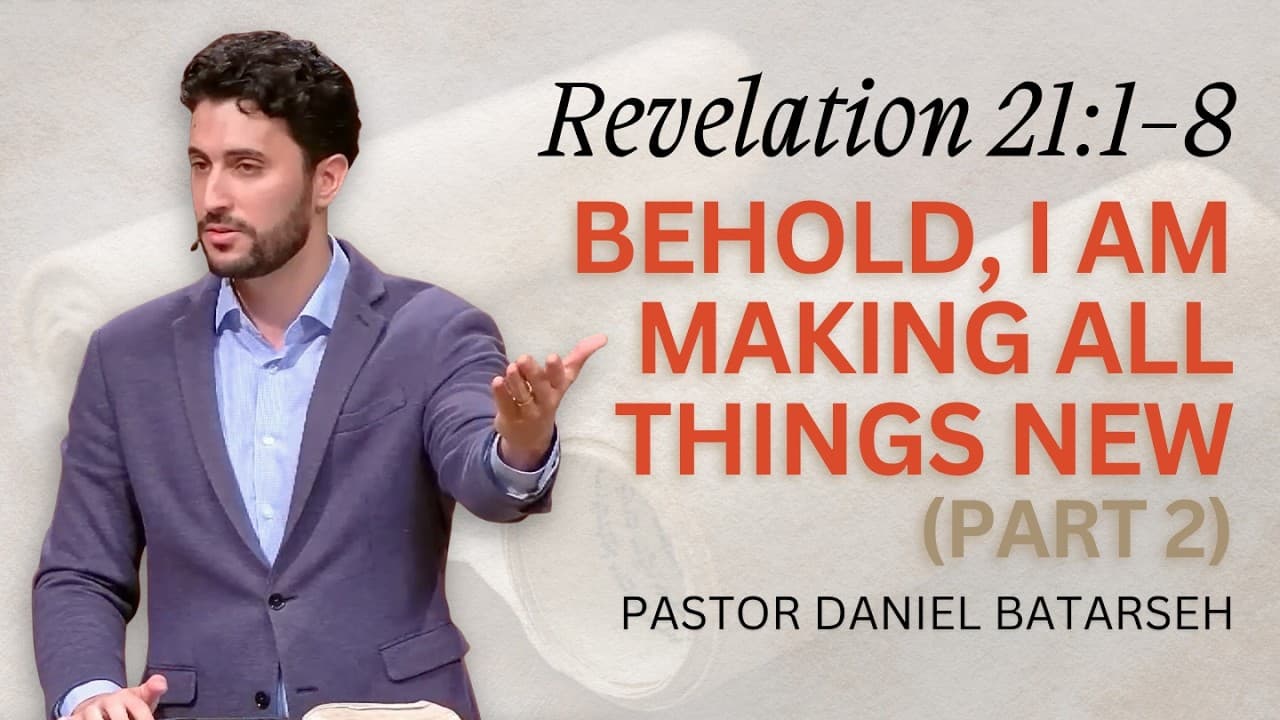
Eternity isn't a hazy, abstract existence on clouds. Revelation 21 describes a city — bustling, holy, and permeated by the love of the Lamb.
Most people, if they're honest, picture eternity as something vague. Clouds, maybe. Harps, if the cartoons have gotten to them. A general sense of peace, floating somewhere above. But Revelation 21:1–8 obliterates that picture. What John actually sees is a city — a holy city descending from heaven, teeming with life, blazing with the glory of God, and populated by people who have been so transformed that they bear the family resemblance of Jesus Christ himself. This isn't a dreamy afterlife. It's a concrete, engineered, God-designed civilization — and the details John records should make every believer lean forward and every skeptic pause.
In part two of his series on this passage, Pastor Daniel Batarseh walked through four realities about the new heaven and new earth that most of us have either never noticed or never let sink deep enough to change how we live today. What follows are the truths that made the room go quiet — and then made it come alive.
A City, Not a Cloud: Why Eternity Involves Community and Activity
After establishing in part one that God will create a completely new universe — one so different that even the sea will be absent — John's vision suddenly shifts in verse 2. Something descends. A city. The New Jerusalem, coming down out of heaven from God, "prepared as a bride adorned for her husband."
Here's what's worth stopping on: when you hear the word city, what comes to mind? People. Infrastructure. Activity. Services, events, institutions, bustling life. This is not accidental language. The Spirit of God chose this image to tell us something about eternity that most of us have missed: our eternal existence will not be passive. There will be interaction, responsibility, recreation. It will be tangible, not hazy. Vital, not vaporous.
But cities in our experience carry baggage — crime, corruption, pollution, loneliness. You can live in a city of eight million people and feel utterly alone. That's why the text is careful: this is a holy city. Revelation 21:27 adds the qualifier — "nothing unclean will ever enter it, nor anyone who does what is detestable or false, but only those who are written in the Lamb's book of life."
Imagine a city with no trace of perversion. No injustice. No suspicion of someone's motives. No neighborhoods you avoid after dark. No isolation in a crowd. Instead: unbroken harmony, sinless fellowship, and perfect beauty on a civic scale.
And this isn't just a future curiosity. It's a diagnostic for your faith right now. The book of Hebrews makes a startling connection: Abraham lived in tents his entire life — and did so gladly — because "he was looking forward to the city that has foundations, whose designer and builder is God" (Hebrews 11:10). Hebrews 13:14 extends that to every believer: "For here we have no lasting city, but we seek the city that is to come" (watch at 56:22).
As Pastor Daniel Batarseh put it, the reason we get so agitated, so flustered, so covetous in this life is simple: "We think we're staying here. Your life in this very body is you staying in a hotel. Your house is in heaven. But we think the hotel is our house" (watch at 54:16). That analogy alone is worth sitting with for a week.
The Presence That Functions Like Sunlight
Verse 3 contains the last "loud voice" in the entire book of Revelation. That matters. Throughout the book, John records loud voices to amplify critical truth. This is the final one — the announcement God wants ringing in our ears as the prophecy closes: "Behold, the dwelling place of God is with man. He will dwell with them, and they will be his people, and God himself will be with them as their God."
Notice how the same truth gets repeated three different ways in a single breath. The dwelling place of God is with man. He will dwell with them. God himself will be with them. The repetition isn't redundancy. It's exhilaration. This is the reality God himself is most thrilled about.
Every previous manifestation of God's presence in redemptive history — the pillar of cloud, the glory in the temple, the incarnation itself — was either momentary or confined to a singular place. What awaits us will be unhindered, unfiltered, and endless. No more of the spiritual "in and out" we experience now, where God feels close in a worship service and distant by Tuesday afternoon. In the new heaven and new earth, it will be constant.
But how? How does one God fellowship intimately with billions of glorified saints simultaneously? Verse 23 offers a stunning clue: "The city has no need of sun or moon to shine on it, for the glory of God gives it light, and its lamp is the Lamb." God's presence will function like sunlight. You've never once in your life seen people taking turns receiving the sun's rays. It shines on everyone, everywhere, all at once. The warmth of God's presence will operate the same way — so powerful, so accessible, that every saint will enjoy it simultaneously.
And the choice of title in that verse is not random. The light source isn't called "the King" or "the Almighty" here. It's called the Lamb. The sacrificial love of Christ — the fact that he laid down his life — will be the atmosphere we breathe for eternity. As Batarseh described it: "The atmosphere that you and I are going to live in in that place will be an atmosphere of love because it will be the Lamb who radiates that truth on us no matter where we are" (watch at 1:05:31).
Jesus Prayed for You to Be There — and He Meant It
Here's a question that cuts deeper than theological curiosity: what do you picture when you imagine standing before Jesus Christ face to face for the first time? A scowl? An emotionless stare? A cosmic audit of your failures?
If that's your default, John 17 should rewire everything. In what's called the High Priestly Prayer, Jesus moves from praying for himself, to praying for his apostles, to praying for everyone who would believe through their message — which means you and me. And here is his request in verse 24: "Father, I desire that they also, whom you have given me, may be with me where I am, to see my glory."
Sit with that. Jesus Christ, shortly before his own death, made it a formal request before the Father that you would be in close proximity to his glory for eternity. He didn't just permit it. He desired it. He is not dreading your arrival. He is anticipating it — the way a father waits at the door for a child returning from a long journey (hear this moment).
This changes the emotional posture of the Christian life. If the Son of God actively wants fellowship with you across a table, eye to eye, face to face — and prayed for it with his final breaths on earth — then the shame that tells you God barely tolerates you is a lie. A bold, destructive lie.
"He Will Be My Son" — The Detail John Saved for Last
This was the moment in the sermon where the room got very still. It requires some knowledge of how John writes, and once you see it, you can't unsee it.
Throughout all of John's writings — his Gospel and his epistles — he is remarkably consistent in his language. When he describes believers' relationship with God, he uses one word: children. "He gave the right to become children of God" (John 1:12). "See what kind of love the Father has given to us, that we should be called children of God" (1 John 3:1). Always children. Never sons.
The word son — and specifically "Son of God" — John reserves exclusively for Jesus Christ. It's his way of marking the unique, unrepeatable relationship between the Father and the eternal Son.
But then we arrive at Revelation 21:7. And for the first and only time in all of John's writings, the term shifts: "The one who conquers will have this heritage, and I will be his God and he will be my son." Son. Not child. Son.
Why the change? Why here? Because the context is eternity. In the new heaven and new earth, after glorification, we will share in the likeness of Christ in a way we have never experienced. Not divinity — we will never be objects of worship. But complete conformity to his moral flawlessness, his spotless nature, his glorious character. What is now only positional — our righteousness in Christ — will become experiential and eternal.
1 John 3:2 confirms it: "We know that when he appears, we shall be like him, because we shall see him as he is." This answers the question people love to debate: can we sin in heaven? The answer isn't about free will being removed. It's about nature being transformed. Can Christ sin? No. We will be like him. The battle is over. The flesh is gone. Not suppressed — gone.
As Batarseh said with visible emotion: "Never to succumb to any impulse. Never to react in the flesh. Never to have a single passing thought of lust. Never to have your heart struggle with envy as you see another brother or sister being exalted. We will be like him" (watch at 1:24:45).
For anyone who has ever wept over a sin they can't seem to conquer, that promise is not abstract theology. It is oxygen.
The Invitation That Comes with a Warning
The passage closes with both an open door and a locked gate. "To the thirsty I will give from the spring of the water of life without payment" (v. 6). But verse 8 lists those whose portion is the lake of fire: the cowardly, the faithless, murderers, the sexually immoral, sorcerers, idolaters, and all liars.
The offer is free, but it isn't universal in its application. You have to be thirsty. God will not force the cup down your throat. He extends it and asks: do you want this? And the uncomfortable truth is that every addiction, every obsession with money, every compulsive return to pornography is actually evidence of thirst — just thirst directed at the wrong well. You're thirsty for satisfaction, for control, for pleasure. The gospel says: there is a spring that never runs dry, and it costs you nothing because Christ paid everything.
The North Korea illustration from earlier in the service haunts this invitation. Pyongyang — now one of the most oppressive places on earth for Christians — was once called the Jerusalem of the East. Missionaries flooded it. Revival swept through it. And then, in a historical blink, everything changed. Freedom to worship is not guaranteed. The window of grace is open now. Walk through it.
What to Remember
- Eternity is not a vague, passive existence — it is a holy city filled with community, activity, and the unbroken presence of God.
- God's presence in the new creation will function like sunlight: simultaneous, universal, and inescapable in the best possible sense.
- Jesus Christ actively prayed — with desire, not mere permission — for you to be near his glory forever. He is not dreading your arrival.
- John's shift from "children" to "son" in Revelation 21:7 is a linguistic signal that in eternity, we will share in Christ's likeness in a way we've never experienced — fully conformed to his holiness, permanently free from sin.
- Isaiah 35:10 promises that even sighing will flee away — not just pain, not just death, but the faintest exhale of grief will be impossible in that world.
- The water of life is free, but you must be thirsty for it. Every misplaced craving in your life is evidence that your soul is already thirsty — it's just drinking from the wrong source.
Questions to Sit With
- If you truly believed your life here is a hotel stay and your real home is being prepared by God, what would you stop clinging to this week?
- When you imagine standing before Jesus face to face, what emotion comes first — and does John 17:24 challenge that instinct?
- What sin in your life would you eliminate instantly if you could snap your fingers? Does the promise of Revelation 21:7 — that you will be free from it forever — give you more courage to fight it now?
- How often do you actually think about the new heaven and new earth? What does the frequency (or absence) of that thought reveal about where your treasure is?
- If Pyongyang could go from the "Jerusalem of the East" to one of the darkest places for Christians in a single generation, what assumptions are you making about the permanence of your own religious freedom?
Scripture Referenced
- Revelation 21:1-8 (primary text)
- Revelation 21:23
- Revelation 21:27
- Hebrews 11:10
- Hebrews 11:16
- Hebrews 13:14
- John 17:20, 24
- John 1:12
- Isaiah 35:10
- 1 John 3:1-2
- 1 Timothy 2:1-2
- Psalm 47:1-9
- Psalm 90
This summary was generated by AI from the sermon "Behold, I Am Making All Things New (Part 2) | Revelation 21:1-8 | Pastor Daniel Batarseh (10/11/26)" preached by Pastor Daniel Batarseh at Maranatha Bible Church Chicago. Watch the full sermon →
Preached by
Pastor Daniel BatarsehSenior Pastor
This summary was generated by AI from the sermon transcript.
Based on the sermon
Behold, I Am Making All Things New (Part 2) | Revelation 21:1-8 | Pastor Daniel Batarseh (10/11/26)
Watch Full SermonRelated Articles
What Revelation 21 Says About Heaven That You've Never Noticed
Pastor Daniel Batarseh · October 11, 2026
Hebrews 9 and Why Christ's Second Coming Isn't About Sin
Pastor Daniel Batarseh · October 4, 2026
Hebrews 9: Why Christ's Blood Secures What Animal Blood Never Could
Pastor Daniel Batarseh · October 4, 2026