The burnt offering in Leviticus 1 reveals Christ as the perfect substitute — and a freeing truth about worship that changes how you approach God in every season of life.
Most people skip Leviticus. They hit the blood and the entrails and the fat arranged on wood, and they move on to something more devotional. But buried in the opening chapter of this overlooked book is a truth that can transform the way you worship God — not just on Sunday morning, but on a Tuesday afternoon when you have fifteen minutes on a work break and a guilty conscience about how little time you've spent in prayer this week.
Here it is: God prescribed three tiers of burnt offering — a bull, a goat, or a bird — and called every single one of them "a pleasing aroma to the Lord." The wealthy man's bull did not please God more than the poor man's pigeon. And that principle, rightly understood, will chase away the guilt that keeps many sincere believers from approaching God at all.
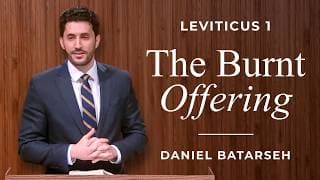
But that's only the beginning. Leviticus 1 is also one of the most vivid portraits of Jesus Christ in the entire Old Testament — his substitutionary death, his total holiness, and even the righteousness he clothes us with. Pastor Daniel Batarseh walked his congregation through these verses on a Lord's Supper Sunday, and what emerged was a sermon that made an ancient sacrificial manual feel like a love letter.
God Didn't Wait for Us to Figure It Out
The burnt offering begins with two verses that are easy to rush past: "The Lord called Moses and spoke to him from the tent of meeting, saying, 'Speak to the people of Israel and say to them, when any of you brings an offering to the Lord, you shall bring your offering of livestock from the herd or from the flock'" (Leviticus 1:1–2).
Notice who initiates. It wasn't Moses climbing the mountain with a proposal. It wasn't the elders of Israel convening a committee to brainstorm how to solve their sin problem. God spoke first. God designed the system. God made the way.
This is the heartbeat of the entire Bible, and it shows up on page one of Leviticus. As sinful people, we were not running toward God — we were gaining ground in the opposite direction, "seeking to be our own gods." And what do you find? The Lord pursuing us. That pursuit runs through the tabernacle, through the sacrificial system, through the prophets, and it culminates in the incarnation. John 1 says Christ "dwelt" among us — and that word is tabernacled. When the tent system failed, when the people could not keep up with these ordinances, God did not abandon the project. He took on flesh. He walked with actual human feet into leper camps and tax collectors' booths and the homes of the sick (watch at 52:37).
So right here, in the first two verses of Leviticus, you see the love of God. You see a relational God. You see a God who does not wait for the diseased patient to diagnose himself and write his own prescription. He comes to us.
Your Sin Put Him There — and That's the Point
The procedure for the burnt offering is startling when you slow down and read it. The worshiper brings a male animal without blemish. He lays his hand on the animal's head. And then — and this is the part that should stop you — he kills it. Not the priest. The worshiper.
Why would God require the person seeking forgiveness to personally slaughter the substitute? Because God wanted the weight of it to land. By placing his hand on the animal's head, the worshiper was confessing: This creature is dying in my place. I deserve this death. My sin is causing this. There was identification, confession, and substitution all in a single gesture.
As Pastor Daniel Batarseh put it: "I want you to recognize that you are contributing to the death of this innocent thing. I want you to feel the weight of it. I want you to understand that it's your sin that's causing this death" (watch at 58:30).
And then he pressed the application where it hurts: "Many people struggle trying to rest in the love of Jesus Christ primarily because they have never or they can't seem to make it personal." We can affirm that God so loved the world. We can celebrate that Christ died for the church. But have you stood at the foot of the cross and said, My sin did this? Paul did. In Galatians 2:20, he doesn't say Christ loved the world and gave himself for the world. He says, "who loved me and gave himself for me." He made it personal.
Here's the tension: making it personal cuts both ways. Yes, your sin — your specific, named, ugly sin — put Christ on the cross. But his death paid for your specific, named, ugly sin. Every last thing. "That's how potent his blood is. That's how rich it is" (hear this moment). So don't generalize the cross. Stand there. Feel the weight. And then feel the relief.
Clean from the Inside Out — and Then Clothed
One of the most striking details in Leviticus 1 is the instruction to cut the animal into pieces and wash specific parts before placing them on the altar. If the entire animal is going to be consumed by fire anyway, why bother with the inspection? Why wash anything?
Because God wanted the priest to verify that the sacrifice was perfect — not just externally, but internally. Verse 9 specifies two things that must be washed: the entrails (the internal organs) and the legs. Inside and outside. This is a portrait of Christ. His holiness was not a performance. He didn't simply say the right things and avoid the wrong actions while harboring impure thoughts. "He never sinned in his imagination. He never broke God's law with his feelings or his ambitions or his passions. Everything about Christ from the inside out was holy" (watch at 1:08:28).
But there's a detail that only emerges when you keep reading. In Leviticus 7:8, you discover that while the entire burnt offering was consumed on the altar, there was one exception: the skin. The priest who helped offer the sacrifice kept the animal's hide. What was it used for? Scripture doesn't say explicitly. But there's a thread running through the Bible that's hard to ignore. In Genesis 3:21, after Adam and Eve sinned, God made garments of animal skins and clothed them. Covering.
The connection is stunning. The sacrifice that is declared a pleasing aroma — perfect inside and out — produces a covering that the priest wears. And when you believe on the sacrifice of Jesus Christ, his righteousness becomes your covering. God looks at you and sees his Son's perfection. This is not metaphor. This is the ground of your confidence in prayer, in eternity, in the face of every accusation Satan throws at you. You might be tempted to agree with the accuser if the verdict depended on your performance. But you are clothed in Christ's.
If You Can't Bring a Bull, Bring a Bird
Here is where the sermon turned from exposition to something deeply personal — and where the room got quiet.
Leviticus 1 prescribes three levels of burnt offering. A bull from the herd (v. 3). A sheep or goat from the flock (v. 10). Or, if you couldn't afford either, a turtledove or pigeon (v. 14). Each animal was dramatically different in size and cost. But look at how God describes each one after the instructions are given. After the goat: "a pleasing aroma to the Lord" (v. 13). After the bird: "a pleasing aroma to the Lord" (v. 17). Identical language. The poor man's pigeon pleased God exactly as much as the rich man's bull.
Pastor Batarseh then told the story of his own conversion in college — the wide-open days when he had two classes in the morning and the rest of the day to read Scripture by the lake, headphones in, praise music blasting, sitting on rocks at a secret spot nobody else knew about. Everything was a bull-sized offering. Hours in prayer. Long stretches in the Word.
Then came the internship. The 6 AM alarm. The bus to the train to the streetcar to downtown Toronto. Home by 6 PM with dinner to cook, errands to run, and a decision about whether the gym was worth the time it stole from devotions. The bull was gone. And the guilt crept in.
Until God opened his eyes to Leviticus 1. "If you can't give a bull, give a goat. If you can't give a goat, give a bird. And if you're doing it from a place of sincerity and honesty, God sees it all as a pleasing aroma to him" (watch at 1:23:54).
What did that look like practically? Two fifteen-minute breaks and a lunch hour at work. Finding a quiet corner in a grand office building and communing with God. "Here's my bird, Lord. I worship you. I come to you now in your word. I seek you. Oh, I wish I could stay here longer, but I have to work. Bible says if you don't work, you don't eat. So I'm gonna honor you in my work. Receive this, Lord."
Do you sense the freedom in that? This is grace in the book of Leviticus. And to drive the point home, consider Luke 2:22–24: when Mary and Joseph brought the infant Jesus to the temple for the purification ritual, they didn't bring a lamb. They brought two turtledoves. The guardians of the Son of God could not afford a lamb. Was God any less pleased with them? The question answers itself.
So to the mother nursing an infant who hasn't had an uninterrupted quiet time in months — give your bird. To the father working two jobs whose soul aches for the unhurried mornings he once had with God — give your bird. It is a pleasing aroma to him.
Close to the Kingdom Is Not Inside It
The sermon ended with a warning drawn from Mark 12:32–34. A scribe asked Jesus about the greatest commandment. Jesus answered. The scribe agreed beautifully — total love for God is "much more than all whole burnt offerings and sacrifices." Jesus looked at him and said, "You are not far from the kingdom of God."
Not far. Not in. The man answered every theological question correctly. He understood the heart behind the sacrificial system. And Jesus told him he was still on the outside.
Knowledge of the things of God does not determine your salvation. It's what you do with that knowledge. You can know Leviticus inside and out. You can explain substitutionary atonement with precision. You can nod along to every point in this article. But can you say — not as a theological proposition, but as a lived reality — that your life is on the altar, totally and completely? That you belong to him?
The burnt offering demanded everything. The whole animal consumed. Nothing held back. And that offering ultimately pointed to a life completely given over to God. Not just the public parts. Cut it in pieces. Inspect each one. Is this part really his? Is that part really his? Or are you reserving something from the altar while calling yourself a worshiper?
What to Remember
- God initiated every means of reconciliation — from the burnt offering to the cross. Your salvation began with his pursuit, not your repentance.
- The worshiper killed the animal himself because God wanted the cost of sin to be felt personally. Don't generalize the cross — your sin put Christ there, and his death paid for your sin specifically.
- Christ's holiness was total: inside and out, entrails and legs, thoughts and actions. No other sacrifice in history has ever matched it, which is why he died once and never again.
- If your season of life only allows a "bird-sized" offering of devotion, give it sincerely — God calls it a pleasing aroma with the same language he uses for the bull.
- Correct theology without personal surrender leaves you near the kingdom but not inside it. Knowing the right answers is not the same as belonging to Christ.
Questions to Sit With
- When is the last time you made the cross personal — not "Christ died for the world" but "my specific sin required his death"?
- Are you punishing yourself with guilt over a "bird-sized" devotional life when God is saying he receives it as a pleasing aroma?
- If your life were cut into pieces and inspected like the burnt offering, which piece would you be most reluctant to place on the altar?
- Do you relate to the scribe in Mark 12 — theologically precise but still standing outside the door of the kingdom?
- What would change in your prayer life if you truly believed you were clothed in Christ's righteousness rather than presenting your own?
Scripture Referenced
- Leviticus 1:1–17 (primary text)
- Leviticus 7:8
- Leviticus 12
- John 8:12–29
- Ephesians 5:1–2
- Galatians 2:20
- Mark 12:32–34
- Luke 2:22–24
- Genesis 3:21
- 1 Samuel 4:3
- 1 Corinthians 10:16–17
- 1 Corinthians 11:24–25
This summary was generated by AI from the sermon "The Burnt Offering | Leviticus 1 | Pastor Daniel Batarseh (8/2/26)" preached by Pastor Daniel Batarseh at Maranatha Bible Church Chicago. Watch the full sermon →
Preached by
Pastor Daniel BatarsehSenior Pastor
This summary was generated by AI from the sermon transcript.
Based on the sermon