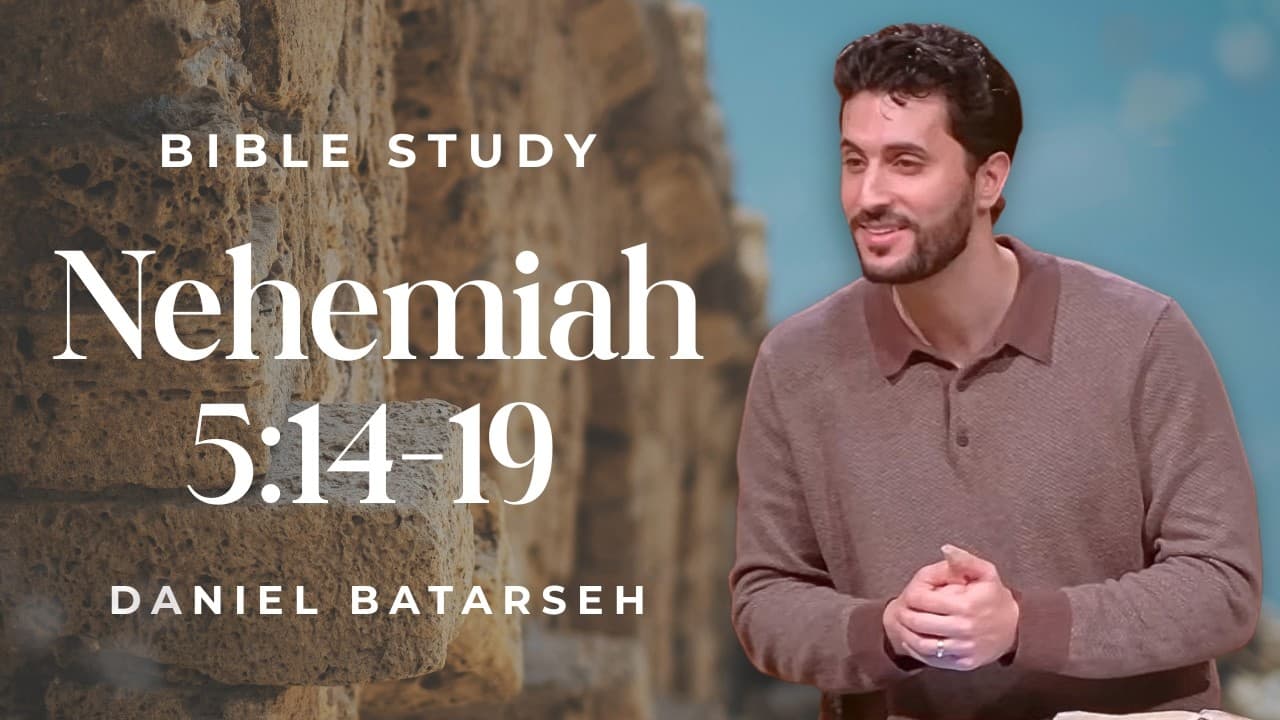
The fear of God isn't just a restraint from evil — it's a stimulus for radical good. Nehemiah 5:14-19 reveals four rewards that only come to those who stand in awe of God.
Most people think the fear of God is a leash. A divine restraint that keeps you from doing terrible things. And while that's partly true, it's tragically incomplete. In Nehemiah 5:14–19, we find a man who feared God for twelve years as governor of Judah — and the result wasn't just the absence of corruption. It was breathtaking generosity, immovable faithfulness, and a kind of leadership that makes you wonder why it's so rare.
The question this passage forces us to answer is uncomfortable: Why do some leaders in God's kingdom finish well while others destroy their testimony? Nehemiah's answer is four words long — because of the fear of God. And as Pastor Daniel Batarseh walked through this text on a Friday night at Maranatha Bible Church, those four words became a searchlight that exposed how shallow most of our decision-making really is.
The Question That Exposes Spiritual Immaturity
Here's the setup. Nehemiah was the governor of Judah, appointed by King Artaxerxes of Persia. With that title came a legitimate perk: a daily food allowance, fully funded. He didn't have to spend a penny on breakfast, lunch, dinner, or anything in between. It was legal. It was expected. Every governor before him had taken it.
But Nehemiah discovered something that changed everything. That food allowance was funded through taxes levied on the very people who could barely afford grain for their own families. The same people who were mortgaging their fields and selling their children into servitude just to survive. And the moment Nehemiah learned that, he refused to eat a single bite of it.
Now here's where this gets convicting. Would it have been sin for Nehemiah to use the food allowance? No. It was his right. It was perfectly legal. And most of us, if we're honest, limit our moral decision-making to exactly that question: Is it sin or isn't it? Is it permissible or not? (watch at 37:12)
As Pastor Daniel Batarseh put it: "I dare to even say that it is spiritually immature to simply ask the question, is this sin or not? Nehemiah shows us another way. Is this the most God-honoring course of action to take?" (watch at 37:51)
A person who fears God asks different questions. Not just can I do this? but should I do this? Not just is this my right? but is there something more right than my right? That distinction separates mature believers from those who spend their entire Christian life tiptoeing along the edge of what's permissible, never once asking whether there's a higher path.
The Apostle Paul operated on the same frequency. In 1 Corinthians 9:12, he told the Corinthian church that he had every right to receive financial support from them — and then refused to claim it. Why? Because false teachers were already whispering doubts about his motives. Instead of fighting for his rights, Paul surrendered them. "We endure anything," he wrote, "rather than put an obstacle in the way of the gospel of Christ." (watch at 40:12)
Everyone wants their rights respected. Even godless people demand that. But the person who fears God holds their rights with open hands, ready to release them the moment they threaten a greater cause. That's not weakness. That's a kind of strength most people never develop because they never get past the question, But isn't this mine?
Why Nehemiah Didn't Follow the Playbook
There's a second layer to Nehemiah's integrity that's easy to miss. Look at verse 15: "The former governors who were before me laid heavy burdens on the people and took from them for their daily ration forty shekels of silver. Even their servants lorded it over the people. But I did not do so, because of the fear of God."
Nehemiah isn't just telling us what he did. He's telling us what he didn't do — and why the temptation was real. The governors before him had all taken the food allowance. They'd all taxed the people. Their servants had all leveraged their bosses' authority to lord it over the population. There was a long, established pattern. A playbook. A way things had always been done.
And Nehemiah looked at that playbook and closed it.
This is where the fear of God becomes a shield. It is human nature to look around at what others in similar positions are doing and conclude, Well, this must be acceptable. Especially when it seems to be working for them. Especially when nobody's pushing back. The inner voice whispers: This is just how governors operate. This is how pastors lead. This is how businesses run. This is how marriages work in our culture.
But when the soul is genuinely captivated by the majesty of God and the weight of His judgment, it doesn't make decisions based on what's customary. It asks what God demands. Nehemiah was swimming against two currents at once — the Persian culture he'd grown up in and the Jewish tradition that preceded him. Neither one mattered more than what God required.
Consider what this looks like practically. What would it mean for a church planter to stop copying whatever model seems most successful and instead ask, "What does God want this church to be?" What would it mean for a parent to stop scrolling through social media comparisons and ask, "What has God actually said about raising children?" What would it mean for a CEO, a teacher, an employee to stop benchmarking against peers and start benchmarking against Scripture?
That's not to say we can't learn from others. That would be foolish. But the fear of God adds a critical filter: What is causing them to do it that way? What's moving them to adopt that philosophy? If the answer is anything other than the fear of God, proceed with extreme caution.
Joshua understood this. When he stood before an entire nation and declared, "As for me and my house, we will serve the Lord" (Joshua 24:15), he was prepared to be the only household in Israel that stayed faithful. But notice what comes immediately before that famous declaration — verse 14: "Now therefore, fear the Lord and serve him in sincerity and in faithfulness." (watch at 51:00) The courage to stand alone didn't come from personality. It came from a trembling before God that made trembling before nations seem absurd.
Prosperity Is More Dangerous Than Persecution
Verse 16 reveals something about Nehemiah that's easy to gloss over: "I also persevered in the work on this wall, and we acquired no land, and all my servants were gathered there for the work."
Why does he mention acquiring no land? Because in the middle of a financial crisis where desperate people were selling their property just to survive, a man with Nehemiah's wealth and authority could have quietly built an empire. The nobles and officials were doing exactly that — snatching up land from people who had no other option. Nehemiah says he didn't take a blade of grass.
Here's what makes this remarkable. We've already watched Nehemiah withstand external threats — Sanballat's mockery, Tobiah's threats, rumors of military attack. He didn't flinch. But chapter five introduces a different kind of danger: the temptation to profit from a position of power during a crisis. And honestly? This one is harder to resist.
Persecution clarifies your loyalties. Prosperity blurs them. When enemies are at the gate, you know exactly where you stand. But when money is flowing and opportunities are multiplying and nobody would even notice if you skimmed a little off the top — that's where character is truly tested.
Nehemiah stayed focused on one thing: the wall. He came to rebuild it, and he refused to let anything — not threats, not wealth, not opportunity — pull him off that assignment. The fear of God kept him faithful to his calling when a dozen legitimate excuses could have justified a detour.
What frustrations are powerful enough to convince you to abandon your marriage? The fear of God won't let you walk away so easily. What disappointments in ministry would make you turn your back on your vow to serve God? A reverential awe of God will make it far more difficult to quit. What excuses could justify lukewarmness? The fear of God will keep you fervent.
The Reward That Changes Everything
Verses 17–19 add a final, staggering detail. Nehemiah wasn't just forgoing his personal food allowance. As governor, he had diplomatic responsibilities — hosting officials, dignitaries, and representatives from surrounding nations. These meetings happened over meals, as they do in every culture. And the regular menu was extravagant: one ox, six choice sheep, birds, and every ten days, wine in abundance.
All of it came out of his own pocket.
Think about what the nobles were asking themselves when they looked at the struggling people of Judah: How can we profit from their suffering? Nehemiah asked the opposite question: How can I alleviate their suffering? That's the difference the fear of God makes. It doesn't just restrain greed — it fuels generosity.
And then comes verse 19, the prayer that reveals what was really driving this man: "Remember for my good, O my God, all that I have done for this people."
Nehemiah wasn't looking for a memorial. He wasn't expecting repayment from the people he served. He was living for an audience of One. As Batarseh explained: "The fear of God is so profound that it is a stimulus. It is a motivator to do great good because it understands God doesn't just see the bad that I might be doing. God sees all the good that I am doing" (watch at 1:07:24).
This is the connection that ties everything together. Turn to John 13:3–5. Before Jesus knelt to wash His disciples' feet — the most menial, humiliating act of service imaginable — John tells us what was in His mind: "Jesus, knowing that the Father had given all things into his hands, and that he had come from God and was going back to God, rose from supper." He knew His identity in God. He knew His destiny with God. And that knowledge freed Him to serve without needing anything in return. (watch at 1:08:59)
And lest anyone think the fear of God is beneath Christ, Isaiah 11:1–3 says the Spirit that rested on the Messiah included "the Spirit of knowledge and the fear of the Lord. And his delight shall be in the fear of the Lord." Every miracle, every teaching, every act of mercy in the Gospels flowed from a Man who delighted in fearing God. If Christ delighted in it, how could we despise it?
What to Remember
- The fear of God doesn't just ask "Is this sin?" — it asks "Is this the most God-honoring thing I can do?" That single shift in questioning separates mature faith from moral minimalism.
- When everyone around you operates by a certain playbook, the fear of God gives you the spine to close it and ask what God actually requires — even if you stand alone.
- Prosperity tests character more ruthlessly than persecution. Threats clarify your loyalties; money and opportunity blur them. Only the fear of God keeps you anchored when no one is watching.
- Nehemiah's prayer — "Remember me, O my God" — reveals the ultimate motivation: living for God's reward rather than human recognition. That's not selfishness; it's the deepest kind of trust.
- The fear of God is not cowering dread. Jesus Christ Himself delighted in it (Isaiah 11:3). If it was good enough for the Son of God, it is good enough — and necessary — for you.
Questions to Sit With
- In what area of your life are you currently making decisions based solely on "Is this permissible?" rather than "Is this the most honoring to God?"
- Where have you adopted a practice, attitude, or standard simply because everyone else in your position does it that way — without ever asking whether God requires something different?
- Nehemiah had wealth and power and used neither to enrich himself. If someone audited your use of whatever influence God has given you, what would they find?
- When you serve sacrificially and no one notices, does it crush you — or can you honestly pray, "Remember me, O my God"? What does your answer reveal about whose approval you're actually living for?
- Proverbs 2:1–5 says the fear of the Lord must be searched for like hidden treasure. What would it look like to actually pursue it with that kind of urgency this week?
Scripture Referenced
- Nehemiah 5:14–19 (primary text)
- Psalm 19:7–11
- Psalm 16:3
- 1 Corinthians 9:12
- Joshua 24:14–15
- Nehemiah 4:14
- John 13:3–5
- Isaiah 11:1–3
- Proverbs 2:1–5
This summary was generated by AI from the sermon "Nehemiah 5 (Part 3) Bible Study (Nehemiah's Generosity) | Pastor Daniel Batarseh (8/14/26)" preached by Pastor Daniel Batarseh at Maranatha Bible Church Chicago. Watch the full sermon →
Preached by
Pastor Daniel BatarsehSenior Pastor
This summary was generated by AI from the sermon transcript.
Based on the sermon