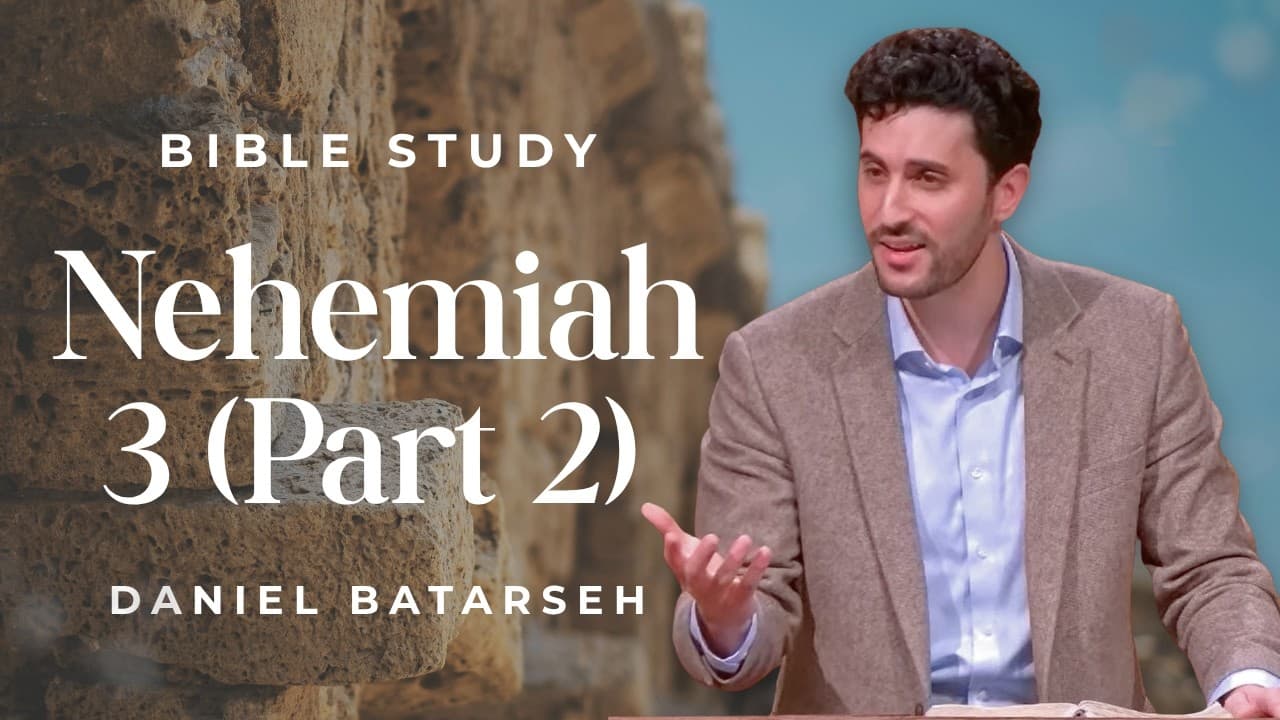
Nehemiah 3 isn't just an ancient blueprint — each gate on Jerusalem's wall exposes something about worship, money, holiness, and the indestructible Word of God.
Most people skip Nehemiah 3. It reads like a construction manifest — names you can't pronounce, walls you can't visualize, gates you've never heard of. But buried in this ancient blueprint of Jerusalem is a map of the human heart. Each gate served a specific function in the life of the city, and each one exposes a specific condition in our spiritual lives: where worship ranks on our priority list, whether money has become our master, how seriously we pursue holiness, and whether the Word of God is actually washing us or just sitting on a shelf gathering dust.
Nehemiah doesn't list these gates randomly. He begins at the Sheep Gate on the northern tip of Jerusalem and traces the entire wall counterclockwise — west, south, east — until he arrives back at the Sheep Gate. Full circle. Start to finish. And what that circular journey reveals, when you slow down long enough to see it, is nothing less than the story of the gospel itself.
Before Anything Else, Secure the Way to God
The first gate Nehemiah mentions is the Sheep Gate (Nehemiah 3:1-2). The high priest Eliashib and his fellow priests built it, and twice in a single verse we're told they consecrated it. That double consecration doesn't appear with any other gate. This wasn't just construction — it was worship.
Why the Sheep Gate first? Because this was almost certainly the gate through which sacrificial animals entered the city on their way to the temple. Every lamb that would be slain on the altar passed through this access point. Nehemiah, with a thousand things demanding his attention — rubble to clear, enemies to watch, workers to organize — makes this his first priority. Before the Fish Gate, before the Valley Gate, before anything else, he ensures that the pathway to fellowship with God is intact.
As Pastor Daniel Batarseh put it: "Before we do anything else, we must be careful and we must invest into the route that would be able to provide for us the means by which we commune with our God" (watch at 13:55).
That's a question worth sitting with. You're building things right now — a career, a family, a ministry, a reputation. Is any of it founded on a living relationship with God, or have you built everything else while the sheep gate in your own life sits in ruins? Nehemiah understood something that most of us learn too late: if every other gate is fortified but this one is neglected, you've missed the entire point.
And here's the connection that stopped me cold. The Sheep Gate appears only once in the entire New Testament — in John 5:1-2, where Jesus arrives at the pool of Bethesda near the Sheep Gate and heals a man paralyzed for thirty-eight years. Think about that. For centuries, innocent lambs passed through that gate on their way to the altar. And then one day, the Lamb of God himself walked through it — the one every other lamb had been pointing to — and demonstrated a mercy that towers over every sacrifice ever made. Every lamb from Solomon's day through Nehemiah's time piled on that altar cannot compare to what Christ accomplished with his blood (hear this moment).
The Fish Gate and the Quiet Mastery of Money
The Fish Gate appears in verse 3, and something immediately distinguishes it from the Sheep Gate. The builders didn't just set its doors — they added bolts and bars. Extra security. The Sheep Gate has no such detail. Why would the Fish Gate need heavier locks?
The answer surfaces ten chapters later. In Nehemiah 13:15-16, Nehemiah returns to Jerusalem after a period of absence and finds the people violating the Sabbath wholesale. Tyrian merchants — Phoenician Gentiles from modern-day Lebanon — are hauling fish and goods into the city and selling them on the day God commanded rest. The gates are wide open. Business as usual. The very commands that led Israel into exile are being trampled again.
The Fish Gate, it seems, was the commercial artery. The main fish market likely stood nearby. And the builders in chapter 3 knew the temptation that would come knocking. They installed bolts and bars because they understood that someone — maybe even their own people from within — would want to swing those doors open when there was money to be made.
But here's the devastating irony: they fortified the physical gate and left their hearts unguarded. "Put the bolts, put the locks, do all you want with the physical doors — as long as you don't guard your heart, it avails to nothing" (watch at 25:24).
This is not an ancient problem. The prophet Amos captured the same attitude centuries earlier when God exposed the hearts of the Israelites in Amos 8:5: they were sitting through the feasts and observing the Sabbath externally, but internally they were calculating — When will the new moon be over so we can sell grain? When will the Sabbath end so we can get back to business? They were physically present and spiritually absent. The service was a nuisance. The worship was an obstacle to the real priority: profit.
Jesus himself identified money as the singular rival to his lordship. Not pleasure, not power — money. "You cannot serve God and money." There are many sins Christ warns about, but when he names a competitor to his throne, he names your wallet. Money doesn't announce its takeover. It doesn't send a memo. It gains mastery quietly, incrementally, until the day you realize that your schedule, your decisions, your anxieties, and your ambitions all orbit around the same thing — and it isn't God.
The Dung Gate and the Holiness No One Wants to Talk About
Of all the gates in Nehemiah 3, the Dung Gate has the least glamorous name and perhaps the most important lesson. Located at the southernmost tip of Jerusalem, it served as the main exit to the Valley of Hinnom — the city dump. Every piece of garbage, every bit of refuse, every foul and rotting thing passed through this gate on its way out.
Not exactly the assignment people line up for. And the text seems to confirm that: only one individual is named at this work site — Malkiah, the son of Rehab, ruler of the district of Beth Hakarem. A ruler. A man of prominence and position. And he's working at the garbage gate. Humility is beautiful precisely because it is rare.
But the Dung Gate teaches more than humility. It teaches necessity. Every city needs a way to expel what is unclean. Every church needs it. Every believer needs it. A spiritual dung gate — an honest, ongoing willingness to examine your heart and remove what defiles.
This isn't brutal, neurotic introspection. It's the normal Christian life: Lord, what needs to go? What thought patterns, what habits, what secret indulgences am I harboring that compromise my purity and my witness? As long as you're in this body on this planet, you have to deal with some dung. The question is whether you have an exit point for it.
The connection to Revelation 21 makes this even more striking. John describes the New Jerusalem — twelve gates, angels at each one, the names of the twelve tribes inscribed. But one thing is conspicuously absent: a dung gate. Why? Because "nothing unclean will ever enter it" (Revelation 21:27). The New Jerusalem is perpetually, eternally holy. No infection. No spiritual disease. No itch toward sin. No compulsion. No wooing.
That's our future. But it's not our present. Right now, the dung gate is essential. And one of the most neglected expressions of it in the modern church is discipline. Jesus mentions the church exactly twice in the Gospels of Matthew, and the only practice he describes is accountability — confronting sin, pursuing restoration, maintaining purity. It's virtually nonexistent in American churches today. No wonder so many congregations smell like something is rotting from the inside.
The Water Gate That Never Needed Repair
If you read Nehemiah 3:26 carefully, you'll notice something strange. The temple servants repaired the walls opposite the Water Gate — around it, connected to it — but the Water Gate itself isn't listed as needing repair. Every other gate was damaged by the Babylonian siege. The Water Gate, somehow, remained intact.
That detail becomes electrifying when you see what happens at the Water Gate in Nehemiah 8:1-3. When the people gather to hear the Word of God read aloud, where do they assemble? Before the Water Gate. Ezra opens the law of Moses, and he reads from early morning until midday, and "the ears of all the people were attentive to the book of the law." Of all the gates they could have chosen, they read Scripture at the Water Gate.
Water, throughout the Bible, is a picture of God's Word — cleansing, washing, renewing. Paul tells husbands in Ephesians 5:26 to love their wives "by the washing of water with the word." When you sit under Scripture being read and proclaimed and explained, it washes you. You've felt it — that sense of being cleaner after time in the Word, like spiritual grime has been rinsed away (watch at 52:13).
But the warning cuts just as deep. If the Word washes, what happens when you stop bathing in it? "Can I tell you why some people are spiritually sick? That they have an unfortunate scent to their spirituality? One reason is they don't wash themselves in the word. Oh, they may dip their toe in once in a while — the verse of the day here, the verse of the day there. That's not washing... Swim in the Bible. Let the word of God bathe you. Immerse yourself in it" (hear this moment).
And the fact that the Water Gate never needed rebuilding? No regime, no philosophy, no army has ever destroyed the Word of God. They've burned it, banned it, mocked it, buried it. It's still here. Still number one. Still undefeated.
Christ at the Start, Christ at the End
Nehemiah begins his tour at the Sheep Gate and ends at the Sheep Gate. Full circle. And unlike the other gates — which are fitted with beams and bolts and bars, designed to be shut at certain times — the Sheep Gate has none of these. No locks. No closing mechanism mentioned.
If the Sheep Gate points to the Lamb of God, and every lamb that passed through it pointed forward to Christ's sacrifice, then the absence of locks carries a staggering implication: the door of salvation remains open. It is not barred. It is not bolted. It does not close for the night.
Pastor Daniel Batarseh closed with a raw confession that landed like a thunderclap in the room. He described his own years of spiritual deadness — sitting in church, enduring services, responding to altar call after altar call, maybe eighteen in total, and walking away unchanged every time. "And it dawned on me — because every single time, down deep inside, I really wanted the world. So when the Lord looked at the heart of that teenage boy, of that athlete, of that very motivated young man who thought that he was gonna live forever, he saw a heart that still wanted sin and not Christ and Christ alone" (watch at 1:01:25).
The gate is open. It has always been open. The question is not whether you can walk through it. The question is whether you want to badly enough to let go of what you're carrying.
What to Remember
- Nehemiah's first priority was the Sheep Gate — the pathway to worship and fellowship with God — because everything else he built depended on that foundation being secure.
- The Fish Gate's extra bolts and bars reveal that the builders knew money's temptation was coming, but physical security means nothing when hearts are left unguarded.
- Every believer and every church needs a spiritual dung gate — an honest, ongoing practice of identifying and removing what is impure before it infects everything else.
- The Water Gate never needed repair, and neither does the Word of God — it has survived every attempt to destroy it and remains the primary agent of spiritual cleansing.
- God notices every detail of your service — every bolt, every beam, every glass of water — and will reward what others overlook.
- The Sheep Gate has no locks, no bars, no closing mechanism. The door of salvation has never been shut.
Questions to Sit With
- If Nehemiah were to audit the "gates" of your life right now, which one would he find in ruins — the one that leads to worship, the one that guards against greed, or the one that expels what's unclean?
- Have you ever sat through a worship service with the attitude of Amos 8:5 — physically present but mentally calculating when it would be over so you could get back to what really matters to you?
- What would change in your marriage, your friendships, or your household if you took Ephesians 5:26 seriously and began actively washing the people closest to you with the Word?
- Is there something in your life right now that needs to go through the dung gate — a habit, a relationship, a pattern of thought — that you've been tolerating instead of expelling?
- If the gate of salvation is truly open and unlocked, what are you still holding onto that keeps you standing outside it?
Scripture Referenced
- Nehemiah 3:1-32 — The rebuilding of Jerusalem's gates and walls
- John 5:1-2 — Jesus at the Sheep Gate, healing the paralyzed man
- Nehemiah 13:15-16 — Sabbath violations and the fish trade
- Amos 8:5 — Israel's impatience with worship
- Nehemiah 8:1-3 — Ezra reading the law at the Water Gate
- Revelation 21:12-14, 27 — The New Jerusalem and its gates
- Ephesians 5:26 — Washing with water through the Word
- 1 Corinthians 3:10 — Building on the foundation with care
This summary was generated by AI from the sermon "Nehemiah 3 (Part 2) Bible Study (Rebuilding the Wall) | Pastor Daniel Batarseh (6/12/26)" preached by Pastor Daniel Batarseh at Maranatha Bible Church Chicago. Watch the full sermon →
Preached by
Pastor Daniel BatarsehSenior Pastor
This summary was generated by AI from the sermon transcript.
Based on the sermon