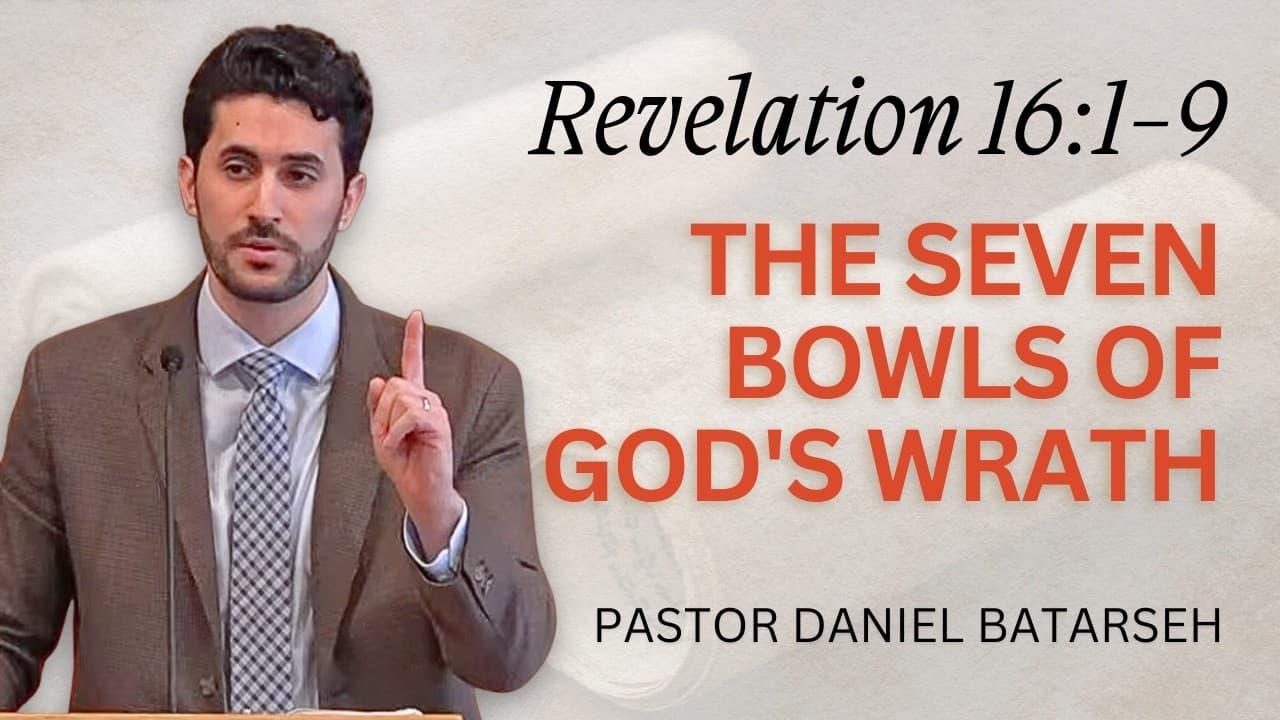
The seven bowls of Revelation 16 aren't arbitrary destruction. They reveal a God whose patience has run out — and whose justice mirrors patterns stretching back to Exodus.
Most people read Revelation 16 and see only catastrophe — plagues, scorching heat, oceans turned to blood. It reads like the end of the world because it is. But buried inside these seven bowls of God's wrath is something far more unsettling than the judgments themselves: the response of the people receiving them. They don't repent. They don't plead. They curse God to his face. And that reaction — not the plagues — is the real revelation of this chapter.
Revelation 16:1–9 records the first four of seven final bowl judgments poured out on the earth during the tribulation period. These aren't random acts of divine fury. They are calculated, sequential, and targeted. And when you trace their pattern back through Exodus, Isaiah, and even Christ's own words in Matthew 24, you discover a God whose justice has never wavered — and a human race whose stubbornness has never changed.
The Mark That Couldn't Protect Them
The first bowl strikes the body. An angel pours out his judgment on the earth, and harmful, painful sores break out on everyone who bears the mark of the beast and worships his image (Revelation 16:2). Not random civilians. Not collateral damage. These are people who made a calculated decision to pledge allegiance to the Antichrist in exchange for economic survival and physical safety.
And now the one they trusted to protect them can't stop their skin from splitting open.
There's a brutal irony here that's easy to miss. These people branded themselves — right hand, forehead — as a declaration of loyalty. And God's first final act of judgment targets their bodies. The very flesh they marked becomes the flesh that suffers. As Pastor Daniel Batarseh put it: "Whatever provision or promise the Antichrist makes for these people who think that this is the best choice... ultimately, he will fail to protect them and provide for them in the greatest time of need when God's wrath shows up" (watch at 47:21).
And these sores don't vanish. By the fifth bowl in verse 10, people are still gnawing their tongues in agony from them. This is lasting pain born from false worship.
Which leads to a principle that Psalms 16 lays out with devastating clarity. Verse 11 is the one everyone quotes — "In your presence there is fullness of joy; at your right hand are pleasures forevermore." Beautiful. True. But verse 4 of that same psalm says something most people never cite: "The sorrows of those who run after another god shall multiply." Not might multiply. Shall. That's the spiritual law of gravity. You worship anything above the living God — a career, a relationship, a political savior, your own autonomy — and it may deliver immediate relief. It may even feel like wholeness for a while. But sorrow is already compounding in the background. The people of Revelation 16 are simply the final, most dramatic proof of what has always been true.
Proverbs 11:4 says it plainly: "Riches do not profit in the day of wrath, but righteousness delivers from death." Most people make decisions without factoring in a final day of accountability. They plan, purchase, pursue, and invest as though this life is all there is. The mark-bearers of Revelation are just the extreme version of something millions do every day.
When God's Patience Runs Dry
The second bowl turns the sea to blood — not a third of it, as in the earlier trumpet judgments, but all of it. Every living thing in the sea dies (Revelation 16:3). The escalation is deliberate, and it tells us something critical about how to read the book of Revelation.
Back in Revelation 8:8–9, during the trumpet judgments, a third of the sea became blood, a third of sea creatures died, a third of ships were destroyed. Partial. Measured. Why? Because God was still extending mercy. He struck a third to wake them up. They didn't wake up. So now he takes it all.
"God's patience has virtually run out. Time is up. The reason why he only affected a third of the sea... in the trumpet judgments is because he still gave them a chance. He didn't completely obliterate it. He still dispensed mercy, but they keep rejecting it" (watch at 57:03).
This progression also settles a debate about how Revelation should be interpreted. Some scholars argue the seals, trumpets, and bowls all describe the same events from different angles. But the escalation from a third to everything makes that nearly impossible to sustain. The timeline is moving forward. Things are getting worse. The judgments are building toward a climax. That matters more than some might think, because how you read the structure of Revelation shapes how you understand God's entire end-times plan.
But beyond the interpretive question, the second bowl carries a practical weight that should humble anyone breathing right now. With a word, God spoke the seas into existence in Genesis. With a word, he can unmake them. "Today according to Hebrews, all of our systems are in order. We get to go fishing. We get to have food. We get to have clear skies... because God upholds it with the power of his word. And there's a time coming where with that same word he'll say, destroy it, and it will be destroyed, and nobody can stop it" (hear this moment). Your next heartbeat is borrowed. So is mine. The sun is positioned exactly where it needs to be — not because of physics alone, but because God permits it.
You Shed Blood — Here's Blood to Drink
The third bowl contaminates the rivers and springs of water, turning them to blood (Revelation 16:4). Drinking water — the most basic necessity for survival — is gone. Worldwide. No safe haven. No nation spared. And just as the reader is ready to sit in judgment on God — How could a loving God remove water from people's lips? — an angel speaks.
"Just are you, O Holy One, who is and who was, for you brought these judgments. For they have shed the blood of saints and prophets, and you have given them blood to drink. It is what they deserve" (Revelation 16:5–6).
The Holy Spirit knows how we think. He anticipates the objection and answers it before we can finish forming it. God is not being cruel. He is being just. The people enduring this judgment have orchestrated the greatest slaughter of believers in human history. They hunted down Christians. They ripped apart families. They poured out innocent blood — and now God hands them a cup of it.
This is where the Exodus connection becomes electric. In Exodus 7:20, the Nile turns to blood — the very first plague on Egypt. Why the Nile? Because earlier in Exodus, Pharaoh had decreed that every Hebrew boy born to the Israelites should be thrown into the Nile. You shed blood there? Here's blood to drink from there. Same God. Same justice. Thousands of years apart, and his righteousness hasn't shifted an inch.
But here's what makes the Exodus parallel even richer. Look at Exodus 7:24: "And all the Egyptians dug along the Nile for water to drink, for they could not drink the water of the Nile." They didn't repent. They didn't look up. They looked down and started digging holes, trying to find their own supply. The sane response would have been surrender. Instead, they pivoted — a stubborn resilience that refused to acknowledge what God was clearly communicating.
And then you read through the rest of the Old Testament, through the New Testament, and arrive at the last book of the Bible, and the pattern is identical. Human nature has not changed. People in Revelation 16 are still digging holes instead of drinking from the fountain of life.
That image should land close to home. Maybe you're enduring something right now — consequences, emptiness, the slow erosion of a life built on your own terms — and instead of going to Christ, you're digging. Digging into new relationships, new distractions, new strategies to make life work without full surrender. It will not satisfy. It never has.
And here's what cuts deepest: the blood God offers the wicked to drink in judgment is a dark mirror of the blood Christ offers us in mercy. On the night he was betrayed, Jesus took the cup, gave thanks, and said, "Drink of it, all of you, for this is my blood of the covenant, which is poured out for many for the forgiveness of sins" (Matthew 26:27–28). One cup brings death. The other brings life. Both are poured out by the same God. The difference is whether you receive it in rebellion or in faith.
The Sun Gets Permission to Burn
The fourth bowl targets the sun. It is allowed — that word matters — to scorch people with fire (Revelation 16:8). The atmosphere becomes an oven. No water to drink. No sea to cool off in. Skin already ravaged by sores. And now the sky itself turns hostile.
Isaiah 24:6 prophesied this very thing: "Therefore a curse devours the earth, and its inhabitants suffer for their guilt; therefore the inhabitants of the earth are scorched, and few men are left." The prophets saw this coming. Christ confirmed it in Matthew 24:21–22 — if those days were not cut short, no human being would survive.
But the most staggering detail isn't the heat. It's verse 9: "They cursed the name of God who had power over these plagues. They did not repent and give him glory." They knew it was God. They acknowledged his power. And they blasphemed him anyway.
Pastor Daniel Batarseh shared a memory from his early days as a believer that puts flesh on this reality. He was watching a panel discussion between atheists and Christians and reading the comments. One commenter wrote something that took his breath away: "I would rather go to hell than be in heaven with your God." And then he said what most of us don't want to hear: "There are more people who believe that and want that than you think" (watch at 1:14:19).
Our sanitized church experience can insulate us from the depth of human depravity. But Revelation pulls back the curtain. There are people — not just in the future, but now — who are so enthralled by darkness that they would choose a brutal, torturous death over submission to a holy God. The tribulation generation isn't an anomaly. They are the final, unrestrained expression of what sin has always wanted: autonomy at any cost.
And yet — and this is the grace note hidden inside the horror — the fact that Revelation specifically mentions they "did not repent" tells us God was hoping they would. Even in the bowls. Even in the final moments. He was still looking for surrender.
What to Remember
- Every decision you make without accounting for judgment day is a decision built on sand — riches, status, and security mean nothing when God's wrath arrives.
- False worship always delivers sorrow on a delay — the pleasures come first, but Psalm 16:4 guarantees the sorrows will multiply.
- God's escalation from partial judgment (the trumpets) to total judgment (the bowls) reveals a patience that was extended and rejected, not a cruelty that was sudden and arbitrary.
- The blood of Christ's covenant and the blood of God's wrath are offered by the same hand — the difference is whether you receive it in faith or face it in rebellion.
- The Exodus pattern repeats in Revelation because human nature hasn't changed — we still dig holes along the riverbank rather than look up and repent.
- That God notes their failure to repent means he desired it — even in his fiercest judgment, he is still a God who longs for sinners to turn.
Questions to Sit With
- What "mark" have you accepted — what allegiance, identity, or security system — that you're quietly trusting more than Christ to protect you?
- Are you currently "digging along the Nile" — working harder to make life function on your own terms rather than surrendering to what God is clearly saying?
- If the people in Revelation 16 could acknowledge God's power and still refuse to repent, what makes you confident that intellectual belief alone is enough?
- When was the last time you looked at the ordinary — the sun, clean water, your next breath — and recognized it as active mercy from a God who could withdraw it at any moment?
- Is there a sorrow multiplying in your life right now that traces back to something you've been worshiping above God?
Scripture Referenced
- Revelation 16:1–9 — The first four bowl judgments
- Matthew 24:21–22 — Christ's warning about the tribulation
- Philippians 2:1–11 — The Christ hymn
- Proverbs 11:4 — Riches in the day of wrath
- Psalm 16:4, 11 — Sorrows multiplied vs. pleasures forevermore
- Revelation 8:8–9 — The second trumpet (partial sea judgment)
- Revelation 16:10 — The fifth bowl (sores persist)
- Isaiah 24:6 — The earth scorched
- Matthew 26:27–28 — The blood of the covenant
- Exodus 7:20–24 — The first plague on Egypt
- Matthew 20:12–15 — The parable of the laborers
- Psalm 33:8–12 — Let all the earth fear the Lord
This summary was generated by AI from the sermon "The Seven Bowls of God's Wrath (Part 1) | Revelation 16:1-9 | Pastor Daniel Batarseh (4/19/26)" preached by Pastor Daniel Batarseh at Maranatha Bible Church Chicago. Watch the full sermon →
Preached by
Pastor Daniel BatarsehSenior Pastor
This summary was generated by AI from the sermon transcript.
Based on the sermon
The Seven Bowls of God's Wrath (Part 1) | Revelation 16:1-9 | Pastor Daniel Batarseh (4/19/26)
Watch Full SermonRelated Articles
What the New Jerusalem Reveals About Your Future (Rev 21)
Pastor Daniel Batarseh · October 18, 2026
What the New Jerusalem Reveals About Eternity (Rev 21:9-27)
Pastor Daniel Batarseh · October 18, 2026
What Revelation 21 Says About Heaven That You've Never Noticed
Pastor Daniel Batarseh · October 11, 2026