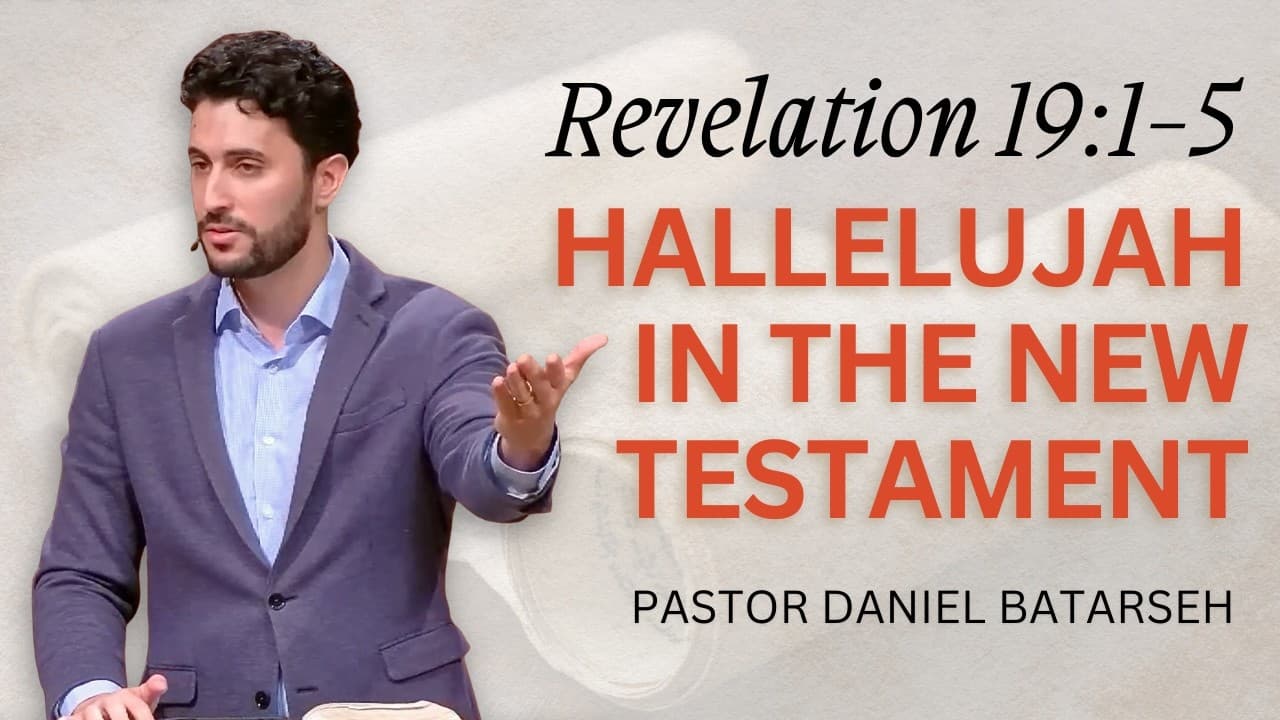
Every hallelujah in the New Testament is found in one chapter — Revelation 19. And every single one is a response to God's judgment. Here's why that should reshape how we think about worship.
Here's something you probably didn't know: the word "hallelujah" never appears in the Gospels. Not once. It's absent from every epistle Paul ever wrote, every letter Peter penned, every word of James or Jude. The entire New Testament contains exactly four occurrences of hallelujah — and all four are clustered in a single chapter: Revelation 19. And every single one of them is a response to divine judgment.
That should stop us. We treat "hallelujah" as a warm, comfortable worship word — something we sing when the music swells and the lights dim. But the Holy Spirit reserved it for something far more startling. The first hallelujah in the New Testament erupts from the lips of glorified saints as they watch the smoke of Babylon's destruction rise forever. If that unsettles you, good. It's supposed to. And what Pastor Daniel Batarseh uncovered in this passage doesn't just explain why heaven celebrates judgment — it exposes how limited our understanding of God, sin, and our own salvation really is.
A Hebrew Battle Cry in a Greek Book
The word itself is a clue. "Hallelujah" is not Greek. It's Hebrew — two words fused together: Hallel (praise) and Yah (a shortened form of Yahweh). Praise Yahweh. The apostle John, writing Revelation in Greek, could have simply translated it. He could have written the Greek equivalent of "praise the Lord" and moved on. But he didn't. He left it untranslated — transliterated instead — and that choice is deliberate (watch at 41:26).
Two reasons. First, hallelujah was already a familiar liturgical cry in the early church. Like "amen," it was something believers actually said aloud in their gatherings. John's readers would have recognized it instantly. Second — and this is where it gets rich — John is doing what he does throughout Revelation: saturating his prophecy with Old Testament language to show that what is coming does not contradict what has already been spoken. The Hebrew hallelujah in a Greek text is a thread connecting the end of the story to the beginning.
And that connection runs deeper than most of us realize. The very first time hallelujah appears anywhere in the Bible is Psalm 104:35: "Let sinners be consumed from the earth, and let the wicked be no more. Bless the Lord, O my soul. Praise the Lord." That final phrase — "Praise the Lord" — is hallelujah in Hebrew. Its context? The permanent removal of evil from the earth. Now look at the last time it appears — Revelation 19, where the saints celebrate the permanent destruction of Babylon. The first hallelujah and the last hallelujah in Scripture bookend the same reality: God bringing an everlasting end to wickedness. That's not coincidence. That's architecture.
Hallelujah for a Salvation That Isn't Finished Yet
The first reason heaven erupts is found in the very first word after the initial hallelujah in verse 1: salvation. "Hallelujah! Salvation and glory and power belong to our God." We tend to hear "salvation" and think backward — to the cross, to conversion, to the moment we believed. And that's right, as far as it goes. But it doesn't go far enough.
As Pastor Daniel Batarseh put it: "Salvation does not just promise you and I a new heart. It guarantees you a new body, a new home, a new world, and a new and everlasting kingdom that will be governed by the righteous king who saved your soul" (watch at 48:16).
This is the dimension of salvation most Christians rarely consider. Paul told the Romans that "salvation is nearer to us now than when we first believed" (Romans 13:11). How can salvation be nearer if it was already gained at conversion? Because the New Testament teaches a salvation that unfolds in stages. You were saved. You are being saved. And you will be saved — fully, finally, bodily. Peter says we are "waiting for new heavens and a new earth in which righteousness dwells" (2 Peter 3:13). Not just a regeneration of the soul, but a regeneration of the cosmos. The universe itself will be born again.
What does this have to do with judgment? Everything. In order for God's salvation to reach its completion, every rival that resists it must be removed. Babylon — that ancient spirit of false religion, idolatry, seduction, and materialism — stands in the way. Her destruction is not separate from salvation; it is the necessary precondition for salvation's final chapter. The saints in heaven understand this, and so they shout hallelujah. Not because they delight in suffering, but because they recognize that the demolition of Babylon means the arrival of everything God promised.
And consider what that arrival includes. Philippians 3:20-21 doesn't just say we'll see Jesus in His glory — it says He "will transform our lowly body to be like His glorious body." Not merely resurrected. Redesigned. Conformed to the pattern of His own risen flesh. What does His resurrection body look like? What can it do? What is it free from? We don't have the full picture. And maybe that's the point. As the sermon gently suggested, perhaps the Lord veils much of this precisely so He can surprise us — like a good father does (hear this moment).
If you need a reason to genuinely praise God, become more acquainted with the future dimensions of your redemption. Most of us are running on fumes because we only look backward at what Christ has done. Look forward at what He is about to do.
Why Glorified Saints Can Celebrate What We Struggle With
Here is where the sermon named the tension that most preachers avoid. The second hallelujah — verse 3 — is explicitly about the permanence of judgment: "The smoke from her goes up forever and ever." This is not temporary discipline. This is irreversible destruction. And the saints respond with worship.
How? How can redeemed people — people saved by grace, people who were once sinners themselves — revel in destruction? The answer lies in a single phrase from verse 1 that is easy to overlook: "a great multitude in heaven." These are not believers on earth. These are believers who dwell in the unfiltered presence of God, liberated from the corruption of sin, forever transformed.
This distinction matters enormously. When the Lord calls us home, every part of our being will be renewed — including our perspective on absolutely everything. Right now, even the most mature Christian cannot see God for who He truly is. We cannot grasp the full weight of His holiness. As the sermon pressed: "If we're honest, we treat him and we think about him as someone who's just a little bit better than us, a little bit more consistent than us. We don't really grasp how he is far above our understanding of what is righteous and what is pure" (watch at 1:03:29).
And there's a second problem compounding the first. We also don't comprehend just how sinful sin is, because we're constantly measuring ourselves against other people instead of against a holy God. And even when we try to measure up, our gauge is broken — because back to problem one, we don't know how holy He is. The prophet Isaiah spent chapters pronouncing "woe" on everyone else. But the moment he stood before God's throne, he shrieked at his own uncleanness.
Glorification will heal both deficiencies. Our minds will know a renewal so radical that we will see as God sees, feel as He feels, and rejoice in what He rejoices in. Isaiah 65:17 promises that in the new creation, "the former things shall not be remembered or come into mind." We rightly celebrate that this means no more regret, no more shame, no more trauma carried over into eternity. But the principle is broader: something will happen to our psyche — our outlook, our analysis, our subconscious — that enables us to say hallelujah at realities we currently struggle to accept.
This is not a call to be callous about judgment now. It's an acknowledgment that our current moral confusion about God's wrath is a symptom of our fallenness, not a sign of our virtue. The discomfort we feel is real, and it's honest. But it will not last. One day, in the presence of perfect holiness, we will understand — and we will worship.
The King Is Coming for His Bride
The third hallelujah comes from the twenty-four elders and the four living creatures in verse 4, and its focus shifts from what God has done to who God is. They fall down before the throne. The hallelujah here is directed at God's sovereignty — His righteous, everlasting, unfolding reign.
Verse 5 issues a command from the throne itself: "Praise our God, all you his servants, you who fear him, small and great." That phrase — "small and great" — is a leveler. Regardless of social status, spiritual maturity, or gifting, every true Christian shares this one excitement: Christ will rule and reign, not just in individual hearts, but over all creation.
But here is what elevates this from theological abstraction to something that should make your pulse quicken. In the very same passage where the saints declare "Hallelujah, for the Lord our God, the Almighty, reigns" (verse 6), the next verses describe the marriage supper of the Lamb. The sovereignty they celebrate is not cold, distant authority. It is the power of a Bridegroom coming to rescue and feast with His bride.
As Pastor Daniel Batarseh declared with visible intensity: "Nothing will stop him from bringing us to himself face to face forever. Nothing. Do you know how strong the grip is of the hand of this king? No one can pluck you out of his hand" (watch at 1:16:00). The Antichrist's entire global empire — every alliance, every weapon, every deception — will collapse at the mere breath of this returning King. Not one bullet fired. Not one missile launched. Just a word, and it's over.
And with that same omnipotent power that destroys His enemies, He draws His church to Himself. We will feast with Him. We will fellowship with Him. We will look into His eyes and know His voice and experience His touch. That is what makes heaven heaven — not the golden streets, not the absence of pain, but the unbroken, face-to-face presence of the One who loved us and gave Himself for us.
That is why they say hallelujah. And that is why we should say it now — not as a relic of religious vocabulary, but as a declaration of what we know is coming.
What to Remember
- Every hallelujah in the New Testament appears in Revelation 19, and every one celebrates God's judgment — the first and last hallelujah in the entire Bible both mark God's permanent removal of evil from the earth.
- Your salvation is not finished. Christ secured your forgiveness at the cross, but He also purchased your resurrection body, your healed mind, your new world, and your everlasting communion with Him. The best is ahead.
- The discomfort Christians feel about God's judgment is real — but it stems from our inability to fully see His holiness or our own sinfulness. Glorification will heal both, and we will worship without hesitation.
- Christ's return is not merely the subjection of nations — it is a Bridegroom coming for His bride, bringing a feast, creating an environment of eternal fellowship and joy.
- You can come to church weak, dry, and struggling. In fact, you're the perfect candidate. Acts 14:22 shows that the church exists to strengthen souls for the journey through tribulation into the kingdom.
Questions to Sit With
- If someone asked you what your salvation includes beyond forgiveness of sins, could you answer with specifics — or have you stopped thinking about it?
- Why does the idea of God permanently judging evil make you uncomfortable? Is that discomfort a sign of Christlike compassion, or could it be a sign that you don't yet see sin the way God does?
- When was the last time you said "hallelujah" and actually meant it — not as a song lyric, but as a deliberate act of praising Yahweh for something specific He has done or promised?
- If the former things truly "will not be remembered or come into mind" in the new creation (Isaiah 65:17), what does that tell you about how thoroughly God intends to heal you — not just your body, but your mind?
- What would change in your daily life if you genuinely believed that a sovereign King is coming back — not as a distant theological concept, but as the most certain event on your calendar?
Scripture Referenced
- Revelation 19:1-6
- 1 Peter 1:13-25
- Acts 14:21-22
- Romans 13:11
- 2 Peter 3:13
- Philippians 3:20-21
- Psalm 104:35
- Isaiah 65:17
This summary was generated by AI from the sermon "Hallelujah in the New Testament | Revelation 19:1-5 | Pastor Daniel Batarseh (6/29/26)" preached by Pastor Daniel Batarseh at Maranatha Bible Church Chicago. Watch the full sermon →
Preached by
Pastor Daniel BatarsehSenior Pastor
This summary was generated by AI from the sermon transcript.
Based on the sermon