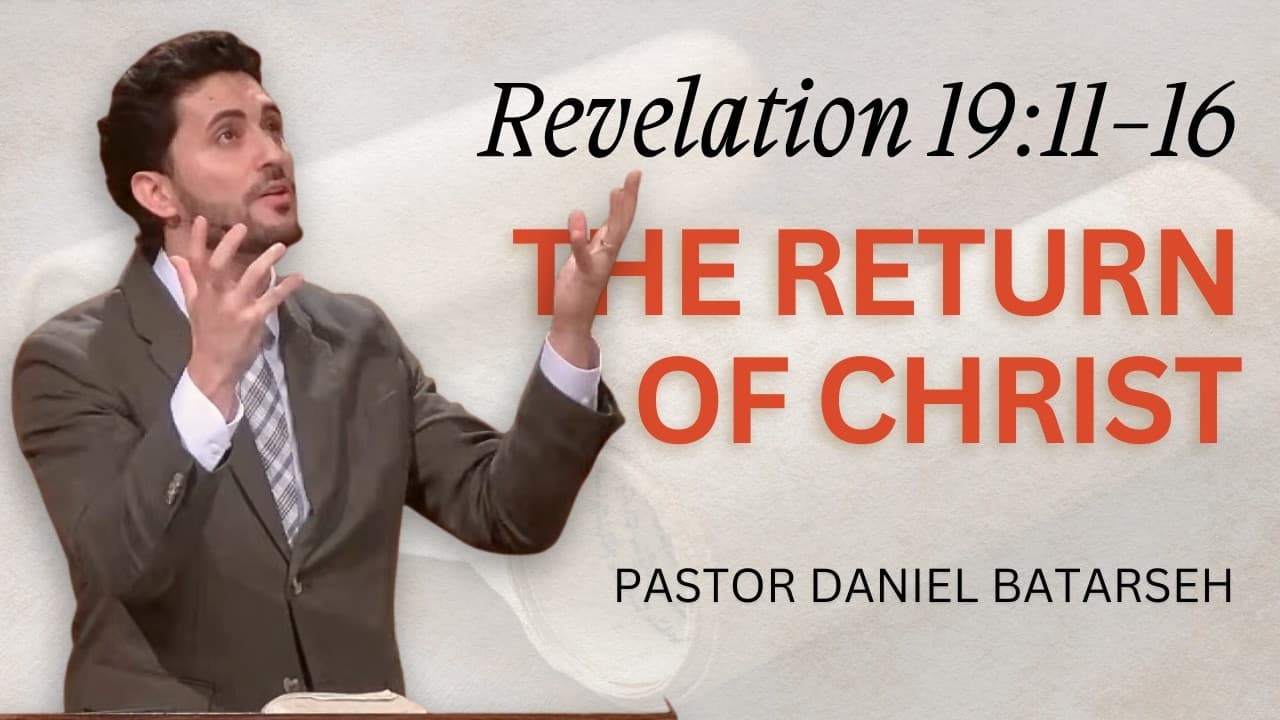
The blood on Christ's robe in Revelation 19 isn't from the cross — it's from his enemies. Five reasons the return of Christ should reshape how you live today.
Why Jesus Returns with Blood-Stained Robes (Revelation 19:11-16)
The blood on Christ's robe in Revelation 19:13 is not his own.
Read that again. Most Christians instinctively associate blood on Jesus with Calvary — with mercy, with grace, with the cross. And understandably so. But the robe dipped in blood that John sees in this vision has nothing to do with the payment Christ made for sinners. It's about a different payment entirely. One that his enemies will make. And if that sentence makes you uncomfortable, you haven't read to the end of your Bible.
This is the climax of the entire book of Revelation. Every seal cracked open, every trumpet blast, every bowl of wrath poured out — all of it has been building to this moment: heaven splits open, and a rider on a white horse descends. Not a baby in a manger. Not a teacher on a hillside. A warrior-king with eyes like fire and a robe stained with the blood of those who refused him.
Pastor Daniel Batarseh walked his congregation through Revelation 19:11–16 with the kind of urgency that made the room go quiet. What emerged were five reasons Jesus Christ is returning — and not one of them is optional for the Christian faith.
The Second Coming Is Not a Secondary Doctrine
Before even opening to Revelation, the sermon grounded itself in Hebrews 9:27–28 — a passage that ties the return of Christ directly to our salvation. "Just as it is appointed for man to die once, and after that comes judgment, so Christ, having been offered once to bear the sins of many, will appear a second time, not to deal with sin but to save those who are eagerly waiting for him" (watch at 40:47).
The logic is airtight. If there is no second coming, our redemption is incomplete. Christ started our salvation at the cross. He continues it now through his intercession in the heavenly sanctuary. But he will bring it to completion only when he returns. Strip away the second coming, and you don't just lose a doctrine — you lose the final act of the gospel itself.
What makes Hebrews 9 so brilliant is the illustration hiding beneath the surface. The author is comparing Jesus to the high priest on the Day of Atonement. Picture the scene: the entire nation of Israel gathered around the tabernacle, holding their breath as the high priest entered the Most Holy Place. One wrong move and he drops dead. The atonement fails. Can you imagine the eruption of joy when he emerged alive — the sacrifice accepted, the people spared for another year?
Now apply the logic. If Old Testament Jews eagerly watched for their high priest to come out of the earthly tabernacle, how much more should we be watching for the true High Priest to emerge from his heavenly sanctuary? As the sermon put it, to not be watching for Christ's return is as absurd as a Jew on the Day of Atonement shrugging his shoulders and walking away while the high priest was still inside (hear this moment).
And notice how the objects of Christ's salvation are described: "those who are eagerly waiting for him." Not casually. Not occasionally. Eagerly. A true follower of Jesus lives in a constant posture of readiness.
The Word "Appear" Shows Up Three Times — and That's Not an Accident
Buried in Hebrews 9:24–28 is a structural gem that most readers miss entirely. The word appear occurs three times in these verses, and each occurrence maps to a different tense of Christ's ministry.
In verse 24, Christ "appeared" in heaven itself, now standing in the presence of God on our behalf. That's his present ministry — the risen Lord interceding for his people as our great High Priest. In verse 26, he "appeared once for all at the end of the ages to put away sin by the sacrifice of himself." That's his past ministry — the cross. And in verse 28, he "will appear a second time." That's his future ministry — the crown.
Past: atoning sacrifice. Present: faithful intercessor. Future: royal king. Three appearances. One complete plan of redemption. And if you remove any one of them, the whole thing collapses.
Eyes of Fire, Countless Crowns, and a Name No One Knows
When John's vision zooms in on the rider in Revelation 19:12, three features dominate: his eyes, his head, and a mysterious name. Each one communicates a different dimension of Christ's sovereignty.
The eyes like a flame of fire are not new in Revelation. They first appear in chapter 1, where Christ stands among the seven lampstands — the churches. His burning gaze there signifies his perfect, penetrating knowledge of everything happening in his church. Nothing is hidden. No scandal, no secret sin, no backroom deal escapes those eyes (watch at 63:19). He repeats the description to the church in Thyatira in Revelation 2:18, essentially saying: Did you forget that I see everything? Let me remind you.
But here's the shift. In Revelation 19, those same eyes of fire are no longer surveying the church. They're turned toward the world. The implication is staggering: Christ's omniscient gaze is not limited to his people. Every activity, every motive, every whispered conversation in every nation, institution, business, and household — all of it is fully known. When he returns, there will be a sudden, universal awareness: He knows everything about me, and we're going to have a conversation about it.
Then there are the crowns. John says Christ wears "many diadems" — and the deliberate absence of a number is the point. Satan's crowns are numbered (seven, in Revelation 12:3). The beast's crowns are numbered (ten, in Revelation 13:1). Christ's? Uncountable. As Pastor Daniel Batarseh declared: "There will not be one hill that will not have the flag of Christ planted on it. There will not be one piece of land that will not be owned by him. There will not be one army that will be able to stand against him. He will cover this planet with his glory as the sea covers our world" (watch at 1:10:46).
And the secret name? It's not there to tease us. It's there to humble us. There are dimensions of Christ's knowledge, his wisdom, his being that remain forever beyond human access. He is the Creator. We are creatures. And that gap will never close.
The Same Word from John 1 Is the Word in Revelation 19
Here is where the sermon confronted one of the most common evasions in modern Christianity. Many people love the Jesus of John 1:1 — "In the beginning was the Word, and the Word was with God, and the Word was God." The gentle teacher. The healer. The one who wept at Lazarus's tomb. But they recoil from the Jesus of Revelation 19, the one whose robe is soaked in the blood of his enemies.
John won't let you separate them. He deliberately calls the returning warrior "the Word of God" in verse 13 — the same title from his Gospel. Same author. Same Jesus. You cannot accept one and reject the other.
This is where Isaiah 63 enters the picture, and it's a passage most Christians have never read. Isaiah sees a mighty warrior marching from Edom with crimson-stained garments and asks, "Why is your apparel red?" The answer: "I have trodden the winepress alone... their lifeblood splattered on my garments and stained all my apparel. For the day of vengeance was in my heart" (hear this moment).
Isaiah 53 describes the first coming — the suffering servant. Isaiah 63 describes the second — the conquering king. Both are the same Messiah. And John, writing Revelation centuries later, is seeing the exact same event Isaiah saw. The blood on the robe is not the blood of atonement. It's the blood of judgment. And the fact that Christ returns this way is what fulfills prophecy and proves God's word never fails.
You're in This Story — But Which Side Are You On?
The heavenly army that follows Christ in verse 14 is not composed of angels. They're wearing the same fine linen described earlier in Revelation 19 at the marriage supper of the Lamb — the bride of Christ. Revelation 17:14 confirms it beyond debate. These are redeemed believers, returning with Jesus.
But notice something critical: only one person in this army is armed. The sword comes from his mouth alone. The bride carries no weapons. Isaiah 63:3 says, "I trodden the winepress alone." The church doesn't fight in this battle. The church witnesses it. We share in his triumph from the side of victory, not judgment.
As Pastor Daniel Batarseh put it with pastoral tenderness: "Do you see your designation in the book of Revelation? Do you see where you show up in the story? We are going to share in his triumph. We are not going to face the eyes of fire. We are going to be behind him, celebrating, rejoicing, and saying our salvation has indeed come" (watch at 1:28:41).
If you're a believer, wrath is not your destiny. But if you're sitting in a church pew unsure whether you belong to Christ, the vision of Revelation 19 should terrify you — not because God is cruel, but because his patience has an expiration date.
The sermon closed with a story about George Whitefield — how a famous atheist was spotted heading to one of Whitefield's outdoor meetings. Someone asked him, "But you don't believe what he says." The atheist replied, "I know I don't believe it. But he does." There is something irresistible about genuine conviction. And if the second coming of Christ is real — if this Jesus who bled on a Roman cross will indeed split the sky on a white horse with uncountable crowns and eyes of fire — then the way we live should make that obvious to everyone watching.
The title on his thigh reads "King of Kings and Lord of Lords." First Timothy 6:14–16 calls this an "eternal dominion." Every empire before him became a castle of sand. His will never end. When he comes, the world will never go back to the way it was.
The only question is whether that reality shapes how you live today.
What to Remember
- The blood on Christ's robe in Revelation 19 is not his own — it belongs to his enemies, fulfilling Isaiah 63's vision of the conquering Messiah treading the winepress of God's wrath.
- The second coming is not a secondary doctrine — Hebrews 9:28 ties it directly to the completion of salvation itself.
- Christ's eyes of fire, which survey his church in Revelation 1, will be turned on the entire world when he returns — every secret exposed, every motive known.
- Satan's crowns are numbered. The beast's crowns are numbered. Christ's crowns are uncountable — his dominion will be total and eternal.
- The church does not fight at Christ's return — we witness his victory from behind him, clothed in purity, sharing in a triumph we did nothing to earn.
- You cannot accept the Jesus of John 1 and reject the Jesus of Revelation 19. Same Word. Same God. Same person.
Questions to Sit With
- If you truly believed Jesus could return in your lifetime, what would you stop postponing — and what would you stop caring about?
- The atheist went to hear Whitefield preach because "he believes it." Does the way you live make anyone curious about what you claim to believe?
- Are you more stirred by political headlines than by the eternal realities described in Revelation 19? What does that reveal about where your hope actually rests?
- If Christ's eyes of fire see everything in his church now, how does that change what you do when no one else is watching?
- The passage says Christ's return will "save those who are eagerly waiting for him." Are you eagerly waiting — or have you grown comfortable with the delay?
Scripture Referenced
- Revelation 19:11-16 — Primary passage: the return of Christ
- Hebrews 9:24-28 — The three appearances of Christ
- Revelation 1:7 — "Every eye will see him"
- Revelation 1:12-14 — Christ among the lampstands, eyes of fire
- Revelation 2:18 — Christ's warning to Thyatira
- Revelation 12:3 — The dragon's seven diadems
- Revelation 13:1 — The beast's ten diadems
- Revelation 14:14 — Christ on a white cloud
- Revelation 17:14 — The Lamb's army identified
- Revelation 20:11 — The great white throne
- Isaiah 63:1-4 — The warrior from Edom
- John 1:1 — "The Word was God"
- 2 Thessalonians 2:8 — Destroyed by the breath of his mouth
- 1 Timothy 6:14-16 — King of kings, eternal dominion
- Psalm 90 — Moses' prayer on the brevity of life
- Psalm 46 — God our refuge and strength
This summary was generated by AI from the sermon "The Return of Christ | Revelation 19:11-16 | Pastor Daniel Batarseh (8/9/26)" preached by Pastor Daniel Batarseh at Maranatha Bible Church Chicago. Watch the full sermon →
Preached by
Pastor Daniel BatarsehSenior Pastor
This summary was generated by AI from the sermon transcript.
Based on the sermon