In the darkest days of Israel’s history, two men served the same God in very different ways. One was a public firebrand; the other was a secret servant. Which one are you called to be?
We live in a world that often demands we keep our convictions quiet. We’re told that faith is a private matter, something to be tucked away in the corners of our lives while we navigate the “real world” of career, politics, and social standing. But 1 Kings 18:1-16 presents us with a haunting question: Is a faith that remains hidden actually the faith God desires for us?
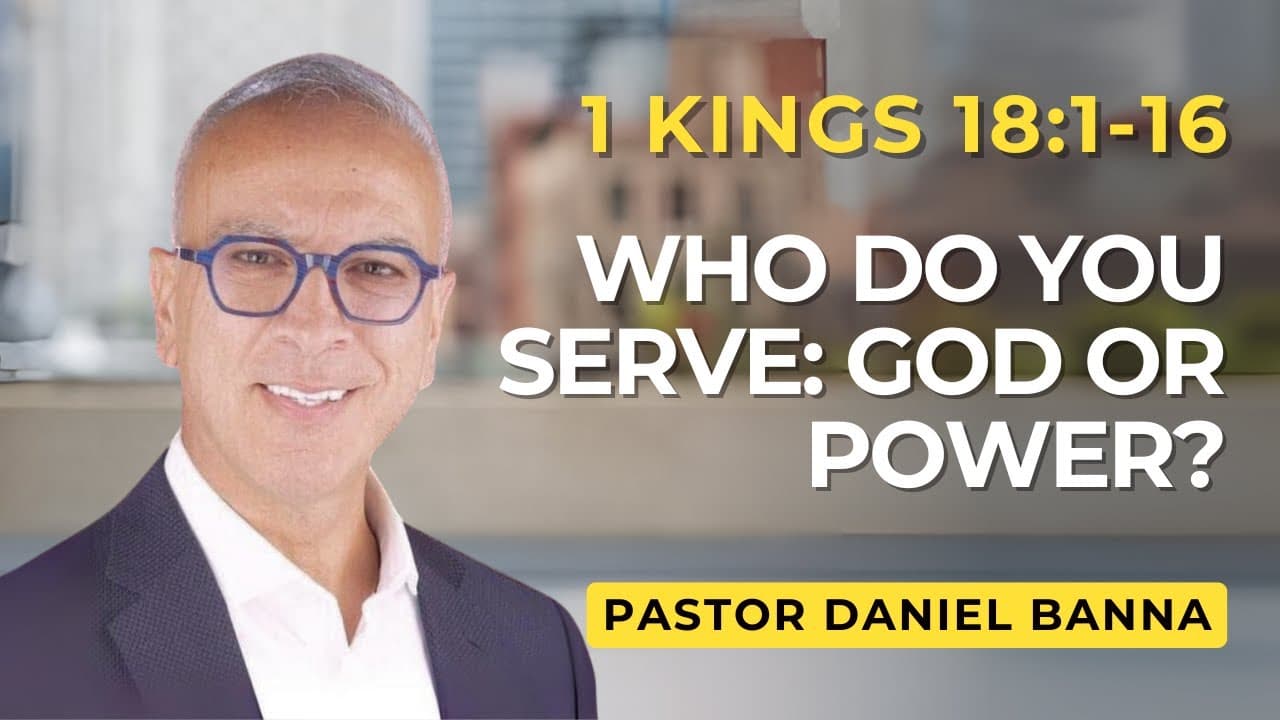
In a recent Friday sermon, Pastor Daniel Banna took us into the heart of one of the most dramatic periods in Israel’s history. The land was parched. For three and a half years, not a drop of rain had fallen. This wasn't just a natural disaster; it was a divine judgment on an apostate king, Ahab, and a people who had traded the worship of Yahweh for the sensuality and power of Baal.
It is against this backdrop of dust and death that we meet two men who both claim to serve the same God: Elijah the prophet and Obadiah the palace administrator. One stands in the spotlight; the other hides in the shadows. By examining their encounter, Pastor Daniel Banna challenges us to look at our own lives and ask: Who do we truly serve—God or power?
The Hero in the Shadows: The Dilemma of Obadiah
Most of us are familiar with Elijah, the fire-calling prophet of 1 Kings. But Pastor Daniel Banna drew our attention to a man often overlooked: Obadiah. His name in Hebrew means “Servant of God,” but his job title was “Governor of Ahab’s House.”
Think about the tension of that position. Obadiah was the right-hand man to the most wicked king Israel had ever known. He was surrounded by the cult of Baal and the murderous whims of Queen Jezebel. Yet, the Holy Spirit gives Obadiah a remarkable testimony in verse 3: he “feared the Lord greatly.”
How did he use that fear? While Jezebel was busy slaughtering the prophets of the Lord, Obadiah was secretly funneling resources to save them. He took 100 prophets, hid them in caves, and fed them with bread and water. In a time of famine, this was no small feat. It was a massive risk.
As Pastor Daniel Banna puts it, "Fear of the Lord always leads to action, and greater fear leads to greater action for the Lord." (watch this moment).
But here is the rub: Obadiah’s faith was entirely private. To the world, and even to King Ahab, Obadiah looked like a loyal servant of the crown. He was out searching for grass to save the king's horses while the people were starving. He was promoting the king’s agenda publicly while protecting God’s people privately.
This raises a question that made the room lean forward: Is it enough to be known to God but not to the people? We often admire the “7,000 in Israel” mentioned in 1 Kings 19 who never bowed to Baal, but as Pastor Daniel Banna pointed out, they were unknown even to Elijah. They were believers in hiding. Is that the ceiling of our Christian calling?
The Prophet’s Poke: "Go Tell Your Lord"
When Elijah finally emerges from hiding to confront Ahab, he meets Obadiah on the road. The interaction is stinging. Obadiah falls on his face, recognizing Elijah’s spiritual authority, and calls him “my lord.”
Elijah’s response is a masterclass in highlighting divided loyalties. He says, “It is I. Go tell your lord, behold, Elijah is here” (v. 8).
Notice the wordplay. Obadiah calls Elijah “lord,” but Elijah points back to Ahab and says, “No, go tell your lord.” Elijah is exposing the reality of Obadiah’s daily life. In practice, Elijah had never been Obadiah’s master. Obadiah didn't take orders from the prophet; he took orders from the wicked king.
Pastor Daniel Banna connected this to the warning of Jesus in Matthew 7:21: “Not everyone who says to me, ‘Lord, Lord,’ will enter the kingdom of heaven, but the one who does the will of my Father who is in heaven.”
It’s a sobering reminder for anyone who tries to balance a “private” devotion to Christ with a “public” devotion to the powers of this world. You can call Jesus “Lord” in the quiet of your heart, but if your hands are busy doing the work of a different master, who is truly in charge?
The Secret to Courage: "Before Whom I Stand"
Why was Elijah so bold while Obadiah was so terrified? When Elijah tells Obadiah to go inform Ahab of his presence, Obadiah spirals into a panic. He’s convinced that as soon as he leaves, the Spirit of the Lord will whisk Elijah away, and Ahab will kill Obadiah for “losing” him.
Obadiah’s fear was so great that he tried to justify his hesitation by listing his past achievements. “Haven't you heard what I did for the 100 prophets?” he asks. He was trying to use past faithfulness to excuse present cowardice.
Elijah’s response in verse 15 contains the secret to his iron-clad courage: “As the Lord of hosts lives, before whom I stand, I will surely show myself to him today.”
Pastor Daniel Banna highlighted this phrase as the turning point of the text. "The one who stands before the Almighty has no fear standing before any human ruler." (hear Pastor Daniel Banna explain this).
Elijah didn't fear Ahab because he spent his life standing in the presence of God. If you are constantly aware of the gaze of the King of Kings, the glare of an earthly king loses its power. Obadiah’s problem was that he spent more time standing before Ahab than he did standing before God. Consequently, Ahab looked huge, and God looked small.
The Tragedy of Manufactured Fear
One of the most insightful moments of the sermon dealt with the psychology of our disobedience. Obadiah spent verses 9 through 14 explaining all the reasons why obeying Elijah would lead to his death. He had constructed a complex, worst-case scenario in his mind.
But look at verse 16: “So Obadiah went to meet Ahab and told him, and Ahab went to meet Elijah.”
That’s it. No execution. No “Spirit of the Lord” whisking Elijah away. No drama. Ahab just went to meet him.
Pastor Daniel Banna challenged us with this: "Many of your fears are manufactured... You think maybe too much. You trust in God too little. Stop thinking too much and start trusting in God more." (watch at 35:10).
How often do we talk ourselves out of a bold witness because we’ve imagined a thousand ways it could go wrong? We worry about losing our jobs, losing our reputation, or losing our comfort. We build elaborate justifications for our silence, just as Obadiah did. But more often than not, our fears are ghosts that vanish the moment we step out in obedience.
Are You an Obadiah or an Elijah?
As the sermon drew to a close, the atmosphere in the room was reflective. Pastor Daniel Banna wasn't saying that Obadiah wasn't a believer—the text is clear that he was. He was a man who did noble things in secret. But he was also a man paralyzed by his environment, a man whose testimony was so intertwined with the world that he was largely unrecognizable as a servant of Yahweh.
Elijah, on the other hand, had no political status. He had no “influence” in the palace. He was a man with a nature just like ours, as James 5:17-18 tells us. Yet, because he prayed fervently and stood before God, he moved the heavens and confronted the earth.
God doesn't need us to have high positions to accomplish His plans. He doesn't need us to be “over the household” of the powerful to save His people. He can feed prophets with ravens and hide them in the hollow of His hand without any help from a compromised bureaucrat.
We are called to be Elijahs. We are called to a faith that is public, bold, and anchored in the presence of the living God.
What to Remember
- Fear of the Lord requires action. True devotion to God cannot remain purely internal; it must eventually manifest in risky, tangible obedience.
- Standing before God cures the fear of man. If you are more afraid of your boss, your culture, or your peers than you are of God, it’s a sign you aren't spending enough time in His presence.
- Don't let past faithfulness excuse present silence. Obadiah tried to use his past “cave work” to avoid his present duty. God is interested in your obedience today.
- Most of our fears are imaginary. We often spend more energy managing our “manufactured fears” than we do simply trusting the Word of God.
- Your identity is defined by your Master. Obadiah was known as Ahab’s servant; Elijah was known as God’s man. At the end of the day, whose servant will people say you were?
Questions to Sit With
- If someone looked only at your public actions and professional life, would they have any reason to suspect you serve the Lord?
- Is there a “manufactured fear” currently keeping you from saying or doing something God has prompted you to do?
- Obadiah used his position to help God's people, but he also had to promote Ahab's agenda. Where is the line between "being in the world" and "being of the world" in your own career?
- What would change in your life this week if you lived with the constant awareness that you are “standing before the Lord of Hosts”?
Scripture Referenced
This article is drawn from the sermon "Who Do You Serve: God or Power? | 1 Kings 18:1-16 | Pastor Daniel Banna" by Pastor Daniel Banna at Maranatha Bible Church Chicago. Watch the full sermon →
Written by
Pastor Daniel Banna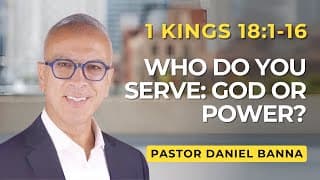
Based on the sermon