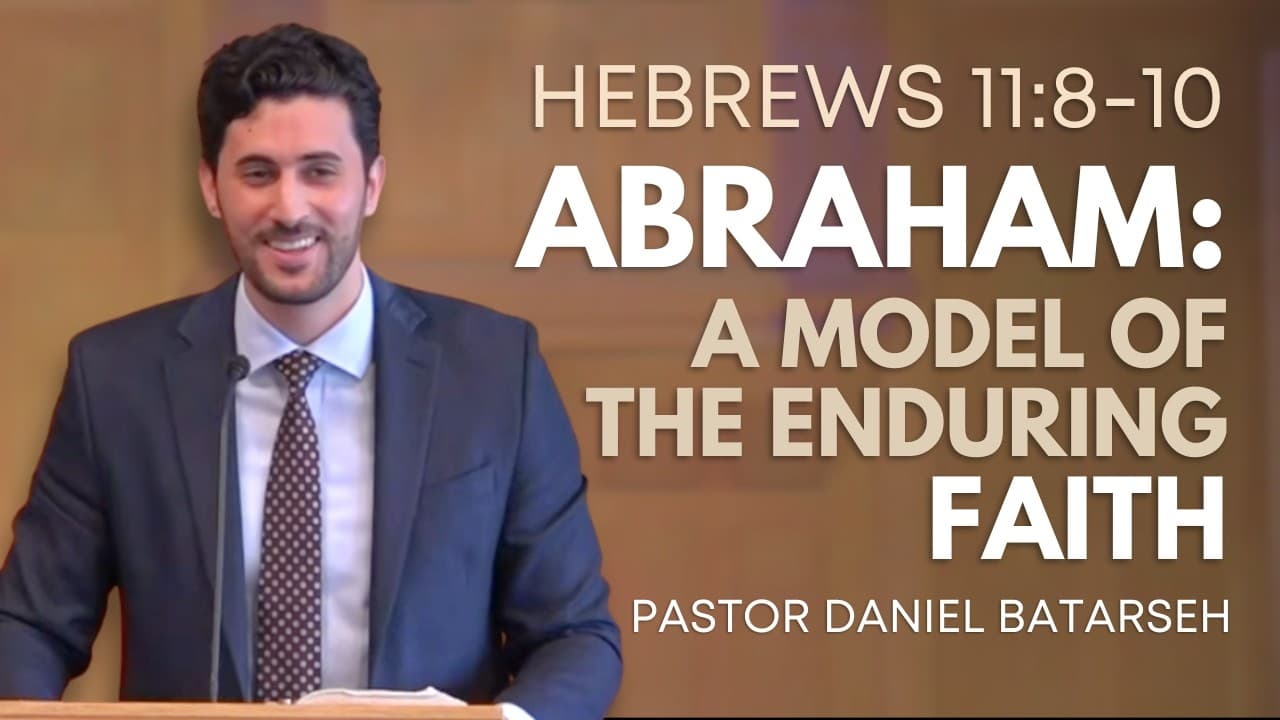
Most of us want a five-year plan before we say 'yes' to God. Abraham didn't even have a map. Explore what it looks like to live with an enduring, pilgrim faith.
We live in an age obsessed with the 'five-year plan.' We want to know the ROI before we invest, the destination before we pack our bags, and the outcome before we commit. But if you were sitting in the room when Pastor Daniel Batarseh opened Hebrews 11:8-10, you quickly realized that the kind of faith God honors doesn't operate on a GPS. It operates on a Voice.
Most people look at the 'Hall of Faith' in Hebrews 11 as a list of spiritual superheroes. But Pastor Daniel Batarseh points out a subtle, masterful move by the author: out of the sixteen figures named, eight of them—exactly half—come from the book of Genesis. Why does that matter? Because Genesis predates the Law of Moses. The author is pleading with his audience to see that what God has always searched for isn't religious performance or legalistic adherence; it is simple, ongoing, enduring trust in Him.
Abraham is the prototype. But as we learned, his faith wasn't powerful because he was perfect; it was powerful because it was persistent.
Faith Obeying Into the Unknown
Hebrews 11:8 gives us a staggering description of Abraham’s departure: "He went out, not knowing where he was going."
Think about the tension in that sentence. We often equate faith with certainty, but Abraham’s faith was characterized by a lack of geographic certainty. He was called out of Mesopotamia—a place where, according to Joshua 24, he was an idolater. He wasn't looking for God; God’s glory looked for him.
As Pastor Daniel Batarseh puts it, "True faith does not need a comprehensive map for the future in order to trustingly obey what God asks of you and I today" (watch this moment).
This is where the sermon hit home for many of us. We often hold our obedience hostage, demanding an explanation of the aftermath before we give God our 'yes.' We want to know: If I end this unequally yoked relationship, who will I marry? If I stop these shady business dealings, how will I pay the mortgage?
But that’s not faith; that’s a transaction. Faith is saying, "I know the One who asked this of me, and He deserves my obedience, no matter what it leads to."
Pastor Daniel pointed us to Acts 7:2-4, where Stephen notes that the "God of glory" appeared to Abraham. That is the secret. If you find yourself hesitating to trust God because you don’t have the blueprints, the answer isn't more information—it’s more of His glory. When you’ve caught a glimpse of who He is, you don’t need to know where you’re going. You just need to know He’s the one leading.
The Theology of the Tent: Why Abraham Refused to Settle
One of the most striking insights from the teaching was the significance of Abraham's housing choice. Hebrews 11:9 tells us he lived in tents. Abraham was a wealthy man—very wealthy—yet he lived as a nomad in the very land God had promised him.
Why? Because true faith makes you a pilgrim. It causes you to live light in this world.
Pastor Daniel Batarseh drew a powerful contrast between Abraham and his nephew, Lot. This wasn't just a story about two relatives; it was a study in two different kinds of faith.
In Genesis 13, we see a pattern in Abraham's life: he would pitch his tent and then build an altar. There is a specific order there that we often miss. "You and I can't truly worship unless we are first separate from the world. We have to be tent dwellers before we have altars built for God" (hear Pastor Daniel explain this).
Lot, however, had a different trajectory. While Abraham was building altars, Lot was looking toward the Jordan Valley because it looked like Egypt. He started by pitching his tent toward Sodom (Genesis 13:12). Then, he was found dwelling in Sodom (Genesis 14:12). Finally, by Genesis 19:1, he was sitting in the gate of Sodom—a position of leadership and total integration into a God-hating culture.
Lot is the picture of the worldly Christian who is too comfortable in this age. Abraham, on the other hand, "shared the soil of Canaan, but not the soul of the Canaanites" (watch at 34:36). Living in a tent was a physical manifestation of a spiritual reality: this world is not my home.
Generational Faith: What Happens Inside the Tent
There is a detail in Hebrews 11:9 that is easy to skip: Abraham lived in those tents with Isaac and Jacob.
If you do the math on the ages provided in Genesis, Abraham was 100 when Isaac was born and lived to be 175. Jacob was born when Isaac was 60. This means Jacob was 15 years old when his grandfather Abraham died.
Can you imagine the scene? A teenage Jacob sitting in a tent, listening to an old, weather-beaten Abraham tell stories about the "God of Glory" appearing in Mesopotamia. Abraham wasn't just a pilgrim; he was a patriarch who modeled his faith at home.
As Pastor Daniel Batarseh challenged the parents in the room: "May the greatest inheritance that you leave your children and their children is a walk with God. Amaze them with God" (watch at 40:40).
Abraham’s faith wasn't a private, weekly ritual. It was a lifestyle of "tent-dwelling" that his son and grandson could see. They saw that he had the money to build a palace, but he chose the tent because his eyes were fixed on something else.
The City with Foundations
What kept Abraham from becoming bitter while living in a temporary tent? Hebrews 11:10 gives us the answer: "For he was looking forward to the city that has foundations, whose designer and builder is God."
True faith anticipates the life to come. The word for "looking forward" in the Greek implies an intense, persistent gaze. Abraham wasn't just glancing at heaven on Sundays; he was living with a constant, yearning expectation of the New Jerusalem.
Pastor Daniel Batarseh connected this to a profound statement Jesus made in John 8:56: "Your father Abraham rejoiced that he would see my day. He saw it and was glad."
This is the "intellectual gold" of the sermon. Abraham had a revelation of Christ and the future city that was so real it impacted his joy in the present. "Knowing certain things about the future and believing them can impact your joy today" (watch this moment).
If you are struggling to remain steadfast, check your gaze. Are you looking at the "well-watered plains" of Sodom—the immediate comforts and thrills of this world? Or are you looking at the city with foundations? Tents are temporary; foundations are forever. Abraham could endure the flapping of the tent canvas in the wind because he knew the Architect of the city to come.
What to Remember
- Faith is proven by obedience, not by information. If you are waiting for God to explain the "why" before you do the "what," you aren't walking by faith. True faith obeys even when the destination is unknown.
- Separation is the prerequisite for worship. Like Abraham, we must pitch our "tents" (living as sojourners separate from the world's systems) before we can build "altars" (offering true worship that pleases God).
- Worldliness is a slippery slope. Lot didn't move into Sodom overnight. He looked, then he pitched toward it, then he lived in it, then he led it. Guard your heart against the slow drift toward cultural conformity.
- Your faith should be visible to the next generation. Abraham’s endurance wasn't just for him; it was a testimony to Isaac and Jacob. The way you live in your "tent" today is teaching your children what you truly value.
- Eternity stabilizes the present. The only way to live contentedly in a temporary world is to have your eyes fixed on an eternal city. When heaven becomes more real to us than earth, we gain the strength to endure anything.
Questions to Sit With
- Is there a clear command from Scripture you are currently suppressing because you're afraid of the consequences of obeying it?
- If someone looked at your lifestyle, would they see a "settler" who is deeply rooted in this world's systems, or a "sojourner" who is just passing through?
- What are the "Sodoms" in your life—things that didn't used to bother you but you've now become comfortable with?
- How often do you talk to your family or those in your circle about the beauty and reality of the "city to come"?
- If you truly believed that the Designer and Builder of your future is God, what worry would you drop right now?
Scripture Referenced
- Hebrews 11:8-10
- Genesis 12
- Genesis 13:3, 10-12, 18
- Genesis 14:11-12
- Genesis 15:6
- Genesis 18:17-19
- Genesis 19:1
- Acts 7:2-4
- Hebrews 10:34
- Hebrews 13:14
- 1 Peter 2:11
- John 8:56
This article is drawn from the sermon "Abraham: A Model of the Enduring Faith | Hebrews 11:8-10 | Pastor Daniel Batarseh (2/15/26)" by Pastor Daniel Batarseh at Maranatha Bible Church Chicago. Watch the full sermon →
Based on the sermon