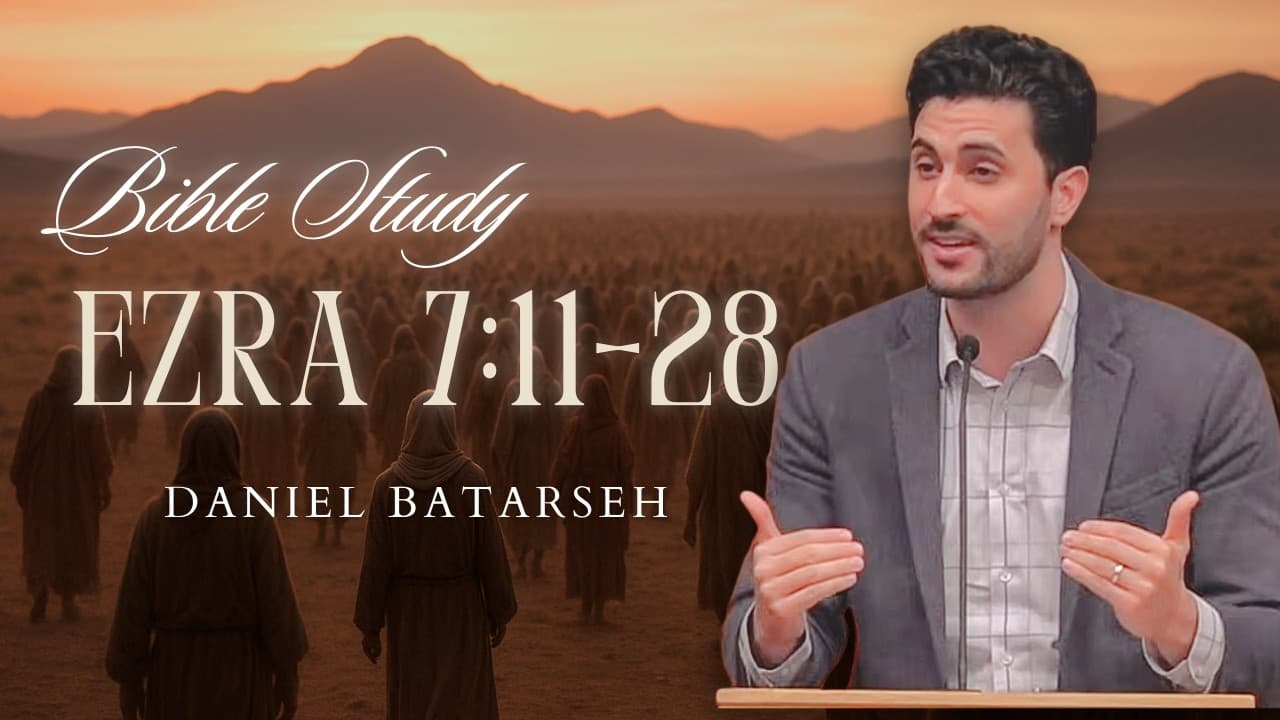
Most people view God’s favor as a sovereign lottery, but Ezra 7:11-28 reveals a different truth: sometimes God is waiting for you to move first. Explore the heart of Ezra’s mission and the radical shift from fear-based religion to love-based worship.
We often think of God’s work in the world as a series of sovereign lightning strikes—moments where He moves, doors open, and we simply walk through. But what if God is actually waiting for you?
In Ezra 7:11-28, we encounter a shift in the biblical narrative that most readers skim right past. While the previous decrees from kings Cyrus and Darius were clearly initiated by a sovereign nudge from God, the decree of King Artaxerxes was different. It was a response to a man who had the audacity to ask.
As Pastor Daniel Batarseh explains, this distinction changes how we view our own walk with Christ: "There are gonna be moments for the church and for individual believers where God will sovereignly intervene in a situation apart from our initial involvement... But then, on the other hand, there are times when the Lord will only move when we move first." (watch this moment at 34:47).
This study of Ezra isn't just a history lesson about a Persian decree; it is an investigation into what motivates the human heart to follow God. Are we serving Him to avoid a cosmic "red button" of judgment, or are we serving Him because we are captivated by His love?
Why Ezra Cared More About People Than Projects
In the grand timeline of the return from exile, there were three major leaders with three distinct missions. Zerubbabel was sent to rebuild the temple. Nehemiah was sent to rebuild the walls. But Ezra was sent to build the people.
Artaxerxes’ letter commissions Ezra to "make inquiries about Judah and Jerusalem according to the law of your God" (Ezra 7:14). This wasn't a building inspection; it was a spiritual audit. Ezra’s priority was to see if the people were actually living out the truth of the scriptures they claimed to possess.
This is the hallmark of true spiritual leadership. A leader in God’s house isn't just someone who manages a budget or maintains a facility; they are someone consumed with the formation of Christ in others. Pastor Daniel connected this to the Apostle Paul’s heart in Galatians. Paul didn't just want the Galatians to be "saved"; he wanted Christ to be formed in them. He described his ministry as the "anguish of childbirth" (Galatians 4:19).
If you want to know if a spiritual leader truly loves you, look at what they do with the truth. As Pastor Daniel Batarseh told the congregation: "A person who manipulates, who massages, who avoids things that will benefit God's people in the name of a pseudo love, they don't really love you, they love themselves... They don't care about Christ being formed in you, they want you to benefit them." (hear this moment at 47:45).
Ezra’s mission reminds us that the goal of the Christian life isn't just to get the "walls" of our life in order; it’s to have the law of God written on our hearts.
The Will of God for Your Wallet
One of the most practical—and often ignored—parts of Artaxerxes’ decree is found in verse 18. The king gives Ezra a massive amount of silver and gold, but then adds a fascinating caveat: "Whatever seems good to you and your brothers to do with the rest of the silver and gold, you may do according to the will of your God."
We often talk about the "will of God" regarding our career, our marriage, or our ministry. But how often do we consider the will of God for our surplus?
Pastor Daniel challenged the room to rethink their relationship with possessions. God doesn't just have a plan for your purity; He has a plan for your bank account. He suggested a radical, simple act of discipleship: sit down with your spouse and explicitly tell the Lord that everything you own belongs to Him.
"Lord, every piece of furniture, every corner of this house, every dollar in our bank account... it's all yours."
When we invite the Lord into our finances, we move from being owners who are stressed about loss to stewards who are excited about investment. It detaches our hearts from the things that seek to grip our affections and realigns us with eternity.
Faith as an Insurance Policy vs. Faith as a Response
Perhaps the most striking insight from the sermon was the contrast between King Artaxerxes and King David.
Artaxerxes was incredibly generous to Ezra, but his motivation was revealed in verse 23: "lest his wrath be against the realm of the king and his sons." To the Persian king, supporting the God of Israel was an insurance policy. He didn't love Yahweh; he just didn't want to get hit by Him. He was moved by a narrow, limited dread of punishment.
Compare that to King David in 1 Chronicles. When David gave toward the temple, he didn't do it to avoid a plague. He did it because he was overwhelmed by God’s majesty. "Yours, O Lord, is the greatness and the power and the glory... all that is in the heavens and in the earth is yours" (1 Chronicles 29:11).
Many Christians today are living like Artaxerxes. They serve, they give, and they abstain from sin because they are terrified that God is waiting to press a "red button" on their lives. They manage a constant state of spiritual misery, hoping they’ve done enough to keep the wrath at bay.
Pastor Daniel’s words on this were sharp and liberating: "The misery that you're managing is not the will of God. That is not Christianity... You and I will never know the joy and delight that Christ wants us to have in our walk with him if anxiety about judgment is the grounds of your godliness." (watch at 1:02:38).
We see the proper order of the Christian life in John 8. To the woman caught in adultery, Jesus didn't say, "Go and sin no more so that I won't condemn you." He said, "Neither do I condemn you; go, and from now on sin no more" (John 8:11). The revelation of "no condemnation" is the fuel for the life of "no sinning."
The Heart-Mover: If He Can Change a Pagan, He Can Change You
As Ezra finishes recording the king’s letter, he breaks into the first person for the first time in the book. He doesn't congratulate himself on his successful negotiation. He says, "Blessed be the Lord... who put such a thing as this into the heart of the king" (Ezra 7:27).
This is a massive source of hope for anyone who feels stuck. If God can reach into the heart of a pagan, Gentile king like Artaxerxes and rewire his desires to favor the kingdom of God, why do we think He is reluctant to do the same for us?
If you struggle to love God, or if you find your heart constantly drifting toward worthless things, the answer isn't just "try harder." The answer is to ask the Heart-Mover to do His work. As Paul prayed in 2 Thessalonians, "May the Lord direct your hearts to the love of God and to the steadfastness of Christ" (2 Thessalonians 3:5).
Pastor Daniel concluded with a practical defense mechanism for the mind: memorizing scripture that emphasizes God's character. He shared how he had been "chewing on" the final words of Jude: "Now to him who is able to keep you from stumbling and to present you blameless before the presence of his glory with great joy..." (Jude 1:24).
When you tuck these truths into your heart, they become a shield. When the "invading thoughts" of condemnation and dread come, they are shot down by the reality that God is not just able to keep you—He is eager to present you blameless with joy.
What to Remember
- God responds to faith-filled initiative. While God often moves sovereignly, Ezra’s story shows that He also waits for His people to step out in obedience and ask for big things.
- True leadership prioritizes people over projects. Ezra’s primary concern wasn't the architecture of Jerusalem, but the spiritual formation of the people according to the Word of God.
- Financial stewardship is a spiritual discipline. The "will of God" applies to your surplus. Acknowledging God’s ownership of everything breaks the grip of materialism.
- Motivation is the difference between religion and relationship. Serving God out of dread (Artaxerxes) leads to misery; serving God out of gratitude (David) leads to worship.
- The order of the Gospel is 'No Condemnation' first. We don't stop sinning to earn God’s love; we stop sinning because we have experienced His love.
Questions to Sit With
- Is there an area of your life where you are waiting for God to move, but He might be waiting for you to take the first step of faith?
- If you looked at your bank account through the lens of "the will of God," what would change about how you view your "surplus"?
- Be honest: Is your primary motivation for following Christ a fear of punishment or a response to His love? What would it look like to shift that today?
- If you truly believed that God is "able to keep you from stumbling" and wants to present you "with great joy," how would that change your prayer life this week?
Scripture Referenced
- Ezra 7:11-28
- Colossians 2:6-10
- Galatians 4:16-19
- 1 Chronicles 29:10-17
- John 8:11
- 2 Thessalonians 3:5
- Jude 1:24-25
This article is drawn from the sermon "Ezra 7 (Part 2) Bible Study (Ezra Sent to Teach the People) | Pastor Daniel Batarseh (2/13/26)" by Pastor Daniel Batarseh at Maranatha Bible Church Chicago. Watch the full sermon →

Based on the sermon