The Second Temple wasn't finished because of government grants or lucky breaks; it was finished because the people were continually exposed to the Word of God. Discover why the 'returned exiles' experienced a joy that those who stayed in Babylon missed entirely.
It is one of the most sobering timelines in the Old Testament. When the Jewish exiles returned from Babylon to Jerusalem, they hit the ground running. They laid the foundation of the temple almost immediately. But then, the work stopped. It didn't just pause for a season; it sat dormant for sixteen years.
When the work finally resumed under the reign of Darius, it only took four years to complete the structure. So why the twenty-year gap? Why does a project that requires four years of labor often take two decades of our lives to realize?
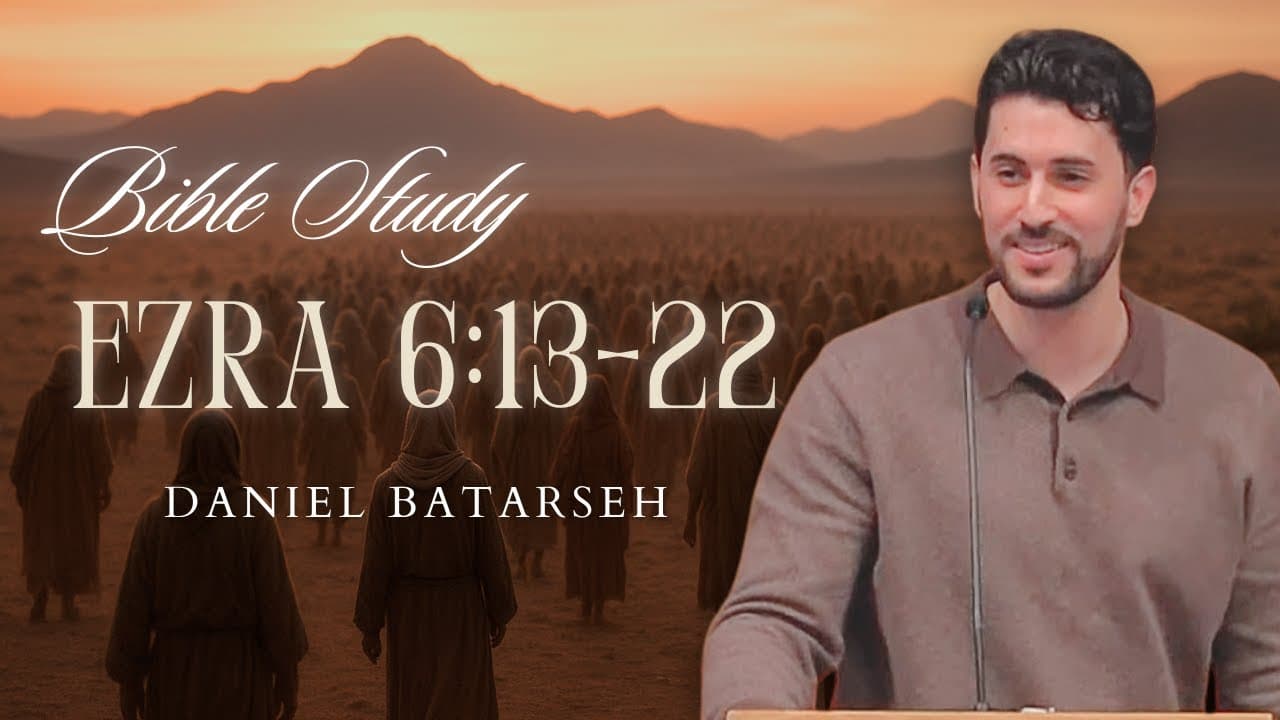
In his study of Ezra 6:13-22, Pastor Daniel Batarseh dives into the grand opening of the Second Temple. But this isn't just a history lesson about ancient architecture. It is a profound look at what it takes to remain steadfast when the initial excitement of a calling wears off. As Pastor Daniel points out, the temple wasn't finished because the opposition disappeared; it was finished because the people finally prioritized the Word of God over their own comfort.
The Surprising Diligence of the Outsider
One of the most striking moments in Ezra 6 occurs in verse 13. Darius the King has just issued a decree: the governors of the region are to stop interfering with the Jews and, instead, start funding the project out of the royal treasury.
The response of these pagan governors—Tattenai and his associates—is convicting. The text says they acted "with all diligence" (watch this moment).
Pastor Daniel Batarseh highlights a tension here that we often overlook. These men weren't believers. They weren't promised a reward in heaven. They weren't even promised a promotion on earth. They obeyed simply because their king gave the word.
"All Darius had to do was what? Give the word. And they complied completely. They unreservedly submitted," Pastor Daniel notes. "Should not your eagerness and mine match or even exceed that of these men? For our King, our King... does he not deserve this exact type of prompting and willingness and eagerness for whatever he asks of us?" (hear the clip at 06:26).
We often wait for a "feeling" or a "sign" or a "clear path" before we obey God. Yet here are pagan governors who obeyed a human king the first time they were asked, simply because it was his pleasure. If they could show that level of loyalty to a man like Darius, how much more should we show to a King who laid down His life for His subjects?
Prospering Through the Prophesying
If you want to know the secret to spiritual success, it’s tucked away in Ezra 6:14: "And the elders of the Jews built and prospered through the prophesying of Haggai the prophet and Zechariah the son of Iddo."
Notice that it doesn't say they prospered because they had more money, or because the government was on their side, or because they finally had the right tools. They prospered through the prophesying.
This is a critical insight for the modern Christian. By this point in the story, the Jews had everything going for them. The King of Persia was paying the bills. The local governors were helping. The doors were wide open. And yet, even with an open door, they still needed the constant, regular exhortation of the Word of God to keep moving.
As Pastor Daniel Batarseh explains: > "This flesh is remarkable at finding ways to drain our enthusiasm for God. Even if everything in your life is cooperating... the people of God still needed the word of God to redirect them, keep them aligned, keep them stable." (watch at 12:54)
We often think that if our circumstances would just improve, we would be more faithful. We think, "If I had a better job, or a more supportive spouse, or fewer bills, I’d really serve God." But the Jews in Ezra's day prove that you can be standing under a shower of blessing and still lose your zeal.
The only thing that sustains spiritual momentum is the regular hearing of God's Word. This is why Satan’s primary strategy is rarely to stop you from being a Christian; it is simply to draw you away from the Book. He knows that if he can cut off the source, it’s only a matter of time before the work stops.
The Joy of the Meager Offering
When the temple was finally finished, the dedication ceremony was a time of massive celebration. They offered 100 bulls, 200 rams, and 400 lambs. To us, that sounds like a lot. But Pastor Daniel Batarseh invites us to compare this to the dedication of the first temple under Solomon in 1 Kings 8.
Solomon offered 22,000 oxen and 120,000 sheep.
By comparison, the offering in Ezra’s day was tiny—less than 1% of what Solomon gave. If you were an older Israelite who remembered the glory of the first temple, you might have been tempted to look at this dedication and feel embarrassed. You might have felt like this "second-best" temple wasn't worth the joy.
But the text says they celebrated "with joy" (Ezra 6:16).
How is that possible? How can you have the same level of joy with 700 animals that Solomon had with 142,000?
"God can make us joyful whether you have little or much," Pastor Daniel explains. "If your joy is in what you have or what you don't have, I promise you a very fickle and flimsy contentment. It won't last because possessions and materials come and go. But if your joy is in God... you will know happiness that will endure all circumstances." (watch at 30:58)
This is the "abundance of joy" that Paul later describes in the churches of Macedonia (2 Corinthians 8:1-2). They were in "extreme poverty," yet they had "overflowing joy." Why? Because true joy isn't found in what you have; it’s found in what you do with what you have. When you sacrifice for the sake of God's house, you unlock a level of contentment that a bank account can never provide.
The High Price of Spiritual Rewards
In the final verses of Ezra 6, the Holy Spirit uses a specific phrase three times in four verses: "the returned exiles" (Ezra 6:19-21).
Why the repetition? Why keep reminding us that these people were former captives?
Pastor Daniel Batarseh suggests that this is a subtle but powerful commentary on the cost of spiritual reward. When Cyrus gave the decree that the Jews could go home, he gave it to all of them. But not all of them went. Many chose to stay in Babylon. They had built businesses there. They had nice homes. They had grown comfortable in the land of their captors.
But the ones who got to experience the miracle of the temple, the ones who got to eat the Passover in the presence of God, were only the ones who were willing to leave.
"The ones who chose to go back were the ones who relished in this revival and entered into a new level in their relationship with the living God," Pastor Daniel says. "There are certain spiritual advantages and there are certain experiences that can only come to those who are willing to walk away from what God asked them to walk away from to truly know him." (hear this point at 42:32)
To illustrate this, Pastor Daniel points to the New Testament character of Timothy in Acts 16. When Paul met Timothy, he invited him to join his missionary journey. But there was a price: Paul wanted Timothy to be circumcised (Acts 16:3).
For a young man, that was a massive, painful, and personal sacrifice. Timothy could have said no. He could have stayed in the comfort of his home in Lystra. But if he had, he would have missed out on becoming a pastor in Ephesus, receiving the letters of 1 and 2 Timothy, and seeing the world changed by the Gospel.
Sacrifice is the path to spiritual reward. You cannot know the fullness of God's will until you are willing to walk away from the things that are keeping you in "Babylon."
What to Remember
- Diligence is a mark of loyalty. If pagan governors can obey a human king with "all diligence" without a promised reward, we should be even more eager to obey Christ simply because it pleases Him.
- The Word of God is the fuel for sustainability. You cannot remain steadfast in your calling based on initial excitement or favorable circumstances. You need regular, consistent exposure to Scripture to keep your flesh from drifting.
- Joy is independent of resources. The Jews at the Second Temple had 1% of Solomon's resources but 100% of his joy, because God is the source of joy, not the size of the offering.
- Sacrifice precedes experience. The people who stayed in Babylon missed the miracle. Only those who were willing to leave comfort and face opposition got to stand in the courts of the finished temple.
- Don't waste your time on useless things. The temple took 20 years to build because of 16 years of idleness. We must guard our days and live maximally for God with whatever time we have left.
Questions to Sit With
- If someone looked at your "diligence" in serving God, would it put the world to shame, or would the world's work ethic put yours to shame?
- Are you waiting for your circumstances to improve before you commit to a deeper spiritual life? How does the story of the Jews in Ezra 6 challenge that mindset?
- What is the "Babylon" in your life—the comfort or familiarity that is keeping you from the "spiritual reward" God has for you in a place of sacrifice?
- Looking back at the last few years, have you been "building the temple," or have you been idle? What would it look like to live "maximally for God" starting today?
Scripture Referenced
This article is drawn from the sermon "Ezra 6 (Part 2) Bible Study (The Temple Finished and Dedicated) | Pastor Daniel Batarseh" by Pastor Daniel Batarseh at Maranatha Bible Church Chicago. Watch the full sermon →
Based on the sermon