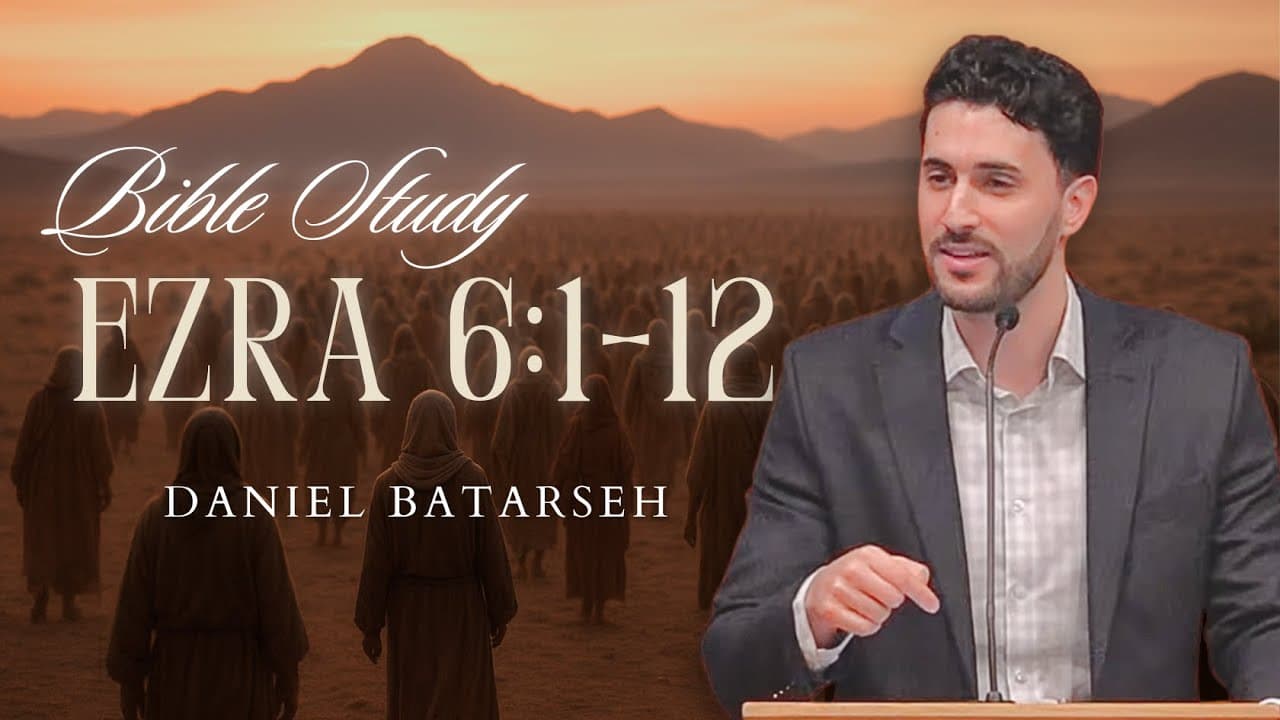
In this study of Ezra 6, Pastor Daniel Batarseh reveals how God sovereignly moves the hearts of secular rulers to accomplish His precise will for His people.
If you have ever felt like the work God called you to do has stalled out—stifled by red tape, opposition, or a lack of resources—Ezra 6 is the passage your soul needs to hear. Most people read the book of Ezra as a dry historical record of a building project. But as Pastor Daniel Batarseh points out, this chapter is actually a masterclass in the absolute sovereignty of God over secular history.
We often think that God only works through “spiritual” means, but Ezra 6 shows us a God who is so powerful that He can harness the resources of a pagan empire, the curiosity of a king, and even the hostility of government bureaucrats to ensure His house is built exactly the way He wants it. The core insight that made everyone in the room lean forward during this study was this: God is a precise God. He isn’t just interested in the “big picture”; He is concerned with the dimensions, the materials, and the specific placement of every vessel in His house.
Why Ezra Calls a Persian King the “King of Assyria”
One of the most jarring moments in the text occurs in verse 22. Ezra identifies King Darius not as the King of Persia, which he was, but as the “King of Assyria.” For the casual reader, this looks like a historical blunder. For the skeptic, it’s a “contradiction.” But for the student of the Word, it is a profound theological statement.
Pastor Daniel Batarseh explains that this isn't a mistake. Assyria was the empire that originally began the downfall and exile of Israel. By labeling Darius as the King of Assyria, Ezra is showing us that God has brought the story full circle. As Pastor Daniel Batarseh puts it, “The Lord is not only sovereign over a king, he is sovereign over all kings” (watch this moment).
When we look at Nehemiah 9:32, we see the same historical marker. The suffering of God’s people began with the kings of Assyria. By using this title for Darius, Ezra is reminding us that the same God who allowed the oppression is the God who is now commanding the restoration. He is the God of the entire arc of history. He didn't just step back in during the Persian era; He was in control when the first Assyrian soldier marched toward Jerusalem.
The Invisible Force: What Kept Darius Searching?
In the first two verses of Ezra 6, we find Darius responding to a letter from local governors who were trying to halt the rebuilding of the temple. They claimed that a previous king, Cyrus, had given them permission. Darius orders a search of the royal archives.
Think about the human element here. Darius doesn't find the scroll in Babylon where he expected it to be. At that point, any secular ruler would have said, “We looked, it’s not there, tell the Jews to stop building.” It would have been the easiest, most efficient path. But Darius doesn't stop. He pushes the search into another province, eventually finding the scroll in Ecbatana.
Why such determination? Darius wasn't a Jew. He wasn't a believer. He had an empire to run. Pastor Daniel Batarseh notes that the only explanation is found in the final verse of the chapter: God had turned the heart of the king.
“Darius's heart at this point is harnessed by an invisible force which we know to be God,” Pastor Daniel Batarseh told the congregation. This is what we might call a “Holy Spirit compulsion.” It is a level of concrete certainty and immovability that comes when God is working in a person to accomplish His will.
This has a direct application for us today. If God can move a pagan king to be that diligent for a building he didn’t worship in, how much more should the love of Christ compel us? Pastor Daniel Batarseh connected this to 2 Corinthians 5:14, where Paul says, “the love of Christ controls us.”
Hear Pastor Daniel explain this: “Believer, if you go by your emotion on a daily basis to determine your fidelity and your commitment to your ministry, your marriage, your work, your sacrifice, you will not last very long. But if you tap into the great affection that Christ has set upon you, oh, you will know something of longevity.”
“Each to Its Place”: The Precision of a Holy God
When the decree of Cyrus is finally found and read in verses 3-5, we see details that weren't mentioned earlier in the book. Cyrus didn't just say, “Build a temple.” He specified the height (60 cubits), the breadth (60 cubits), the layers of stone, the timber, and the fact that the royal treasury would pay for it.
But the detail that Pastor Daniel Batarseh highlighted as most significant was the instruction regarding the gold and silver vessels. Cyrus (moved by God) didn't just want them returned to Jerusalem. He commanded that they be restored “each to its place” (watch at 20:26).
This reveals a God who is meticulously concerned with order. He wanted the lampstand here, the table of showbread there, and the altar over there. Fast forward to the New Covenant, and we find that while the “temple” has changed—it is now the local church—God’s heart for order has not.
Pastor Daniel Batarseh challenged the room by looking at 1 Timothy 3:14-15, where Paul writes so that we may know “how one ought to behave in the household of God.” In the modern era, we are quick to dismiss biblical instructions about church roles, gender distinctions, and leadership qualifications as “cultural” or “unimportant.”
“We are living in an age where more and more people take liberties in ignoring or misinterpreting God's rules for his own house,” Pastor Daniel Batarseh observed. If we would be offended by a priest in Ezra’s day moving the furniture around just because he “felt like it,” why are we not offended when we ignore the blueprints God has given for the Church today? Precision matters because it is God’s house, not ours.
The Power of a Pagan King’s Prayer Request
One of the most surprising turns in the text is found in verse 10. Darius doesn't just fund the building; he asks the Jews to “pray for the life of the king and his sons.”
Darius, whether out of genuine conviction or a bit of superstitious caution, recognized that there was power in the intercession of God’s people. This serves as a stinging rebuke to Christians who treat prayer as a last resort. If a pagan king saw the value in having the people of God seek the “God of heaven” on his behalf, why do we struggle to believe our prayers change things?
Pastor Daniel Batarseh pointed to the small, personal request Paul makes in Philemon 1:22: “Prepare a guest room for me, for I am hoping that through your prayers I will be graciously given to you.” Paul didn't just ask for prayer for “big” things like the conversion of the Gentiles; he believed prayer could influence his travel plans and his release from prison.
“When was the last time, not as a Christian reflex, not as a knee-jerk reaction, but genuinely with your faith... you asked somebody else to pray for you believing that God would honor that prayer?” Pastor Daniel Batarseh asked. We are commanded in 1 Timothy 2 to pray for those in high positions, not just for their sake, but so that the church can live in peace and the gospel can go forth.
I’m Not Afraid OF Troublemakers; I’m Afraid FOR Them
The sermon concluded with a sobering look at Darius’s warning in verses 11-12. Darius decreed that if anyone altered his edict, a beam should be pulled from their own house and they should be impaled on it. It’s a gruesome, violent image that underscores a spiritual reality: You do not mess with what God is building.
In the New Testament, the temple is the body of believers. In 1 Corinthians 3:16-17, Paul gives a warning that mirrors the intensity of Darius: “If anyone destroys God's temple, God will destroy him.”
How do people destroy the temple today? In the context of 1 Corinthians, it was through division. When we sow discord, when we create factions, when we gossip, or when we prioritize our own preferences over the unity of the Spirit, we are attempting to dismantle the house God is building.
Pastor Daniel Batarseh’s final word on this was a powerful shift in perspective. Many leaders worry about “troublemakers” coming into the church to cause havoc. But Pastor Daniel Batarseh said, “I'm not afraid of troublemakers... I've determined that I'm afraid for troublemakers” (watch at 47:31).
Why? Because this isn't a pastor’s church. It isn't a board’s church. It is God’s temple. And God protects what is His. If you make it your mission to tear down what God is building, you aren't just fighting men; you are fighting the One who holds the hearts of kings in His hand.
What to Remember
- God is sovereign over the entire timeline of your struggle. He was in control when the “Assyrians” (the trouble) arrived, and He is in control as the “Persians” (the solution) provide the way out.
- True commitment is fueled by God’s love, not our emotions. Like Darius being moved by an invisible force, we must be compelled by the love of Christ to remain resilient in our calling.
- Precision is an act of worship. God’s instructions for His house—the Church—are not suggestions. We honor Him by following His blueprints, not our feelings.
- Prayer is a powerful tool for societal and personal change. Even secular rulers recognize the weight of the intercession of the saints.
- The unity of the Church is sacred. To cause division in the local body is to invite the discipline of God, who is the fierce protector of His temple.
Questions to Sit With
- Ezra calls Darius the “King of Assyria” to show God’s long-term sovereignty. Can you look back at a difficult season in your life and see how God was actually setting the stage for a later restoration?
- Pastor Daniel Batarseh spoke about the “love of Christ controlling us.” In what areas of your life are you currently relying on your own fluctuating emotions rather than Christ’s steady love to keep you going?
- If God is a “precise God,” are there areas of “church life” or personal obedience where you have become careless, assuming the details don't matter to Him?
- Paul asked Philemon to pray for a guest room. Do you have the humility to ask fellow believers to pray for the “small” or “personal” details of your life, or do you only ask for prayer in a crisis?
- If you truly believed 1 Corinthians 3:17—that God will destroy those who destroy His temple—how would that change the way you speak about your local church or handle disagreements with other believers?
Scripture Referenced
- Ezra 6:1-22
- Nehemiah 9:32
- 2 Corinthians 5:14
- 1 Timothy 3:14-15
- Philemon 1:22
- 1 Corinthians 3:16-17
- 1 Timothy 2:1-2
This article is drawn from the sermon "Ezra 6 (Part 1) Bible Study (The Decree of Darius) | Pastor Daniel Batarseh" by Pastor Daniel Batarseh at Maranatha Bible Church Chicago. Watch the full sermon →
Based on the sermon
Ezra 6 (Part 1) Bible Study (The Decree of Darius) | Pastor Daniel Batarseh
Watch Full SermonRelated Articles
Ezra 7: Is Your Faith an Insurance Policy or a Love Story?
Pastor Daniel Batarseh · February 14, 2026
Ezra 7:11-28: Why Building People Matters More Than Building Walls
Pastor Daniel Batarseh · February 14, 2026
Ezra 6: Why the Second Temple Took 20 Years to Finish
Pastor Daniel Batarseh · January 17, 2026