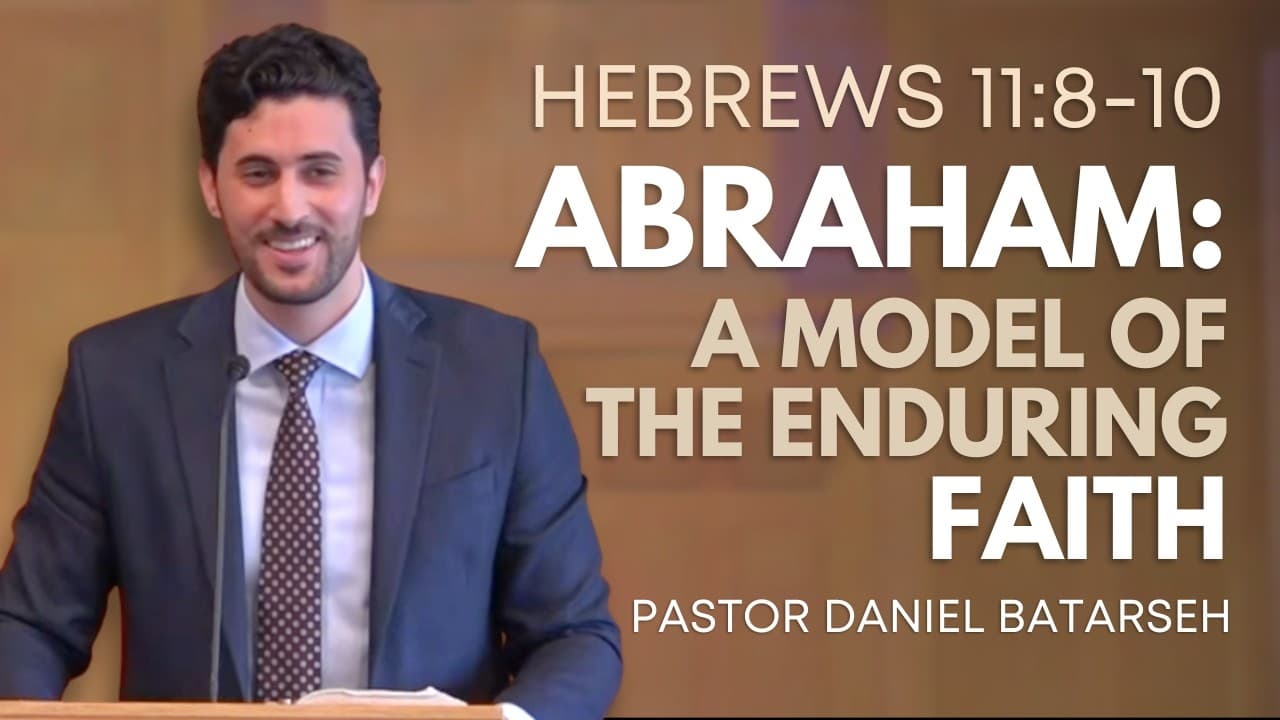
Abraham didn't have a GPS or a five-year plan. He had a call and a promise. Discover why the 'father of faith' chose a tent over a city and what that means for your walk with God today.
Most of us wouldn't dream of starting a road trip without a GPS, let alone moving our entire lives to a different country without an address. We want the blueprint. We want the five-year plan. We want to know exactly what the 'aftermath' of our obedience will look like before we ever say 'yes' to God.
But as Pastor Daniel Batarseh pointed out in his study of Hebrews 11:8-10, that isn't faith. In fact, if you require an explanation before you offer your obedience, you aren't actually trusting God—you're negotiating with Him.
In this powerful teaching, Pastor Daniel Batarseh moved past the Sunday school versions of Abraham to show us the gritty, enduring reality of what it means to walk with God. He challenged the congregation at Maranatha Bible Church to consider a startling truth: True faith is proven not by how much we know, but by how far we are willing to go into the unknown.
The Difference Between Justification and Endurance
When we think of Abraham and faith, our minds usually go to Genesis 15:6: "Abraham believed God, and it was counted to him as righteousness." This is the verse Paul and James use to discuss justification—how we are made right with God. But Pastor Daniel Batarseh noted a fascinating shift in Hebrews. The author of Hebrews doesn't quote Genesis 15:6 once.
Why? Because the author isn't trying to explain how to be saved; he’s trying to show a group of persecuted, weary Christians how to keep going. He is holding up Abraham as a model of enduring faith.
As Pastor Daniel Batarseh explains, "The author of Hebrews... wants to look at a different component of sincere faith. And here with Abraham, he wants to show that true faith is something that perseveres in the face of conflict and challenges that that faith might cause in your life" (watch this moment).
Obedience Without the Map
Hebrews 11:8 tells us that "Abraham obeyed when he was called to go out... and he went out, not knowing where he was going."
Pause there. He went out not knowing.
Pastor Daniel Batarseh used a simple but convicting illustration: If you say you trust your doctor’s expertise, but you refuse to take the medicine he prescribes until you personally understand every chemical reaction it will cause in your body, do you actually trust the doctor? No. Your trust is in your own understanding, not his expertise.
In the same way, we often hold God at arm's length. We tell Him, "Lord, I’m only willing to go ahead if you tell me exactly what will happen when I do."
Pastor Daniel Batarseh’s response was blunt: "That is not true faith... True faith does not need a comprehensive map for the future in order to trustingly obey what God asks of you and I today" (hear this at 12:05).
This applies to the messy parts of our lives. Maybe it's a relationship where you know you're unequally yoked, but you're afraid of being lonely. Maybe it's a shady business practice that provides a steady income, and you're afraid of what happens to your bank account if you stop. If you're waiting for God to show you the replacement spouse or the new job before you obey, you aren't walking by faith. You're walking by sight.
The Theology of the Tent: Why Abraham Stayed a Nomad
One of the most striking insights from the sermon was the significance of the tent.
Hebrews 11:9 says that even when Abraham reached the land of promise, he lived there "as in a foreign land, living in tents." Abraham was wealthy. He could have built a palace. He could have established a fortress. Instead, he chose the life of a nomad.
Why? Because the tent was a physical manifestation of his spiritual reality. He was a sojourner. He was an exile. He refused to plant deep roots in a world that wasn't his final home.
Pastor Daniel Batarseh connected this back to 1 Peter 2:11, where Peter urges us as "sojourners and exiles" to abstain from fleshly passions. There is a direct link between being a nomad in this world and being holy. When you become a "settler" in this world—adopting its values, its comforts, and its pace—your spiritual life begins to atrophy.
The Pattern: Tent First, Then Altar
Pastor Daniel Batarseh pointed out a recurring pattern in Genesis (specifically 12:8, 13:3, and 13:18). Every time Abraham moved, he did two things: he pitched his tent and he built an altar.
But look at the order. The tent is always mentioned first.
"You and I can't truly worship unless we are first separate from the world," Pastor Daniel Batarseh observed. "We have to be tent dwellers before we have altars built for God... Only exiles can build true altars to God" (watch at 26:08).
If we are too connected to the systems, pleasures, and convictions of this world, our "altars" are hollow. We cannot offer pleasing sacrifice to God while our hearts are fully settled in the culture around us.
The Cautionary Tale of Lot: From Tent to Gate
To show the danger of losing this "nomad" mentality, Pastor Daniel Batarseh contrasted Abraham with his nephew, Lot. Their stories in Genesis 13 and Genesis 19 provide a sobering warning about "spiritual drift."
Lot started with a tent, just like Abraham. But then he began to look toward the Jordan Valley because it looked like Egypt—the place they had just left. Pastor Daniel Batarseh noted, "Though Lot followed Abraham out of Egypt, Egypt didn't leave Lot" (hear this warning at 28:19).
Watch the progression of Lot's compromise:
- He pitched his tent toward Sodom (Gen 13:12).
- He dwelt in Sodom (Gen 14:12).
- He sat in the gate of Sodom (Gen 19:1).
While the New Testament calls Lot "righteous" (positionally), he is the picture of a worldly Christian. He was so embedded in the culture that when the angels came to rescue him, he had no moral authority left. He had shared the soul of the Canaanites, while Abraham only shared their soil.
Pastor Daniel Batarseh asked the room a haunting question: "Which faith out of the two reflects yours? Are you striving more and more to be like Abraham? That you refuse to be shackled by the sins of this life... or do you find yourself month after month, year after year being accustomed and comfortable in this age?" (watch at 34:01).
A Legacy Built in a Tent
One of the most "lean forward" moments in the sermon was a bit of biblical math that most of us overlook. Hebrews 11:9 says Abraham lived in tents with Isaac and Jacob.
If you look at the ages provided in Genesis, Abraham was 100 when Isaac was born and lived to be 175. Isaac was 60 when Jacob was born. This means Jacob was 15 years old when his grandfather Abraham died.
Pastor Daniel Batarseh painted a beautiful picture of what those 15 years must have looked like: "Can you imagine it? Abraham sitting there in his old age and Jacob is sitting on his knee. 'Let me tell you what it means to walk by faith. Let me tell you why we're living in tents.'"
Abraham’s faith wasn't a private, Sunday-only affair. It was generational. Isaac and Jacob didn't just hear about God; they watched their father and grandfather live as exiles. They saw that he was very wealthy, yet he stayed in a tent because he was waiting for something better.
As parents and grandparents, the greatest inheritance we can leave is not a bank account or a property, but a visible, tangible walk with God that makes the next generation say, "He’s living for something else."
Looking for the City with Foundations
How did Abraham do it? How do you stay in a tent for 100 years without getting bitter or restless?
Hebrews 11:10 gives us the secret: "For he was looking forward to the city that has foundations, whose designer and builder is God."
The Greek word for "looking forward" implies an intense gaze. Abraham wasn't just occasionally glancing at heaven; he was fixated on it. He understood that every city built by men—including Sodom—has a foundation of sand. They all crumble. But he was looking for the city with real foundations.
Pastor Daniel Batarseh connected this to a surprising statement Jesus made in John 8:56: "Your father Abraham rejoiced that he would see my day. He saw it and was glad."
Somehow, in the middle of that desert, living in a tent, God gave Abraham a glimpse of the coming Messiah. He saw the day of Christ and it stabilized him. It gave him joy in the "now" because he was living in the "then."
What This Means for Us Today
We are all living in a "tent" season. Whether we realize it or not, this life is temporary. The question is whether we are trying to turn our tents into permanent mansions or if we are using our time here to build altars to the living God.
Pastor Daniel Batarseh closed with a challenge to look at our own "gaze." Are we like Lot, looking at the well-watered plains of the world and drifting toward them? Or are we like Abraham, looking past the horizon to the city whose builder is God?
"Abraham saw Christ's day and was glad," Pastor Daniel Batarseh reminded us. "There is a day for us to meet Christ... and the one who really has this kind of a faith thinks about it and lives by it and strengthens it" (watch the conclusion at 48:12).
If you find your zeal for God dwindling, it might be because you've stopped looking at the city and started looking at the suburbs of Sodom. Today is the day to pitch your tent in a new direction, build an altar, and start walking—even if you don't have the map.
What to Remember
- Faith is proven by obedience into the unknown. If you demand to know the results before you obey, you are trusting your own logic, not God's character.
- True worship requires separation. In Abraham's life, the tent (separation) always preceded the altar (worship). You cannot build a true altar while being fully settled in the world's systems.
- Spiritual drift is a slippery slope. Lot didn't start in the gate of Sodom; he started by pitching his tent toward it. Be careful what you allow your heart to gaze upon.
- Faith should be generational. Abraham lived in a tent with his son and grandson, modeling a "pilgrim" lifestyle that shaped the future of Israel.
- The secret to endurance is your perspective. Abraham could endure the tent because he was fixated on the city with foundations. Joy in the present comes from a clear vision of the future.
Questions to Sit With
- Is there a clear command from Scripture that you are currently ignoring because you're afraid of the consequences?
- In what areas of your life have you become a "settler" rather than a "sojourner"?
- If your children or grandchildren looked at your lifestyle, would they conclude that your treasure is in this world or the next?
- What "Sodom-like" influences have you become comfortable with that used to grieve your heart?
- How often do you spend time in "intense gaze" on the person of Christ and the reality of the New Jerusalem?
Scripture Referenced
- Hebrews 11:8-10
- Genesis 12:1-8
- Genesis 13:3-18
- Genesis 14:11-12
- Genesis 15:6
- Genesis 18:17-19
- Genesis 19:1
- Acts 7:2-4
- John 8:56
- Hebrews 10:34
- Hebrews 13:14
- 1 Peter 2:11
- 2 Peter 2:7-8
This article is drawn from the sermon "Abraham: A Model of the Enduring Faith | Hebrews 11:8-10 | Pastor Daniel Batarseh (2/15/26)" by Pastor Daniel Batarseh at Maranatha Bible Church Chicago. Watch the full sermon →
Based on the sermon