The beast of Revelation 13 isn't new. Daniel saw the same figure centuries earlier. When you lay these visions side by side, the identity and career of the Antichrist snap into sharp focus.
The world will one day hand its keys to a man it considers brilliant. God will look at the same man and see a monster. That is the confrontation at the center of Revelation 13:1-2 — not a riddle for prophecy enthusiasts, but a divine exposé of what unchecked power actually looks like when heaven strips away the polish. And the most stunning part is that God did not reveal this once. He revealed it twice, to two different men, separated by six hundred years — and both visions match down to the animals.
If you have ever wondered whether the Bible is truly supernatural, lay Daniel 7 next to Revelation 13. The case makes itself.
The Charisma the World Sees vs. the Horror God Sees
John's opening portrait of the beast in Revelation 13:1-2 is deliberately revolting: a creature rising from the sea, seven heads crowned with blasphemous names, ten horns bearing ten diadems, a body stitched together from a leopard, a bear, and a lion. This is not a figure anyone would vote for. This is a nightmare pulled from the deep.
And yet this same figure will be the most beloved political leader in human history. He will solve problems that have stumped the world's finest minds. Nations will not merely tolerate him — they will beg to surrender their sovereignty to him. The gap between what the world sees and what God sees has never been wider.
As Pastor Daniel Batarseh put it: "From a human standpoint, he has to be charismatic. He has to be a genius. He has to be charming to some degree, if he's going to sway the world to surrender to his leadership. But from God's standpoint, he's hideous. He's ugly. He's vile. He's destructive" (watch at 7:47).
That gap is not merely a curiosity about the end times. It is an indictment of every generation, including ours. We evaluate by résumé, by rhetoric, by results — and Scripture keeps warning us that the most dangerous figures in history will be the ones who score highest on every human metric while being abominations in the sight of God. The false teacher who fills stadiums. The ideology that sounds compassionate but devours the vulnerable. The political savior who promises peace on terms that require you to abandon truth. Revelation 13 tears the mask off before the beast ever takes the stage.
The sea from which he rises is itself significant. Revelation 17:15 interprets it explicitly: "The waters that you saw... are peoples and multitudes and nations and languages." The beast is not an alien. He emerges from the churning chaos of human civilization — specifically the Gentile world — summoned by the dragon who, after his defeat in Revelation 12, now stands at the shoreline, ready to delegate his own throne to a willing vessel.
Satan's Counterfeit Incarnation
Notice how closely the beast mirrors the dragon. In Revelation 12:3, the dragon has seven heads, ten horns, and seven crowns. In Revelation 13:1, the beast has seven heads, ten horns, and ten crowns. The resemblance is not accidental. The beast carries the likeness of Satan because he is, in the most terrifying sense imaginable, the devil incarnate.
"This is in a sense Satan trying to mimic God, where God who in Christ came in the flesh — he wants to do the same. He wants to appear in the flesh. He wants to embody someone. He wants to take over and operate through a human being, and he will do so successfully" (hear this moment).
Pause on the symmetry. God entered human history through a virgin's womb in Bethlehem — power concealed in weakness, glory wrapped in a feeding trough. Satan's imitation is the inverse: raw, dominating power dressed in a tailored suit, demanding not faith but worship, offering not salvation but control. Christ came to serve and lay down His life. The beast will come to rule and take every life that resists him. The counterfeit is precise enough to deceive, but the direction is exactly opposite.
The heads and horns, as Revelation 17:9-12 explains, represent political rulers and their kingdoms — powers that have operated under satanic influence throughout history. In chapter 12, the dragon wore those horns. Now in chapter 13, he hands them to the beast. This is not some regional dictator grabbing a single nation. This is global consolidation — every seat of power on earth funneled into one man, given willingly by nations desperate enough to surrender everything for stability.
And the world will be desperate. "There will be so much confusion and havoc. There'll be such a lack of competent leadership that when this figure does eventually emerge on the scene, people will desperately throw themselves at him" (watch at 19:44). He will not seize power. The world will gift-wrap it for him.
Daniel's Four Beasts Are John's One Beast
Here is where the text becomes exhilarating. The leopard, the bear, and the lion in Revelation 13:2 are not decorative imagery. They are direct callbacks to Daniel 7:1-6, where the prophet — writing during the Babylonian exile, centuries before Christ — saw four great beasts rise from the same sea, each representing a successive world empire. The lion was Babylon: majestic, fierce, imperial. The bear was Medo-Persia: not as elegant, but crushing and relentless. The leopard was Greece: fast, winged, conquering the known world under Alexander at a pace that still staggers historians.
But notice two differences that reveal the fingerprints of a single divine Author.
First, the order is reversed. Daniel looks forward in time and sees lion, then bear, then leopard — empires rising in sequence. John looks backward and sees leopard, then bear, then lion — empires that have already come and gone. One prophet watches the parade approach. The other watches it recede.
Second — and this is the insight that should stop you mid-breath — Daniel sees four separate beasts. John sees them fused into one.
"John's vision is that this new beast will be a convergence of these former world empires that are historically known for persecuting the people of God. The future empire will be a combination of the strengths of these historical empires" (watch at 28:13).
Babylon's imperial grandeur. Persia's grinding military might. Greece's blinding speed. And Rome's iron-toothed administrative machinery — the fourth beast in Daniel's vision, the one so terrible it had no animal analogy. All of it compressed into a single regime under a single ruler. "You think America is powerful? You've seen nothing yet. This will eclipse all former things. Whatever the history books have testified about, this will be unlike anything that we've ever known."
The precision of Daniel's prophecy is so exact that secular scholars have argued he must have written after these empires rose and fell. The prophecy is too accurate, they say, to be genuine prediction. That skepticism is itself a backhanded confession: the text so perfectly matches history that unbelief has no explanation except to deny the dating. And if the first three beasts were fulfilled with photographic accuracy, on what grounds does anyone dismiss the fourth?
A Revived Rome — Person and System Fused Together
Daniel's fourth beast — iron teeth, ten horns, different from all the others — historically represents Rome. But Daniel says something about the fourth beast that does not fit ancient Rome: when it is finally destroyed, the eternal kingdom of God immediately begins. Rome collapsed fifteen centuries ago. We are plainly not living in the kingdom age.
Three options. The prophecy failed — but Daniel's track record on the first three empires makes that absurd. The kingdom is purely spiritual, inaugurated at Christ's first coming — but as was noted with disarming honesty, "Which would be a disappointment to me if this is it" (watch at 33:20). The third option, and the one the text most naturally supports, is that Daniel and John are seeing the same beast at two different stages. Rome was the historical preview. The beast of Revelation 13 is the eschatological fulfillment — a revived, Roman-style confederation of nations that will carry the DNA of every great persecuting power that preceded it.
Some interpreters try to reduce the beast to pure ideology — a system of government, a political philosophy. But Revelation 19 settles the question with finality. When Christ returns, He throws the beast and the false prophet alive into the lake of fire. You do not throw a political philosophy into a lake of fire. You throw a person. The beast is both an empire and the man who runs it, the way Rome was both a system and Caesar, the way Nazi Germany was both a machine and the man at the podium. The duration of his reign confirms it: "a time, times, and half a time" — the same three-and-a-half-year period that Revelation assigns to the worst stretch of the tribulation. This is not ancient history. This is a future that ancient history merely previewed.
Daniel Lost the Color in His Face — What Did It Do to You?
The sermon does not end with a timeline or a chart. It ends with a man going pale. Daniel 7:28: "My thoughts greatly alarmed me and my color changed, but I kept the matter in my heart."
Daniel did not treat the vision as intellectual entertainment. It physically registered in his body — the blood draining from his face, the weight of implication pressing down on his chest. And the reason was not that Daniel was especially dramatic. The reason was that Daniel believed what he saw. He understood that this was not a riddle to solve but a future to reckon with — for himself, for the nations, for the people he loved who would be caught in the gears of that final empire.
"How did you respond in this past fifty minutes sitting there today to what was just said? What did it do for you? Do you actually understand the implications of these predictions? Where this is all heading?" (watch at 43:06).
That question deserves an honest answer. You can study Revelation and walk away with your curiosity satisfied, your timeline updated, your cross-references neatly cataloged — and be completely unchanged. But these words were not given to satisfy curiosity. They were given to produce something: not panic, but sobriety. Not anxiety, but urgency. Not a fascination with the beast, but a fiercer love for the One who will destroy him.
The prayer offered at the close of the sermon is as honest as it is dangerous: "Lord, if I can hear these things and it doesn't do anything to me, then do something in me." That is the prayer of someone who understands that right doctrine without right affection is a kind of spiritual anesthesia — you know all the facts and feel none of them.
Because the story does not end with the beast. It never has. The beast is a chapter. Christ's kingdom is the conclusion. Every horn will be broken. Every blasphemous name will be silenced. Every counterfeit throne will be overturned. And the saints of the Most High will receive a kingdom that will never, ever end. That is not a metaphor. That is where all of history is headed — every page, every empire, every Sunday afternoon sermon. It all leads to the Son of Man receiving dominion, and glory, and a kingdom that no beast, however powerful, can outlast.
What to Remember
- God's evaluation of power and the world's evaluation of power are often exactly opposite — what the nations will celebrate as genius, heaven has already labeled a beast.
- The beast of Revelation 13 is the culmination of history's mightiest persecuting empires — Babylon, Persia, Greece, and Rome — merged into a single regime under satanic authority.
- Daniel and John, separated by six centuries, describe the same figure with the same imagery from different directions in time — evidence that one divine Author stands behind both visions.
- The beast is both a political system and a person; Revelation 19 settles the debate by describing his personal, bodily judgment at the hands of Christ.
- Prophecy is not given to satisfy curiosity but to produce transformation — Daniel's physical alarm is the model response, not mere intellectual interest.
- Every earthly institution, government, and empire has an expiration date; only the kingdom of the Son of Man is everlasting.
Questions to Sit With
- If God's portrait of the beast is "hideous" while the world's portrait is "brilliant," what current leaders, movements, or cultural trends might you be evaluating by the wrong standard?
- Daniel was physically shaken by what he saw. When was the last time a passage of Scripture actually disturbed you — not just informed you, but changed the color in your face?
- Are you more excited about the things of this world than about what is coming to this world? If you are honest, what does that reveal about where your treasure is?
- If you truly believed every earthly institution has an expiration date, what would you stop building your identity around — and what would you start investing in instead?
Scripture Referenced
- Revelation 13:1-2 (primary text)
- Revelation 17:15
- Revelation 12:3
- Revelation 17:8-12
- Daniel 7:1-6
- Daniel 7:17-18
- Daniel 7:7
- Daniel 7:23-26
- Daniel 7:28
- Revelation 19
- Psalm 139
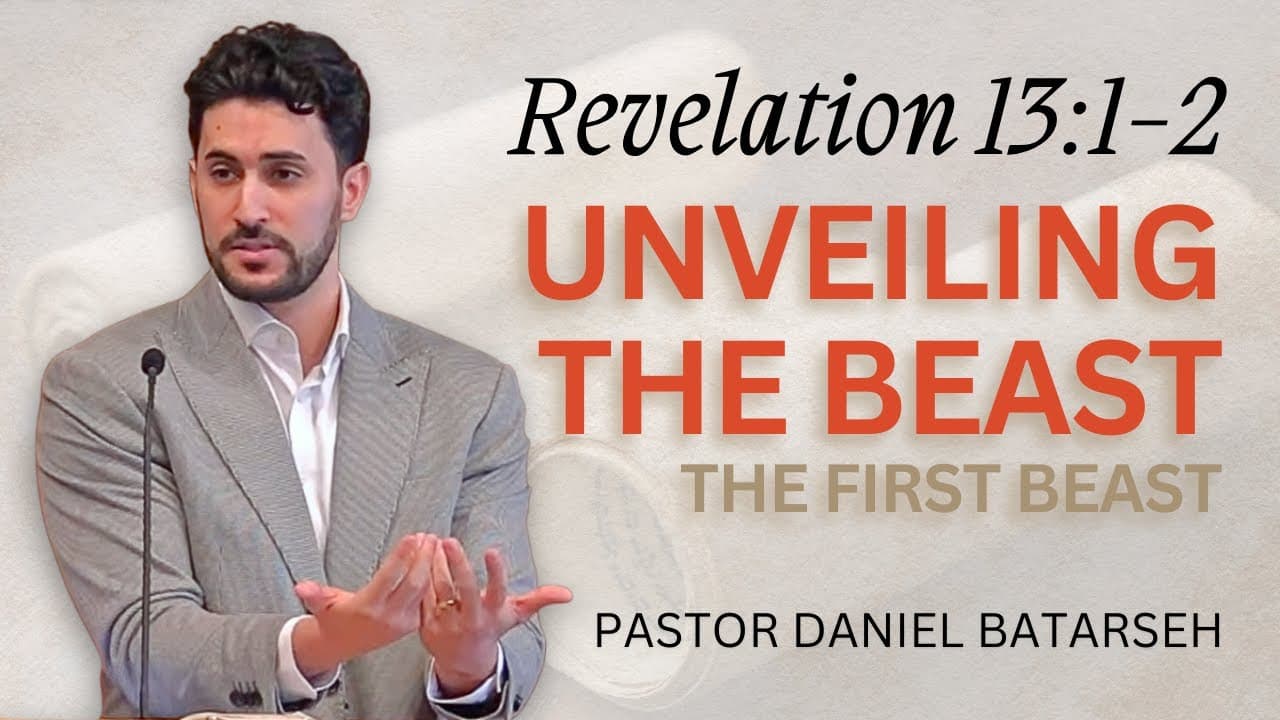
This article is drawn from the sermon "Unveiling The Beast | Revelation 13:1-2 | Pastor Daniel Batarseh" by Pastor Daniel Batarseh at Maranatha Bible Church Chicago. Watch the full sermon →
Based on the sermon