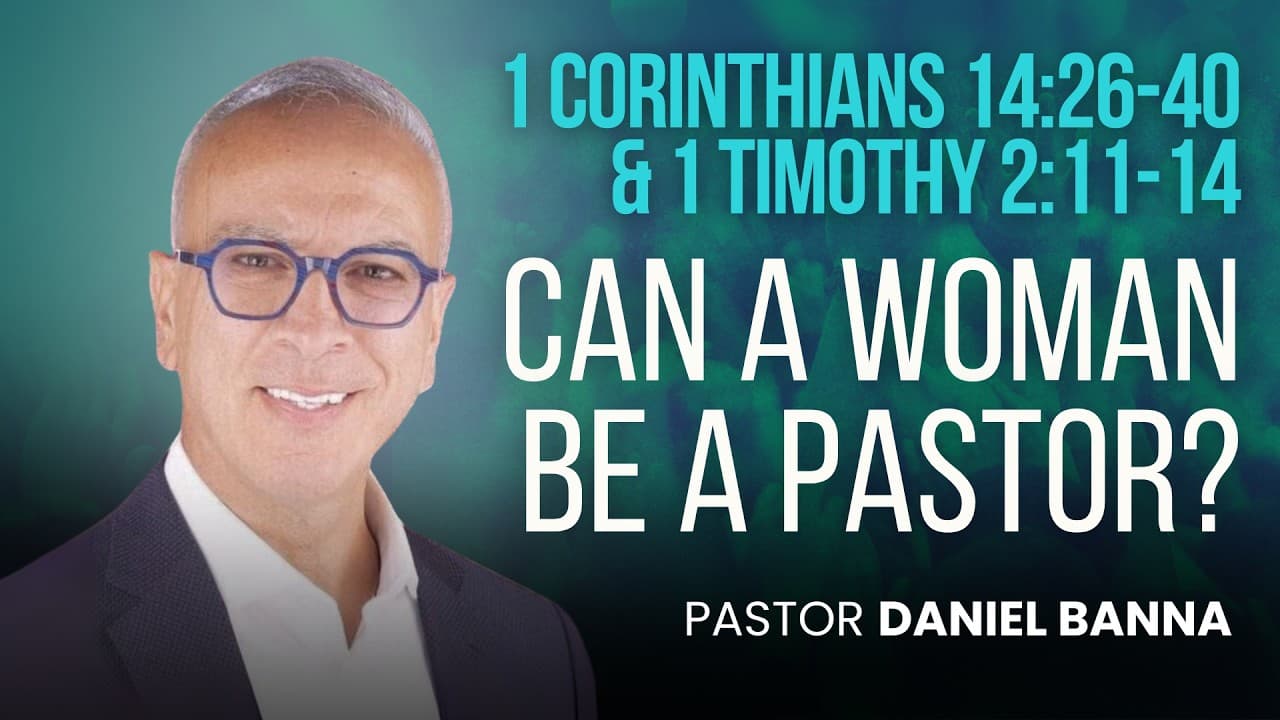
Paul didn't leave room for ambiguity — his instructions about women in pastoral leadership weren't cultural preferences but 'a command of the Lord.' Here's what the text actually says.
No major Christian tradition, no Bible commentator before the twentieth century argued that the office of pastor or elder was open to women. None.
That single historical fact should stop us in our tracks before we even open our Bibles. Not because tradition determines truth — Scripture does — but because when every generation of Christians for nearly two thousand years read 1 Corinthians 14 and 1 Timothy 2 and arrived at the same conclusion, and then one generation suddenly discovers they all got it wrong, we ought to ask whether the text changed or whether we did.
The answer, as Pastor Daniel Banna walked his congregation through with unflinching clarity, is that the text hasn't moved an inch. What has moved is the culture — and with it, a growing willingness to make Scripture say what we wish it said rather than what it actually says.
This is not a question about whether women are valuable, gifted, or mightily used by God. The answer to all three is an emphatic yes. The question is narrower and more specific than most people realize: Has God reserved the office of pastor and elder in the local church for qualified men? And the New Testament answers that question with a directness that leaves little room for creative reinterpretation.
This Was Never Just About Corinth
The most common escape hatch people use to dismiss Paul's instructions is to claim they were written for one church in one city dealing with one cultural situation. Corinth was messy, the argument goes. Women were disrupting the service. Paul was just putting out a local fire.
But Paul himself demolishes this reading before the letter even gets past its opening lines. In 1 Corinthians 1:1-2, he addresses his letter not only to the church in Corinth but "together with all those who in every place call upon the name of our Lord Jesus Christ, both their Lord and ours" (watch at 24:29).
And Paul doesn't say it just once. He hammers the point with a repetition that feels almost like he's looking across the centuries at us:
- 1 Corinthians 4:17 — "my ways in Christ Jesus, as I teach them everywhere in every church."
- 1 Corinthians 7:17 — "This is my rule in all the churches."
- 1 Corinthians 11:16 — "We have no such practice, nor do the churches of God."
- 1 Corinthians 14:33 — "As in all the churches of the saints."
As Pastor Daniel Banna put it: "Paul's expectation was not that each church would develop its own doctrine according to the culture, but that every church would submit to the same apostolic teaching" (watch at 27:26). Jerusalem was vastly different from Corinth. Corinth was different from Ephesus. Ephesus was different from Crete. Yet Paul taught the same principles everywhere. The culture changed. God's order did not.
Nowhere else in all of Scripture is the same truth repeated this many times in a single letter. The Holy Spirit knew what was coming.
The John Hagee Problem — and Why It Matters
One of the most striking moments in this sermon was a direct engagement with a popular — and deeply flawed — interpretation from a well-known preacher. John Hagee, who commands an audience of millions, has taught that Paul's instructions about women keeping silent in church were simply about Orthodox Jewish synagogue customs. According to Hagee, synagogues had a curtain dividing men and women, and the women were shouting through the curtain asking their husbands to repeat things they missed. Paul, Hagee claims, was just telling them to stop interrupting.
Hagee's conclusion? "To say that a woman in the twenty-first century may not preach or teach the word of God because of this custom is just biblical ignorance."
The response was devastating in its simplicity: the first two verses of the letter destroy this reading entirely. Paul is not writing as an Orthodox rabbi to a synagogue. He is writing as "an apostle of Jesus Christ" to "the church of God" — and not just the one in Corinth, but to all believers everywhere (watch at 40:23).
This matters because when a teacher with millions of followers handles Scripture carelessly, millions of people absorb a false reading without ever checking the text. And the irony is thick — calling faithful adherence to Paul's apostolic command "biblical ignorance" is itself a stunning display of the very thing it accuses others of.
"A Command of the Lord" — Not a Cultural Preference
Here is where Paul removes every last shred of ambiguity. After stating that women should keep silent in the churches and learn in submission (1 Corinthians 14:34-35), he anticipates the objection. He knows some will push back. And so he writes with the force of an apostle who has been given authority by the risen Christ:
"If anyone thinks that he is a prophet or spiritual, he should acknowledge that the things I am writing to you are a command of the Lord" (1 Corinthians 14:37).
Notice what Paul does not say. He does not say, "This is my opinion." He does not say, "This is my cultural preference." He does not even say, "This is my command" — though even that would carry apostolic authority. He says these are a command of the Lord. As the sermon pressed the point: "To reject Paul's apostolic instruction is not merely to disagree with Paul. It is to reject the authority of the Lord Jesus who sent him" (watch at 45:56).
And then comes the chilling follow-up in verse 38: "If anyone does not recognize this, he is not recognized." The person who refuses to acknowledge this command is themselves unrecognized — not acknowledged as having spiritual authority or discernment. That is a sobering word for any church leader advocating a position that directly contradicts what Paul calls a command of the Lord.
The Reason Goes Back to Eden, Not to Culture
When Paul addresses the same issue in 1 Timothy 2:11-14, he gives his theological reasoning — and it has nothing to do with first-century customs. "I do not permit a woman to teach or exercise authority over a man," he writes. And then the reason: "For Adam was formed first, then Eve. And Adam was not deceived, but the woman was deceived and became a transgressor."
Paul reaches past every culture, past every tradition, past every society, all the way back to Genesis — to creation itself. Before sin entered the world. Before any culture existed. Before any tradition developed. God established an order: Adam was formed first, given responsibility, given the command. Eve was formed as his helper — a word, it's worth noting, that Scripture also uses to describe God himself, so it carries no connotation of inferiority.
This order of roles — not of value, not of essence, but of function — runs like a golden thread through the entire Bible. It appears in creation. It appears in the family, where "the husband is the head of the wife as Christ is the head of the church" (Ephesians 5:23). And it appears in the church.
But perhaps the most breathtaking connection in the entire sermon was this: the same pattern exists within the Godhead itself. Father, Son, and Holy Spirit — one God, coequal in essence, coequal in glory — yet operating in an order of roles. The Son says, "I have come down from heaven not to do my own will, but the will of him who sent me" (John 6:38). The Spirit glorifies the Son (John 16:14). Does this make the Son inferior? Does it make the Spirit lesser? The very suggestion is heresy. Yet within the perfect unity of the Trinity, there is perfect order. No confusion. No competition. No struggle for position. Only harmony.
If role distinction within equality is the eternal reality of God himself, then role distinction within equality in the church is not oppression. It is a reflection of the divine nature.
What About Deborah, Priscilla, and Phoebe?
These names come up every time this conversation happens, and they deserve honest treatment rather than dismissal.
Deborah was a prophetess and a judge in Israel (Judges 4:4). She was not a priest. She never served in the temple. And the period of the judges was explicitly a time when "there was no king in Israel" and "everyone did what was right in his own eyes" — a time of spiritual decline and failed male leadership. When Deborah told Barak that God commanded him to go to war, Barak responded, "If you go with me, I will go." Deborah's reply is telling: "I will surely go with you. Nevertheless, the Lord will sell Sisera into the hand of a woman." Why say that? Because this was not the normal pattern. It was a judgment on failed leadership (watch at 63:16).
Priscilla, along with her husband Aquila, took Apollos aside privately and explained the way of God more accurately (Acts 18:26). This was a private conversation — husband and wife together discipling a fellow believer. It was not authoritative public teaching in the gathered church.
Phoebe is called a "servant" (Greek: diakonos) of the church at Cenchreae (Romans 16:1). But being a servant is not the same as holding the office of deacon. Every Christian is called to serve. When Paul describes the qualifications for the office of deacon in 1 Timothy 3:12, he writes: "Let deacons each be the husband of one wife."
And then there's the quietly stunning detail about Philip's four daughters who prophesied (Acts 21:8-9). Paul is staying in Philip's house. These four women have genuine prophetic gifts. And yet, when the Holy Spirit has a prophetic message for Paul about his journey to Jerusalem, He doesn't use any of them. Instead, He sends a prophet named Agabus all the way from Judea to deliver it. The text doesn't explain why. But the pattern is consistent with everything else we see: the gifts were real; their exercise was kept within God's established order.
The Slippery Slope Isn't a Fallacy — It's a Historical Pattern
One of the most sobering warnings in this sermon was not exegetical but historical. Over the past century, denomination after denomination that began by ordaining women to the pastoral office eventually moved toward redefining marriage and human sexuality. The pattern is documented and repeatable. Once the biblical qualifications for church leadership are treated as culturally conditioned rather than divinely commanded, other biblical teachings become equally negotiable.
As Pastor Daniel Banna warned: "You might find it difficult to believe it today. You may even reject the possibility. But time and again, we have seen this pattern repeated" (watch at 57:36). This is not a scare tactic. It is an observable historical trajectory, and churches that love the Word should take it seriously.
What to Remember
- Paul's instruction about women and pastoral authority is explicitly called "a command of the Lord" (1 Corinthians 14:37) — not a cultural suggestion, not an apostolic opinion, and not a synagogue custom.
- No major Christian tradition or Bible commentator before the twentieth century argued that the office of pastor was open to women. The modern position is the novelty, not the traditional one.
- Paul roots his reasoning in creation (Genesis 1-2), not in culture — which means no cultural shift can overturn it.
- Role distinction does not imply inequality. The Trinity itself — Father, Son, and Holy Spirit, coequal in essence yet distinct in role — is the ultimate proof.
- Deborah, Priscilla, Phoebe, and Philip's daughters were all genuinely used by God. None of them held the office of pastor or elder in a local church. These examples support the complementarian position rather than undermining it.
- The historical pattern is clear: denominations that redefine the biblical qualifications for church leadership rarely stop there.
Questions to Sit With
- If Paul calls his instruction "a command of the Lord," on what basis can any church today set it aside? What would have to be true about Scripture for that to be legitimate?
- Why do we instinctively resist the idea that role distinction can coexist with full equality — and what does the Trinity teach us about that resistance?
- If you attend a church that has moved away from the historic position on this issue, have you personally studied the passages involved, or have you simply absorbed the position of your community?
- What is the difference between saying "God can use women powerfully" and saying "women should hold the office of pastor"? Why does conflating these two statements cause so much confusion?
- How does Ephesians 3:10 — that through the church God's manifold wisdom is displayed to heavenly rulers — change the way you think about church order?
Scripture Referenced
- 1 Corinthians 14:26-40 (primary text)
- 1 Timothy 2:11-14 (primary text)
- 1 Corinthians 1:1-2
- 1 Corinthians 4:17
- 1 Corinthians 7:17
- 1 Corinthians 11:10, 16
- 1 Corinthians 12:4-7, 12-14
- Genesis 3:16
- Judges 4:4-9
- Acts 18:26
- Acts 21:8-11
- Romans 16:1
- 1 Timothy 3:8-12
- Ephesians 3:10
- Ephesians 5:23
- John 6:38
- John 16:14
- 1 Peter 1:12
This summary was generated by AI from the sermon "Can a Woman be a Pastor? | 1 Corinthians 14:26-40 & 1 Timothy 2:11-14 | Pastor Daniel Banna (7/17)" preached by Pastor Daniel Banna at Maranatha Bible Church Chicago. Watch the full sermon →
Based on the sermon
Can a Woman be a Pastor? | 1 Corinthians 14:26-40 & 1 Timothy 2:11-14 | Pastor Daniel Banna (7/17)
Watch Full SermonRelated Articles
What Revelation 20 Reveals About the Human Heart
Pastor Daniel Batarseh · September 13, 2026
What Happens When Satan Is Removed for 1,000 Years? (Rev 20)
Pastor Daniel Batarseh · September 13, 2026
Nehemiah 6:15-19 — What 52 Days of Rebuilding Teaches About Prayer and Fruitfulness
Pastor Daniel Batarseh · September 11, 2026